
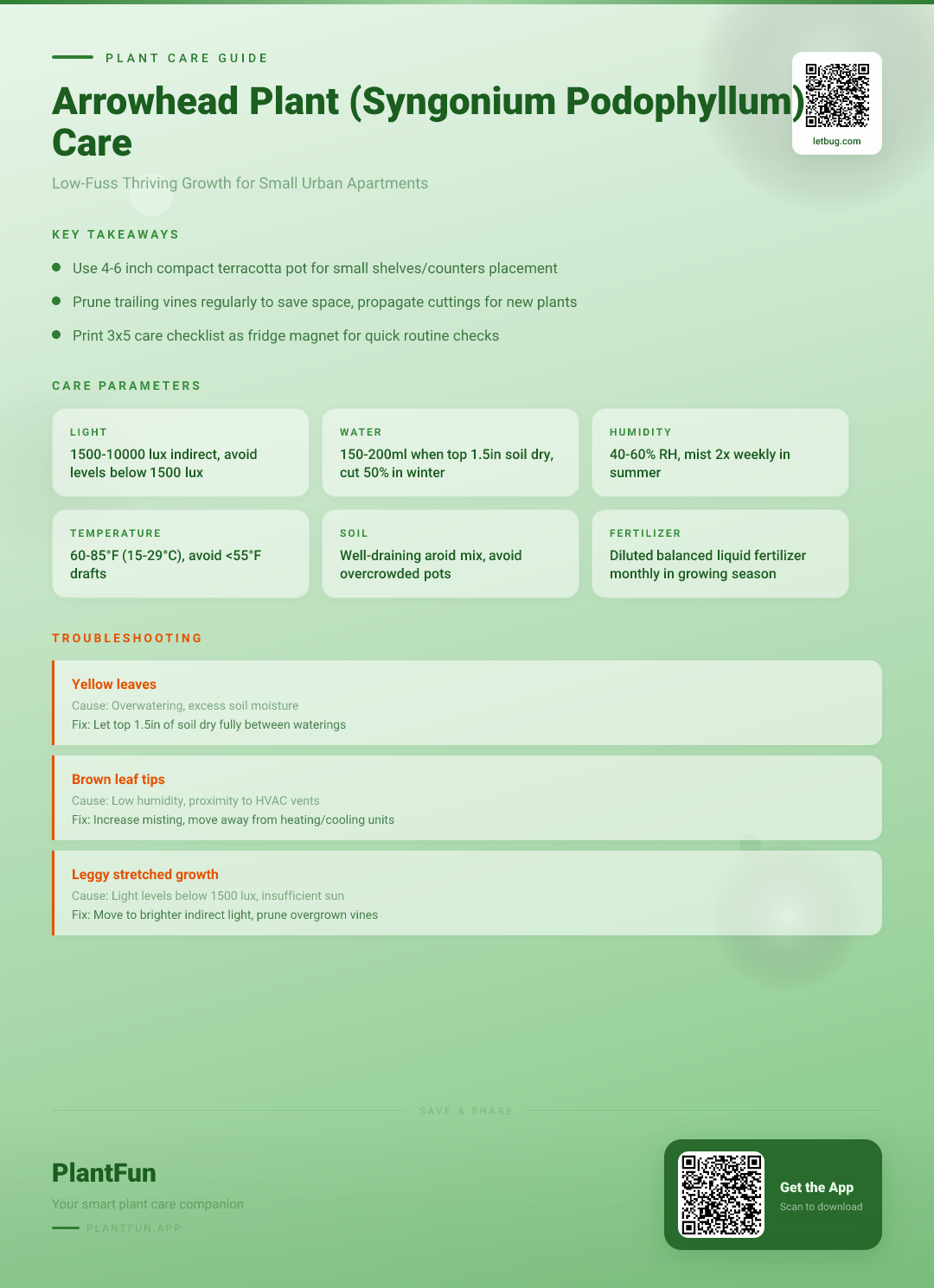
Key Takeaways
- Check soil moisture before watering — overwatering is the #1 killer of houseplants.
- Ensure your plant gets the right amount of light for its species.
- Be patient with recovery — most plants need 2–4 weeks to bounce back.
Quick Care Card: Printable 3x5 Fridge Magnet
This table is sized to print as a 3x5 fridge magnet for fast, regular care checks:
| Care Parameter | Exact Threshold for Small Apartments |
|---|---|
| Light | 1,500–10,000 lux (indirect bright to low indirect light) |
| Water | 150–200 mL room-temperature water when top 1.5 inches of soil is dry |
| Humidity | 40–60% RH |
| Temperature | 60–85°F / 15–29°C |
| Soil | 60% indoor potting mix + 20% perlite + 20% orchid bark |
| Fertilizer | ½-strength balanced liquid fertilizer every 4 weeks (spring/summer only) |
| Toxicity | Toxic to cats and dogs (ASPCA, 2026) |
Why Arrowhead Plants Are Perfect for Small Apartments
Syngonium podophyllum (arrowhead plant) is made for cramped urban spaces, no dedicated plant stand required. Their compact vining habit grows just as well bushy as it does trailing, so you can shape it to fit 6-inch deep floating shelves, counter tops, and tight corner nooks. They are also extremely tolerant of the low light levels common in urban apartments (Gautam et al, 2021), making them far more low-fuss than finicky species like fiddle leaf figs.
Myth vs Reality: Myth: Arrowhead plants need large hanging planters to thrive. Reality: With regular pruning, they stay under 12 inches tall and wide, making them ideal for even the smallest 500 sq ft apartments. Note that ASPCA classifies arrowhead plants as toxic to cats and dogs (ASPCA, 2026), so place them out of reach of pets and young children if needed.
Step-by-Step Small-Space Arrowhead Plant Setup
Follow these steps to set up your plant without wasting valuable shelf space:
- Pot selection: Choose a 4–6 inch terracotta pot with one drainage hole (the standard arrowhead plant pot size for small shelves, fitting most 7-inch deep floating shelves). Only select a pot 1 inch larger than the root ball to avoid excess soil that holds moisture and causes root rot (NC State Extension, 2026).
- Soil mix: Combine 60% general indoor potting mix, 20% perlite, and 20% orchid bark for fast drainage that prevents overwatering in compact pots.
- Placement: Position your plant in one of these apartment-friendly spots: north-facing counter 2 feet from a window, floating shelf above a desk, or corner nook that gets indirect morning light. Avoid spots with direct midday sun that scorches leaves.
Measurable Daily & Weekly Care Routine
These space-optimized parameters eliminate guesswork for beginner plant owners:
- Light: Arrowhead plant light requirements are 1,500–10,000 lux. Test levels with a cheap light meter: if levels are below 1,500 lux, you can use a small clip-on grow light (see our guide to the best small-space grow lights for apartments for budget options) 1 foot above the plant for 6 hours a day. This answers the common question: can arrowhead plants grow in low light apartments? Yes, as long as you meet the 1,500 lux minimum (Gautam et al, 2021).
- Water: Wondering how often to water arrowhead plant? Stick your finger 1.5 inches into the soil: if completely dry, add 150–200 mL of room-temperature water, and drain excess water from the saucer immediately to avoid root rot.
- Humidity: Arrowhead plant humidity needs are 40–60% RH. Test with a $10 hygrometer: if levels are below 40%, place a pebble tray under the pot (no bulky humidifier required for small spaces).
- Temperature: Keep your plant in 60–85°F (15–29°C) temperatures, away from extreme swings.
Seasonal Care Calendar for Apartment Dwellers
Adjust your routine to match apartment seasonal conditions:
- Winter (Oct–Feb, Northern Hemisphere): For arrowhead plant winter care, reduce watering by 50% (only add 75–100 mL when top 2 inches of soil is dry), avoid drafty window sills where temperatures drop below 55°F, and stop fertilizing completely.
- Summer (Jun–Aug): For arrowhead plant summer watering, check soil moisture every 3–4 days instead of weekly, mist leaves 2x weekly to boost humidity, and prune trailing vines every 2 months to keep the plant compact for small spaces.
Common Small-Space Care Mistakes to Avoid
- Mistake: Using an 8+ inch pot to skip repotting and save space long term. What happens: Excess unused soil holds moisture, leading to root rot before the plant grows into the pot. Instead: Stick to 4–6 inch pots, and repot only once every 2–3 years when roots grow out the drainage hole.
- Mistake: Placing the plant within 1 foot of heating/cooling vents to fit it on a small shelf. What happens: Dry forced air burns leaf tips and causes rapid moisture loss. Instead: Pick a shelf at least 2 feet away from vents, or use a small vent deflector if space is extremely limited.
- Mistake: Tucking the plant into a dark corner below 1,500 lux to fill empty space. What happens: Leggy growth with large gaps between leaves and pale foliage (Gautam et al, 2021). Instead: Add a small clip-on grow light above the corner, or move the plant to a brighter spot.
FAQ: Can I keep my arrowhead plant on a tiny kitchen windowsill above the sink?
Yes! This is actually an ideal spot for arrowhead plant care for small apartments: the sink adds ambient humidity, and most kitchen windows get 1,500–8,000 lux of indirect light, which is perfect for Syngonium podophyllum care. Just make sure the sill is at least 5 inches wide to fit a 4 inch pot, and avoid windows that get direct midday sun that can scorch leaves.
FAQ: Why is my arrowhead plant getting leggy in my apartment?
The most common cause is light levels below 1,500 lux, which forces the plant to stretch to reach more light (Gautam et al, 2021). Other causes include infrequent pruning, or over-fertilizing with high-nitrogen fertilizer that pushes rapid, sparse growth. If your plant is leggy, move it to a brighter spot or add a grow light, then trim back overgrown stems to encourage bushy growth.
FAQ: How often do I need to repot my arrowhead plant in a small apartment?
Only once every 2–3 years, when you see roots growing out of the drainage hole at the bottom of the pot (NC State Extension, 2026). To keep it compact for small shelves, you can also trim 1/3 of the root ball when repotting, and put it back in the same size pot instead of upsizing. If you suspect root rot before that 2–3 year mark, our guide to fixing root rot in indoor plants walks you through the full rescue process.
Space-Saving Pruning Hack for Trailing Vines
Learn how to prune arrowhead plant for small spaces without stunting growth, plus propagate cuttings for new plants:
- Gather clean, sharp pruning shears, rubbing alcohol, and a small glass of water if you want to propagate cuttings.
- Identify trailing vines longer than 6 inches, or vines growing outside the width of your shelf or counter.
- Cut the vine 1/4 inch above a leaf node (the small bump on the stem where leaves grow) to encourage bushy new growth instead of trailing.
- For a compact, rounded shape, trim no more than 1/3 of the total plant volume at one time to avoid stunting growth.
- To propagate, place 4–6 inch cuttings in a glass of room-temperature water, change water every 3 days, and plant in soil once roots are 1 inch long. You can follow our step-by-step guide to propagating houseplants for beginners for more tips.
Troubleshooting Common Symptoms
Yellow Leaves
Symptom: Soft, yellow lower leaves that fall off easily.
Likely cause: Overwatering, or using a pot that is too large for the root system.
Fix:
- Stop watering until the top 2 inches of soil are completely dry.
- If the pot is larger than 6 inches, repot into a smaller 4–5 inch terracotta pot with fresh well-draining soil.
Brown Leaf Tips
Symptom: Dry, crispy brown tips on the edges of mature leaves, no discoloration on the rest of the leaf.
Likely cause: Low humidity below 40% RH, or exposure to forced air from heating/cooling vents.
Fix:
- Mist the leaves 2x a week with room temperature water, or place a pebble tray under the pot.
- Move the plant at least 2ft away from any HVAC vents.
Drooping Foliage
Symptom: Limp, drooping leaves that curl inward, no yellowing.
Likely cause: Underwatering, or exposure to temperatures below 60°F (15°C).
Fix:
- Add 150–200ml of room temperature water to the soil, and check moisture levels every 3 days until the plant recovers.
- Move the plant away from drafty windows or exterior doors if temperatures are low.
Leggy Sparse Growth
Symptom: Long stems with large gaps between leaves, pale foliage.
Likely cause: Light levels below 1,500 lux, or infrequent pruning.
Fix:
- Move the plant to a brighter spot, or add a clip-on LED grow light 1ft above the plant for 6 hours a day.
- Trim back leggy stems 1/4 inch above a leaf node to encourage bushy new growth.
References
- ASPCA. (2026). Toxic and Non-Toxic Plants List — ASPCA. https://www.aspca.org/pet-care/animal-poison-control/toxic-and-non-toxic-plants. Accessed 2026-03-06.
- Gautam, B.; Dubey, R.; Kaur, N. (2021). GROWTH RESPONSE OF INDOOR ORNAMENTAL PLANT SPECIES TO VARIOUS ARTIFICIAL LIGHT INTENSITIES (LED) IN AN INDOOR VERTICAL GARDEN. PLANT ARCHIVES. https://doi.org/10.51470/plantarchives.2021.v21.no1.096. Accessed 2026-03-06.
- NC State Extension. (2026). The Complete Arrowhead Plant — NC State Extension Gardener Plant Toolbox. https://plants.ces.ncsu.edu/plants/arrowhead-plant/. Accessed 2026-03-06.
- Šrámek, F. (1999). Vaughan, M.J.: The Complete Book on Cut Flower Care. Biologia plantarum. https://doi.org/10.1023/a:1001770114931. Accessed 2026-03-06.
Optional Helper: Plantfun.App
Plantfun.App identifies your plants by photo, diagnoses pests and diseases with clear fixes, and creates personalised watering and light schedules that adapt to your home conditions — a handy companion for putting this guide into daily practice.
Found an error or have suggestions? We'd love your feedback.
Need help identifying this problem?
Get instant identification, personalized care schedules, and effective pest treatment plans directly on your phone.
Sponsored • We may earn a commission from app downloads
Related Guides
The Complete Arrowhead Plant Care Checklist for Resilient Growth in Typical Apartments
Stop guessing at Arrowhead Plant care. Get a tailored checklist, exact light, water, and humidity parameters to grow lush, resilient vines even in typical low-light city apartments.
Care GuideArrowhead Plant in Small Urban Apartments: The Complete Care Checklist for Resilient Growth
Keep your Arrowhead Plant thriving even in tiny, light-limited urban apartments. Get exact light levels, watering amounts, and a 4-step checklist to prevent yellow leaves and encourage lush trailing growth.
Care GuideThe Budget Arrowhead Plant Care Checklist for Resilient Growth in Typical Urban Apartments
Grow a lush arrowhead plant on a tight budget in your apartment. Get exact light, water, and humidity thresholds plus a free printable checklist for resilient, pest-free growth all year.
Pest ControlAnts on Plants: What They Mean and What to Do
Ants usually aren't eating your plant. They are farming other pests.