
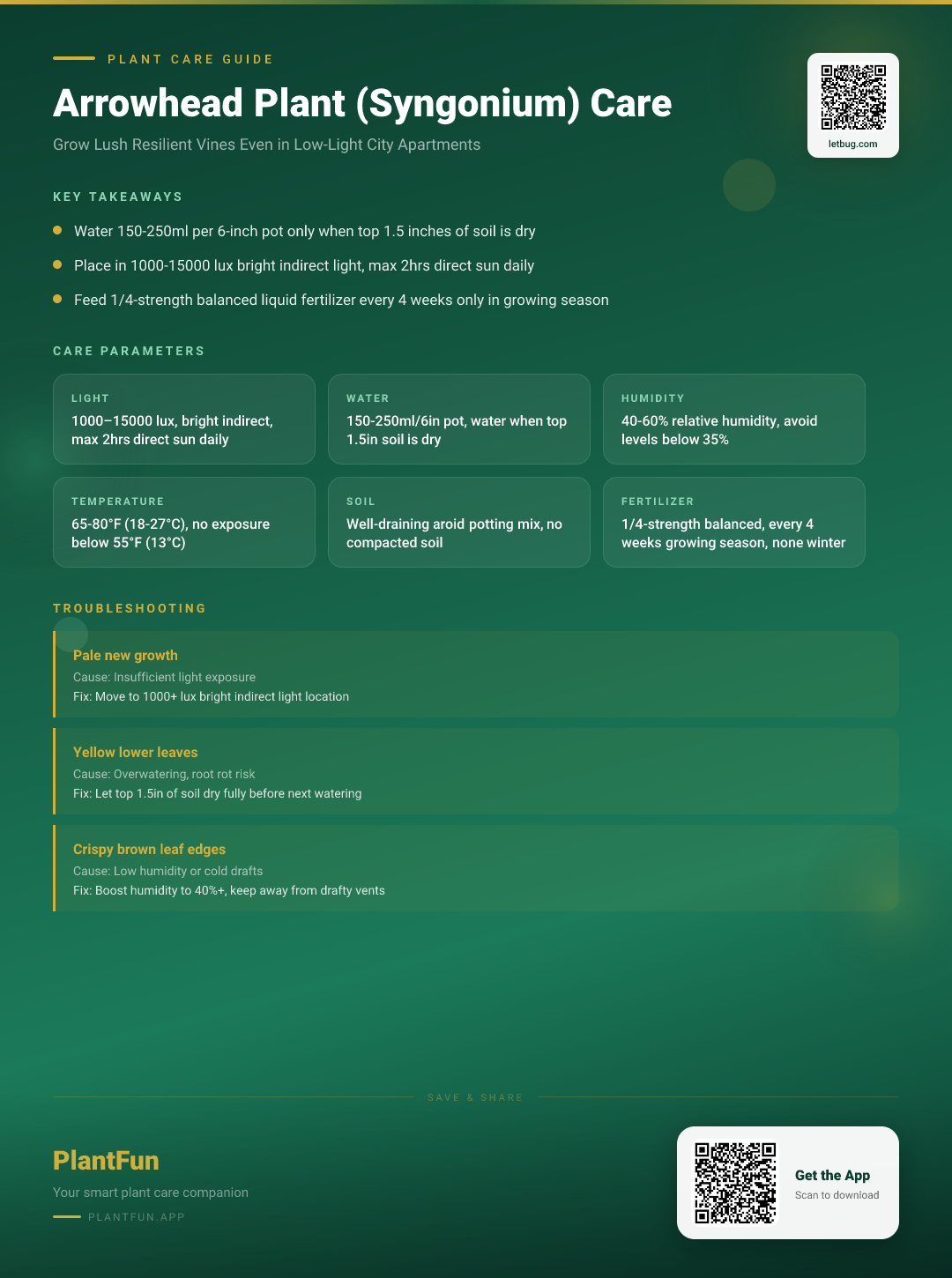
Key Takeaways
- Check soil moisture before watering — overwatering is the #1 killer of houseplants.
- Ensure your plant gets the right amount of light for its species.
- Be patient with recovery — most plants need 2–4 weeks to bounce back.
Quick Care Card
| Care Factor | Measurable Threshold | Apartment-Specific Notes |
|---|---|---|
| Light | 1,000–15,000 lux, max 2 hours direct sun daily | Tolerates low north-facing light, avoid unfiltered afternoon sun |
| Water | 150–250ml per 6-inch pot when top 1.5 inches of soil is dry | 6–9 days in summer, 8–12 days in winter |
| Humidity | 40–60% relative humidity | Most apartments sit at 30–40% baseline, so supplemental humidity may be needed |
| Temperature | 65–80°F (18–27°C), no exposure below 55°F (13°C) | Avoid placement near heating/cooling vents to prevent temperature swings |
| Soil | Well-draining aroid mix | 1 part potting soil, 1 part perlite, 1 part orchid bark, 1 part coco coir |
| Fertilizer | 1/4-strength balanced 10-10-10 liquid fertilizer every 4 weeks in growing season | No fertilizer in winter to avoid root burn |
| Toxicity | Toxic to cats, dogs, and humans if ingested | Contains calcium oxalate crystals (ASPCA, 2026) |
Why Typical Apartments Pose Unique Arrowhead Plant Challenges
Syngonium podophyllum, commonly called the Arrowhead Plant, is native to the warm, humid, dappled light of tropical Central and South American understories. Typical apartment conditions directly contradict these native preferences, creating hidden stress that often goes unnoticed until damage is irreversible:
- Drafty heating and cooling vents create sudden 20°F+ temperature swings that shock root systems
- North-facing or windowless rooms provide light levels far lower than the species’ minimum threshold for steady growth
- Baseline apartment humidity sits at 30–40%, 10% below the minimum needed for stress-free Arrowhead Plant care
- Inconsistent heating and cooling cycles change soil evaporation rates, making fixed watering schedules unreliable for even experienced owners
Diagnosis First: 3 Early Warning Signs Your Arrowhead Plant Is Struggling
Catch these red flags 2–3 weeks before permanent damage occurs to keep your plant resilient:
Pale New Growth
Symptom: New unfurling leaves are faded, pale green, and 30%+ smaller than mature leaves on the same vine.
Likely cause: Insufficient light exposure, limiting photosynthesis needed for new leaf development.
Fix:
- Move your plant 2–3 feet closer to a bright window, avoiding direct sun
- Add a 10W full-spectrum grow light for 8–10 hours daily if you only have low-light space
Yellow Lower Leaves
Symptom: Older bottom leaves turn soft, uniform yellow, with no brown spots or crispy edges.
Likely cause: Early onset overwatering, the top cause of Arrowhead Plant loss for beginners.
Fix:
- Pause all watering until the top 1.5 inches of soil is completely dry
- Lift the pot to check for excess water pooled in the saucer, and empty immediately
Crispy Brown Leaf Edges
Symptom: The outer edges of leaves turn dry and brown, while the center of the leaf remains bright green.
Likely cause: Exposure to cold drafts or consistent humidity levels below 40%.
Fix:
- Move your plant at least 3 feet away from heating/cooling vents and drafty exterior doors
- Set up a pebble tray filled with water under the pot to boost local humidity by 10–15%
Step-by-Step Weekly Care Checklist
Follow these 5 actionable tasks tailored to apartment living for consistent Arrowhead Plant care:
- Insert your index finger 1.5 inches into the top of the soil. If completely dry, water with 150–250ml of room-temperature filtered water for a 6-inch pot.
- Inspect the undersides of all leaves for tiny spider mites or cottony mealybugs, the two most common apartment pests that target stressed Syngonium.
- Wipe leaf surfaces with a damp microfiber cloth to remove dust that blocks light absorption and slows growth.
- Confirm your plant is not positioned within 2 feet of draft vents, exterior doors, or single-pane windows.
- Top off water in your pebble tray if used, to maintain consistent humidity levels around the foliage.
Measurable Light Requirements for Apartment Dwellers
Arrowhead Plant light requirements fall between 1,000–15,000 lux (Gautam et al, 2021), making them one of the most flexible low-light aroids for apartment use. Follow these placement tips for every room orientation:
- North-facing windows: Place 1–2 feet away from the glass for consistent low light, perfect for Arrowhead Plant low light care. No supplemental light is needed for most varieties.
- East-facing windows: Place 2–3 feet away to get gentle 1–2 hours of morning direct sun, the ideal light level for fast, lush growth.
- South/west-facing windows: Place 3–5 feet away, and hang a sheer curtain to filter harsh afternoon sun that can scorch leaves. Limit direct sun exposure to 2 hours max per day.
- Windowless apartments: Use a 10W full-spectrum grow light positioned 12 inches above the plant, run for 8–10 hours daily to meet minimum light requirements.
Exact Watering Rules for Inconsistent Apartment Temperatures
Forget fixed watering schedules: apartment temperature swings from heating and cooling change soil evaporation rates drastically week to week. Follow these evidence-based rules for Syngonium podophyllum care (NC State Extension, 2026):
- For a standard 6-inch nursery pot, add 150–250ml of water only when the top 1.5 inches of soil is completely dry.
- Arrowhead Plant summer watering: Expect to water every 6–9 days, as warm temperatures and AC use speed up soil drying.
- Arrowhead Plant winter care: Reduce watering to every 8–12 days, as heating systems dry air but slow soil evaporation in cooler rooms. Myth vs Reality: You do not need to saturate the entire soil volume every time you water. Small, measured doses prevent excess moisture from sitting around roots and causing rot.
Humidity & Temperature Thresholds for Stress-Free Growth
Arrowhead Plant humidity needs and temperature ranges are tailored to their tropical native habitat, adjusted for real apartment conditions (NC State Extension, 2026):
- Humidity: 40–60% relative humidity is ideal. If your apartment sits at 30–40% baseline, use a pebble tray, group your plant with other tropicals, or run a small desk humidifier for 4–6 hours daily to boost levels.
- Temperature: 65–80°F (18–27°C) is the preferred range. Strictly avoid exposure to temperatures below 55°F (13°C), which causes permanent leaf drop and root shock. Quick test: Hold your hand 6 inches away from the nearest vent for 10 seconds. If the air feels noticeably hot or cold, your plant is too close to the draft source.
Soil & Fertilizer Recommendations for Potted Apartment Arrowhead Plants
The right soil and feeding routine support resilient root growth and lush foliage, and help you avoid common overwatering issues:
- Soil: Use a well-draining aroid mix made of 1 part all-purpose potting soil, 1 part perlite, 1 part orchid bark, and 1 part coco coir. This mix drains excess water quickly while holding enough moisture to support roots between waterings.
- Fertilizer: Apply 1/4-strength balanced 10-10-10 liquid fertilizer every 4 weeks from March to September (growing season) if you want to know how to make Arrowhead Plant grow faster. Skip all fertilizer in winter, when the plant is dormant and cannot absorb extra nutrients without risking root burn (NC State Extension, 2026).
Seasonal Care Calendar for Apartment Arrowhead Plants
Adjust your care routine to match apartment heating and cooling cycles throughout the year:
- Spring (March–May): 1. Repot only if roots are growing out of the drainage holes or circling the top of the soil, 2. Start your 4-week fertilization routine, 3. Prune leggy vines back by 1/3 to encourage bushier growth.
- Summer (June–August): 1. Check soil moisture every 5 days to adjust Arrowhead Plant summer watering frequency, 2. Move plants away from west-facing windows if afternoon sun becomes too harsh, 3. Mist foliage once weekly if humidity drops below 40%.
- Fall (September–November): 1. Gradually extend time between waterings as temperatures cool, 2. Stop fertilizing by mid-October to prepare the plant for dormancy, 3. Move plants away from drafty windows as outdoor temperatures drop.
- Winter (December–February): 1. Follow Arrowhead Plant winter care rules: water only every 8–12 days, 2. Keep plants at least 3 feet away from heating vents that dry out foliage, 3. Avoid repotting or pruning until spring to prevent root shock.
5 Common Apartment Care Mistakes to Avoid
- Mistake: Overwatering on a fixed schedule without testing soil moisture first. What happens: Soggy soil causes root rot, leading to widespread yellow leaves and eventual plant death, the top issue reported for beginner Arrowhead Plant care. Instead: Test the top 1.5 inches of soil every 7 days, and only water when it is completely dry to the touch.
- Mistake: Placement within 2 feet of drafty heating/cooling vents or exterior doors. What happens: Sudden temperature swings of 20°F+ shock root systems, leading to crispy leaf edges and stunted growth. Instead: Position your plant in a corner away from direct airflow, or use a draft blocker near vents to deflect cold/hot air.
- Mistake: Exposing the plant to more than 2 hours of unfiltered direct afternoon sun. What happens: Harsh UV rays scorch leaves, leaving brown, dry spots that do not heal, and increase stress that makes the plant prone to pest infestations. Instead: Hang a sheer curtain over south/west-facing windows, or move the plant 3+ feet back from the glass to filter direct sun.
- Mistake: Skipping growing season fertilization entirely. What happens: Slow, leggy growth, pale new leaves, and reduced resistance to temperature and humidity stress. Instead: Apply 1/4-strength balanced liquid fertilizer every 4 weeks from March to September to support steady, lush growth.
- Mistake: Repotting every year even if the plant is not root-bound. What happens: Excess soil holds unnecessary moisture, increasing overwatering risk, and causes root shock that stunts growth for 2–3 months. Instead: Repot only once every 2–3 years, when you see roots growing out of the drainage holes or circling the top of the soil mass.
Voice Search FAQ
Why is my Arrowhead Plant turning yellow?
The most common cause of yellow lower leaves is early overwatering (NC State Extension, 2026). First check if the top 1.5 inches of soil is soggy: if yes, pause all watering until it dries completely. If yellow leaves have mushy brown spots, you may have early root rot, so trim damaged roots and repot in fresh dry aroid mix for a simple Arrowhead Plant yellow leaves fix. If new top leaves are yellow, your plant likely needs more light.
Can I keep my Arrowhead Plant in a dark apartment?
Yes! Arrowhead Plant low light care supports growth in light levels as low as 1,000 lux (Gautam et al, 2021), which is typical for dim, windowless apartment rooms. Use a 10W full-spectrum grow light positioned 12 inches above the plant, run for 8–10 hours daily, to support steady, healthy growth.
How often do I need to water my Arrowhead Plant?
Watering frequency depends on your apartment’s temperature and season: 6–9 days in summer, and 8–12 days in winter for a standard 6-inch pot (NC State Extension, 2026). Always test the top 1.5 inches of soil first before watering, as fixed schedules do not account for temperature swings from heating and cooling systems.
Is Arrowhead Plant safe for cats and dogs?
No, the ASPCA (2026) classifies Syngonium podophyllum as toxic to cats, dogs, and humans if ingested, as it contains calcium oxalate crystals that cause mouth, throat, and stomach irritation. Keep the plant on a high shelf or hanging planter out of reach of small children and curious pets.
References
- NC State Extension. (2026). The Complete Arrowhead Plant — NC State Extension Gardener Plant Toolbox. https://plants.ces.ncsu.edu/plants/plant-care/. Accessed 2026-03-08.
- Gautam, B.; Dubey, R.; Kaur, N. (2021). GROWTH RESPONSE OF INDOOR ORNAMENTAL PLANT SPECIES TO VARIOUS ARTIFICIAL LIGHT INTENSITIES (LED) IN AN INDOOR VERTICAL GARDEN. PLANT ARCHIVES. https://doi.org/10.51470/plantarchives.2021.v21.no1.096. Accessed 2026-03-08.
- Šrámek, F. (1999). Vaughan, M.J.: The Complete Book on Cut Flower Care. Biologia plantarum. https://doi.org/10.1023/a:1001770114931. Accessed 2026-03-08.
- ASPCA. (2026). Toxic and Non-Toxic Plants List — ASPCA. https://www.aspca.org/pet-care/animal-poison-control/toxic-and-non-toxic-plants. Accessed 2026-03-08.
Optional Helper: Plantfun.App
Plantfun.App identifies your plants by photo, diagnoses pests and diseases with clear fixes, and creates personalised watering and light schedules that adapt to your home conditions — a handy companion for putting this guide into daily practice.
Found an error or have suggestions? We'd love your feedback.
Need help identifying this problem?
Get instant identification, personalized care schedules, and effective pest treatment plans directly on your phone.
Sponsored • We may earn a commission from app downloads
Related Guides
The Complete Arrowhead Plant Care Guide for Typical Apartments: Seasonal Tips For Resilient Growth
Grow a lush, trailing arrowhead plant even in a basic urban apartment. Get exact light levels, watering amounts, and a seasonal care calendar to avoid yellow leaves and leggy growth.
Care GuideThe Budget Arrowhead Plant Care Checklist for Resilient Growth in Typical Urban Apartments
Grow a lush arrowhead plant on a tight budget in your apartment. Get exact light, water, and humidity thresholds plus a free printable checklist for resilient, pest-free growth all year.
Care GuideThe Complete Arrowhead Plant Care Checklist for Thriving Growth in Small Urban Apartments
Grow a lush arrowhead plant even in a cramped apartment. Get exact light, water, and humidity thresholds, plus space-saving hacks and a free printable care checklist you can reference fast.
Pest ControlAnts on Plants: What They Mean and What to Do
Ants usually aren't eating your plant. They are farming other pests.