
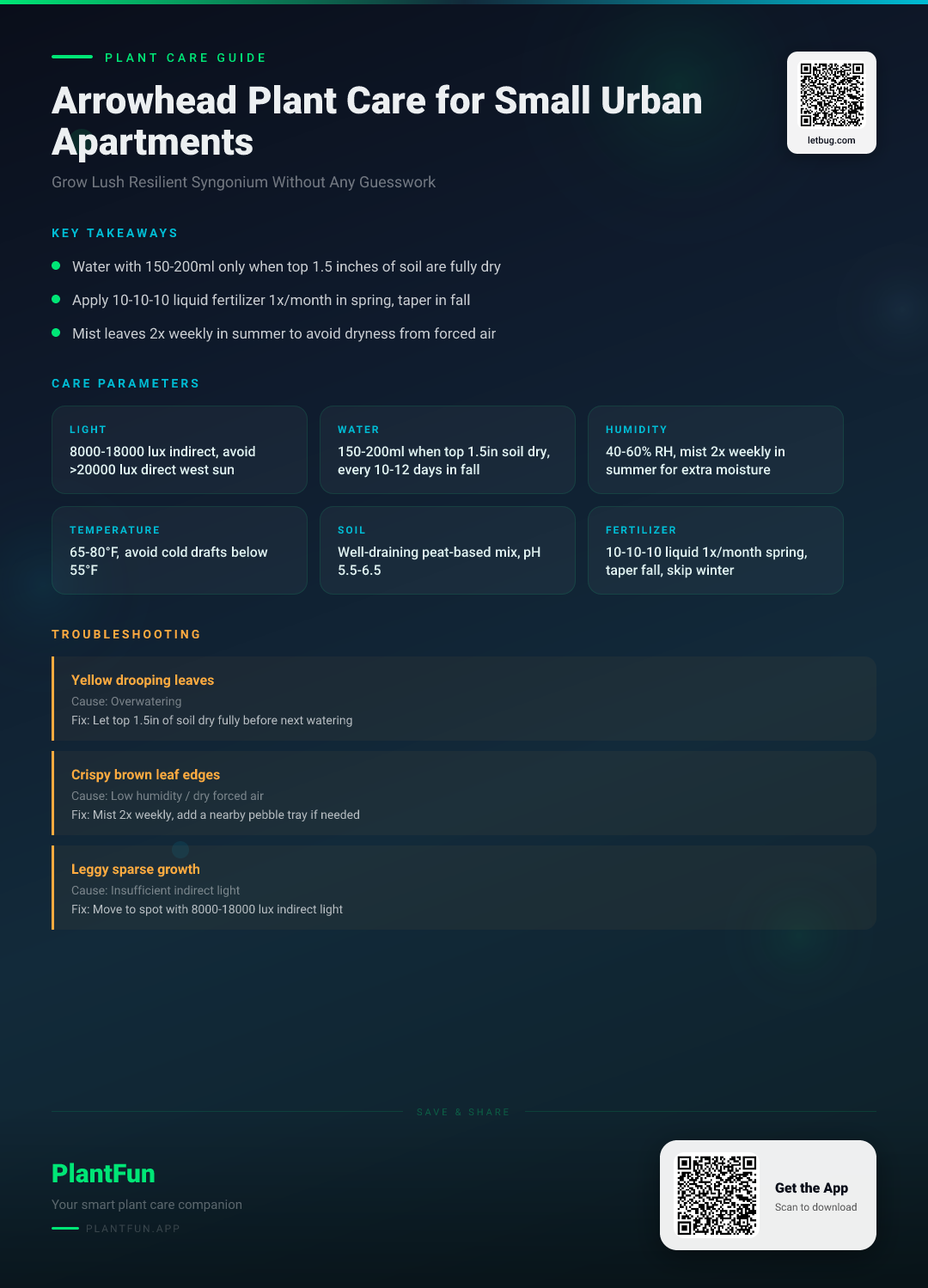
Key Takeaways
- Check soil moisture before watering — overwatering is the #1 killer of houseplants.
- Ensure your plant gets the right amount of light for its species.
- Be patient with recovery — most plants need 2–4 weeks to bounce back.
Quick Care Card
| Parameter | Threshold |
|---|---|
| Light | 8,000-18,000 lux (no direct midday sun) |
| Water | 150-200ml when top 1.5 inches of soil are completely dry |
| Humidity | 40-60% |
| Temperature | 65-80°F (18-27°C), avoid drops below 55°F |
| Soil | Well-draining aroid mix (3 parts potting soil, 1 part perlite, 1 part orchid bark) |
| Fertilizer | 10-10-10 liquid fertilizer diluted to half strength, monthly in growing season |
| Toxicity | Toxic to cats, dogs, and humans if ingested (ASPCA, 2026) |
Why Arrowhead Plants Thrive (or Struggle) in Typical Urban Apartments
Syngonium podophyllum, or the arrowhead plant, is native to tropical understories, so it’s naturally adaptable to the lower light and consistent temperatures of most homes (NC State Extension, 2026). But small 600-800 sq ft urban apartments have unique stressors that often trip up new plant parents: drafty old windows, forced air heating and cooling that swings humidity by 30%+ in 24 hours, and limited bright window space. These fluctuations are the most common cause of common issues like yellowing leaves or stunted growth, not a “fussy” plant.
A quick test to spot high-risk zones in your apartment: Hold your hand 1 foot from windows or HVAC vents for 10 seconds. If it feels uncomfortably cold, hot, or drafty, that spot is not ideal for your arrowhead plant. If you have pets, keep the plant out of reach, as ASPCA (2026) classifies it as toxic to cats and dogs; you can find alternative low-light pet-safe plants in our pet-safe houseplant guide.
Step-by-Step Everyday Care Routine
Tailored for 600-800 sq ft apartment layouts, this routine takes 5 minutes or less per week:
- Daily 30-second check: Glance at leaves for drooping or crisp edges. If you adjusted your AC or heat that day, move the plant 3+ feet away from vents to avoid direct air exposure.
- Weekly light check: Use a cheap light meter or our guide to testing houseplant light levels to confirm your spot hits 8,000-18,000 lux (Gautam et al., 2021). The best placement for most apartments is 3-5 feet from an east-facing window, or 5-7 feet from a south/west-facing window with a sheer curtain.
- Weekly soil check: Stick your index finger 1.5 inches deep into the soil. If it’s completely dry, water with 150-200ml of room-temperature filtered water, poured directly at the base to avoid wetting leaves.
- Bi-weekly humidity check: Use a $10 hygrometer near the plant to confirm it stays within the 40-60% arrowhead plant humidity needs range.
Spring Care Routine (March-May)
Spring is the peak growing season for arrowhead plants, so these steps will help you learn how to make arrowhead plant grow faster:
- Repot if needed: If you see roots growing out of drainage holes or the plant lifts out of the pot easily when tugged, repot into a pot 1-2 inches larger than the current one, using a well-draining aroid mix (our aroid soil recipe guide has a no-fuss blend tailored for apartments).
- Fertilize monthly: Apply 10-10-10 liquid fertilizer diluted to half strength once per month, only after watering to avoid burning roots (NC State Extension, 2026).
- Adjust light placement: As days get longer, check light levels weekly to make sure they don’t exceed 18,000 lux, which can scorch variegated leaves.
Summer Care Routine (June-August)
Higher temperatures and brighter sun call for these adjustments to your arrowhead plant summer watering and care routine:
- Increase watering checks: Check soil moisture every 5-7 days, as higher temps will dry soil faster. Avoid watering on a fixed schedule — always confirm the top 1.5 inches of soil are dry first.
- Boost humidity: Mist the plant 2x per week, or set it on a pebble tray filled with water, to counteract dry AC air.
- Block harsh sun: If your plant is near a west-facing window, add a sheer curtain if light levels exceed 20,000 lux at midday, which will cause brown leaf burn (Gautam et al., 2021).
Fall Care Routine (September-November)
As days shorten and temperatures cool, adjust your care to prepare for heating season:
- Taper fertilizing: Stop fertilizing by mid-October, as growth slows significantly in lower light, and excess fertilizer will build up in soil.
- Reduce watering frequency: Check soil every 10-12 days, as cooler temps and lower light slow evaporation. Overwatering in fall is a top cause of the “why is my arrowhead plant turning yellow” question we get most often.
- Prep for heating startup: Move the plant at least 3 feet away from radiators, baseboard heaters, or forced air vents before you turn your heat on for the first time.
Winter Care Routine (December-February)
Follow these arrowhead plant winter care tips to avoid cold damage and leaf crisping:
- Prevent dry air damage: Forced air heating can drop apartment humidity to 20% or lower, which causes brown crispy leaf edges. Group your arrowhead plant with other houseplants to create a humid microclimate, or run a small humidifier nearby for 4-6 hours per day.
- Avoid cold drafts: Temperatures below 55°F will cause leaf drop and cold damage (NC State Extension, 2026). Use the 10-second hand test near windows at night: if your hand feels cold, move the plant 2 feet away from the window after dark for extra arrowhead plant draft protection.
- Water sparingly: Only water when the top 2 inches of soil are dry, usually every 14-18 days, as low light slows the plant’s water uptake significantly.
4 Common Apartment Care Mistakes to Avoid
These are the top errors we see new plant parents make with arrowhead plant care for apartments, with 5-minute fixes:
- Mistake: Watering on a fixed weekly schedule, regardless of soil moisture. What happens: Root rot, yellowing leaves, and eventual plant death. Instead: Check the top 1.5 inches of soil every 7 days, only water when it’s completely dry, using 150-200ml of water per session.
- Mistake: Placing the plant in a dark corner with less than 5,000 lux of light. What happens: Leggy growth, faded variegation, and stunted growth. Instead: If you don’t have a bright window, add a small LED grow light set to 10,000 lux for 12 hours a day, or choose a more shade-tolerant plant if you don’t want to use extra lighting.
- Mistake: Ignoring humidity drops from forced air. What happens: Crispy brown leaf edges and increased pest risk. Instead: Mist 2x weekly in dry months, or place the plant on a pebble tray filled with water to boost local humidity by 10-15%.
- Mistake: Leaving the plant near drafty windows or vents. What happens: Sudden leaf drop, cold damage, or scorched leaves. Instead: Use the 10-second hand test to spot draft zones, and move the plant 3+ feet away from high-risk spots in extreme weather.
FAQ
Can I put my arrowhead plant in a dark apartment corner with no direct window light?
Arrowhead plants can survive low light apartments for 2-3 months, but they will not thrive long-term in spots with less than 5,000 lux of light (Gautam et al., 2021). If your corner gets no natural light, add a small LED grow light set to 8,000-10,000 lux for 12 hours a day to keep it healthy. If you don’t want to use a grow light, opt for a more shade-tolerant species like a snake plant or ZZ plant.
How often should I water my arrowhead plant if my apartment is very dry from forced heat?
In dry forced heat conditions, check the soil every 7-10 days, and water with 150-200ml when the top 1.5 inches of soil are completely dry (NC State Extension, 2026). Note that dry air dries out the top layer of soil much faster than the lower layers, so make sure to push your finger 1.5 inches deep to avoid overwatering. Boosting humidity around the plant will also reduce how often you need to water.
Can I propagate my arrowhead plant right in my apartment without special tools?
Yes! Arrowhead plants are extremely easy to propagate in apartment conditions with no special supplies. Simply cut a 4-6 inch stem with at least 2 leaves and 1 visible node (the small bump where leaves attach to the stem), place it in a jar of room-temperature filtered water, and set it in a spot with 8,000-10,000 lux of light. Roots will grow in 2-4 weeks, and you can plant it in aroid mix once roots are 2 inches long. Our beginner houseplant propagation guide has step-by-step instructions for this process.
Free Printable Year-Round Care Checklist
You can download our free printable Syngonium podophyllum care checklist here, formatted to fit on a 4x6 inch index card or fridge magnet. It includes monthly care tasks, core threshold reminders, and quick troubleshooting tips for every season, so you never have to guess what your plant needs. It’s perfect for beginner plant parents who want to stick to a simple, no-fuss arrowhead plant seasonal care routine.
References
- NC State Extension. (2026). The Complete Arrowhead Plant — NC State Extension Gardener Plant Toolbox. https://plants.ces.ncsu.edu/plants/arrowhead-plant/. Accessed 2026-03-07.
- Gautam, B.; Dubey, R.; Kaur, N. (2021). GROWTH RESPONSE OF INDOOR ORNAMENTAL PLANT SPECIES TO VARIOUS ARTIFICIAL LIGHT INTENSITIES (LED) IN AN INDOOR VERTICAL GARDEN. PLANT ARCHIVES. https://doi.org/10.51470/plantarchives.2021.v21.no1.096. Accessed 2026-03-07.
- Šrámek, F. (1999). Vaughan, M.J.: The Complete Book on Cut Flower Care. Biologia plantarum. https://doi.org/10.1023/a:1001770114931. Accessed 2026-03-07.
- ASPCA. (2026). Toxic and Non-Toxic Plants List — ASPCA. https://www.aspca.org/pet-care/animal-poison-control/toxic-and-non-toxic-plants. Accessed 2026-03-07.
Optional Helper: Plantfun.App
Plantfun.App identifies your plants by photo, diagnoses pests and diseases with clear fixes, and creates personalised watering and light schedules that adapt to your home conditions — a handy companion for putting this guide into daily practice.
Found an error or have suggestions? We'd love your feedback.
Need help identifying this problem?
Get instant identification, personalized care schedules, and effective pest treatment plans directly on your phone.
Sponsored • We may earn a commission from app downloads
Related Guides
The Complete Arrowhead Plant Care Checklist for Lush, Resilient Growth in Small Urban Apartments
Keep your Arrowhead Plant thriving in your small urban apartment. Get exact light levels, watering amounts, and a weekly checklist to prevent yellow leaves and grow full, trailing vines.
Care GuideThe Budget Arrowhead Plant Care Checklist for Resilient Growth in Typical Urban Apartments
Grow a lush arrowhead plant on a tight budget in your apartment. Get exact light, water, and humidity thresholds plus a free printable checklist for resilient, pest-free growth all year.
Care GuideThe Complete Arrowhead Plant Care Checklist for Resilient Growth in Typical Apartments
Stop guessing at Arrowhead Plant care. Get a tailored checklist, exact light, water, and humidity parameters to grow lush, resilient vines even in typical low-light city apartments.
Pest ControlAnts on Plants: What They Mean and What to Do
Ants usually aren't eating your plant. They are farming other pests.