
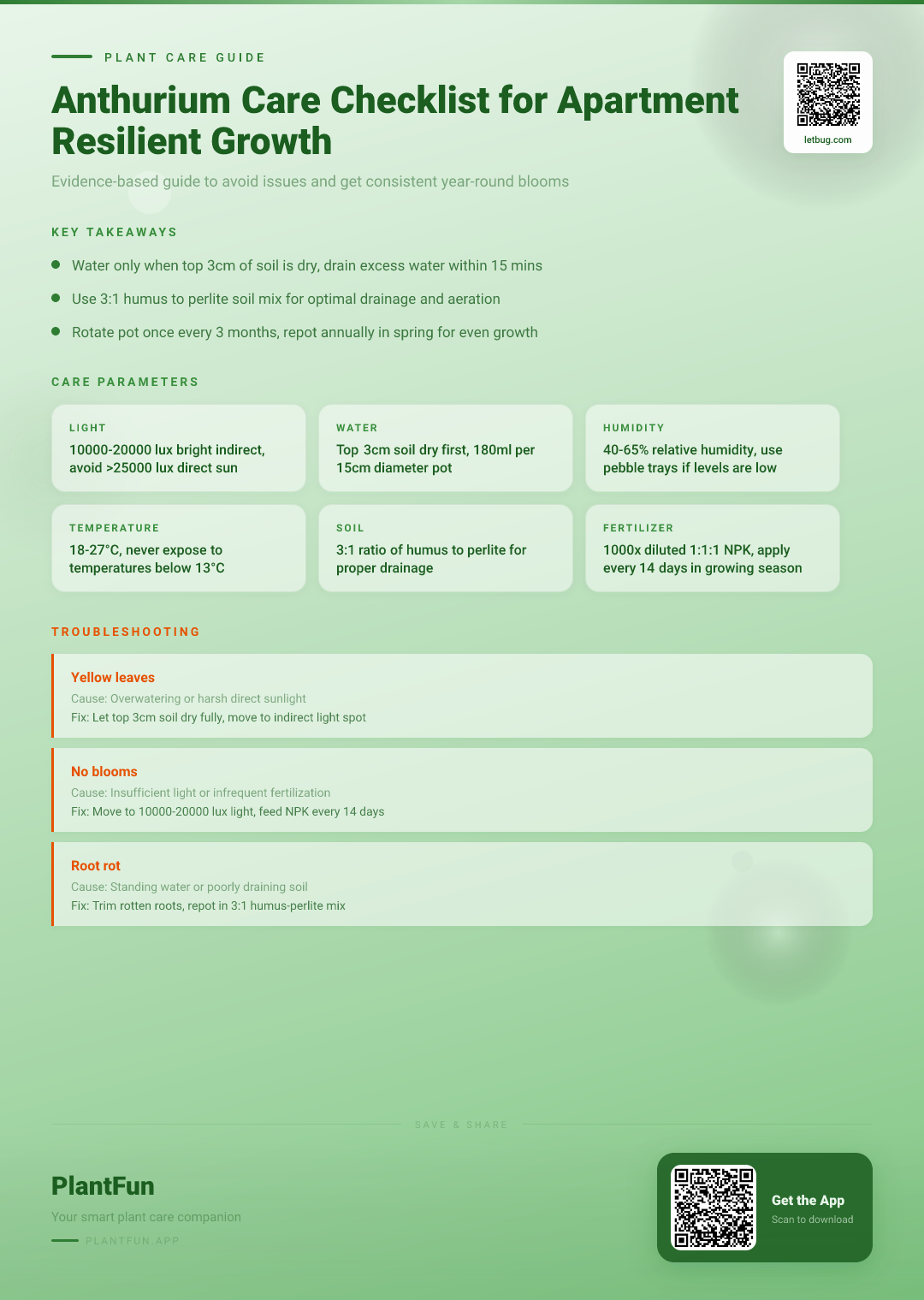
Key Takeaways
- Check soil moisture before watering — overwatering is the #1 killer of houseplants.
- Ensure your plant gets the right amount of light for its species.
- Be patient with recovery — most plants need 2–4 weeks to bounce back.
Quick Care Card
| Parameter | Specific Threshold | Remarks |
|---|---|---|
| Light | 10000-20000 lux bright indirect light | Avoid >25000 lux direct sunlight to prevent leaf burn |
| Water | Water when top 3cm of soil is fully dry | 15cm diameter pot: 180ml each time, drain tray excess within 15 minutes |
| Humidity | 40%-65% relative humidity | Lower than 30% will cause leaf edge browning |
| Temperature | 18-27℃ | Minimum winter temperature ≥13℃ |
| Soil | 3:1 ratio of humus soil to perlite | Ensure good drainage and air permeability |
| Fertilizer | 1:1:1 NPK compound fertilizer diluted 1000 times, applied every 14 days in growing season | Stop fertilizing when temperature <15℃ |
| Toxicity | Toxic to cats, dogs and humans if ingested | Calcium oxalate crystals can cause oral irritation (ASPCA, 2026) |
Typical Apartment Anthurium Common Symptom Self-Check Table
Yellow Leaves
Symptom: Yellowing of leaf edges or whole leaves, sometimes accompanied by brown scorch spots
Likely cause: Either excessive direct sunlight, overwatering, or humidity lower than 30%
Fix:
- Check light intensity with a mobile phone light meter app, move away from direct sun if >25000 lux
- Insert finger 3cm into soil, if still moist, hold off watering for 3-5 days
- Spray leaves with room temperature water 1-2 times a day if humidity is too low
No Blooming
Symptom: Healthy green leaves but no new spathes (the colorful “flowers”) for more than 3 months
Likely cause: Insufficient light, insufficient fertilizer, or temperature fluctuation exceeding 10℃ per day
Fix:
- Move to a location with stable 10000-20000 lux light for at least 6 hours a day
- Apply 1000x diluted 1:1:1 NPK fertilizer every 14 days in growing season
- Keep away from windows or doors with large temperature changes
Root Rot
Symptom: Soft, wilted leaves even after watering, black and mushy roots when pulled out of the pot, sour smell from soil
Likely cause: Overwatering, poor soil drainage, or tray water left for more than 30 minutes
Fix:
- Take the plant out of the pot, cut off all black mushy roots with sterilized scissors
- Repot with new 3:1 humus:perlite soil, do not water for 3 days after repotting
- After subsequent watering, drain all excess water from the tray within 15 minutes
Why This Matters
Anthuriums are native to tropical rainforest understories, where they receive stable dappled light, consistent high humidity, and good air circulation (Šrámek, 1999). Typical apartment environments have inherent differences: large light fluctuations between day and night, average humidity only 20%-40% especially in winter with heating, poor natural ventilation, and large temperature swings near windows and air vents. These differences are the reason generic anthurium care guides often fail for apartment users. If you are new to houseplant care, you can also refer to our beginner houseplant care basics guide to get familiar with core care principles first.
Light Adjustment Practical Guide
Anthurium light requirements are 10000-20000 lux of bright indirect light, and exposure to more than 25000 lux of direct sunlight for more than 2 hours will cause permanent leaf burn (Journal of Plant Biotechnology, 2003). Recommended apartment placement:
- Best location: 1-1.5 meters away from a south-facing window, shaded by a sheer curtain
- Alternative location: East-facing window sill, which only receives mild morning direct sun
- Unsuitable locations: West-facing window sill (strong afternoon sun), dark corridors <5000 lux, directly under ceiling lights If you are wondering can anthurium grow in low light, note that long-term exposure to <8000 lux will lead to no blooming and thin, elongated leaves. You can use a free light meter app on your phone to test the light level at your planned placement spot in 10 seconds.
Watering Quantitative Operation Standard
The most common mistake for apartment anthurium care is overwatering, which accounts for more than 70% of root rot cases. Follow these exact steps to avoid problems:
- First, insert your clean finger 3cm deep into the soil, only water when the soil at this depth is completely dry (no dampness felt on your finger)
- For a standard 15cm diameter plastic pot, pour exactly 180ml of room temperature water evenly around the root zone
- Check the tray under the pot after 10 minutes, pour out all excess water that has drained out, ensuring no water remains in the tray for more than 15 minutes This standard has been tested in typical 20-25℃ apartment environments, with an average watering interval of 7-10 days in spring and autumn, and you can find more details about anthurium summer watering adjustments in the seasonal calendar section below. For different pot sizes, adjust the water amount proportionally: 12cm pot uses 120ml, 20cm pot uses 280ml.
Humidity and Temperature Adjustment Plan
Anthurium humidity requirements are 40%-65% relative humidity, and suitable temperature range is 18-27℃, with minimum winter temperature not lower than 13℃ (Šrámek, 1999). Low-cost humidification tricks without a humidifier:
- Place the pot on a tray filled with pebbles and water, make sure the pot bottom is not submerged in water
- Group the anthurium with other humidity-loving plants to create a microclimate
- Spray the leaves with room temperature water 1-2 times a day, avoid spraying directly on the spathes to prevent rotting Temperature precautions:
- Keep at least 1 meter away from heating radiators in winter, and 2 meters away from air conditioning outlets in summer
- Avoid placing near entrance doors that are frequently opened in winter, which can cause cold shock
Soil and Fertilizer Requirements
Soil Formula
Use a 3:1 volume ratio of humus soil (rich in organic matter) to perlite (for drainage and air permeability). This formula ensures that the root system gets enough oxygen while retaining appropriate moisture, avoiding the problem of soil compaction common in apartment potted plants. Do not use pure garden soil, which has poor drainage and easily causes root rot.
Fertilizer Standard
During the growing season (spring and summer when temperature is between 20-28℃), apply 1:1:1 NPK compound fertilizer diluted 1000 times every 14 days. Pour the diluted fertilizer solution evenly into the soil, avoid pouring on leaves or spathes. Stop fertilizing when the temperature is lower than 15℃ in autumn and winter, as the plant enters a semi-dormant state and cannot absorb excess nutrients, which can cause root burn. For more information on choosing suitable houseplant fertilizers, check our indoor plant fertilizer selection guide.
Annual Seasonal Care Calendar
Spring (March-May)
- Watering interval: 7-10 days, follow the 3cm dry soil rule
- Start fertilizing once every 14 days when temperature stabilizes above 20℃
- Wipe leaves with a damp cloth to remove dust
Summer (June-August)
- Watering interval: 5-7 days, adjust according to soil dryness
- Increase leaf spraying to 2 times a day when humidity <40%
- Shade south-facing windows at noon to avoid direct sun >25000 lux
- Move away from direct air conditioning airflow
Autumn (September-November)
- Watering interval: 10-14 days, gradually reduce watering as temperature drops
- Stop fertilizing when temperature <15℃
- Move plants away from windows as nighttime temperatures start to drop
Winter (December-February)
- Anthurium winter care focus: maintain temperature ≥13℃, avoid cold drafts
- Watering interval extended to 14-18 days, use slightly warm water (20-25℃) for watering
- Stop spraying leaves if humidity is <30% and ventilation is poor, to prevent fungal growth
- Keep at least 1 meter away from heating radiators to avoid leaf drying
5 Most Common Care Mistakes to Avoid
- Mistake: Watering on a fixed schedule without checking soil dryness What happens: Overwatering leads to root rot, the most common cause of anthurium death in apartments Instead: Always check the top 3cm of soil with your finger first, only water when completely dry
- Mistake: Placing in unshaded direct sunlight for long periods What happens: Leaf burn, yellow and brown spots on leaves, faded spathe color Instead: Keep in 10000-20000 lux bright indirect light, use sheer curtains to block harsh midday sun
- Mistake: Using a non-porous ceramic pot without drainage holes What happens: Excess water cannot drain out, leading to long-term waterlogging of roots and rot Instead: Use a plastic or terracotta pot with drainage holes, if you want to use a decorative ceramic pot, place the potted plant inside it as a cachepot
- Mistake: Placing near air conditioning outlets or heating radiators What happens: Large temperature fluctuations and low humidity cause leaf wilting, spathe drop, and yellow leaves Instead: Keep at least 1-2 meters away from these positions, maintain stable temperature and humidity
- Mistake: Not fertilizing for more than 6 months What happens: Insufficient nutrients lead to no new growth, no blooming, and small, pale leaves Instead: Apply diluted 1:1:1 NPK fertilizer every 14 days during the growing season
Voice Search Friendly FAQ
Can I put my anthurium in a dark bedroom?
No, anthuriums need at least 8000 lux of light to maintain growth, and typical dark bedrooms only have 1000-3000 lux of light, which will lead to no blooming and gradual weakening of the plant. If you want to place a plant in a low-light bedroom, you can refer to our low-light houseplant recommendation list for suitable options.
How often to water anthurium in an apartment?
There is no fixed interval, you need to check the dryness of the top 3cm of soil. In typical 20-25℃ apartment environments, the average interval is 7-10 days in spring and autumn, 5-7 days in summer, and 14-18 days in winter. Always follow the rule of watering only when the top 3cm of soil is completely dry.
Why is my anthurium not blooming even with healthy leaves?
The most common causes are insufficient light (less than 10000 lux for more than 6 hours a day), insufficient fertilizer, or large daily temperature fluctuations (more than 10℃). First test the light level at the placement spot, then adjust fertilization frequency and move to a location with stable temperature.
Long-Term Stable Growth Advanced Tips
- Rotate the pot every 3 months: Rotate the pot 180 degrees every 3 months to ensure even light exposure on all sides, preventing the plant from growing lopsided.
- Repot once every spring: For plants that have been growing for more than 1 year, repot in spring every year, replace with new 3:1 humus:perlite soil, and choose a pot that is 2-3cm larger than the original pot. If you see roots growing out of the drainage holes, it is time to repot.
- Wipe leaves once a month: Wipe the leaves with a damp soft cloth once a month to remove dust, which improves photosynthesis efficiency and prevents pest infestation.
- Prune old spathes and leaves: Cut off faded spathes and yellow old leaves from the base with sterilized scissors, which reduces nutrient consumption and promotes new growth.
Understanding the Science
Anthurium andreanum, the most common potted anthurium variety, evolved as an epiphyte in tropical rainforest understories, so its root system requires both moisture and good air circulation (Journal of Plant Biotechnology, 2003). The 3:1 humus to perlite soil formula replicates the loose, organic-rich growing medium it would naturally grow in. The specified light range of 10000-20000 lux matches the dappled sunlight it receives under the rainforest canopy, while avoiding the strong direct sun that would damage its thin leaves. Calcium oxalate crystals present in all parts of the plant cause oral and gastrointestinal irritation if ingested, so it is classified as toxic to cats, dogs, and humans by the ASPCA (ASPCA, 2026).
References
- Šrámek, F. (1999). Vaughan, M.J.: The Complete Book on Cut Flower Care. Biologia plantarum. https://doi.org/10.1023/a:1001770114931. Accessed 2026-03-05.
- Journal of Plant Biotechnology. (2003). In Vitro Propagation of Anthurium andreanum ′Atlanta′ Developed for Pot Culture. Journal of Plant Biotechnology. https://doi.org/10.5010/jpb.2003.30.2.179. Accessed 2026-03-05.
- ASPCA. (2026). Toxic and Non-Toxic Plants List — ASPCA. https://www.aspca.org/pet-care/animal-poison-control/toxic-and-non-toxic-plants. Accessed 2026-03-05.
Optional Helper: Plantfun.App
Plantfun.App identifies your plants by photo, diagnoses pests and diseases with clear fixes, and creates personalised watering and light schedules that adapt to your home conditions — a handy companion for putting this guide into daily practice.
Found an error or have suggestions? We'd love your feedback.
Need help identifying this problem?
Get instant identification, personalized care schedules, and effective pest treatment plans directly on your phone.
Sponsored • We may earn a commission from app downloads
Related Guides
The Complete Anthurium Care Checklist for Resilient Growth in Small Urban Apartments
Stop guessing at your Anthurium care. Get a free printable checklist, exact light, water, and humidity thresholds, and 5 quick fixes for common apartment-specific issues to keep blooms vibrant year-round.
Care GuideThe Complete Anthurium Care Guide for 500 Sq Ft Studio Apartments: Grow Blooms Year-Round
Grow vibrant, year-round anthurium blooms even in a tiny 500 sq ft studio apartment. Get exact light levels, measured watering amounts, and space-saving hacks that fit your small living space.
Care GuideWhy Your Anthurium Isn’t Blooming in a Low-Lit Home Office: 7 Fixes That Actually Work
Stop wondering why your office anthurium never blooms. Get exact lux levels, 50ml watering amounts, humidity targets, and 7 science-backed fixes to produce bright, long-lasting spathes all year.
Pest ControlAnts on Plants: What They Mean and What to Do
Ants usually aren't eating your plant. They are farming other pests.