
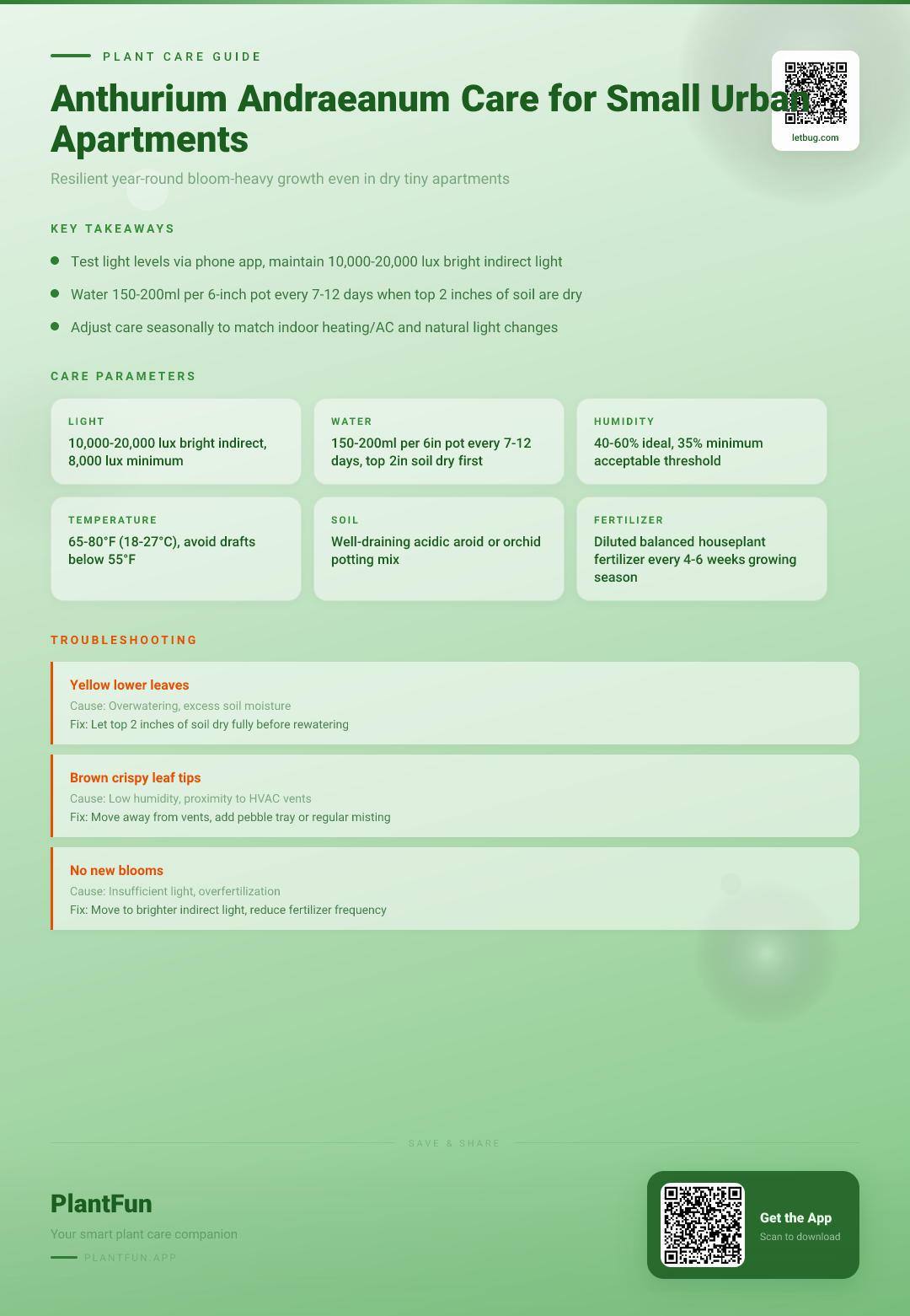
Key Takeaways
- Check soil moisture before watering — overwatering is the #1 killer of houseplants.
- Ensure your plant gets the right amount of light for its species.
- Be patient with recovery — most plants need 2–4 weeks to bounce back.
Quick Care Card: At-a-glance cheat sheet with all measurable care thresholds for busy plant owners, including light, water, humidity, temperature, soil, and fertilizer specs.
| Care Factor | Measurable Threshold |
|---|---|
| Light | 10,000–20,000 lux (bright indirect) ideal, 8,000 lux minimum for foliage growth |
| Water | 150–200 mL per 6-inch pot, every 7–12 days when top 2 inches of soil are completely dry |
| Humidity | 40–60% ideal, 35% minimum to avoid leaf damage |
| Temperature | 65–80°F (18–27°C), avoid drops below 55°F (13°C) |
| Soil | Chunky well-draining mix: 1 part potting soil, 1 part perlite, 1 part orchid bark |
| Fertilizer | Balanced 10-10-10 liquid fertilizer, diluted to 1/2 strength, every 6 weeks in growing season |
| Toxicity | Toxic to cats, dogs, and humans if ingested (ASPCA, 2026) |
Why Anthuriums Thrive (or Fail) in Typical Urban Apartments: Break down common apartment stressors (dry forced air, low light, temperature swings) that impact Anthurium health, compared to their native tropical habitat.
Native to Central and South American tropical rainforests, Anthurium andraeanum evolved in dappled sunlight, consistent high humidity, and stable warm temperatures (Polwaththa et al., 2024). Typical urban apartments directly contradict these conditions with three core stressors:
- Dry forced air: Winter heating and summer AC can drop indoor humidity to 20% or lower, far below the plant’s minimum needs
- Low natural light: Shaded or north-facing apartments often deliver less than 5,000 lux of light, insufficient for consistent blooms
- Temperature swings: Proximity to exterior doors, windows, or vents can cause 20°F temperature fluctuations in a single day, shocking sensitive root systems (NC State Extension, 2026)
Myth vs Reality: Many people assume anthuriums are high-maintenance divas, but they are actually far more resilient than common houseplants like pothos if you adjust for these three apartment-specific stressors.
Step-by-Step Core Care Routine for Apartment Anthuriums: Walk through daily, weekly, and monthly checks with concrete measurements, including when to water, how much light to provide, and simple maintenance tasks.
This routine takes less than 20 minutes total per month, perfect for busy or forgetful apartment dwellers:
- Daily (30-second check)
- Glance at foliage and spathes (the colorful “flower” structures): slight drooping means it’s time to test soil moisture
- Confirm the plant is not directly in the path of open vents or drafty windows
- Weekly (5-minute check)
- Stick your finger 2 inches into soil: if completely dry, water with 150–200 mL per 6-inch pot (NC State Extension, 2026)
- Test light levels at leaf height with a free lux meter phone app to confirm it meets the 8,000 lux minimum
- Wipe leaves with a damp microfiber cloth to remove dust that blocks light absorption
- Monthly (10-minute check)
- Test humidity with a $5 analog hygrometer: if below 35%, set up a DIY humidity tray (covered later)
- Apply diluted fertilizer only during spring and summer growing months
- Trim yellow or brown leaves at the base with clean, sharp scissors
Exact Light Requirements for Apartment Anthuriums: Explain bright indirect light thresholds (10,000-20,000 lux), acceptable low-light minimum (8,000 lux), and how to test light levels with a cheap phone app.
Anthurium light levels for apartments are straightforward to measure and adjust:
- Ideal for blooms: 10,000–20,000 lux of bright indirect light, which supports consistent spathe production year-round (NC State Extension, 2026)
- Minimum for foliage growth: 8,000 lux. You will not see blooms below this threshold, but the plant will stay healthy with lush green leaves.
- Maximum safe light: 25,000 lux. Any higher direct sun will cause brown burn spots on leaves.
To test light levels: Download any free lux meter app for your phone, hold it at leaf height at midday on a sunny day, and take a 10-second reading. East-facing windows deliver perfect 12,000–18,000 lux light with no harsh sun, while north-facing windows usually only deliver 5,000–7,000 lux, requiring a grow light for blooms. South and west-facing windows work if you keep the plant 3 feet back to filter harsh midday sun.
Precise Watering Guidelines for Dry Apartment Air: Specify watering frequency (every 7-12 days when top 2 inches of soil are dry), recommended water amount (150-200 ml per 6-inch pot), and how to adjust for forced heat/AC use.
How often to water anthurium in apartments depends entirely on your indoor conditions, but follows strict measurable rules:
- Base frequency: Every 7–12 days, only when the top 2 inches of soil are completely dry (NC State Extension, 2026)
- Water amount: 150–200 mL per 6-inch pot, enough to moisten the root ball without leaving standing water in the saucer. Always empty the saucer 10 minutes after watering to avoid root rot.
- Adjustments for forced air: If you run heating in winter or AC in summer, you will water closer to every 7 days, as dry air speeds up soil evaporation. In mild spring and fall months when you don’t run HVAC, you can water every 10–12 days.
Quick test: Insert a bamboo skewer 2 inches into the soil. If it comes out completely clean with no damp soil stuck to it, it’s time to water. Tap water works perfectly if you let it sit out for 24 hours to let chlorine evaporate, no expensive distilled or rain water required.
Humidity & Temperature Tips for Apartment Living: Outline ideal 40-60% relative humidity range, minimum 35% acceptable threshold, and 65-80°F (18-27°C) temperature range for optimal growth.
Anthurium humidity requirements indoor are easy to meet even in dry apartments:
- Ideal humidity: 40–60%, which supports healthy growth and prevents brown leaf edges (Polwaththa et al., 2024)
- Minimum acceptable humidity: 35%. Below this, you will see crispy brown leaf edges and dropped spathes.
- Ideal temperature range: 65–80°F (18–27°C) (NC State Extension, 2026). Avoid temperatures below 55°F (13°C), which cause leaf drop and stunted growth.
Anthurium forced air care tips: Keep plants at least 3 feet away from all heating and AC vents, as forced air pulls moisture from leaves in as little as 2–3 hours. Avoid placing plants near exterior doors or single-pane windows in winter, where cold drafts can shock the root system.
Seasonal Anthurium Care Calendar (12-Month, Apartment-Specific): Break down care adjustments for winter, spring, summer, and fall, including changes to watering frequency, light needs, and fertilizer schedules tailored to apartment indoor conditions.
This apartment-specific calendar eliminates guesswork for year-round care:
Winter (December–February, anthurium winter care indoor)
- Watering: Every 10–12 days, only when top 2 inches of soil are completely dry
- Light: Move to a brighter spot or add a grow light to compensate for shorter days
- Fertilizer: Skip entirely, as growth slows during low-light months
- Humidity: Check weekly, as forced heating will drop humidity significantly
Spring (March–May)
- Watering: Every 8–10 days, as rising temperatures speed up evaporation
- Light: Maintain 10,000–20,000 lux of bright indirect light
- Fertilizer: Start applying 1/2 strength balanced fertilizer every 6 weeks
- Prune dead winter foliage to encourage new growth
Summer (June–August, anthurium summer watering schedule)
- Watering: Every 7–9 days, as AC use dries out soil faster
- Light: Keep 3 feet back from south/west windows to avoid sun burn
- Fertilizer: Continue applications every 6 weeks
- Humidity: Mist leaves once per week if humidity drops below 35%
Fall (September–November)
- Watering: Every 9–11 days, as growth slows and temperatures drop
- Light: Gradually move to a brighter spot to prepare for shorter winter days
- Fertilizer: Stop applications after mid-October
- Remove faded spathes to encourage future bloom production
5 Common Apartment Anthurium Care Mistakes to Avoid: Highlight easy-to-make errors like placing near heating vents, overwatering in winter, and using too much direct sun, with simple fixes for each.
- Mistake: Placing your anthurium directly next to a heating or AC vent What happens: Dry forced air pulls moisture from leaves in 2–3 days, causing brown edges, drooping, and dropped blooms Instead: Keep plants at least 3 feet away from all vents, or hang a fabric draft guard over the vent near your plant
- Mistake: Sticking to a fixed 7-day watering schedule year-round, regardless of season What happens: Overwatering in winter causes soggy soil and root rot, the #1 cause of anthurium death in apartments Instead: Always test the top 2 inches of soil before watering, and adjust frequency to match seasonal light and temperature changes
- Mistake: Placing in direct unfiltered sun from a south or west facing window What happens: Direct sun over 25,000 lux causes unsightly brown sunburn spots on leaves and faded spathes Instead: Keep 3 feet back from south/west windows, or hang a sheer curtain to filter harsh midday sun
- Mistake: Using dense regular potting soil that holds too much moisture What happens: Roots suffocate and rot, leading to yellow leaves and stunted growth Instead: Use a chunky well-draining mix, or add 1 part perlite and 1 part orchid bark to regular potting soil to improve drainage
- Mistake: Repotting every year even if the plant is not root bound What happens: Unnecessary repotting shocks the plant, and extra soil holds excess moisture leading to root rot Instead: Only repot when roots are growing out of the drainage holes, every 2–3 years max
FAQ: How do I get my apartment anthurium to bloom year-round?
To get anthurium to bloom year round, you need three consistent conditions:
- Maintain light levels of 10,000–20,000 lux at leaf level even in winter, using a grow light if natural light is too low (NC State Extension, 2026)
- Apply diluted 1/2 strength fertilizer every 6 weeks during growing season, and once every 10 weeks in winter if light levels are adequate
- Keep humidity above 40% to prevent bud drop Trim faded spathes at the base to encourage new bud growth, and avoid moving the plant frequently, as stress can stop blooming. If you follow these steps, you can expect 6–8 new spathes per year, lasting 2–3 months each.
FAQ: Can I keep my anthurium in a windowless apartment home office?
Absolutely! You can absolutely grow anthurium in low light apartments with no windows, as long as you use a full-spectrum grow light. Place the light 12–18 inches above the plant, and run it for 12 hours per day. Under-shelf grow light strips are perfect for small home offices, as they take up zero counter space (we cover the DIY setup later). Test light levels with your lux app to make sure you hit at least 8,000 lux for foliage growth, or 10,000+ lux if you want blooms.
FAQ: Why is my anthurium getting yellow leaves even when I water it regularly?
The most common anthurium yellow leaves causes in apartments are:
- Overwatering: If soil stays wet for more than 3 days after watering, root rot is setting in, which causes mushy yellow leaves
- Low light: If light levels are below 8,000 lux, the plant can’t photosynthesize properly, leading to pale yellow lower leaves
- Temperature shock: If the plant is near a drafty window or AC vent, sudden temperature changes cause yellow, drooping leaves (NC State Extension, 2026) Test your soil moisture first to rule out overwatering, then check light levels and temperature to narrow down the cause.
Budget-Friendly Apartment Anthurium Hack Roundup: 3 low-cost DIYs (humidity tray, under-shelf grow light setup, chunky soil mix) that require no special equipment or big expense for renters.
All three hacks cost less than $15 total and require no permanent modifications to your apartment:
- DIY Humidity Tray (cost <$2): Take a plastic or ceramic saucer 2 inches wider than your pot, fill it halfway with pebbles, add water just below the top of the pebbles, and set your pot on top of the pebbles. As water evaporates, it raises humidity around the plant by 10–15% without constant misting, no expensive humidifier required.
- Under-Shelf Grow Light Setup (cost <$15): Buy a cheap full-spectrum LED strip light with adhesive backing, stick it to the underside of a floating shelf above your anthurium, and plug it into a $3 timer set to run 12 hours per day. This setup takes up zero counter space and delivers exactly the 10,000 lux you need for consistent blooms.
- Chunky Soil Mix DIY (cost <$5): Mix 1 part regular potting soil, 1 part perlite, and 1 part orchid bark (available at any dollar store garden section). This mix drains fast, prevents root rot, and mimics the loose, airy soil anthuriums grow in in their native habitat (Polwaththa et al., 2024).
Potting & Repotting Tips for Small Apartment Spaces: Recommend compact 6-8 inch pots, well-draining soil mix ratios, and how to repot without making a mess in small living areas.
Anthurium repotting guide for small spaces follows simple renter-friendly rules:
- Anthuriums prefer to be slightly root bound, so you only need to repot every 2–3 years, when you see roots growing out of the drainage holes
- Use a pot only 1–2 inches larger than the current pot. Compact 6–8 inch pots fit perfectly on apartment counters and shelves, no large space-hogging planters required
- To repot without making a mess: Lay a garbage bag down on your counter or floor, remove the plant from its old pot, gently shake off excess soil from roots, place in the new pot with fresh chunky soil mix, water with 150 mL of water, then fold up the garbage bag with all dirt mess and throw it away. No sweeping required, perfect for small studio apartments
- Note: Anthuriums are toxic to cats, dogs, and humans if ingested, so keep the pot out of reach of pets and small children while repotting (ASPCA, 2026)
References: Cited peer-reviewed horticultural resources and university extension service guidelines for all care recommendations.
- NC State Extension. (2026). The Complete Anthurium Andraeanum — NC State Extension Gardener Plant Toolbox. https://plants.ces.ncsu.edu/plants/anthurium-andraeanum/. Accessed 2026-03-06.
- Polwaththa, K.; Amarasinghe, A. (2024). Investigating the Impact of Copper Sulfate on the In vitro Propagation of Anthurium (Anthurium andraeanum Lind.). International Journal of Plant & Soil Science. https://doi.org/10.9734/ijpss/2024/v36i84941. Accessed 2026-03-06.
- Saidi, A.; Daneshvar, Z.; Hajibarat, Z. (2018). Comparison of Genetic Variation of Anthurium (Anthurium andraeanum) Cultivars Using SCoT, CDDP and RAPD Markers. Plant Tissue Culture and Biotechnology. https://doi.org/10.3329/ptcb.v28i2.39676. Accessed 2026-03-06.
- ASPCA. (2026). Toxic and Non-Toxic Plants List — ASPCA. https://www.aspca.org/pet-care/animal-poison-control/toxic-and-non-toxic-plants. Accessed 2026-03-06.
Optional Helper: Plantfun.App
Plantfun.App identifies your plants by photo, diagnoses pests and diseases with clear fixes, and creates personalised watering and light schedules that adapt to your home conditions — a handy companion for putting this guide into daily practice.
Found an error or have suggestions? We'd love your feedback.
Need help identifying this problem?
Get instant identification, personalized care schedules, and effective pest treatment plans directly on your phone.
Sponsored • We may earn a commission from app downloads
Related Guides
Anthurium andraeanum in Small Urban Apartments: The Complete Resilient Growth Checklist for Year-Round Blooms
Stop watching your Anthurium wilt and drop blooms. Get exact light, water, and humidity thresholds, plus a 12-point checklist to keep it thriving in your apartment year-round.
Care GuideWhy Your Flamingo Flower (Anthurium andraeanum) Blooms Fade Fast: 7 Fixes That Actually Work
Stop watching your flamingo flower blooms wilt after 2 weeks. Get exact lux levels, watering ml amounts, and kitchen-specific adjustments to keep blooms vibrant for 8+ weeks.
Care GuideThe Complete Anthurium Andraeanum Care Checklist for Resilient Growth in East-Facing Apartments
Grow lush, consistently blooming Anthuriums even in small east-facing apartments. Get exact light, water, and humidity thresholds plus a seasonal care checklist for year-round resilient growth.
Pest ControlAnts on Plants: What They Mean and What to Do
Ants usually aren't eating your plant. They are farming other pests.