
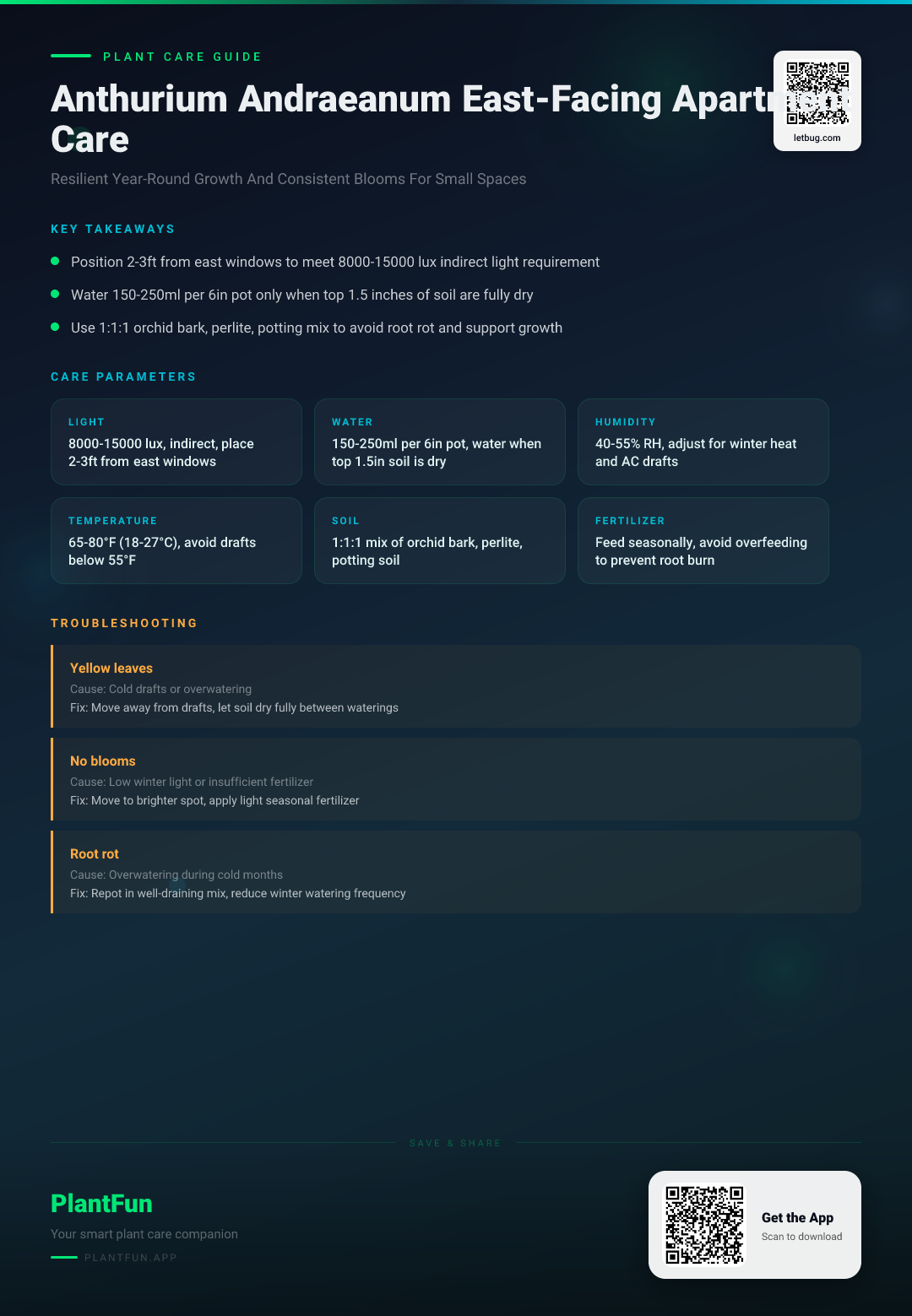
Key Takeaways
- Check soil moisture before watering — overwatering is the #1 killer of houseplants.
- Ensure your plant gets the right amount of light for its species.
- Be patient with recovery — most plants need 2–4 weeks to bounce back.
Quick Care Card
| Parameter | Rule |
|---|---|
| Light | 8,000-15,000 lux, positioned 2-3ft from east-facing windows (NC State Extension, 2026) |
| Water | 150-250ml per 6-inch pot when the top 1.5 inches of soil are completely dry |
| Humidity | 40-55% relative humidity, no greenhouse-level humidity required for apartment growing |
| Temperature | 65-80°F (18-27°C), avoid drafts below 60°F (15°C) |
| Soil | 1:1:1 mix of orchid bark, perlite, and general-purpose potting mix for fast drainage |
| Fertilizer | Half-strength 10-10-10 liquid fertilizer every 6 weeks in spring/summer, no feed in fall/winter |
| Toxicity | Toxic to cats, dogs, and humans if ingested due to calcium oxalate crystals (ASPCA, 2026) |
Download our printable Anthurium care checklist for fridge reference to skip guesswork all year long.
Why Anthurium Andraeanum Thrives in Typical East-Facing Apartments
Native to the dappled tropical understories of Central and South America, Anthurium andraeanum evolved to grow in soft, indirect morning light — exactly the light exposure east-facing apartments provide (Polwaththa et al, 2024). Unlike generic care guides that recommend bright indirect light with no context, this species doesn’t need harsh midday sun to bloom, making it ideal for 600-900 sq ft 1-2 bedroom rental units.
Myth vs Reality: Myth: Anthuriums need full south-facing sun to produce flowers. Reality: East-facing morning light is perfect for consistent blooms, and direct midday sun will scorch their glossy leaves. The most common issues for anthurium in east facing apartment setups come from easily fixed quirks: dry forced air, drafty old window frames, and overwatering when renters overcorrect for low humidity.
This guide is tailored for anthurium care for beginners and intermediate owners, with no specialized equipment required.
Step 1: Light Setup for Consistent Blooms
The exact anthurium light requirements indoors for consistent blooms are 8,000-15,000 lux for 4-6 hours per day (NC State Extension, 2026). Follow these simple rules for your east-facing window:
- Position your plant 2-3ft away from the east window, never directly on the sill (to avoid cold draft exposure in winter)
- If your apartment has adjacent south-facing glass, hang a cheap sheer curtain to block light between 10am and 2pm to prevent leaf scorch
- Quick test: Hold your hand at plant height at 9am: if you feel a soft warm glow with no sharp, defined shadow, the light level is perfect.
If you don’t own a light meter, our guide to measuring indoor light without special equipment can help you confirm your setup meets requirements.
Step 2: Measured Watering Routine for Average Apartment Humidity
Wondering how often to water anthurium in an apartment? Follow these measurable rules to avoid overwatering, the #1 cause of anthurium death:
- For a standard 6-inch nursery pot, give 150-250ml of room-temperature water per watering session
- Only water when the top 1.5 inches of soil are completely dry: stick your finger into the soil up to your second knuckle; if no soil sticks, it’s time to water
- Don’t overcorrect for dry forced air by watering more often: dry air affects leaf tips first, while soggy soil causes fatal root rot far faster.
In summer, this usually translates to watering every 7-10 days, while winter watering drops to every 14-21 days. For more tips on avoiding overwatering, check our complete guide to watering houseplants correctly.
Step 3: Humidity & Temperature Adjustments for Drafty Spaces
Anthurium humidity levels for apartments only need to hit 40-55% — you don’t need a fancy humidifier to keep your plant healthy (Polwaththa et al, 2024). Follow these 5-minute fixes:
- Group your anthurium with 2-3 other plants to raise local humidity by 5-10% naturally
- Place a pebble tray (a tray filled with water and pebbles, with the pot sitting on top of the pebbles, not in the water) under the plant to add moisture to the air as the water evaporates
- Follow the 65-80°F (18-27°C) temperature rule: never let the temperature near your plant drop below 60°F (15°C), as anthurium draft tolerance is very low for cold, fast-moving air.
For more easy DIY humidity hacks, see our guide to fixing dry indoor air for plants.
Step 4: Soil & Fertilizer Tips for Low-Maintenance Growth
Use an exact 1:1:1 mix of orchid bark, perlite, and general-purpose potting mix for your anthurium. This mix drains fast enough to prevent root rot, while retaining enough moisture to keep roots hydrated between waterings.
Follow this anthurium fertilizer schedule to avoid root burn and encourage blooms:
- Apply half-strength 10-10-10 liquid fertilizer every 6 weeks in spring and summer, when the plant is actively growing
- Skip all fertilizer in fall and winter, when growth slows down
- Never apply fertilizer to dry soil, as this can burn delicate root hairs.
If you want to make your own custom soil mix, our guide to the best soil mixes for common houseplants has more tailored recipes.
Seasonal Care Calendar
All of these quarterly tasks take 5 minutes or less to complete, perfect for busy renters:
- Spring (March): 1) Wipe leaves with a damp cloth to remove dust that blocks light, 2) Apply first dose of diluted fertilizer if new growth is visible, 3) Check if roots are growing out of drainage holes to schedule repotting
- Summer (June): 1) Move plant 6 inches further back from east window if adjacent south glass is causing midday scorch, 2) Check soil moisture 2x per week during heatwaves for anthurium summer watering adjustments, 3) Snip off spent blooms at the base to encourage new flowers
- Fall (September): 1) Stop fertilizing for the winter, 2) Move plant 6 inches closer to east window to capture less intense morning light, 3) Seal any drafty gaps around the window frame near the plant
- Winter (December): 1) Cut back watering to every 14-21 days for anthurium winter care, 2) Keep plant at least 3ft away from heating vents to avoid dry air damage, 3) Trim any yellow or brown leaves to redirect energy to new growth
Common Apartment-Specific Anthurium Mistakes to Avoid
- Mistake: Placing the plant directly on the drafty east window sill in winter. What happens: Cold air seeping through old window frames causes yellow leaves and stunted growth, one of the top reasons people search for how to fix anthurium yellow leaves. Instead: Keep the plant 2-3ft back from the glass, or add a layer of foam insulation between the sill and the pot to buffer cold.
- Mistake: Watering on a fixed schedule instead of checking soil moisture, especially in winter when heaters run. What happens: Overwatering leads to root rot, the #1 killer of indoor anthuriums. Instead: Test the top 1.5 inches of soil every 10 days in winter, only water if it’s completely dry.
- Mistake: Skipping fertilizer in growing season or using full strength fertilizer. What happens: No blooms, or brown leaf tips from root burn. Instead: Follow the anthurium fertilizer schedule of half-strength liquid feed every 6 weeks in spring and summer only.
- Mistake: Leaving the plant near AC vents in summer. What happens: Sudden temperature swings damage leaf tissue and cause drooping, given anthurium draft tolerance is very low for cold, fast-moving air. Instead: Redirect the vent away from the plant, or place a small decorative screen between the vent and the plant to block direct airflow.
FAQ: Why is my anthurium not blooming in my apartment?
The most common reasons for no blooms are insufficient light (less than 8,000 lux for 4+ hours per day), skipped fertilizer in growing season, or normal winter dormancy (NC State Extension, 2026). To fix: Move the plant 1ft closer to your east window to boost light levels, apply a half-strength dose of 10-10-10 fertilizer if it’s spring or summer, and wait 4-6 weeks for new blooms to form. In winter, reduced light and cooler temperatures trigger a short dormancy period, so blooms will resume in early spring. This is the simplest way to learn how to get anthurium to bloom indoors in apartment conditions.
FAQ: Can I keep my Anthurium near my apartment AC vent in summer?
No, anthurium draft tolerance is very low for fast-moving cold air, which can cause leaf scorch, drooping, and bloom drop. If you don’t have another spot for the plant, adjust the vent louvers to point away from the plant, or place a small cardboard or fabric screen between the vent and plant to block direct airflow. Check the temperature near the plant regularly to make sure it stays within the 65-80°F range.
FAQ: How often should I water my Anthurium in winter when my heater is running?
In winter, even with dry forced air, you only need to water your anthurium every 14-21 days, giving 150-200ml per 6-inch pot only when the top 1.5 inches of soil are completely dry (NC State Extension, 2026). Dry air will dry out the leaf tips faster, but it won’t dry out the root zone as quickly as summer heat, so avoid overwatering to prevent root rot. You can boost humidity around the plant with a pebble tray to reduce crispy tips instead of watering more often.
Troubleshooting Quick Fix Guide
Yellow Lower Leaves
Symptom: Soft, yellow leaves near the base of the plant, no brown edges.
Likely cause: Overwatering or cold draft exposure from the east window sill.
Fix:
- Let the top 2 inches of soil dry out completely before watering again
- Move the plant 1ft further back from the window to avoid cold drafts
Brown Leaf Tips
Symptom: Crispy, light brown tips on otherwise healthy green leaves.
Likely cause: Low humidity from dry forced air or direct exposure to heating/AC vents.
Fix:
- Place a pebble tray with water under the pot to raise local humidity by 5-10%
- Move the plant at least 3ft away from any heating or cooling vents
Drooping Stems
Symptom: Limp, floppy stems and leaves, no yellowing or browning.
Likely cause: Underwatering or sudden temperature swings from drafts.
Fix:
- Give 150ml of room-temperature water per 6-inch pot, and check soil moisture every 7 days moving forward
- Check the temperature near the plant to ensure it stays between 65-80°F
No Blooms For 3+ Months
Symptom: Healthy green leaves, no new colorful spathes (the “flower” part of the anthurium) forming.
Likely cause: Insufficient light or missed fertilizer applications in the growing season.
Fix:
- Move the plant 1ft closer to your east window to hit the 8,000-15,000 lux light target
- Apply a half-strength dose of 10-10-10 liquid fertilizer if it’s spring or summer
Understanding the Science
Recent horticultural research on Anthurium andraeanum confirms that the species evolved to thrive in dappled, low to medium light levels matching east-facing apartment conditions (Polwaththa et al, 2024). A 2018 genetic study of anthurium cultivars found that most common houseplant varieties are adapted to stable, warm temperatures and moderate humidity, making them well-suited to indoor residential growing when draft exposure is limited (Saidi et al, 2018). NC State Extension notes that proper drainage and avoiding overwatering are the most important factors for long-term anthurium health in indoor environments (NC State Extension, 2026). The ASPCA classifies Anthurium andraeanum as toxic to cats, dogs, and humans if ingested, due to calcium oxalate crystals in the leaves and stems (ASPCA, 2026), so keep it out of reach of small children and pets.
References
- NC State Extension. (2026). The Complete Anthurium Andraeanum — NC State Extension Gardener Plant Toolbox. https://plants.ces.ncsu.edu/plants/anthurium-andraeanum/. Accessed 2026-03-06.
- Polwaththa, K.; Amarasinghe, A. (2024). Investigating the Impact of Copper Sulfate on the In vitro Propagation of Anthurium (Anthurium andraeanum Lind.). International Journal of Plant & Soil Science. https://doi.org/10.9734/ijpss/2024/v36i84941. Accessed 2026-03-06.
- Saidi, A.; Daneshvar, Z.; Hajibarat, Z. (2018). Comparison of Genetic Variation of Anthurium (Anthurium andraeanum) Cultivars Using SCoT, CDDP and RAPD Markers. Plant Tissue Culture and Biotechnology. https://doi.org/10.3329/ptcb.v28i2.39676. Accessed 2026-03-06.
- ASPCA. (2026). Toxic and Non-Toxic Plants List — ASPCA. https://www.aspca.org/pet-care/animal-poison-control/toxic-and-non-toxic-plants. Accessed 2026-03-06.
Optional Helper: Plantfun.App
Plantfun.App identifies your plants by photo, diagnoses pests and diseases with clear fixes, and creates personalised watering and light schedules that adapt to your home conditions — a handy companion for putting this guide into daily practice.
Found an error or have suggestions? We'd love your feedback.
Need help identifying this problem?
Get instant identification, personalized care schedules, and effective pest treatment plans directly on your phone.
Sponsored • We may earn a commission from app downloads
Related Guides
The Complete Anthurium Care Checklist for Resilient Growth in Small Urban Apartments
Stop guessing at your Anthurium care. Get a free printable checklist, exact light, water, and humidity thresholds, and 5 quick fixes for common apartment-specific issues to keep blooms vibrant year-round.
Care GuideThe Complete Anthurium Care Checklist for Resilient Growth in Typical Apartments
Stop struggling to keep your anthurium thriving in your apartment. Get our evidence-based checklist with exact light, water, humidity parameters to avoid yellow leaves and get year-round consistent blooms.
Care GuideWhy Your Anthurium andraeanum Isn’t Blooming: 7 Fixes That Actually Work For East-Facing Home Offices
Stop wondering why your anthurium won’t bloom. Get 7 evidence-based fixes, exact light/lux levels, and a seasonal care calendar tailored for your east-facing home office Anthurium andraeanum, even with forced winter heating and weekend neglect.
Pest ControlAnts on Plants: What They Mean and What to Do
Ants usually aren't eating your plant. They are farming other pests.