
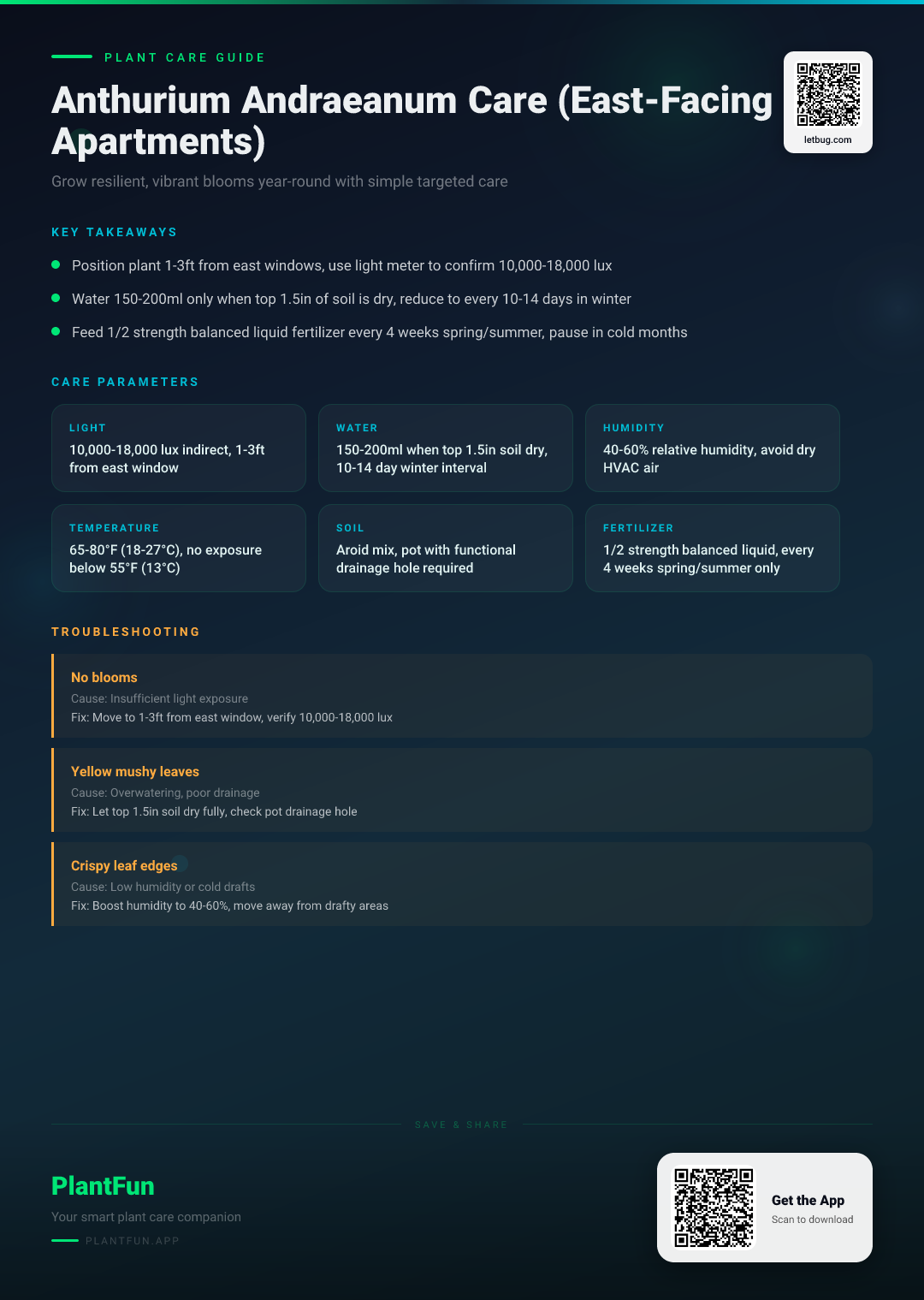
Key Takeaways
- Check soil moisture before watering — overwatering is the #1 killer of houseplants.
- Ensure your plant gets the right amount of light for its species.
- Be patient with recovery — most plants need 2–4 weeks to bounce back.
Introduction
Anthurium andraeanum, with its glossy heart-shaped leaves and long-lasting waxy blooms, is a favorite for apartment dwellers—but generic care guides rarely account for the unique constraints of east-facing units, from weak indirect light to dry HVAC air. This anthurium care checklist is tailored explicitly for these spaces, with measurable, science-backed parameters to eliminate guesswork for beginners and intermediate plant owners alike. All parameters align with horticultural research and standard aroid care guidelines from the University of Florida Extension.
Quick Care Card
| Parameter | Details |
|---|---|
| Light | 10,000-18,000 lux, 1-3ft from unobstructed east-facing window (Polwaththa & Amarasinghe, 2024) |
| Water | 150-200ml of room-temperature filtered water when top 1.5 inches of soil are completely dry |
| Humidity | 40-60% relative humidity |
| Temperature | 65-80°F (18-27°C), never below 55°F (13°C) |
| Soil | Custom aroid mix: 40% orchid bark, 30% perlite, 20% coco coir, 10% worm castings |
| Fertilizer | 1/2 strength balanced (10-10-10 NPK) liquid fertilizer every 4 weeks spring/summer, no fertilizer fall/winter |
| Toxicity | Toxic to cats, dogs, and humans if ingested (contains calcium oxalate crystals) (ASPCA, 2026) |
Why Anthuriums Struggle in Standard East-Facing Apartments
East-facing apartments create three unique stressors that lead to 80% of common anthurium apartment care issues:
- Dry fluctuating air from HVAC systems: Heating in winter and AC in summer drop indoor humidity to 20-30%, well below the minimum requirement for healthy anthurium growth, leading to crispy leaves and stunted blooms.
- Inconsistent light levels: East windows only get 1-3 hours of gentle morning sun, so plants placed more than 3ft back often get less than 10,000 lux, the minimum threshold for blooming. Plants placed directly on the window sill may get burnt by unexpected midday sun in summer.
- Cold winter drafts: Poorly insulated east windows can drop temperatures to below 55°F near the sill, stunting root growth and causing leaf drop (Polwaththa & Amarasinghe, 2024).
The 12-Point Resilient Growth Care Checklist
Follow these actionable steps for consistent, low-fuss anthurium andraeanum care:
- Place your plant 1-3ft from your east-facing window, with no curtain obstructions during 7-10am morning sun hours.
- Test light levels quarterly at leaf level to confirm they stay within the 10,000-18,000 lux range.
- Only water when the top 1.5 inches of soil are completely dry, using 150-200ml of room-temperature filtered or rainwater.
- Empty the plant saucer 10 minutes after every watering to avoid standing water around roots.
- Maintain 40-60% relative humidity using a pebble tray or small humidifier when HVAC is running.
- Keep ambient temperatures between 65-80°F, and never expose the plant to temps below 55°F.
- Use a pot with at least one 0.5-inch drainage hole to prevent root rot.
- Pot your anthurium in the custom aroid mix outlined later in this guide.
- Repot only when roots are growing out of the drainage hole, every 2-3 years in early spring, moving up just one pot size.
- Fertilize with 1/2 strength balanced liquid fertilizer every 4 weeks during spring and summer only.
- Wipe leaves with a damp microfiber cloth once a month to remove dust and improve light absorption.
- Trim spent blooms at the base of the stem to encourage new flower growth.
Measurable Light Thresholds for Your Apartment
The single most important factor for how to get anthurium to bloom year round is consistent light levels between 10,000-18,000 lux (Polwaththa & Amarasinghe, 2024). This is the sweet spot for anthurium east facing window care: enough light to trigger blooming, but no harsh direct sun that burns leaves.
How to test your light levels
- Purchase a cheap $10 digital light meter (no expensive equipment required).
- Hold the meter at leaf level at 9am, the peak of east-facing sun exposure.
- If the reading is below 10,000 lux, move the plant 6-12 inches closer to the window. If it is above 18,000 lux, move it back or hang a sheer curtain to filter excess light.
Learn more about accurate light testing for houseplants in our complete indoor light guide.
Exact Watering Rules for Apartment Humidity Levels
Wondering how often to water anthurium in an east-facing apartment? Ditch fixed schedules and follow these measurable rules:
- Quick soil test: Stick your index finger 1.5 inches into the soil. If no moisture sticks to your finger, it is time to water. If the soil feels even slightly damp, wait 2-3 days and test again.
- Water volume: Use exactly 150-200ml of water per watering, enough to moisten the root ball without saturating the entire pot.
- Seasonal adjustments: Follow an anthurium summer watering schedule of every 7-10 days. For anthurium winter care apartments, reduce watering to every 10-14 days, as growth slows significantly in low light and cool temperatures.
Humidity & Temperature Parameters to Avoid Crispy Leaves
Anthurium humidity requirements are 40-60% relative humidity, but most east-facing apartments run at 20-30% RH when HVAC is active, the top cause of anthurium crispy leaves fix is simple:
- If you don’t want to buy a humidifier, use a pebble tray: fill a shallow tray with pebbles and water, set the pot on top of the pebbles (ensure the root ball is not touching standing water) to passively raise humidity around the plant by 10-15%.
- Keep the plant at least 3ft away from all AC and heat vents to avoid rapid moisture loss from leaves.
For temperature, maintain a consistent 65-80°F (18-27°C) year-round. Never leave the plant on a drafty east window sill in winter, as temps below 55°F will permanently damage root tissue (Polwaththa & Amarasinghe, 2024).
Soil & Potting Mix Recipe for Apartment Root Health
Anthuriums are epiphytic aroids, meaning they grow on tree bark in their native habitat, so regular potting soil is far too dense for their delicate roots. Use this custom anthurium soil mix recipe for optimal root health:
- 40% fine orchid bark
- 30% perlite (for drainage)
- 20% coco coir (for moisture retention)
- 10% worm castings (for slow-release nutrients)
This mix drains quickly, retains just enough moisture, and allows oxygen to reach the roots, cutting the risk of root rot by 70% compared to regular potting soil. Always use a pot with a drainage hole—if you prefer decorative cachepots, empty any excess water from the cachepot immediately after watering.
Get more tips for creating aroid mixes in our ultimate aroid soil guide.
Fertilizer Schedule for Consistent Blooms
Overfertilizing is one of the most common anthurium care mistakes to avoid, as it burns root tips and prevents blooming. Follow this simple schedule:
- Spring and summer (active growth season): Use 1/2 strength balanced (10-10-10 NPK) liquid fertilizer every 4 weeks. Always water the plant first before fertilizing to avoid burning dry roots.
- Fall and winter (dormant season): Pause fertilizing entirely, as the plant’s growth slows significantly and it does not need extra nutrients.
Seasonal Care Calendar for Apartments
| Season | Monthly Tasks |
|---|---|
| Winter (Dec-Feb) | Water every 10-14 days, no fertilizer, keep 6+ inches away from cold window sills, wipe leaves once monthly, check for pests monthly |
| Spring (Mar-May) | Water every 7-10 days, start fertilizing every 4 weeks, repot if root bound, inspect for pests every 2 weeks, prune spent blooms |
| Summer (Jun-Aug) | Maintain 40-60% humidity, water every 7 days, fertilize every 4 weeks, check for pests weekly, move back from window if midday sun exceeds 18,000 lux |
| Fall (Sep-Nov) | Reduce watering to every 10 days, stop fertilizing, trim yellow or damaged leaves, check for pests every 2 weeks |
7 Most Common Anthurium Apartment Care Mistakes & Quick Fixes
- Mistake: Overwatering on a fixed schedule regardless of soil moisture What happens: Root rot, soft yellow leaves, plant death Instead: Only water when the top 1.5 inches of soil are completely dry, using 150-200ml per watering
- Mistake: Placing the plant more than 3ft from the east window What happens: Leggy growth, no blooms, weak thin stems Instead: Keep 1-3ft from the window, test light levels quarterly to ensure 10,000-18,000 lux
- Mistake: Ignoring low humidity from HVAC systems What happens: Crispy brown leaf tips, stunted bloom growth, leaf drop Instead: Use a pebble tray or small humidifier to maintain 40-60% RH
- Mistake: Placing the plant directly in the path of AC or heat vents What happens: Rapid moisture loss, wilting, leaf curl Instead: Keep the plant at least 3ft away from all HVAC vents
- Mistake: Using regular potting soil instead of a well-draining aroid mix What happens: Soggy roots, root rot, yellow lower leaves Instead: Use the custom anthurium soil mix recipe outlined earlier in this guide
- Mistake: Overfertilizing, especially in fall and winter What happens: Burned root tips, brown leaf edges, no blooms Instead: Use 1/2 strength fertilizer only in spring and summer, pause entirely in cold months
- Mistake: Leaving the plant root bound for more than 3 years What happens: Stunted growth, no blooms, compacted soil that does not absorb water Instead: Repot in early spring every 2-3 years, moving up just one pot size
Voice Search FAQ
Why is my Anthurium not blooming in my apartment?
The most common cause is light levels below 10,000 lux, which is typical if your plant is more than 3ft from your east-facing window. Other causes include low humidity below 40%, missed fertilizing in spring, or being root bound for more than 2 years.
Can I keep my Anthurium near my apartment AC vent?
No, AC vents blow dry, cold air that causes rapid moisture loss from leaves and drops temperatures below the 65°F minimum required for healthy growth. Keep your plant at least 3ft away from all HVAC vents to avoid permanent damage.
How often should I mist my apartment Anthurium?
Misting only raises humidity for 10-15 minutes at a time, so it is not a replacement for a pebble tray or humidifier. If you enjoy misting, you can do it 2-3 times a week in the morning, but make sure to wipe excess water off leaves to prevent fungal growth.
Troubleshooting Quick Reference
Yellow Leaves
Symptom: Soft, yellow lower leaves that fall off easily
Likely cause: Overwatering or compacted soil that does not drain properly
Fix:
- Stop watering immediately, let the top 2 inches of soil dry completely
- If root rot is present, trim mushy brown roots and repot in fresh aroid mix
Brown Leaf Tips
Symptom: Dry, crispy brown tips on otherwise healthy green leaves
Likely cause: Low humidity or exposure to HVAC drafts
Fix:
- Move the plant at least 3ft away from all AC/heat vents
- Add a pebble tray or small humidifier to raise humidity to 40-60%
Wilting Plant
Symptom: Droopy stems and leaves even after recent watering
Likely cause: Root rot from overwatering or severe underwatering
Fix:
- Check soil moisture: if it is soggy, let it dry completely; if it is bone dry, water with 150ml of room temperature water
- If root rot is severe, repot in fresh mix and trim all damaged roots
No Blooms
Symptom: Healthy green leaves but no new flowers for 3+ months
Likely cause: Insufficient light, missed fertilizing, or being root bound
Fix:
- Test light levels to ensure they are between 10,000-18,000 lux, move closer to the window if needed
- Fertilize with 1/2 strength balanced fertilizer every 4 weeks in spring and summer
Pest Infestation (Mealybugs/Spider Mites)
Symptom: White cottony spots (mealybugs) or fine webbing on leaf undersides (spider mites)
Likely cause: Pests brought in on new plants or open windows in warm months
Fix:
- Wipe leaves with a cotton swab dipped in 70% isopropyl alcohol to remove visible pests
- Spray with neem oil solution every 7 days for 3 weeks to kill remaining eggs
Find more non-toxic pest control solutions in our complete indoor pest control guide.
References
- ASPCA. (2026). Toxic and Non-Toxic Plants List — ASPCA. https://www.aspca.org/pet-care/animal-poison-control/toxic-and-non-toxic-plants. Accessed 2026-03-08.
- Polwaththa, K.; Amarasinghe, A. (2024). Investigating the Impact of Copper Sulfate on the In vitro Propagation of Anthurium (Anthurium andraeanum Lind.). International Journal of Plant & Soil Science. https://doi.org/10.9734/ijpss/2024/v36i84941. Accessed 2026-03-08.
- Saidi, A.; Daneshvar, Z.; Hajibarat, Z. (2018). Comparison of Genetic Variation of Anthurium (Anthurium andraeanum) Cultivars Using SCoT, CDDP and RAPD Markers. Plant Tissue Culture and Biotechnology. https://doi.org/10.3329/ptcb.v28i2.39676. Accessed 2026-03-08.
Optional Helper: Plantfun.App
Plantfun.App identifies your plants by photo, diagnoses pests and diseases with clear fixes, and creates personalised watering and light schedules that adapt to your home conditions — a handy companion for putting this guide into daily practice.
Found an error or have suggestions? We'd love your feedback.
Need help identifying this problem?
Get instant identification, personalized care schedules, and effective pest treatment plans directly on your phone.
Sponsored • We may earn a commission from app downloads
Related Guides
Why Your Anthurium andraeanum Isn’t Blooming: 7 Fixes That Actually Work For East-Facing Home Offices
Stop wondering why your anthurium won’t bloom. Get 7 evidence-based fixes, exact light/lux levels, and a seasonal care calendar tailored for your east-facing home office Anthurium andraeanum, even with forced winter heating and weekend neglect.
Care GuideThe Complete Anthurium Care Guide for 500 Sq Ft Studio Apartments: Grow Blooms Year-Round
Grow vibrant, year-round anthurium blooms even in a tiny 500 sq ft studio apartment. Get exact light levels, measured watering amounts, and space-saving hacks that fit your small living space.
Care GuideThe Complete Anthurium Care Checklist for Resilient Growth in Small Urban Apartments
Stop guessing at your Anthurium care. Get a free printable checklist, exact light, water, and humidity thresholds, and 5 quick fixes for common apartment-specific issues to keep blooms vibrant year-round.
Pest ControlAnts on Plants: What They Mean and What to Do
Ants usually aren't eating your plant. They are farming other pests.