
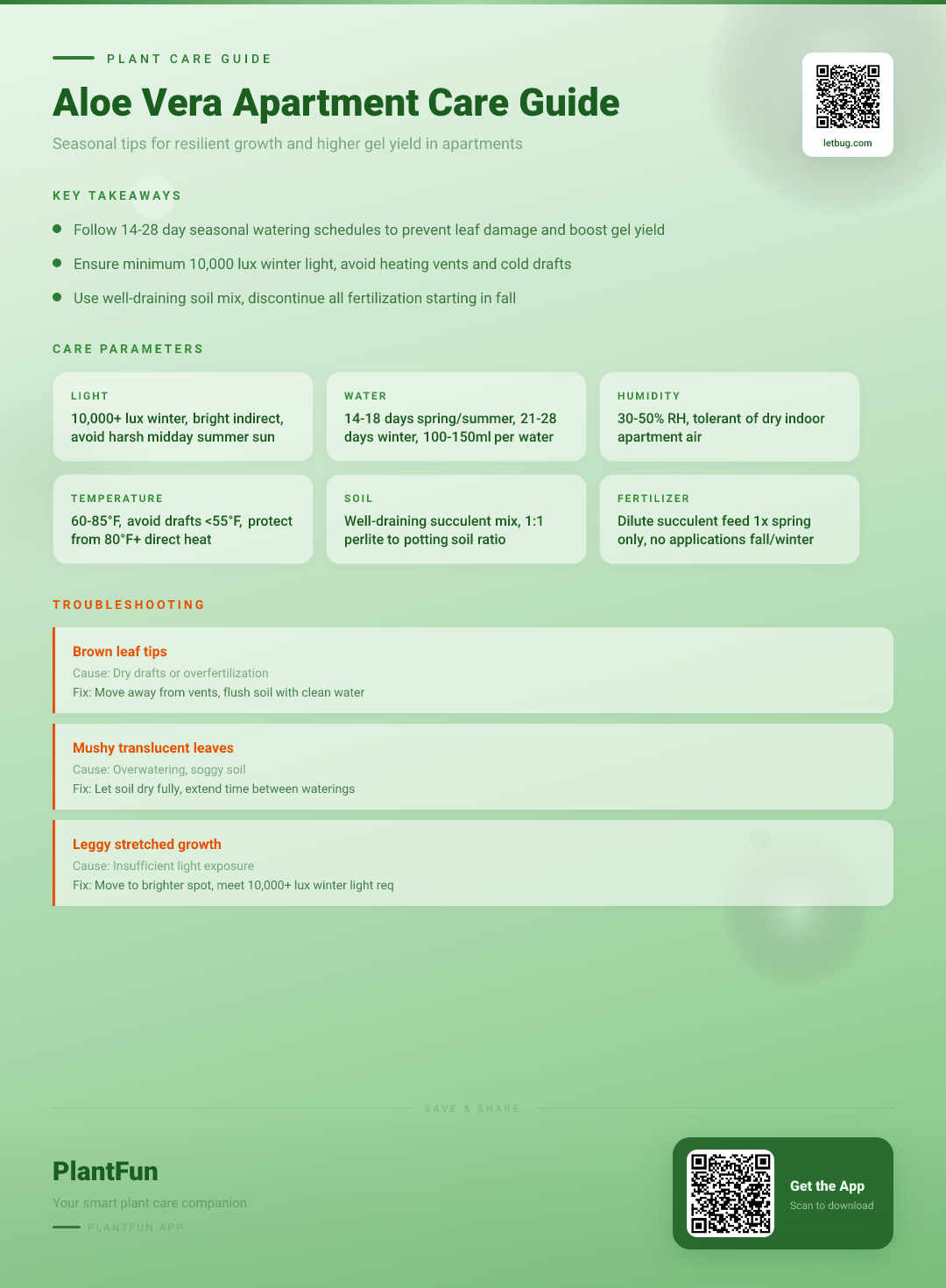
Key Takeaways
- Check soil moisture before watering — overwatering is the #1 killer of houseplants.
- Ensure your plant gets the right amount of light for its species.
- Be patient with recovery — most plants need 2–4 weeks to bounce back.
Quick Care Card: At-a-glance measurable thresholds for light, water, humidity, temperature, and soil mix for apartment-grown aloe vera
| Category | Measurable Threshold for Apartment Aloe |
|---|---|
| Light | 6+ hours of bright indirect light daily; minimum 10,000 lux in winter (Plant Science Archives, 2019) |
| Water | Seasonal frequency: 14-28 days; 100-150ml per watering in summer; only water when soil 2 inches deep is completely dry |
| Humidity | 30-50% (matches standard apartment humidity, no humidifier needed) |
| Temperature | 55-80°F; avoid exposure to temps below 50°F |
| Soil | 2 parts cactus mix + 1 part perlite + 1 part coarse horticultural sand (Derbe, 2015) |
| Fertilizer | 1x per year in spring only; half-strength diluted 10-10-10 cactus fertilizer |
| Toxicity | Toxic to dogs and cats if ingested (ASPCA, 2026) |
Why Apartment Aloe Care Is Unique: Breakdown of common stressors including forced air, drafty windows, and limited window space that generic guides ignore
Most generic aloe vera care guides assume access to outdoor space or full-sun sunrooms, which are rare in standard 1-bed and studio apartments. Aloe vera apartment care requires adjusting for unique stressors: forced heating and cooling systems that dry out leaf tissue and disrupt soil moisture levels, drafty old window sills that cause sudden temperature drops, and limited south-facing window space that makes meeting light requirements tricky. This guide is tailored explicitly to these conditions, eliminating the guesswork that leads to stressed, browning aloe plants for many first-time owners.
Step-by-Step Initial Setup for New Aloe Plants: Pot size recommendations, drainage requirements, ideal soil mix ratio, and first placement tips for small apartments
Follow these steps to set up your new aloe for success, even in tight spaces:
- Pot selection: Choose a pot 1-2 inches wider than the plant’s root ball, no more than 6 inches deep to save counter or sill space. The pot must have at least one ½-inch drainage hole; skip attached saucers that trap standing water to support aloe vera root rot prevention. If you have pets, place the pot on a high out-of-reach shelf per ASPCA toxicity guidelines (ASPCA, 2026).
- Soil mix: Use the 2:1:1 blend of cactus mix, perlite, and coarse horticultural sand referenced in the quick care card, which is the best soil for aloe vera indoors because it drains quickly and mimics the sandy, well-draining soil aloe grows in naturally (Derbe, 2015).
- First placement: Position the plant 1-2 feet away from a south or east-facing window for the first 2 weeks to acclimate it to indoor light. If you only have north-facing windows, add a 10W full-spectrum grow light 12 inches above the plant, run 8 hours daily, to meet aloe vera light requirements indoors.
Spring Aloe Vera Care Routine: Watering frequency (every 14-18 days), repotting cues, and light adjustment as daylight hours lengthen
As daylight hours increase in spring, aloe enters its active growth phase:
- Water every 14-18 days, only after confirming the soil 2 inches deep is completely dry (stick your finger in to test, no moisture should cling to your skin).
- Repot only if you see roots growing out of the drainage holes or the plant is pushing itself up out of the pot; aloe prefers slightly root-bound conditions, so repotting more than once every 2-3 years is unnecessary.
- Gradually move the plant 6 inches closer to the window each week as daylight increases to support new growth without shocking the plant. This is also the only time of year you should fertilize, using half-strength cactus fertilizer to avoid burning the roots.
Summer Aloe Vera Care Routine: 100-150ml watering volume guidance, sunburn prevention for south-facing sills, and heat protection tips for 80°F+ days
Aloe vera summer watering adjustments are key to avoiding sun damage and overwatering:
- When you water, use exactly 100-150ml of room temperature water per 6-inch pot, pouring directly onto the soil (avoid wetting the leaves).
- Myth vs Reality: Many generic guides say aloe needs full direct sun all day, but this only applies to outdoor aloe in mild climates. In apartments, unfiltered south-facing midday sun (12pm-4pm) will cause brown sunburn patches on leaves, so hang a sheer curtain between the aloe and the window for protection.
- If indoor temperatures rise above 80°F, move the plant 2 feet away from the window to avoid heat stress; do not increase watering frequency to compensate for heat, as aloe stores water in its leaves to survive high temps.
Fall Aloe Vera Care Routine: Gradual watering reduction, fertilization stop, and preparation for indoor heating system activation
As daylight shortens in fall, aloe slows its growth to prepare for winter:
- Gradually reduce watering frequency: add 3-4 days between waterings each week as daylight hours decrease, to avoid overwatering during slower growth.
- Stop fertilizing completely; any added nutrients will force weak leggy growth during low-light winter months.
- When your building activates its forced heating system, move the aloe at least 3 feet away from all heating vents to avoid dry brown leaf tips from forced air exposure.
Winter Aloe Vera Care Routine: Minimum 10,000 lux light requirement, reduced 21-28 day watering schedule, and cold draft protection to avoid leaf damage
Aloe vera winter care is the most common pain point for apartment owners, as low light and dry air cause stress:
- Meet the minimum 10,000 lux light requirement (Plant Science Archives, 2019): if you don’t have a light meter, this equals 6+ hours of bright indirect light from a south-facing window daily. If you don’t have access to this light, run a full-spectrum grow light 10 hours a day 12 inches above the plant.
- Water only every 21-28 days, using room temperature water to avoid shocking the cold-sensitive roots. Only water if the soil 2 inches deep is completely dry, and pour out any excess water that drains into the saucer immediately.
- Keep the plant at least 6 inches away from drafty window edges where nighttime temps drop below 50°F; cold exposure will cause soft, discolored leaf damage.
Common Apartment Aloe Mistakes to Avoid: Overwatering, placing near heating vents, using moisture-retentive soil, and insufficient light exposure
- Mistake: Overwatering on a fixed schedule without testing soil moisture What happens: Mushy roots, mushy leaves, and fatal root rot that can kill the plant in as little as 2 weeks Instead: Always do the 2-inch finger test before watering; if any moisture clings to your skin, wait 3 more days and test again
- Mistake: Placing aloe directly next to heating or AC vents What happens: Dry crispy brown leaf tips, stunted growth, and reduced gel production Instead: Keep aloe at least 3 feet away from all forced air vents, and use a small side table to raise it if needed to avoid draft exposure
- Mistake: Using regular moisture-retentive houseplant soil What happens: Soil stays wet for weeks after watering, leading to root rot even if you only water infrequently Instead: Use the 2:1:1 cactus mix, perlite, and sand blend, the best soil for aloe vera indoors for fast drainage
- Mistake: Keeping aloe in a dark corner far from windows What happens: Long, thin leggy growth, pale leaves, and almost no gel production Instead: Place aloe within 2 feet of a bright window, or use a grow light to meet its minimum light requirement
Troubleshooting Common Symptoms: Step-by-step fixes for brown tips, mushy leaves, leggy growth, and poor gel production
Brown Tips
Symptom: Dry, crispy light brown tips on otherwise firm green leaves
Likely cause: Exposure to forced air from heating/AC vents, or extended low-humidity conditions
Fix:
- Move the plant at least 3 feet away from all forced air vents
- Wipe leaves with a damp microfiber cloth once a week to remove dust and add small amounts of moisture directly to leaf tissue
Mushy Leaves
Symptom: Soft, translucent, squishy leaves that fall off easily, sometimes with a sour rotten smell coming from the soil
Likely cause: Overwatering leading to early stage root rot, or using soil that retains too much moisture
Fix:
- Tip the plant out of its pot, cut away all black, mushy roots with sterile scissors, leaving only firm white roots intact
- Repot in fresh, dry 2:1:1 cactus soil mix, and do not water for 10 days after repotting to let roots heal
Leggy Growth
Symptom: Long, thin stretched-out leaves, visible gaps between leaf nodes, and the plant leans heavily toward the nearest window
Likely cause: Insufficient light exposure over 4+ weeks, forcing the plant to stretch toward light sources
Fix:
- Move the plant to a spot with 6+ hours of bright indirect light daily, or add a grow light set to run 8 hours a day 12 inches above the plant
- Prune the top 1/3 of stretched leaves with sterile scissors to encourage new, compact growth at the base of the plant
Poor Gel Production
Symptom: Thin, flat leaves that don’t plump up after watering, and very little clear gel inside when you cut a leaf open
Likely cause: Inconsistent watering, insufficient light, or nutrient-depleted soil
Fix:
- Follow the seasonal aloe vera watering schedule closely, always waiting for the soil to dry completely between waterings
- Ensure the plant meets the 10,000 lux minimum light requirement in winter (Plant Science Archives, 2019)
- Fertilize once per spring with half-strength cactus fertilizer to replenish soil nutrients
Voice Search Optimized FAQ: Answers to conversational, first-person questions from apartment aloe owners
Q: Can I keep aloe vera in a north facing apartment? A: Yes, but you will need to supplement with artificial light to meet its needs. North-facing windows only provide 2,000-5,000 lux of light, which is less than half of the 10,000 lux minimum aloe requires. Use a 10W full-spectrum grow light placed 12 inches above the plant, run 8 hours a day, to keep it healthy.
Q: How often to water aloe vera in my small apartment? A: It depends on the season: spring every 14-18 days, summer every 10-14 days with 100-150ml of water, fall every 18-21 days, and winter every 21-28 days. Always do the 2-inch finger test before watering to confirm the soil is completely dry, as apartment temperatures and humidity levels can vary widely.
Q: Is aloe vera safe around my cat and dog? A: No, ASPCA classifies aloe vera as toxic to dogs, cats, and horses if ingested, as it contains saponins that cause vomiting, diarrhea, and lethargy (ASPCA, 2026). Keep your aloe on a high windowsill or floating shelf that your pets can’t reach to avoid accidental ingestion.
Q: How to get aloe vera to produce more gel? A: First, ensure it gets 6+ hours of bright indirect light daily, meets the 10,000 lux minimum light requirement in winter, and follows the seasonal watering schedule. Fertilize once a year in spring with half-strength cactus fertilizer, and avoid repotting more than once every 2-3 years, as aloe produces more gel when it is slightly root-bound.
Printable Seasonal Care Cheat Sheet: 1-page quick reference for year-round aloe care in apartment settings
Print this and tape it near your aloe plant for fast, no-guesswork reference:
- Spring: Water every 14-18 days, repot only if roots are growing out drainage holes, move closer to the window gradually as daylight increases, fertilize once with half-strength cactus fertilizer
- Summer: Water with 100-150ml when soil is completely dry, use a sheer curtain to block midday sun on south-facing sills, move 2 feet away from the window if indoor temps exceed 80°F
- Fall: Add 3-4 days between waterings each week as daylight shortens, stop fertilizing completely, move 3 feet away from heating vents when your building turns on the heat
- Winter: Water every 21-28 days with room-temperature water, ensure 6+ hours of bright light or use a grow light to hit the 10,000 lux minimum, keep 6 inches away from cold drafty window edges
References: Peer-reviewed horticultural sources on aloe vera indoor growth requirements and stress response
- Plant Science Archives. (2019). Aloe vera plant products as antimicrobial agents. Plant Science Archives. https://doi.org/10.33680/plsa.2019.016. Accessed 2026-03-04.
- Derbe, T. (2015). Spectroscopic Investigation of Metal Level in Aloe Vera Plant, and the Soil Where the Aloe Vera Grows: Arba Minch, Southern Ethiopia. Modern Chemistry. https://doi.org/10.11648/j.mc.20150301.11. Accessed 2026-03-04.
- American Society for the Prevention of Cruelty to Animals. (2026). Toxic and Non-Toxic Plants List — ASPCA. https://www.aspca.org/pet-care/animal-poison-control/toxic-and-non-toxic-plants. Accessed 2026-03-04.
Optional Helper: Plantfun.App
Plantfun.App identifies your plants by photo, diagnoses pests and diseases with clear fixes, and creates personalised watering and light schedules that adapt to your home conditions — a handy companion for putting this guide into daily practice.
Found an error or have suggestions? We'd love your feedback.
Need help identifying this problem?
Get instant identification, personalized care schedules, and effective pest treatment plans directly on your phone.
Sponsored • We may earn a commission from app downloads
Related Guides
The Complete Aloe Vera Care Guide for Small Low-Light Apartments: Resilient Growth On A Budget
Grow lush, gel-producing aloe vera in your apartment without expensive supplies. Get exact light, water, and soil parameters plus a free care checklist for year-round resilient growth.
Care GuideAloe Vera In Typical Small Apartments: The Only Resilient Growth Checklist You’ll Ever Need
Skip generic aloe care advice. Get exact light, water, and soil thresholds, plus a printable weekly checklist to keep your aloe vera thriving in any standard apartment.
Care GuideAloe Vera in Small Urban Apartments: The Budget Care Checklist for Resilient Growth
Grow plump, resilient aloe vera in your small urban apartment without spending extra on fancy plant supplies. Grab our free printable checklist with exact light, water, and soil parameters for hassle-free low-effort care.
Pest ControlAnts on Plants: What They Mean and What to Do
Ants usually aren't eating your plant. They are farming other pests.