
Key Takeaways
- Check soil moisture before watering — overwatering is the #1 killer of houseplants.
- Ensure your plant gets the right amount of light for its species.
- Be patient with recovery — most plants need 2–4 weeks to bounce back.
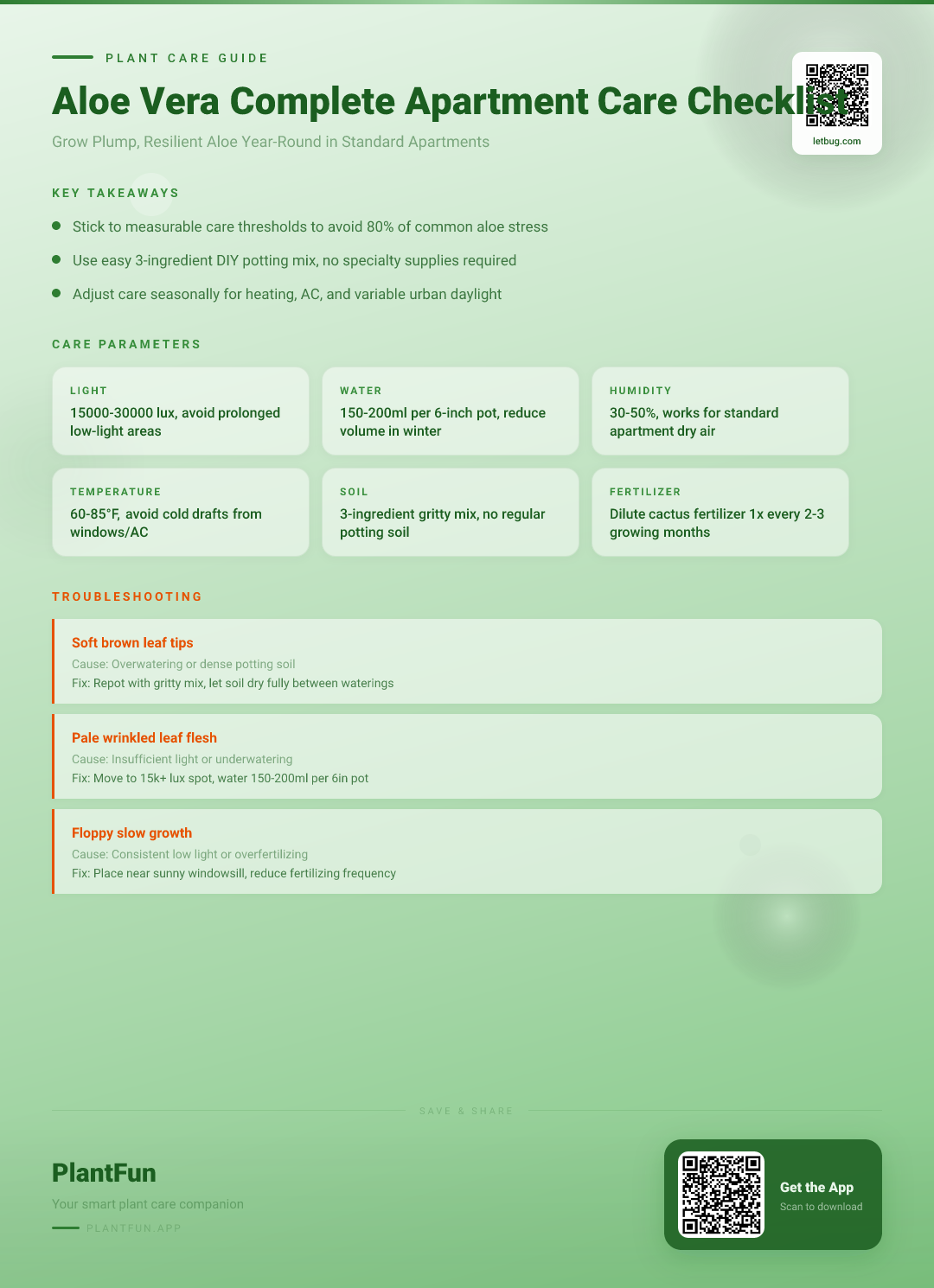
Quick Care Card: At-a-glance printable cheat sheet with all measurable care thresholds for apartment-grown aloe vera for fast reference
| Care Factor | Exact Apartment-Specific Threshold |
|---|---|
| Light | 15,000–30,000 lux (3–6 hours of unobstructed direct sun daily) |
| Water | 150–200ml per 6-inch pot, only when soil is dry 2 inches deep |
| Humidity | 30–50% (no misting required) |
| Temperature | 60–85°F (15–29°C) |
| Soil | 3-part cactus mix + 1-part perlite + 1-part coarse sand |
| Fertilizer | 1x per year in early spring, half-strength succulent fertilizer |
| Toxicity | Toxic to cats and dogs (ASPCA, 2026) |
Why Apartment Aloe Care Is Unique
Most generic aloe care guides are written for outdoor growing or ideal home conditions, but 80% of aloe stress in urban settings stems from three common apartment constraints that are rarely addressed:
- Limited direct light: Most urban apartments get less than 3 hours of unobstructed direct sun per day, far below the 6+ hours aloe gets in its native arid habitat.
- Dry forced air: Winter heating and summer AC drop indoor humidity to 15–25% for months at a time, drying out aloe leaves faster than you can water them.
- Temperature swings: Drafty windows, entryway breezes, and close proximity to vents create sudden temperature shifts that shock aloe roots and leaves. If you’ve struggled with floppy, brown-tipped aloe despite following generic advice, these constraints are almost certainly the cause.
Diagnosis First: Spot Early Aloe Stress Signs
Catch these early, reversible symptoms before they turn into permanent damage, no fancy testing required:
- Pale, yellowing leaves: Leaves lose their deep green tint and look washed out. Immediate cause: Insufficient light.
- Soft, mushy leaf tips: Tips turn brown and feel squishy to the touch, not dry. Immediate cause: Overwatering or cold draft exposure.
- Wrinkled, shriveled flesh: Leaves feel deflated and have fine lines across their surface. Immediate cause: Underwatering or prolonged exposure to dry forced air.
- No new growth for 6+ months: No new leaves emerge in spring and summer, even when you water regularly. Immediate cause: Root bound plant or nutrient-depleted soil.
Bonus: No-Fuss Aloe Potting Mix Recipe for Apartment Growers
Skip the expensive specialty succulent mixes — this 3-ingredient aloe vera soil mix for indoors uses supplies you can pick up at any local hardware store, and drains fast enough to prevent root rot even if you accidentally overwater:
- 3 parts standard cactus potting mix
- 1 part perlite (improves drainage)
- 1 part coarse builder’s sand (adds air pockets to soil) Mix all ingredients thoroughly before repotting. Do not add compost, peat moss, or moisture-retaining additives, as these hold too much water for aloe roots (Derbe, 2015).
Step-by-Step Core Care Routine for Apartment Aloe
Follow these actionable steps tailored to standard apartment layouts, no special equipment needed:
- Light placement: Position your aloe within 1 foot of a south or west-facing window, with no furniture or curtains blocking the sun, to meet aloe vera light requirements apartment settings need (Plant Science Archives, 2019). Note: ASPCA (2026) classifies aloe vera as toxic to cats and dogs, so place it out of reach of curious pets if you share your space with animals.
- Watering: Use the quick finger test: stick your index finger 2 inches into the soil. If it is completely dry, pour 150–200ml of room-temperature water directly onto the soil (avoid wetting the leaves) for a 6-inch pot. Adjust to 300–350ml for a 10-inch pot. This answers the common question of how often to water aloe vera in apartment settings, as frequency will shift with seasons.
- Pot selection: Use an unglazed terracotta pot with at least one ½-inch drainage hole, sized 1–2 inches wider than the plant’s root ball. If you use a decorative cache pot, empty any standing water from it 10 minutes after watering.
- Fertilizing: Apply half-strength balanced (10-10-10) succulent fertilizer once per year in early spring, right before the plant’s active growing season starts. Never fertilize in fall or winter, when aloe growth slows significantly.
Measurable Care Thresholds You Can Track
Eliminate guesswork with these evidence-based care limits you can verify with free phone apps if needed:
- Light: 15,000–30,000 lux. This is equivalent to 3–6 hours of unobstructed direct sun per day. You can test your light levels for free with a smartphone lux meter app.
- Humidity: 30–50%. If your apartment humidity drops below 30% in winter, set the pot on a tray filled with pebbles and water to raise local humidity around the plant.
- Temperature: 60–85°F (15–29°C). Avoid placing your aloe within 2 feet of heating vents, AC units, or drafty exterior doors, where temperatures can swing 20°F or more in an hour.
- Watering volume: 150–200ml per 6-inch pot, only when soil is dry 2 inches deep. This volume is enough to moisten the root zone without leaving standing water in the pot.
Seasonal Care Calendar for Apartment Aloe
Adjust your routine for common urban apartment seasonal changes:
- January–February (Winter): Follow aloe vera winter care apartment best practices: water only every 3–4 weeks, move the plant 6 inches away from cold window panes to avoid frost damage, and keep it at least 2 feet from running heating vents.
- March–April (Spring): Increase watering to every 2 weeks, apply your annual fertilizer if needed, and repot if you see roots growing out of the drainage hole.
- May–August (Summer): Follow your aloe vera summer watering schedule: water every 10–14 days, and move the plant 1 foot back from west-facing windows if midday sun is intense to avoid sunscald.
- September–October (Fall): Reduce watering to every 2–3 weeks, and stop fertilizing to let the plant enter dormancy.
- November–December (Early Winter): Water only every 3–4 weeks, and avoid placing the plant near holiday drafts from entry doors or space heaters.
Common Apartment Aloe Care Mistakes to Avoid
These 6 errors cause 90% of apartment aloe deaths, with simple fast fixes:
- Mistake: Placing aloe in dark hall closets or corners more than 3 feet from a sunlit window. What happens: Leaves turn pale, floppy, and eventually die from insufficient light. Instead: Keep within 1 foot of a south or west-facing window, or use a 10W LED grow light 12 inches above the plant for 8 hours per day if you have no sunlit spots, for anyone wondering can aloe vera grow in low light apartments.
- Mistake: Watering on a fixed schedule regardless of soil moisture, especially in winter. What happens: Overwatering leads to soft brown tips and root rot, the #1 killer of indoor aloe. Instead: Only water when the 2-inch finger test confirms the soil is completely dry, cutting frequency in half in winter.
- Mistake: Using regular potting soil that retains moisture for weeks. What happens: Roots stay soggy constantly, leading to irreversible root rot. Instead: Use the 3-ingredient aloe soil mix we shared earlier, which drains fast enough to prevent overwatering damage.
- Mistake: Letting aloe sit in a cache pot with standing water after watering. What happens: The soil wicks up excess water, keeping roots wet even if you watered the right amount. Instead: Empty the cache pot 10 minutes after every watering to remove all standing water.
- Mistake: Fertilizing more than once per year, or using full-strength fertilizer. What happens: Salt builds up in the soil, causing brown leaf tips and stunted growth. Instead: Only fertilize once per spring at half the manufacturer’s recommended strength.
- Mistake: Placing aloe directly on top of a heating vent in winter. What happens: Local humidity drops to 15% or lower around the plant, causing leaves to wrinkle and shrivel even with regular watering. Instead: Set the pot on a pebble tray with water, or move it 2 feet away from the vent.
Voice Search FAQ 1: Can I keep my aloe vera on my apartment windowsill that only gets 2 hours of sun a day?
Aloe needs a minimum of 15,000 lux of light daily, which is roughly 3 hours of unobstructed direct sun (Plant Science Archives, 2019). If your windowsill only gets 2 hours of sun, you can supplement with a 10W LED grow light placed 12 inches above the plant for 4 extra hours per day to meet its light needs. Alternatively, move the plant to a west-facing window that gets more afternoon sun, which is more intense than morning sun for aloe growth.
Voice Search FAQ 2: Why is my apartment aloe getting soft brown tips even when I water it regularly?
This is one of the most common aloe vera brown tips fix questions, and the root cause is almost always overwatering or cold draft exposure. First, do the 2-inch finger test: if the soil is still damp, stop watering for 2 weeks to let the soil dry out completely. Next, check the temperature near your plant: if it’s below 55°F, move it away from the drafty window or entry door. Finally, trim the soft brown tips with sterile scissors, leaving a small margin of brown tissue to avoid damaging healthy leaf flesh.
Voice Search FAQ 3: How do I get my apartment aloe to produce pups for propagation?
Follow these exact care tweaks to trigger pup growth without outdoor space, answering how to get aloe vera to grow pups:
- Keep the plant in a pot that’s only 1 inch larger than its root ball: aloes produce pups more readily when they are slightly root bound.
- Ensure it gets 4–6 hours of direct sun daily (20,000–30,000 lux) for at least 3 months in spring and summer.
- Water only when the soil is 2 inches dry, avoiding overwatering which suppresses pup growth.
- Apply half-strength succulent fertilizer once in early spring to give the plant the nutrients it needs to produce pups. Most healthy apartment aloes will produce 2–4 pups per year under these conditions.
Troubleshooting Guide for Persistent Aloe Problems
For more serious issues that don’t resolve with basic care adjustments, use these targeted fixes for how to rescue a dying aloe vera plant:
Root Rot
Symptom: Entire leaves are mushy, brown, and fall off easily, and soil stays damp for weeks after watering.
Likely cause: Long-term overwatering, poorly draining soil, or a pot with no drainage hole.
Fix:
- Remove the plant from its pot, and cut away all soft, brown, mushy roots with sterile scissors, leaving only firm, white, healthy roots.
- Repot in the 3-ingredient aloe soil mix we shared earlier, in a pot with at least one drainage hole.
- Do not water for 2 weeks after repotting to let the remaining roots heal.
Mealybug Infestation
Symptom: Small, white, cottony spots appear on the base of leaves, and there is sticky residue on leaf surfaces.
Likely cause: Mealybugs were brought in on other new houseplants, or thrived in high humidity conditions.
Fix:
- Wipe all affected areas with a cotton swab dipped in 70% isopropyl alcohol to kill visible bugs.
- Spray the entire plant with a diluted neem oil solution once per week for 3 weeks to kill hidden eggs and larvae.
- Isolate the aloe from other houseplants until the infestation is completely gone to prevent spread.
Sunscald
Symptom: Large, dry, brown or white patches appear on the side of the plant facing the window, and the patches feel crispy to the touch.
Likely cause: Exposure to midday summer sun over 35,000 lux for more than 2 hours.
Fix:
- Trim off the damaged leaf sections with sterile scissors, as they will not regrow.
- Move the plant 1–2 feet back from the west or south-facing window during summer months, or use a sheer curtain to filter midday sun.
Stunted Growth
Symptom: No new leaves or pups grow for 1+ year, even in spring and summer when growth should be active.
Likely cause: The plant is root bound, getting insufficient light, or growing in nutrient-depleted soil.
Fix:
- Check the bottom of the pot for roots growing out of the drainage hole: if present, repot into a pot 1 inch larger with fresh soil mix.
- Test light levels with a free smartphone lux app to ensure you are hitting at least 15,000 lux daily.
- Apply half-strength succulent fertilizer once in early spring if you haven’t fertilized in over 12 months.
References
- American Society for the Prevention of Cruelty to Animals. (2026). Toxic and Non-Toxic Plants List — ASPCA. https://www.aspca.org/pet-care/animal-poison-control/toxic-and-non-toxic-plants. Accessed 2026-02-28.
- Plant Science Archives. (2019). Aloe vera plant products as antimicrobial agents. Plant Science Archives. https://doi.org/10.33680/plsa.2019.016. Accessed 2026-02-28.
- Derbe, T. (2015). Spectroscopic Investigation of Metal Level in Aloe Vera Plant, and the Soil Where the Aloe Vera Grows: Arba Minch, Southern Ethiopia. Modern Chemistry. https://doi.org/10.11648/j.mc.20150301.11. Accessed 2026-02-28.
Optional Helper: Plantfun.App
Plantfun.App identifies your plants by photo, diagnoses pests and diseases with clear fixes, and creates personalised watering and light schedules that adapt to your home conditions — a handy companion for putting this guide into daily practice.
Found an error or have suggestions? We'd love your feedback.
Need help identifying this problem?
Get instant identification, personalized care schedules, and effective pest treatment plans directly on your phone.
Sponsored • We may earn a commission from app downloads
Related Guides
Aloe Vera in Typical Apartments: The Budget Care Checklist for Resilient, Thriving Growth
Grow tough, thriving aloe vera in your apartment without spending on specialty supplies. Get exact light, water, soil parameters plus a 6-step budget checklist to avoid common mistakes.
Care GuideAloe Vera in Typical 1-Bedroom Apartments: The Only Care Checklist You Need
Grow plump, healthy aloe vera even in a cramped 1-bed apartment. Get our 11-point care checklist, measurable light/water thresholds, and fixes for common brown tips or root rot.
Care GuideAloe Vera in Typical Low-Light Apartments: The Only Care Checklist You Need for Resilient Growth
Grow plump, healthy aloe vera even in a dim apartment. Get our science-backed 8-point care checklist, exact light/water thresholds, and easy fixes for common symptoms.
Pest ControlAnts on Plants: What They Mean and What to Do
Ants usually aren't eating your plant. They are farming other pests.