
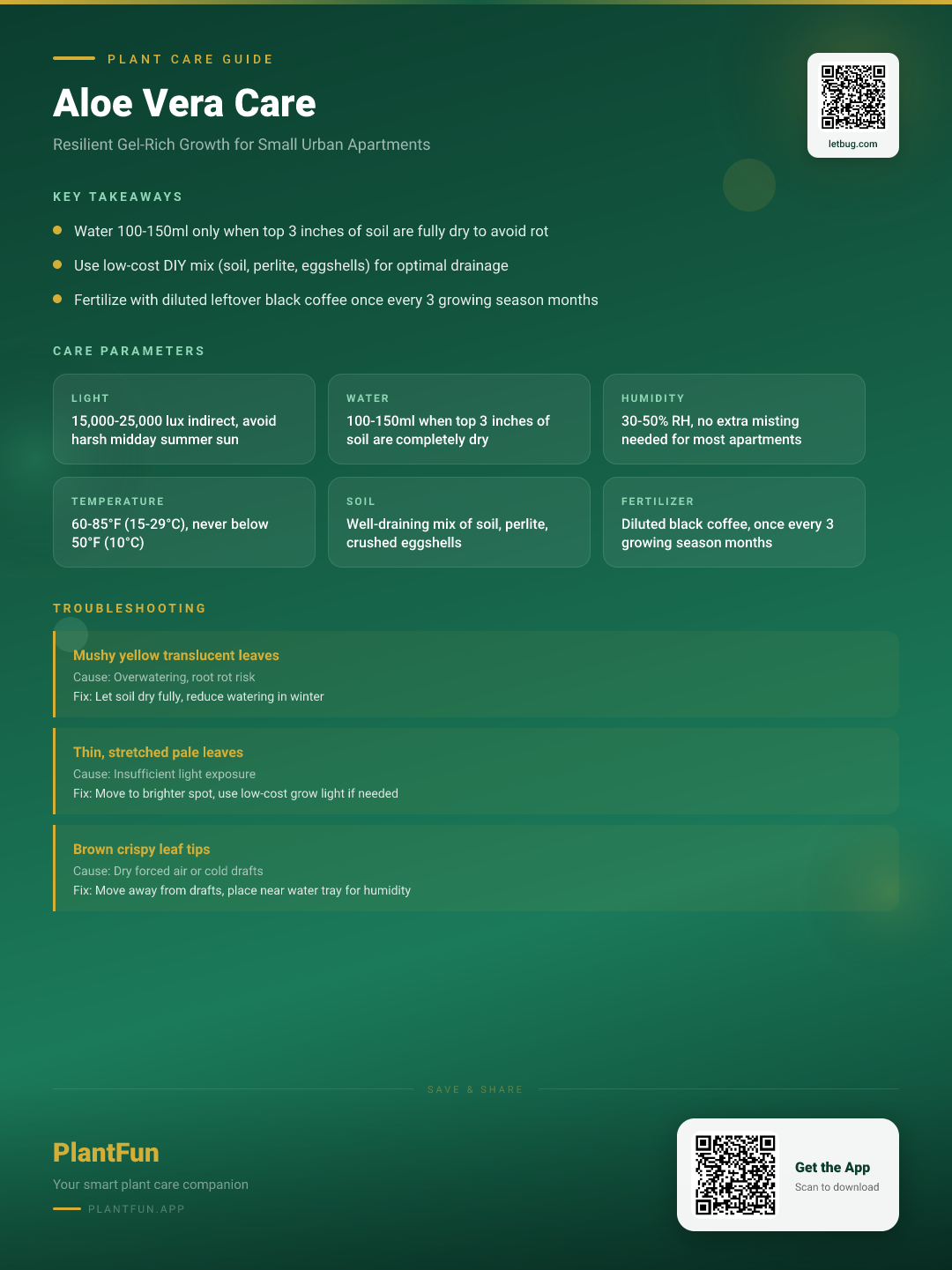
Key Takeaways
- Check soil moisture before watering — overwatering is the #1 killer of houseplants.
- Ensure your plant gets the right amount of light for its species.
- Be patient with recovery — most plants need 2–4 weeks to bounce back.
If you’ve struggled to keep aloe vera alive in a cramped, dark rental apartment, this checklist is for you. We adapted 1920s home economics succulent care hacks for modern apartment constraints, with zero fancy supplies or expensive products required. Every step includes measurable, actionable parameters so you can grow plump, gel-rich aloe without guesswork.
Quick Care Card: At-a-glance measurable thresholds for apartment-grown aloe vera, no extra fluff
| Parameter | Exact Threshold for Apartment Growth |
|---|---|
| Light | 15,000-25,000 lux, 4-6 hours of bright indirect light daily |
| Water | 100-150ml only when top 3 inches of soil are completely dry |
| Humidity | 30-50% relative humidity |
| Temperature | 60-85°F (15-29°C) preferred, never below 50°F (10°C) |
| Soil | 1:1:1 mix of regular potting soil, perlite, crushed eggshells |
| Fertilizer | Diluted black coffee (1:3 coffee to water) once every 3 months growing season |
| Toxicity | Non-toxic to humans, toxic to cats, dogs, horses (ASPCA, 2026) |
Why This Guide Works for Small Urban Apartments
Common apartment constraints—dry forced air, limited window space, irregular renter schedules, no permission to drill for grow lights—are the top reasons aloe plants fail for urban growers. Our budget aloe vera care checklist solves all these pain points with zero-cost or low-cost hacks using household items you already own. Myth vs Reality: You don’t need specialty succulent supplies to grow healthy aloe; 1920s home gardeners grew aloe exclusively with kitchen scraps and basic household items, and our updated methods are tailored to modern apartment living. If you’re looking for more low-maintenance plants for your space, check our curated list of the best low-light indoor plants for renters (https://letbug.com/best-indoor-plants-for-low-light-apartments).
Step 1: Optimal Light Placement for Apartment Aloe
Aloe requires 15,000-25,000 lux of light daily to produce thick, gel-rich leaves (Plant Science Archives, 2019). Follow these placement rules for your apartment:
- East-facing windows (ideal): Place directly on the sill for 4-6 hours of soft morning light, no risk of scorch.
- South-facing windows: Place 2-3 feet away from the sill to avoid harsh midday sun that causes brown leaf marks.
- North-facing windows or dark rooms: Supplement with a no-cost grow light alternative: use a 10W 6500K daylight LED desk lamp you already own, placed 12 inches above the plant, run for 8 hours daily. This answers the common question: can aloe vera survive in dark apartment? Yes, with minimal supplemental light.
Step 2: Budget Watering Routine That Prevents Rot
Overwatering is the #1 cause of aloe death for apartment growers, so we’ve removed all guesswork with measurable rules:
- Do a quick soil test every 2 weeks: Stick your index finger 3 inches deep into the soil. If no moisture sticks to your skin, it’s time to water.
- Apply exactly 100-150ml of water directly to the soil (avoid getting leaves wet). Use a repurposed plastic bottle with holes poked in the cap if you don’t own a watering can.
- Adjust for seasons: For aloe vera summer watering, you’ll water every 2-3 weeks. For aloe vera winter care, reduce watering to every 3-4 weeks when the plant is dormant. This routine prevents the mushy leaves that come with overwatering, a common complaint for new aloe owners.
Step 3: 3-Ingredient DIY Aloe Potting Mix Recipe
You don’t need expensive specialty succulent soil for healthy aloe. Our aloe vera soil recipe costs under $5 total, and uses items you likely already have at home:
- 1 part regular all-purpose potting soil
- 1 part perlite (available for $2 at most dollar stores)
- 1 part crushed household eggshells (rinsed, baked at 200°F for 10 minutes, then crushed into small pieces) Mix all ingredients thoroughly. The perlite improves drainage, while eggshells add calcium that supports healthy root growth (Derbe, 2015). A common question: can I use regular potting soil for aloe vera? Only if you amend it with perlite and eggshells, as straight potting soil holds too much moisture and causes root rot. If you’re new to moving your aloe to new soil, follow our step-by-step guide to repotting succulents without damaging roots (https://letbug.com/how-to-repot-succulents).
Step 4: Temperature & Humidity Adjustments for Apartments
Aloe tolerates most apartment conditions, but follow these measurable thresholds for optimal growth:
- Keep temperatures between 60-85°F (15-29°C) at all times, never expose to temperatures below 50°F (10°C). Avoid placing aloe near heating vents, AC units, or drafty windows.
- Aim for 30-50% relative humidity, which is standard for most apartments. If your heating system dries air out below 30% in winter, use a no-cost fix: place the aloe pot on a tray filled with pebbles and water (make sure the pot is not sitting directly in water) or group it with other houseplants to raise ambient humidity.
Seasonal Care Calendar for Apartment Aloe
Adjust your care routine month-by-month for consistent growth:
- January-February (Winter): Water every 3-4 weeks, skip fertilizer, keep away from drafty windows.
- March-May (Spring): Increase watering to every 2-3 weeks, apply first fertilizer of the year, repot if roots are growing out of drainage holes.
- June-August (Summer): Water every 2 weeks, move south-facing aloe away from sills after 12pm to avoid leaf scorch, mist leaves once weekly if humidity is below 30%.
- September-November (Fall): Reduce watering gradually, stop fertilizer after October, move plants indoors if you’ve placed them on a balcony for summer.
No-Cost Fertilizing Tips for Aloe Growth
You don’t need expensive specialty aloe fertilizer to boost growth. This no-cost hack answers the question: how to make aloe grow faster? Dilute leftover unsweetened black coffee with 3 parts water (1 part coffee, 3 parts water) and apply directly to the soil once every 3 months during the growing season (spring, summer, early fall). The nitrogen and potassium in coffee support healthy leaf growth and gel production. For more kitchen scrap fertilizer hacks, see our guide to DIY plant fertilizer using common household items (https://letbug.com/how-to-make-diy-plant-fertilizer-with-household-items).
5 Common Apartment Aloe Mistakes to Avoid
- Mistake: Overwatering on a fixed schedule instead of checking soil moisture. What happens: Root rot, mushy yellow leaves, plant death. Instead: Check the top 3 inches of soil every 2 weeks, only water 100-150ml when completely dry.
- Mistake: Planting aloe in an oversized pot to “give it room to grow”. What happens: Excess soil holds extra moisture, leading to root rot. Instead: Use a pot only 1-2 inches larger than the root ball, with drainage holes.
- Mistake: Placing aloe directly on a south-facing windowsill in summer. What happens: Brown scorch marks on leaves, stunted growth. Instead: Try this aloe vera brown leaves fix: move the plant 2-3 feet away from the south sill after 12pm, or place a sheer curtain between the plant and window.
- Mistake: Using straight regular potting soil without amendments. What happens: Poor drainage, compacted soil, root suffocation. Instead: Amend regular soil with equal parts perlite and crushed eggshells for optimal drainage.
- Mistake: Keeping aloe in a dark bathroom or corner with no supplemental light. What happens: Leggy growth, thin leaves, no gel production. Instead: Supplement with a regular 10W 6500K desk lamp 8 hours a day, or move to an east-facing window.
Voice Search FAQ
How do I keep my aloe vera alive in a dark apartment?
Aloe can survive in low light if you supplement with a regular 10W 6500K daylight LED desk lamp placed 12 inches above the plant, run for 8 hours daily. Avoid overwatering in low light, as the plant uses less moisture, so water only when the top 4 inches of soil are dry.
Can I use regular potting soil for my aloe vera?
You can use regular potting soil if you amend it with equal parts perlite and crushed eggshells to improve drainage. Straight regular potting soil holds too much moisture, leading to root rot, so never use it unamended for aloe.
Why are my aloe vera leaves getting mushy?
Mushy aloe leaves are almost always caused by overwatering or poorly draining soil. First, stop watering immediately, then check the roots: if they are brown and soft, trim the rotten roots, repot in fresh amended soil, and wait 2 weeks before watering again. For more detailed repair steps, read our full guide to fixing succulent root rot in 3 easy steps (https://letbug.com/succulent-root-rot-fix).
Understanding the Science Behind This Checklist
- Aloe vera requires well-draining, calcium-rich soil to support healthy root growth and nutrient uptake (Derbe, 2015).
- Adequate light exposure (15,000-25,000 lux) ensures maximum production of the antimicrobial compounds that make aloe gel useful for minor burns and skin irritation (Plant Science Archives, 2019).
- Aloe vera is classified as toxic to cats, dogs, and horses when ingested, as it contains saponins that can cause vomiting and diarrhea (ASPCA, 2026). Keep it out of reach of pets and small children.
References
- American Society for the Prevention of Cruelty to Animals. (2026). Toxic and Non-Toxic Plants List — ASPCA. https://www.aspca.org/pet-care/animal-poison-control/toxic-and-non-toxic-plants. Accessed 2026-03-07.
- Plant Science Archives. (2019). Aloe vera plant products as antimicrobial agents. Plant Science Archives. https://doi.org/10.33680/plsa.2019.016. Accessed 2026-03-07.
- Derbe, T. (2015). Spectroscopic Investigation of Metal Level in Aloe Vera Plant, and the Soil Where the Aloe Vera Grows: Arba Minch, Southern Ethiopia. Modern Chemistry. https://doi.org/10.11648/j.mc.20150301.11. Accessed 2026-03-07.
Optional Helper: Plantfun.App
Plantfun.App identifies your plants by photo, diagnoses pests and diseases with clear fixes, and creates personalised watering and light schedules that adapt to your home conditions — a handy companion for putting this guide into daily practice.
Found an error or have suggestions? We'd love your feedback.
Need help identifying this problem?
Get instant identification, personalized care schedules, and effective pest treatment plans directly on your phone.
Sponsored • We may earn a commission from app downloads
Related Guides
The Complete Aloe Vera Care Guide for Small Low-Light Apartments: Resilient Growth On A Budget
Grow lush, gel-producing aloe vera in your apartment without expensive supplies. Get exact light, water, and soil parameters plus a free care checklist for year-round resilient growth.
Care GuideAloe Vera In Typical Small Apartments: The Only Resilient Growth Checklist You’ll Ever Need
Skip generic aloe care advice. Get exact light, water, and soil thresholds, plus a printable weekly checklist to keep your aloe vera thriving in any standard apartment.
Care GuideThe Complete Aloe Vera Care Guide for Typical Apartments: Seasonal Tips for Resilient Growth
Grow plump, hardy aloe vera in your apartment without guesswork. Get exact light, water, and soil thresholds plus a 4-season care routine to prevent browning and boost gel yield.
Pest ControlAnts on Plants: What They Mean and What to Do
Ants usually aren't eating your plant. They are farming other pests.