
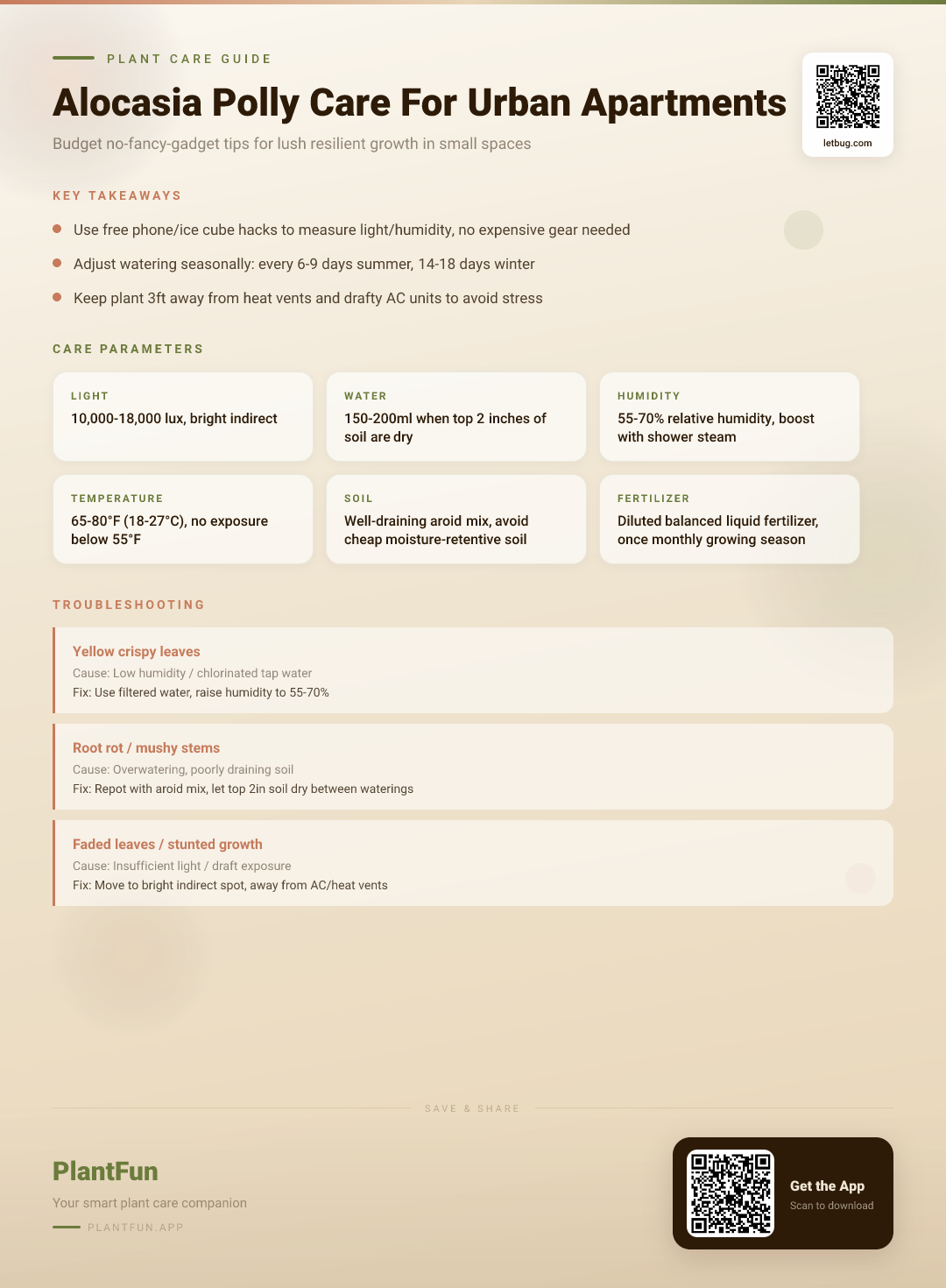
Key Takeaways
- Check soil moisture before watering — overwatering is the #1 killer of houseplants.
- Ensure your plant gets the right amount of light for its species.
- Be patient with recovery — most plants need 2–4 weeks to bounce back.
Quick Care Card
Print this table and tape it to your fridge for easy, at-a-glance reference for your apartment Alocasia Polly care:
| Category | Measurable Threshold for Urban Apartments |
|---|---|
| Light | 10,000-18,000 lux bright indirect light |
| Water | 150-200ml when top 2 inches of soil are fully dry |
| Humidity | 55-70% relative humidity |
| Temperature | 65-80°F (18-27°C), no exposure below 55°F (13°C) |
| Soil | Well-draining mix, 30% perlite + 70% potting soil |
| Fertilizer | Diluted balanced liquid fertilizer every 6 weeks in growing season |
| Toxicity | Toxic to cats, dogs, and humans if ingested (ASPCA, 2026) |
Intro
With its glossy, arrow-shaped deep green leaves and silver veining, Alocasia Polly (Alocasia amazonica) is one of the most sought-after houseplants for small apartment decor. It’s also one of the most frequently killed, as first-time owners follow generic greenhouse-focused care guides that don’t account for the dry, variable conditions of standard urban apartments with forced air HVAC. This Alocasia Polly care checklist is tailored exclusively for renters, requires zero fancy equipment, and costs less than $10 to implement, eliminating common pain points like droopy leaves, yellowing, and brown edges. Note that Alocasia Polly is toxic to pets and small children, so place it out of reach of curious paws and hands (ASPCA, 2026).
Why Generic Alocasia Guides Fail for Apartment Dwellers
Most standard Alocasia care guides are written for greenhouse environments, where humidity stays above 70% year-round, light levels are consistent, and forced air heating/cooling systems don’t dry out foliage overnight. For apartment renters, this advice is often irrelevant: forced air HVAC can reduce indoor humidity by 30% or more in winter, natural light is limited to a few small windows, and rental rules prohibit drilling to install grow lights or permanent humidifiers. A common myth spread by generic guides is that daily misting will boost humidity enough for Alocasia Polly, but NC State Extension confirms misting only raises local humidity for 10 minutes or less, making it useless for dry apartment environments (NC State Extension, 2026). Our framework is built for the reality of apartment living, no modifications required.
Step-by-Step 8-Step Budget Care Plan
Follow these actionable steps for Alocasia Polly care for beginners, with a total setup cost under $10:
- Place your Alocasia Polly 2-3 feet away from an east or south-facing window, behind a sheer curtain to filter direct sun. Use a cheap tension rod for curtains if your rental doesn’t include hardware, no drilling needed.
- Test soil moisture weekly by sticking your index finger 2 inches deep into the potting mix; only water if the soil is completely dry to the touch.
- When watering, pour 150-200ml of room-temperature, dechlorinated water directly onto the soil, avoiding the leaf crown to prevent rot.
- Mix 1 part free perlite (scrap from garden center scrap bins) with 3 parts standard potting soil if repotting, to improve drainage without extra cost. Follow our DIY well-draining potting mix guide for more low-cost mix ideas.
- Boost humidity for free by placing your plant on the bathroom counter for 1 hour after every hot shower, to absorb leftover steam.
- Fertilize once every 6 weeks in spring and summer with diluted balanced liquid fertilizer (1/4 the recommended strength) to avoid leaf burn.
- Keep the plant at least 3 feet away from forced air heat vents, AC units, and drafty exterior doors year-round.
- Wipe leaves down once every 2 weeks with a damp microfiber cloth to remove dust and prevent pest infestations.
Non-Negotiable Measurable Care Thresholds
Stick to these evidence-based thresholds for Alocasia Polly resilient growth tips, no guesswork required:
- Light: 10,000-18,000 lux bright indirect light (NC State Extension, 2026)
- Humidity: 55-70% relative humidity (Surahmaida & Aisa, 2025)
- Water: 150-200ml only when the top 2 inches of soil are fully dry
- Temperature: 65-80°F (18-27°C), no exposure below 55°F (13°C) (Journal of Plant Biotechnology, 2004)
- Fertilizer: 1/4 strength balanced liquid fertilizer every 6 weeks in growing season only
How to Measure These Metrics for Free
You don’t need expensive plant monitors for Alocasia Polly no fancy tools care. Use these simple hacks:
- Lux test: Open your phone’s default camera, point it at the spot you want to place your plant. If you can see a clear shadow of your phone on the wall without squinting, that’s ~10,000+ lux. If the shadow is sharp and dark, that’s over 18,000 lux (too much direct sun).
- Humidity test: Fill a standard drinking glass with ice water, set it next to your plant for 10 minutes. If condensation forms on the outside of the glass, humidity is above 55% (good). If no condensation forms, humidity is too low.
- Soil moisture test: Stick your index finger 2 inches deep into the soil. If it feels completely dry, it’s time to water. If it’s even slightly damp, wait 2-3 days and test again.
Seasonal Apartment-Specific Care Calendar
Adjust your care routine for seasonal changes in apartment temperature and light:
- Winter (Dec-Feb): Alocasia Polly winter care requires reducing watering to every 14-18 days, keeping the plant 3 feet from heat vents, and stopping fertilizing entirely. It’s normal for a few lower leaves to drop during dormancy, so don’t panic.
- Spring (Mar-May): Gradually increase watering to every 8-10 days, start fertilizing once every 6 weeks, and move the plant closer to the window if you had it further away in winter.
- Summer (Jun-Aug): Alocasia Polly summer watering calls for watering every 6-9 days, boosting humidity with shower steam 2x a week, and keeping the plant away from drafty AC units.
- Fall (Sep-Nov): Reduce watering to every 10-14 days, stop fertilizing after mid-October, and move the plant away from drafty exterior windows as temperatures drop.
Common Budget Care Mistakes That Kill Alocasia Polly
Avoid these easy errors that lead to avoidable plant death:
- Mistake: Using straight chlorinated tap water for watering What happens: Chlorine burns leaf edges, leading to brown crispy tips and yellowing leaves, one of the top answers to “why is my Alocasia Polly turning yellow” Instead: Leave tap water out in an open container for 24 hours before watering to let chlorine evaporate, or use leftover rainwater collected from your windowsill
- Mistake: Overpotting your Alocasia Polly to skip repotting for a few years What happens: Extra soil holds excess moisture, leading to root rot, the #1 cause of Alocasia Polly death in apartments Instead: Repot only when roots are growing out of the drainage holes, and use a pot only 1-2 inches larger than the current one
- Mistake: Placing your plant near drafty AC units or exterior doors in summer What happens: Sudden temperature drops shock the plant, leading to drooping leaves and leaf drop Instead: Keep your plant at least 3 feet away from all drafts, and use a portable fan if you need to circulate air without blowing directly on the plant
- Mistake: Using cheap dollar store potting soil with no added perlite What happens: Dense soil retains too much moisture, suffocates roots, and leads to fungal growth Instead: Mix 30% free perlite from garden center scrap bins into your potting soil to improve drainage for free
Voice Search FAQ 1: Why is my Alocasia Polly getting yellow crispy leaves in my apartment?
The most common cause is low humidity from forced air HVAC, or overwatering with chlorinated tap water (Surahmaida & Aisa, 2025). First, test your humidity with the ice cube hack, and check if the top 2 inches of soil are soggy. If humidity is below 55%, use the shower steam hack to boost it, and switch to dechlorinated water for future waterings. If the soil is soggy, hold off on watering until it dries out completely.
Voice Search FAQ 2: Can I keep my Alocasia Polly in a north-facing apartment bedroom?
Yes, you absolutely can, as long as you place it within 1 foot of the north-facing window, and you get at least 4 hours of bright indirect light per day (test with the phone camera lux hack). If the light is below 10,000 lux, you can use a cheap clip-on LED light (under $10) if rental rules allow, but most north-facing apartments get enough light for slow, healthy growth. It’s normal for growth to be slower in north-facing spaces, so don’t expect fast new leaf growth.
Voice Search FAQ 3: How often do I water my Alocasia Polly if I have forced air heating?
For Alocasia Polly forced air heat care in winter, water every 14-18 days, only when the top 2 inches of soil are completely dry (NC State Extension, 2026). Forced air dries out the top layer of soil much faster than the lower layer, so always test the soil 2 inches deep instead of just looking at the surface. If you’re unsure, wait 2 extra days before watering to avoid overwatering.
2-Minute Troubleshooting Fixes for Common Issues
Use these fast, low-cost fixes for common Alocasia Polly problems using household items:
Drooping Leaves
Symptom: Entire leaves are limp and hanging downward, no brown or yellow discoloration.
Likely cause: Underwatering, or sudden temperature shock from a draft.
Fix:
- Pour 150ml of room-temperature dechlorinated water directly onto the soil, wait 1 hour for the plant to rehydrate
- Move the plant at least 3 feet away from any heat vents, AC units, or drafty doors
Brown Leaf Edges
Symptom: Crispy brown edges on otherwise healthy green leaves, no yellowing.
Likely cause: Low humidity from forced air, or chlorinated tap water.
Fix:
- Place the plant in the bathroom for 1 hour after your next hot shower to absorb steam
- Switch to dechlorinated water for all future waterings. This is the most effective Alocasia Polly brown edges fix for apartment dwellers
Spider Mite Outbreak
Symptom: Tiny white or brown dots on the undersides of leaves, fine webbing between stems.
Likely cause: Dry air from forced air HVAC, which attracts spider mites.
Fix:
- Wipe all leaf surfaces (top and bottom) with a mix of 1 teaspoon dish soap and 1 quart of room-temperature water. See our natural spider mite fixes guide for more no-chemical solutions
- Wipe leaves down once a week for 3 weeks to eliminate all mite eggs, and boost humidity to 60%+ to prevent future outbreaks
Optional Low-Cost Upgrades for Lusher Growth
These budget Alocasia care tips cost $5 or less, and will help your plant grow faster and lusher:
- Free perlite: Most garden centers throw away leftover perlite scraps in open bins near the potting soil section; you can grab enough for 2 repots for free, no purchase required
- $2 humidity tray: Take a clean plastic takeout container, fill it with cheap dollar store pebbles and a small amount of water, set your plant pot on top of the pebbles (make sure the pot isn’t sitting in the water) to boost local humidity by 10-15%
- Free coffee grounds fertilizer: Mix leftover coffee grounds (1 part grounds to 10 parts water) and use it to water your plant once every 8 weeks for a free nitrogen boost
Long-Term Resilience Tips
Keep your Alocasia Polly alive for years, even through apartment moves and variable conditions:
- Winter dormancy: If your Alocasia Polly drops all its leaves in winter, don’t throw it away! Cut back any dead stems, reduce watering to once a month, and keep it in a warm spot above 60°F. It will grow new leaves in spring when light levels increase (Journal of Plant Biotechnology, 2004)
- Free propagation: When your plant is 2+ years old, it will grow small offsets (baby Alocasia plants) at the base. Gently separate the offset from the mother plant when it has at least 2 leaves, and repot it in a small 4-inch pot with well-draining soil for a free new plant. Our Alocasia propagation guide has step-by-step instructions for this process
- Apartment moves: Wrap the entire plant in a cotton pillowcase for moving day to protect leaves from wind and cold, and keep it in the temperature-controlled cabin of your car instead of the trunk. Water it lightly 2 days before moving to reduce stress
References
- NC State Extension. (2026). The Complete Alocasia Polly — NC State Extension Gardener Plant Toolbox. https://plants.ces.ncsu.edu/plants/polly-care/. Accessed 2026-02-26.
- Journal of Plant Biotechnology. (2004). In Vitro Propagation of Alocasia cadieri Chantrier. Journal of Plant Biotechnology. https://doi.org/10.5010/jpb.2004.31.1.061. Accessed 2026-02-26.
- Surahmaida, S.; Aisa, I. (2025). Pharmacognostic Study of Donkey Ear Taro Leaves (Alocasia polly). Jurnal Biologi Tropis. https://doi.org/10.29303/jbt.v25i3.9239. Accessed 2026-02-26.
- ASPCA. (2026). Toxic and Non-Toxic Plants List — ASPCA. https://www.aspca.org/pet-care/animal-poison-control/toxic-and-non-toxic-plants. Accessed 2026-02-26.
Optional Helper: Plantfun.App
Plantfun.App identifies your plants by photo, diagnoses pests and diseases with clear fixes, and creates personalised watering and light schedules that adapt to your home conditions — a handy companion for putting this guide into daily practice.
Found an error or have suggestions? We'd love your feedback.
Need help identifying this problem?
Get instant identification, personalized care schedules, and effective pest treatment plans directly on your phone.
Sponsored • We may earn a commission from app downloads
Related Guides
Alocasia Polly Care Checklist for Resilient Growth in Typical Urban Apartments
Stop watching your Alocasia wilt in your urban apartment. Grab our 8-step care checklist, exact light/water thresholds, and symptom fixes for resilient, year-round growth.
Care GuideThe Complete Alocasia Polly Care Checklist for Resilient Growth in Urban Apartments
Grow a lush, happy Alocasia Polly even in a small, drafty apartment. Get exact light levels, watering amounts, and a seasonal care calendar to prevent yellow leaves and encourage new growth.
Care GuideThe Complete Alocasia Polly Care Guide for Typical Urban Apartments: Proven Tips for Resilient Growth
Stop watching your Alocasia Polly wilt or drop leaves in your urban apartment. Get exact light levels, watering amounts, and humidity hacks to keep it growing vibrantly year-round.
Pest ControlAnts on Plants: What They Mean and What to Do
Ants usually aren't eating your plant. They are farming other pests.