
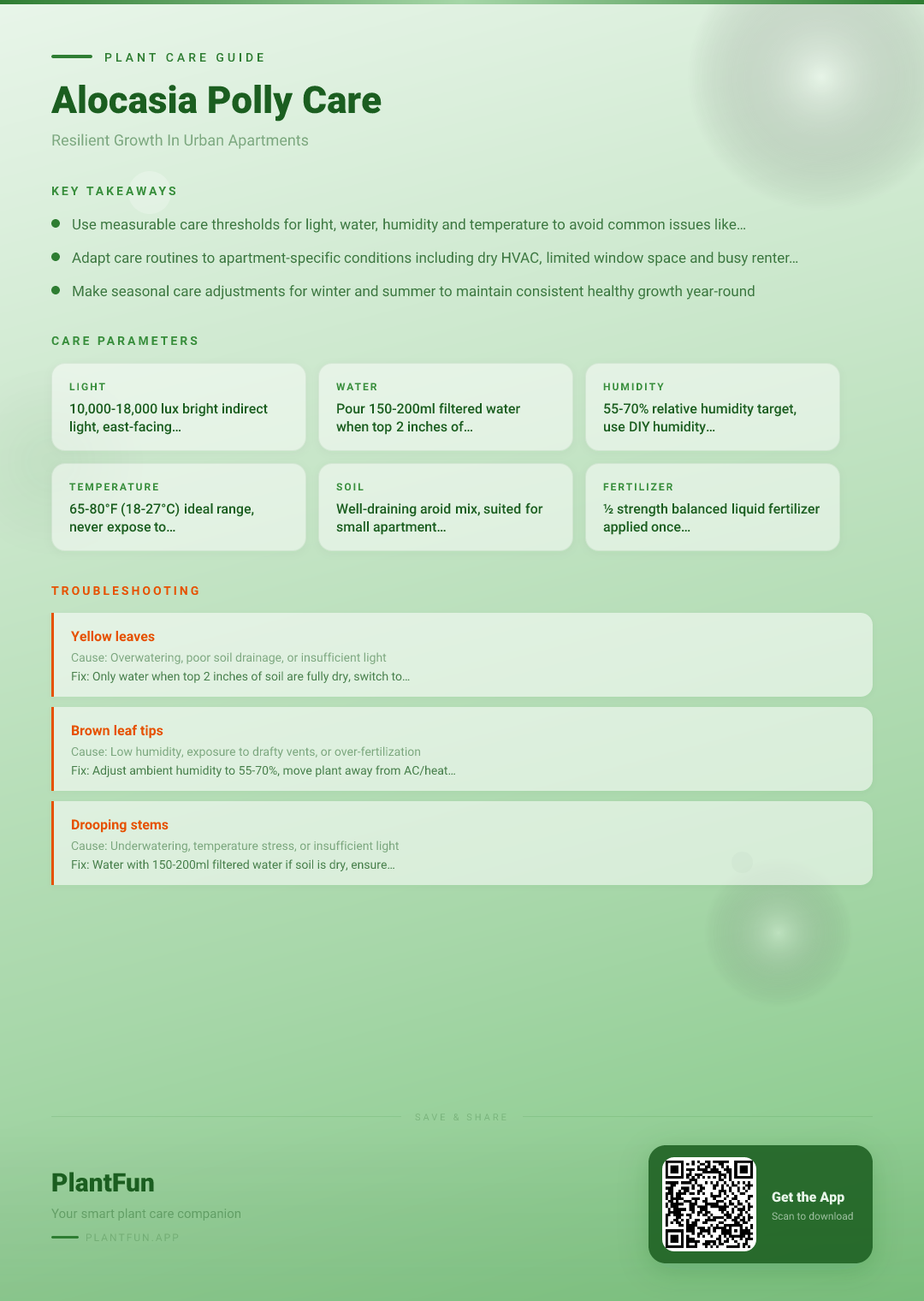
Key Takeaways
- Check soil moisture before watering — overwatering is the #1 killer of houseplants.
- Ensure your plant gets the right amount of light for its species.
- Be patient with recovery — most plants need 2–4 weeks to bounce back.
Quick Care Card
| Care Factor | Apartment-Specific Threshold |
|---|---|
| Light | 10,000–18,000 lux (bright indirect light, no direct midday sun) |
| Water | 150–200ml per 6-inch pot when top 2 inches of soil are dry (growing season); 100–125ml when top 3 inches are dry (winter) |
| Humidity | 45–60% RH |
| Temperature | 65–80°F (18–27°C) |
| Soil | Well-draining aroid mix (1 part perlite, 1 part orchid bark, 1 part peat-free potting mix) |
| Fertilizer | Half-strength balanced 10-10-10 liquid fertilizer every 4 weeks (March–August only) |
| Toxicity | Toxic to cats, dogs, and humans if ingested (ASPCA, 2026) |
Why This Guide Is Different
Generic Alocasia care advice is designed for greenhouse conditions, not urban apartments with 35-45% average humidity, drafty windows, and limited bright light. Most guides give vague tips like “keep moist” or “provide high humidity” without measurable thresholds, leading to common mistakes like overwatering or underlighting. This Alocasia care checklist is tailored specifically to apartment constraints, includes a science-backed Alocasia Polly seasonal care calendar so you don’t have to guess care adjustments, and shares evidence-based Alocasia Polly resilient growth tips to help you master Alocasia Polly apartment care even as a beginner.
A common myth we bust here: You need a high-end humidifier to grow Alocasia Polly in apartments. Reality: With targeted adjustments, these plants thrive at 45% RH, the upper end of average household humidity (NC State Extension, 2026). These tips are the key to how to keep Alocasia alive in apartments even with limited space and less-than-ideal conditions. If you’re new to growing tropical houseplants, our guide to beginner-friendly aroid care will help you build foundational skills before you dive into more specific routines.
Spring Care Routine (March–May)
Spring is the start of active growth for Alocasia Polly, so adjust your routine to support new foliage:
Weekly Tasks
- Test soil moisture by sticking your index finger 2 inches deep into the potting mix; water 150-200ml per 6-inch pot if the soil is completely dry.
- Wipe both sides of leaves with a damp microfiber cloth to remove dust that blocks light absorption.
Monthly Tasks
- Apply half-strength balanced 10-10-10 liquid fertilizer to support steady new growth (Surahmaida & Aisa, 2025).
- Inspect drainage holes for protruding roots; if you see 3+ roots sticking out and 2+ new unfurling leaves, repot to a container 1-2 inches larger than the current pot.
If you’re unsure how to repot aroids without damaging roots, follow our step-by-step aroid repotting guide for best results.
Summer Care Routine (June–August)
Higher temperatures and longer days speed up soil drying, so adjust your Alocasia Polly summer watering routine to check moisture every 4 days instead of weekly, still only watering when the top 2 inches of soil are dry. Add these tasks to your monthly routine:
- Inspect the undersides of leaves for spider mites and aphids, which are common when windows are left open for ventilation; spray with a diluted neem oil solution every 2 weeks to prevent infestations.
- Move the plant 1-2 feet back from south-facing windows to avoid direct midday sun, which can scorch leaves when light levels exceed 20,000 lux.
If you struggle with summer pest outbreaks, our guide to common houseplant pest prevention has easy, non-toxic solutions for apartment dwellers.
Fall Care Routine (September–November)
As light levels drop, your Alocasia Polly will slow its growth, so gradually taper care to prep for dormancy:
- Return to checking soil moisture every 7 days, and reduce watering amounts to 150ml per 6-inch pot when the top 2 inches are dry.
- Stop all fertilizing by mid-October, as adding nutrients during slow growth can burn roots (NC State Extension, 2026).
- Move the plant at least 1 foot away from window sills that will get cold drafts as nighttime temperatures drop below 60°F.
For more tips on adjusting your plant care as days get shorter, our fall houseplant prep guide covers all the key tasks for apartment growers.
Winter Care Routine (December–February)
Alocasia Polly winter care focuses on supporting natural dormancy and avoiding stress, and requires far less frequent intervention than growing season care:
- Only water when the top 3 inches of soil are completely dry, using 100-125ml per 6-inch pot to avoid root rot, the top cause of winter Alocasia death.
- Keep the plant away from radiators, AC vents, and drafty windows: Alocasia draft tolerance is very low, and sudden temperature swings can cause sudden leaf drop.
- Do not fertilize at all during this period, even if you see no new growth, as this is normal for dormancy. Expect 1-2 older leaves to drop naturally over the winter, which is not a sign of poor care.
4 Non-Negotiable Care Thresholds for Alocasia Polly
These evidence-based metrics eliminate guesswork and are tailored to apartment growing conditions, so you can follow them exactly for consistent, resilient growth:
1. Light: 10,000–18,000 lux
Alocasia Polly light levels in this range support steady growth without leaf scorch. You can measure light with a cheap digital light meter: levels below 10,000 lux lead to stunted growth and leggy stems, while levels above 20,000 lux cause brown burn spots on leaves (Surahmaida & Aisa, 2025). East or west-facing windows are ideal for apartments, as they provide bright indirect light without harsh midday sun.
2. Humidity: 45–60% RH
Alocasia Polly humidity requirements sit at the upper end of average apartment humidity (35-45%), so small adjustments are often enough to hit this range. You don’t need a humidifier unless your humidity is consistently below 40% RH: a pebble tray or grouping with other plants will raise humidity enough for healthy growth (NC State Extension, 2026).
3. Temperature: 65–80°F (18–27°C)
This is the standard temperature range for most heated/cooled apartments, but avoid spots where temperatures drop below 60°F or spike above 85°F for extended periods, as this causes stress and leaf drop.
4. Soil Moisture
For a standard 6-inch nursery pot, water 150-200ml when the top 2 inches of soil are dry (growing season) and 100-125ml when the top 3 inches are dry (winter). This answers the most common question we get: how often to water Alocasia Polly. The exact amount eliminates the risk of overwatering, which kills more Alocasias than any other issue.
Common Apartment-Specific Mistakes to Avoid
- Mistake: Placing your Alocasia Polly directly next to AC vents, radiators, or drafty window edges. What happens: Sudden temperature swings cause rapid leaf drop and brown leaf edges, as Alocasia draft tolerance is very low. Instead: Keep your plant at least 1 foot away from any heat or cooling sources, and use window insulation film on drafty sills if you have no other bright placement spot.
- Mistake: Overwatering in low light, especially during winter. What happens: Dense, soggy soil leads to root rot, which causes yellow mushy leaves and can kill the plant in 2-3 weeks. Instead: Use a soil moisture meter or stick your finger 2-3 inches deep into the soil before watering, and stick to the exact ml amounts outlined earlier for your pot size.
- Mistake: Using regular potting soil for your Alocasia Polly. What happens: Dense, peat-heavy regular potting soil holds too much moisture, suffocates aroid roots, and prevents proper drainage. Instead: Use a well-draining aroid mix of 1 part perlite, 1 part orchid bark, and 1 part peat-free potting mix, as recommended by NC State Extension (2026).
FAQ: Can I keep my Alocasia Polly next to my drafty apartment window?
Only if the window is fully sealed and the temperature 6 inches from the glass stays between 65-80°F year-round. If you feel cold air coming through the glass when you hold your hand there in winter, it’s too drafty: Alocasia draft tolerance drops significantly below 60°F, and you risk leaf drop and root damage if you leave it there in cold months (NC State Extension, 2026). If that’s your only bright spot, use a low-cost window insulation kit in winter to block cold drafts.
FAQ: Why is my Alocasia Polly dropping leaves every winter?
This is almost always either normal dormancy, cold draft exposure, or overwatering in low light. Alocasia Polly naturally slows growth in winter when light levels drop, and will shed 1-2 older leaves to conserve energy. If you’re seeing more than 2 leaves drop a month, check for cold drafts nearby and test your soil moisture: if it’s soggy 2 inches deep, you’re overwatering (NC State Extension, 2026). This is one of the most common questions about Alocasia care for beginners, and it’s almost always easy to fix by adjusting your watering schedule and moving the plant away from drafts.
FAQ: How often do I need to mist my Alocasia Polly in a low-humidity apartment?
Misting only raises humidity for 10-15 minutes at a time, so it’s not a long-term solution for low humidity. If your apartment is below 45% RH, misting 1-2 times a day can help temporarily, but you’ll get far better results from a pebble tray (fill a tray with pebbles and water, set the pot on top so it’s not sitting in standing water) or grouping it with other plants (NC State Extension, 2026). For more easy hacks to boost humidity without a humidifier, check out our guide to low-cost humidity solutions for apartment plants.
Troubleshooting Quick Reference
Yellow Mushy Leaves
Symptom: Soft, yellow, translucent leaves that fall off easily when touched.
Likely cause: Overwatering leading to root rot, the most common issue with Alocasia Polly care.
Fix:
- Stop watering immediately and remove the plant from its pot to inspect roots.
- Trim any black, mushy roots with sterile scissors, repot in fresh dry aroid mix, and do not water for 7-10 days.
Brown Crispy Leaf Edges
Symptom: Dry, brown edges on otherwise healthy green leaves, no yellowing or mushy texture.
Likely cause: Humidity below 40% RH or exposure to hot/cold drafts from vents or windows.
Fix:
- Test your humidity with a cheap hygrometer, and add a pebble tray under the pot if it’s below 45% RH.
- Move the plant at least 1 foot away from any AC vents, radiators, or drafty window sills.
No New Growth
Symptom: No new unfurling leaves for 2+ months, especially in spring and summer.
Likely cause: Light levels below 10,000 lux, or lack of fertilizer during the growing season.
Fix:
- Measure your light levels with a light meter, and move the plant closer to a bright east or west-facing window if it’s below 10,000 lux.
- Apply diluted half-strength 10-10-10 fertilizer every 4 weeks during spring and summer.
Sudden Leaf Drop
Symptom: Multiple healthy green leaves dropping off the plant in less than a week.
Likely cause: Sudden temperature swing from draft exposure, or recent move to a much darker spot.
Fix:
- Check the temperature near your plant with a thermometer, ensure it stays between 65-80°F at all times.
- If you recently moved the plant, give it 2-3 weeks to acclimate to the new spot before making further care changes.
References
- American Society for the Prevention of Cruelty to Animals. (2026). Toxic and Non-Toxic Plants List — ASPCA. https://www.aspca.org/pet-care/animal-poison-control/toxic-and-non-toxic-plants. Accessed 2026-02-23.
- North Carolina State University Extension. (2026). The Complete Alocasia Polly — NC State Extension Gardener Plant Toolbox. https://plants.ces.ncsu.edu/plants/polly-care/. Accessed 2026-02-23.
- Surahmaida, S.; Aisa, I. (2025). Pharmacognostic Study of Donkey Ear Taro Leaves (Alocasia polly). Jurnal Biologi Tropis. https://doi.org/10.29303/jbt.v25i3.9239. Accessed 2026-02-23.
- Journal of Plant Biotechnology. (2004). In Vitro Propagation of Alocasia cadieri Chantrier. Journal of Plant Biotechnology. https://doi.org/10.5010/jpb.2004.31.1.061. Accessed 2026-02-23.
Optional Helper: Plantfun.App
Plantfun.App identifies your plants by photo, diagnoses pests and diseases with clear fixes, and creates personalised watering and light schedules that adapt to your home conditions — a handy companion for putting this guide into daily practice.
Found an error or have suggestions? We'd love your feedback.
Need help identifying this problem?
Get instant identification, personalized care schedules, and effective pest treatment plans directly on your phone.
Sponsored • We may earn a commission from app downloads
Related Guides
Alocasia Polly Care Checklist for Resilient Growth in Typical Urban Apartments
Stop watching your Alocasia wilt in your urban apartment. Grab our 8-step care checklist, exact light/water thresholds, and symptom fixes for resilient, year-round growth.
Care GuideThe Complete Alocasia Polly Care Checklist for Thriving Growth in Small Urban Apartments
Skip pricy plant gadgets to keep your Alocasia Polly thriving in your apartment. Get exact light, water, and humidity thresholds plus a budget 8-step care checklist for resilient, lush growth.
Care GuideThe Complete Alocasia Polly Care Guide for Typical Urban Apartments: Proven Tips for Resilient Growth
Stop watching your Alocasia Polly wilt or drop leaves in your urban apartment. Get exact light levels, watering amounts, and humidity hacks to keep it growing vibrantly year-round.
Pest ControlAnts on Plants: What They Mean and What to Do
Ants usually aren't eating your plant. They are farming other pests.