
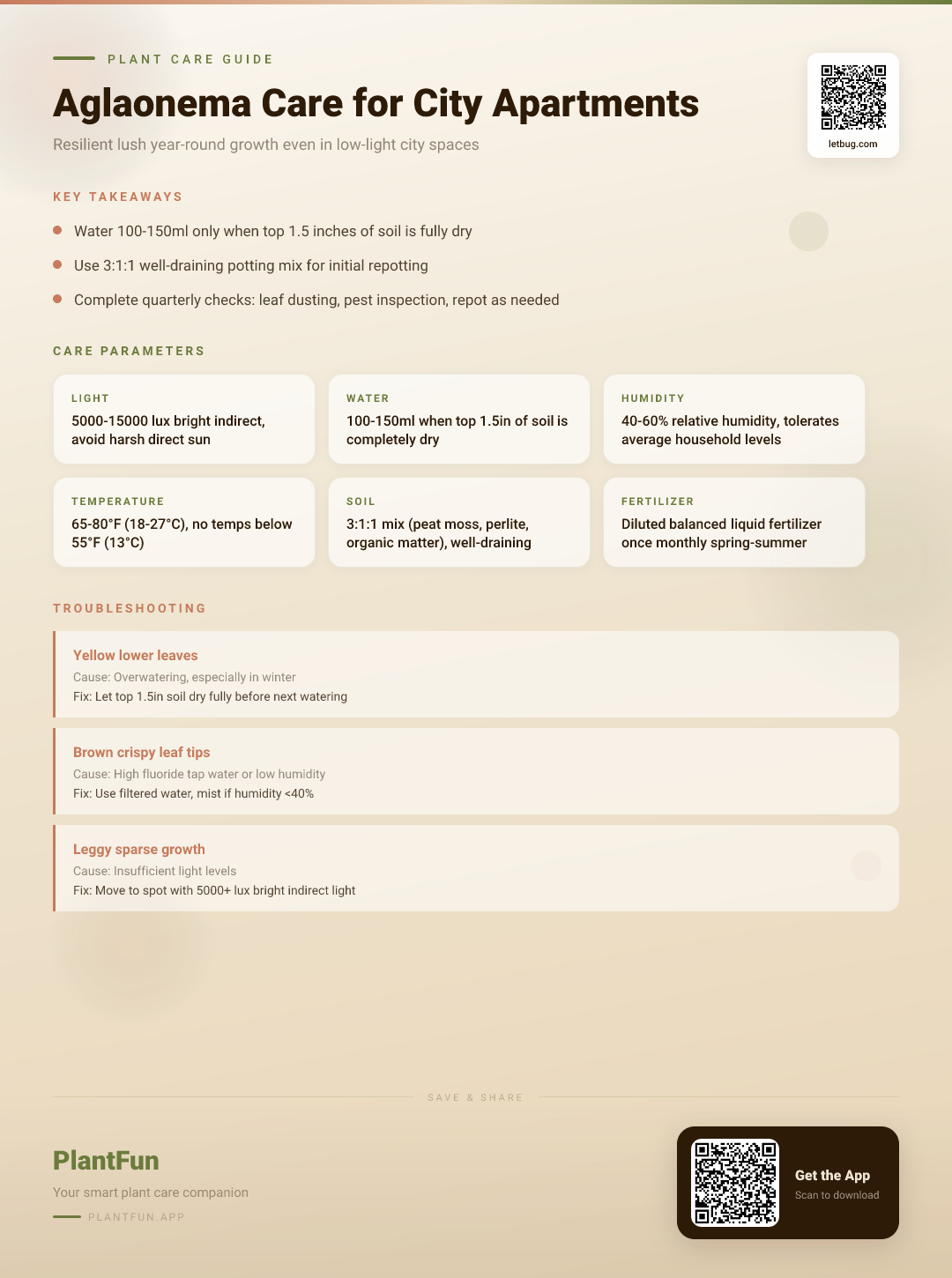
Key Takeaways
- Check soil moisture before watering — overwatering is the #1 killer of houseplants.
- Ensure your plant gets the right amount of light for its species.
- Be patient with recovery — most plants need 2–4 weeks to bounce back.
Quick Care Card: At-a-glance printable snapshot of all key measurable care thresholds for apartment-grown Aglaonema for fast reference
| Parameter | Exact Apartment-Specific Threshold |
|---|---|
| Light | 5,000-15,000 lux bright indirect, max 2 hours direct morning sun |
| Water | 100-150ml per 6-inch pot when top 1.5 inches of soil is dry; 150-200ml first water for new 6-inch plants |
| Humidity | 40-60% relative humidity, minimum 35% temporary tolerance |
| Temperature | 65-80°F (18-27°C), never below 55°F (13°C) |
| Soil | 3:1:1 ratio peat moss : perlite : orchid bark (excellent drainage) |
| Fertilizer | Half-strength balanced 10-10-10 liquid fertilizer once every 2 months spring/summer, no fertilization fall/winter |
| Toxicity | Toxic to cats and dogs (ASPCA, 2026) |
Why Aglaonema Thrives in Typical City Apartments
Aglaonema (also called Chinese evergreen) evolved as a tropical understory plant in Southeast Asia, where it grows in dappled, low light, fluctuating temperatures, and moderate humidity — conditions that almost exactly match standard 1-bed city apartments. A 2016 study confirmed Aglaonema has exceptional tolerance for indoor environmental stressors, including low light and volatile organic compound exposure (Ghate, 2016).
A common myth is that Aglaonema require steamy tropical humidity to thrive, but the reality is they handle average apartment humidity levels of 35-40% perfectly fine (NC State Extension, 2026). Note that Aglaonema is toxic to cats and dogs, so place it on high shelves or out of reach of curious pets (ASPCA, 2026). This makes it one of the best options for Aglaonema in low light apartment spaces, with minimal upkeep required.
Step-by-Step Initial Setup for New Aglaonema in Your Apartment
Follow these exact steps when bringing a new Aglaonema home to avoid shock and establish strong growth:
- Repot only if root-bound: Skip repotting for the first 2-3 months unless you see roots growing out of the drainage holes, to reduce transplant shock.
- Use the ideal Aglaonema soil mix for apartments: Mix 3 parts peat moss, 1 part perlite, and 1 part orchid bark for fast drainage that prevents root rot (NC State Extension, 2026).
- Pick the perfect spot: Place the plant 3-5 feet away from a north or east-facing window, which delivers consistent 5,000-15,000 lux bright indirect light without scorching leaves.
- First watering: Pour 150-200ml of room-temperature filtered water directly around the root ball for a 6-inch pot; do not drench the entire soil volume.
- Humidity boost (optional): If your apartment regularly runs below 40% humidity, add a 1-inch layer of pebbles under the pot with a small amount of water to increase ambient moisture around the leaves.
Seasonal Care Calendar for Year-Round Resilient Growth
This schedule is tailored to the fluctuating conditions of city rental units, including winter heating and summer AC use:
Winter (Heating season)
- Watering: Every 2-3 weeks, 100ml per 6-inch pot, only when top 1.5 inches of soil is completely dry. This is core to good Aglaonema winter care, as dry heating air reduces soil evaporation rates.
- Light: Can tolerate as low as 5,000 lux; move closer to windows if you see leggy growth.
- Fertilizer: None, as growth slows significantly in cold months.
- Placement: Keep at least 3 feet away from heating vents to avoid leaf scorch.
Spring (Heating off, temps rising)
- Watering: Every 10-14 days, 125ml per 6-inch pot.
- Light: Maintain 5,000-12,000 lux; hang a sheer curtain if spring sun gets brighter.
- Fertilizer: Start half-strength balanced liquid fertilizer applications once every 2 months.
Summer (AC season)
- Aglaonema summer watering: Every 7-10 days, 150ml per 6-inch pot, as AC use can dry soil faster.
- Light: Keep below 15,000 lux; avoid direct midday sun through west/south windows, which burns leaves.
- Placement: Keep 3 feet away from AC vents to prevent cold shock.
Fall (AC off, temps cooling)
- Watering: Every 10-14 days, reduce volume to 100ml per 6-inch pot as temperatures drop.
- Fertilizer: Stop all applications to avoid salt build-up in soil during slow growth periods.
- Light: Gradually move closer to windows to compensate for shorter daylight hours.
Non-Negotiable Measurable Care Thresholds
Stick to these exact parameters to eliminate guesswork for Aglaonema care for beginners:
- Light: 5,000-15,000 lux bright indirect light (NC State Extension, 2026). Quick test: Hold your hand 1 foot above the plant at midday; if you see a faint, soft shadow, light levels are perfect. A hard, sharp shadow means too much direct sun; no shadow means too little light.
- Humidity: 40-60% relative humidity (Šrámek, 1999). Use a cheap hygrometer to measure; mist leaves 2x per week or use a pebble tray if levels drop below 40% regularly.
- Temperature: 65-80°F (18-27°C), never below 55°F (13°C) (NC State Extension, 2026). Temperatures below this threshold will cause leaf drop and permanent damage.
- Water: 100-150ml per 6-inch pot when top 1.5 inches of soil is completely dry. Quick test: Stick your index finger 1.5 inches into the soil; if no soil sticks to your finger, it is time to water.
Common Apartment-Specific Mistakes That Stunt Aglaonema Growth
Avoid these errors that are unique to urban rental unit environments:
- Mistake: Placing within 1 foot of heating vents in winter. What happens: Dry hot air scorches leaf edges and causes rapid foliage drop. Instead: Keep at least 3 feet away from vents, and add a pebble tray under the pot to boost local humidity.
- Mistake: Following a fixed weekly watering schedule year-round. What happens: Overwatering in winter is the top cause of Aglaonema death in apartments, as heating reduces evaporation and plants use less water. Instead: Always check soil moisture before watering, and adjust frequency to match seasonal conditions.
- Mistake: Placing directly in unobstructed west/south facing windows in summer. What happens: Direct midday sun burns leaves, leaving brown crispy patches that do not heal. Instead: Hang a sheer curtain, or place the plant 5 feet away from the window to keep light within the 5,000-15,000 lux range.
- Mistake: Using high-fluoride tap water for watering. What happens: Fluoride builds up in soil over time, causing brown leaf tips even with proper humidity levels. Instead: Use filtered, rain, or distilled water, or leave tap water out overnight to let chlorine and fluoride evaporate before use.
FAQ: Can I keep my Aglaonema in a windowless apartment room with only artificial LED light?
Yes, can Aglaonema grow in artificial light very successfully, as long as you use full-spectrum LED bulbs placed 12-18 inches above the plant, running for 12-14 hours per day, delivering at least 5,000 lux (NC State Extension, 2026). This makes Aglaonema perfect for windowless home offices, closet nooks, or bathroom spaces with no natural light access.
FAQ: Why is my Aglaonema getting yellow leaves when I water it every single week?
The most common cause of why is my Aglaonema leaves turning yellow is overwatering. Weekly watering is almost always too frequent for apartment conditions, especially in winter when plant growth slows and evaporation rates are low (NC State Extension, 2026). Cut back to watering only when the top 1.5 inches of soil is completely dry, which will be every 2-3 weeks in cold months for most apartment units.
FAQ: How often do I need to fertilize my Aglaonema in a small 500 sq ft apartment?
Small apartments typically have very stable, consistent temperature and light conditions, so you only need to fertilize once every 2 months in spring and summer, using a balanced 10-10-10 liquid fertilizer diluted to half strength. Skip fertilizing entirely in fall and winter, as excess fertilizer will build up in soil and burn root systems, stunting growth.
Printable 5-Point Quarterly Aglaonema Care Checklist
This free, downloadable Aglaonema care checklist takes 10 minutes to complete every 3 months, making consistent care effortless for busy renters:
- Watering audit: Confirm your watering frequency and volume matches the current seasonal care schedule, adjust if needed based on recent temperature or humidity changes.
- Light check: Use a free lux meter app on your phone to confirm light levels are within the 5,000-15,000 lux range, move the plant closer to a window or add a grow light if levels are too low.
- Leaf dusting: Wipe all leaves with a damp microfiber cloth to remove dust build-up, which blocks light absorption and slows growth.
- Repot check: Inspect drainage holes for visible roots; if root-bound, repot in a pot 1-2 inches larger using the 3:1:1 Aglaonema soil mix for apartments. This is also the perfect time to learn how to make Aglaonema bushier: prune the top 2 inches of tall, leggy stems to encourage side growth.
- Pest inspection: Check the undersides of leaves for spider mites or mealybugs, treat with diluted neem oil if any pests are spotted.
Troubleshooting Quick Fixes for Common Apartment Aglaonema Issues
Yellow Lower Leaves
Symptom: Older lower leaves turn pale yellow and drop off, with no brown spots or discoloration on new growth.
Likely cause: Overwatering, or natural seasonal leaf shedding.
Fix:
- Check soil moisture; if the top 1.5 inches is damp, hold off watering for 1-2 weeks until it dries completely.
- If only 1-2 leaves yellow every 2-3 months, this is normal shedding, no action is needed.
Brown Leaf Tips
Symptom: Tips of leaves turn crispy brown, while the rest of the leaf remains green and healthy.
Likely cause: Low humidity, high fluoride in tap water, or placement near heating/AC vents.
Fix:
- Move the plant at least 3 feet away from vents, and add a pebble tray under the pot to boost humidity to 40% minimum.
- Switch to filtered or rain water for all future waterings to avoid fluoride build-up.
Leggy Sparse Growth
Symptom: Stems grow long and thin, with large gaps between leaves, and new leaves are smaller than older mature leaves.
Likely cause: Insufficient light, below 5,000 lux for extended periods of time.
Fix:
- Move the plant 2-3 feet closer to a north or east-facing window, or add a full-spectrum LED grow light 12 inches above the plant.
- Prune back leggy stems by 1/3 to encourage bushier, fuller growth.
Mild Root Rot
Symptom: Leaves wilt even when soil is damp, and roots are soft and brown instead of firm and white.
Likely cause: Consistent overwatering, poorly draining soil, or a pot with no working drainage holes.
Fix:
- Remove the plant from its pot, and trim off all soft, brown rotting roots with sterile scissors.
- Repot in fresh 3:1:1 soil mix, in a pot with working drainage holes.
- Hold off watering for 1 full week after repotting to let remaining healthy roots recover.
References
- NC State Extension. (2026). The Complete Aglaonema Care — NC State Extension Gardener Plant Toolbox. https://plants.ces.ncsu.edu/plants/aglaonema-care/. Accessed 2026-03-06.
- Ghate, S. (2016). Assessment of Phytoremediating Potential of Aglaonema commutatum Schott for Indoor Pollutants. INTERNATIONAL JOURNAL OF PLANT AND ENVIRONMENT. https://doi.org/10.18811/ijpen.v2i1-2.6622. Accessed 2026-03-06.
- Šrámek, F. (1999). Vaughan, M.J.: The Complete Book on Cut Flower Care. Biologia plantarum. https://doi.org/10.1023/a:1001770114931. Accessed 2026-03-06.
- ASPCA. (2026). Toxic and Non-Toxic Plants List — ASPCA. https://www.aspca.org/pet-care/animal-poison-control/toxic-and-non-toxic-plants. Accessed 2026-03-06.
Optional Helper: Plantfun.App
Plantfun.App identifies your plants by photo, diagnoses pests and diseases with clear fixes, and creates personalised watering and light schedules that adapt to your home conditions — a handy companion for putting this guide into daily practice.
Found an error or have suggestions? We'd love your feedback.
Need help identifying this problem?
Get instant identification, personalized care schedules, and effective pest treatment plans directly on your phone.
Sponsored • We may earn a commission from app downloads
Related Guides
The Complete Aglaonema Care Checklist for Resilient Growth in Low-Light Urban Apartments
Keep your Aglaonema thriving even in dark, dry urban apartments. Get a free printable checklist, exact light/water thresholds, and 7 fast fixes for common leaf symptoms to boost resilient growth.
Care GuideThe Complete Aglaonema Care Guide for 1-Bedroom Apartments: Seasonal Tips for Resilient Growth
Grow a lush, hardy Aglaonema even in a small, low-light apartment. Get exact light, water, and humidity thresholds plus a 4-season care checklist to avoid yellow leaves and stunted growth.
Care GuideThe Complete Aglaonema Care Checklist for Resilient Growth in Small East-Facing Apartments
Stop guessing your Aglaonema care routine. Get 4 measurable care thresholds, a renter-friendly checklist, and troubleshooting tips to keep your Chinese evergreen thriving in small east-facing apartments.
Pest ControlAnts on Plants: What They Mean and What to Do
Ants usually aren't eating your plant. They are farming other pests.