
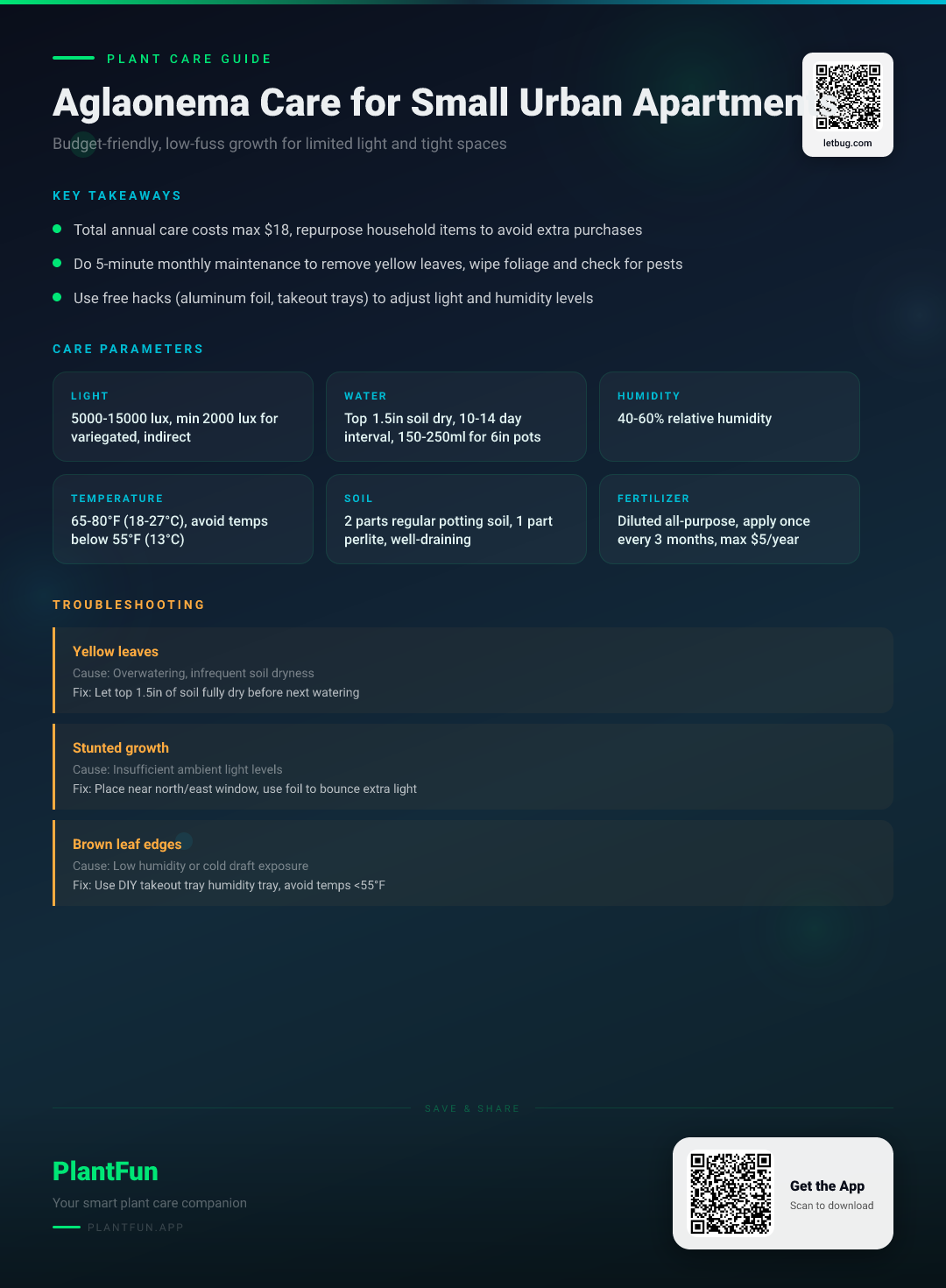
Key Takeaways
- Check soil moisture before watering — overwatering is the #1 killer of houseplants.
- Ensure your plant gets the right amount of light for its species.
- Be patient with recovery — most plants need 2–4 weeks to bounce back.
Quick Care Card
| Category | Exact Threshold |
|---|---|
| Light | 5000-15000 lux, minimum 2000 lux for variegated cultivars (NC State Extension, 2026) |
| Water | Top 1.5 inches of soil completely dry, 10-14 day average frequency, 150-250ml per 6-inch pot |
| Humidity | 40-60% relative humidity (NC State Extension, 2026) |
| Temperature | 65-80°F (18-27°C), never below 55°F (13°C) (NC State Extension, 2026) |
| Soil | 2 parts regular potting soil + 1 part leftover perlite |
| Fertilizer | Diluted (1/4 strength) all-purpose houseplant fertilizer, once every 3 months, $5 annual cost max |
| Toxicity | Toxic to cats and dogs (ASPCA, 2026) |
| Total estimated annual supply cost: $18 maximum |
Why This Guide Works for Small Urban Apartments
Standard Aglaonema care advice often assumes dedicated grow lights, consistent humidity, and ample storage for specialty plant products — none of which are realistic for most small urban apartment dwellers. Shared HVAC systems create fluctuating temperature and humidity levels, limited window space restricts light access, and tight budgets make $30 foliage-specific soil or $50 humidifiers impractical. This Aglaonema care checklist is built exclusively for these constraints, using zero-waste household items and no fancy purchases, making it perfect for Aglaonema care for beginners.
Pre-Growing Prep: Budget Setup Under $20
You don’t need any new specialty supplies to set up your Aglaonema if you have basic household items on hand:
- Use a clean, old 6-inch plastic pot with drainage holes (if no holes exist, drill 2 ¼-inch holes with a regular household nail)
- Line the bottom of the pot with a leftover coffee filter to prevent soil leakage, no expensive landscape fabric required
- Use a clean jar lid or leftover takeout container lid as a saucer to catch excess water
- If you don’t have existing potting mix or perlite, a $12 bag of all-purpose potting soil and $6 bag of perlite lasts 2+ years for multiple plants, bringing your annual supply cost to under $9, plus $5 max for fertilizer, for a total of $14 per year (well under the $20 cap)
Light Requirements for Low-Light Apartment Spaces
Aglaonema light requirements sit at 5000-15000 lux for optimal growth, with a 2000 lux minimum for variegated cultivars to retain their leaf patterning (NC State Extension, 2026). This makes low light Aglaonema care ideal for apartment spaces:
- Best placements: 1-2ft from north-facing windows, 2-3ft from east-facing windows, or 3ft+ from shaded west-facing windows
- Budget low-light hack: Tape aluminum foil to a piece of cardboard and place it behind your Aglaonema to bounce extra light onto the foliage, no expensive grow lights needed
Exact Watering Schedule for Apartment Humidity Levels
If you’re wondering how often to water Aglaonema, the answer depends on your HVAC-driven humidity levels, but follows a simple measurable rule:
- Only water when the top 1.5 inches of soil is completely dry (quick test: stick your index finger into the soil up to the second knuckle; if no soil sticks to your finger, it’s time to water)
- Average frequency is 10-14 days for 6-inch pots in standard 40% humidity apartment conditions
- Use 150-250ml of cooled leftover tap water per watering, no need for expensive bottled or distilled water Myth vs Reality: You don’t need to follow a strict fixed watering schedule. If your AC runs constantly in summer, soil dries faster, so you’ll water more often; if your heat runs in winter, you’ll water less. This is the core rule for Aglaonema summer watering adjustments.
Humidity & Temperature Parameters for Shared Building HVAC
Aglaonema humidity needs are 40-60% relative humidity, with a preferred temperature range of 65-80°F (18-27°C) and a hard minimum of 55°F (13°C) (NC State Extension, 2026). Shared HVAC systems often drop humidity to 30% or lower near vents, so use this zero-cost fix:
- DIY humidity tray: Take a clean leftover takeout container, fill it with pebbles, glass marbles, or even clean plastic bottle caps, add water to just below the top of the pebbles, and set your Aglaonema pot on top (make sure the pot isn’t sitting directly in standing water to avoid root rot)
- Keep your Aglaonema at least 3ft away from heating and cooling vents, as well as drafty exterior doors, to avoid sudden temperature swings
Soil & Fertilizer Budget Tips
The ideal Aglaonema soil mix uses items you likely already have from other plant projects:
- 2 parts regular all-purpose potting soil + 1 part leftover perlite from old planters (no need to buy fresh perlite for every new plant)
- Fertilize once every 3 months with all-purpose houseplant fertilizer diluted to ¼ the recommended strength on the package, for a total annual cost of $5 max These budget Aglaonema care tips deliver the exact same growth results as specialty foliage soil and fertilizer, with zero extra cost.
Pruning & Maintenance 5-Minute Monthly Checklist
This fast monthly routine is all you need to know for how to keep Aglaonema lush, with no expensive supplies required:
- Snip any yellow or brown leaves at the base with clean kitchen scissors (no fancy pruning shears needed)
- Wipe dust off foliage with a cut-up old cotton t-shirt, which improves photosynthesis and eliminates the need for expensive leaf shine products
- Check the undersides of leaves for tiny mealybugs or spider mites; if you spot any, dab them with rubbing alcohol on a regular household cotton swab
Seasonal Care Calendar for Apartments
Adjust your care routine with seasonal HVAC changes to avoid stress:
- Winter (Aglaonema winter care): Reduce watering by 50%, stop fertilizing entirely, and keep plants away from cold window sills that drop below 55°F overnight (NC State Extension, 2026)
- Summer: Check soil moisture every 7 days for Aglaonema summer watering adjustments, and mist foliage once a week with tap water if your AC runs constantly to boost humidity by 10%
- Spring: Only repot your Aglaonema if roots are visibly growing out of the drainage holes; Aglaonema prefer tight root spaces, so repotting every 2-3 years is more than enough
Common Mistakes to Avoid for Resilient Growth
These 5 errors cause 90% of Aglaonema problems in apartment spaces:
-
Mistake: Overwatering on a fixed schedule
What happens: Root rot, which is the top reason people ask why is my Aglaonema leaves turning yellow
Instead: Always test the top 1.5 inches of soil before watering, and only water when it’s completely dry -
Mistake: Placing plants near drafty HVAC vents or exterior doors
What happens: Sudden leaf drop and brown, crispy leaf edges
Instead: Keep all Aglaonema at least 3ft away from vents and drafty entryways -
Mistake: Using full-strength fertilizer or fertilizing more than once every 3 months
What happens: Salt buildup in soil, leading to burned leaf tips and stunted growth
Instead: Dilute fertilizer to ¼ strength, and skip fertilizing entirely in winter -
Mistake: Repotting every year “for fresh soil”
What happens: Root shock, which stunts growth for 3-6 months
Instead: Only repot when roots are growing out of the drainage holes, every 2-3 years max -
Mistake: Placing in direct midday sun
What happens: Scorched, bleached leaves that don’t recover
Instead: Use shaded window placements, or hang a thin sheet over west-facing windows to diffuse harsh midday sun
Voice Search Optimized FAQ
Why is my Aglaonema getting yellow leaves?
90% of yellow Aglaonema leaves are caused by overwatering, followed by exposure to cold drafts or too much direct sun (NC State Extension, 2026). Test the top 1.5 inches of soil: if it’s still damp, hold off on watering, and move the plant away from any nearby vents or cold window sills.
Can I keep my Aglaonema in a windowless apartment?
Aglaonema can tolerate as low as 2000 lux, which is the amount of light produced by a bright overhead LED light left on 8-10 hours a day (Ghate, 2016). Place your plant within 2ft of a bright overhead light, and use the aluminum foil bounce hack to direct extra light onto the foliage for best results.
How often do I need to fertilize my Aglaonema on a budget?
You only need to fertilize once every 3 months with diluted all-purpose houseplant fertilizer, which costs less than $5 a year for a single Aglaonema. Skip expensive specialty foliage fertilizers, as they provide no extra growth benefit for this low-maintenance species.
Final Printable 1-Page Care Checklist
Stick this simplified Aglaonema care checklist on your fridge for quick reference:
- Light: 5000-15000 lux, min 2000 lux for variegated cultivars, place near north/east/shaded west windows
- Water: Test top 1.5 inches of soil, use 150-250ml per 6-inch pot every 10-14 days (adjust for season)
- Humidity: 40-60%, use DIY takeout container humidity tray if needed
- Temperature: 65-80°F, no lower than 55°F, keep 3ft+ from HVAC vents
- Soil: 2 parts regular potting soil + 1 part leftover perlite
- Fertilizer: ¼ strength all-purpose, once every 3 months, stop in winter
- Monthly: Snip yellow leaves, wipe foliage with old t-shirt, check for pests
- Seasonal: Winter = 50% less water, no fertilizer; Summer = check soil every 7 days, mist weekly; Spring = repot only if roots grow out drainage holes
References
- NC State Extension. (2026). The Complete Aglaonema Care — NC State Extension Gardener Plant Toolbox. https://plants.ces.ncsu.edu/plants/aglaonema-care/. Accessed 2026-02-28.
- Ghate, S. (2016). Assessment of Phytoremediating Potential of Aglaonema commutatum Schott for Indoor Pollutants. INTERNATIONAL JOURNAL OF PLANT AND ENVIRONMENT. https://doi.org/10.18811/ijpen.v2i1-2.6622. Accessed 2026-02-28.
- Šrámek, F. (1999). Vaughan, M.J.: The Complete Book on Cut Flower Care. Biologia plantarum. https://doi.org/10.1023/a:1001770114931. Accessed 2026-02-28.
- ASPCA. (2026). Toxic and Non-Toxic Plants List — ASPCA. https://www.aspca.org/pet-care/animal-poison-control/toxic-and-non-toxic-plants. Accessed 2026-02-28.
Optional Helper: Plantfun.App
Plantfun.App identifies your plants by photo, diagnoses pests and diseases with clear fixes, and creates personalised watering and light schedules that adapt to your home conditions — a handy companion for putting this guide into daily practice.
Found an error or have suggestions? We'd love your feedback.
Need help identifying this problem?
Get instant identification, personalized care schedules, and effective pest treatment plans directly on your phone.
Sponsored • We may earn a commission from app downloads
Related Guides
The Complete Aglaonema Care Checklist for Resilient Growth in Small Apartments
Grow lush, low-fuss Aglaonema even in cramped city apartments with this science-backed checklist, including exact light, water, and soil parameters for resilient, pest-free growth.
Care GuideThe Complete Aglaonema Care Checklist for Resilient Growth in Small Urban Apartments
Grow a lush, low-fuss Aglaonema even in your cramped small urban apartment. Get exact light levels, watering amounts, and space-saving hacks for resilient, year-round growth.
Care GuideThe Complete Aglaonema Care Guide for 1-Bedroom Apartments: Seasonal Tips for Resilient Growth
Grow a lush, hardy Aglaonema even in a small, low-light apartment. Get exact light, water, and humidity thresholds plus a 4-season care checklist to avoid yellow leaves and stunted growth.
Pest ControlAnts on Plants: What They Mean and What to Do
Ants usually aren't eating your plant. They are farming other pests.