
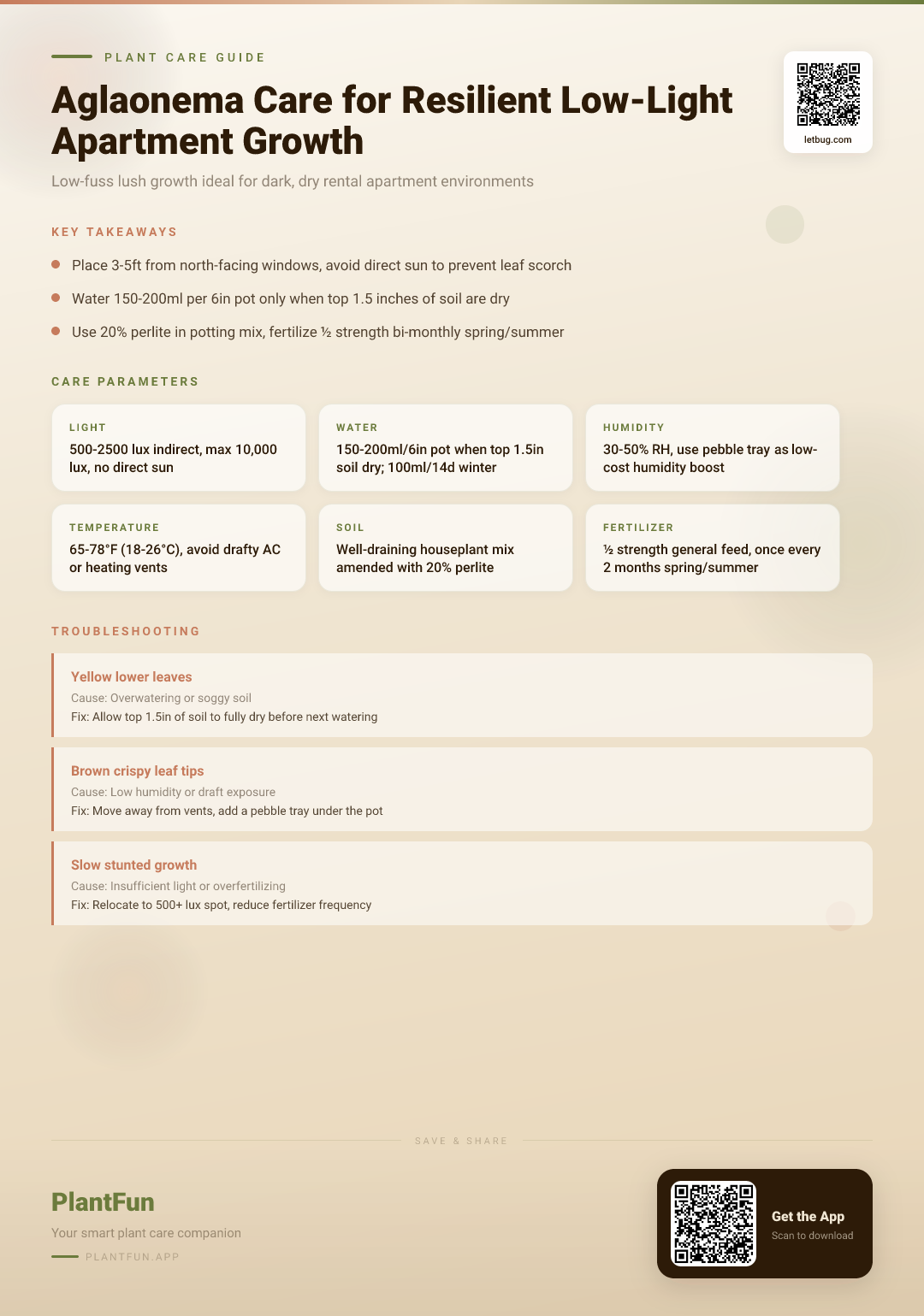
Key Takeaways
- Check soil moisture before watering — overwatering is the #1 killer of houseplants.
- Ensure your plant gets the right amount of light for its species.
- Be patient with recovery — most plants need 2–4 weeks to bounce back.
Quick Care Card
| Care Category | Exact Apartment-Friendly Thresholds |
|---|---|
| Light | 500-2500 lux low indirect light, max 10,000 lux indirect, no direct sun exposure (NC State Extension, 2026) |
| Water | 150-200ml per 6in pot when top 1.5in of soil is dry; 100ml every 14 days in winter heating months |
| Humidity | 30-50% relative humidity, no humidifier required |
| Temperature | 65-78°F (18-26°C), avoid drafty vents or exterior doors |
| Soil | 80% standard well-draining potting mix + 20% perlite |
| Fertilizer | ½ strength general houseplant fertilizer every 2 months spring/summer, no fertilizer fall/winter |
| Toxicity | Mildly toxic to cats, dogs, and humans if ingested (ASPCA, 2026) |
Why Aglaonema Thrives (or Fails) in Typical Apartments
Aglaonema (also called Chinese Evergreen) is native to the tropical Southeast Asian understory, where it grows in dappled low light, consistent warm temperatures, and moderate humidity. Most rental apartments closely match its preferred temperature range (65-78°F) but often have lower 30-40% humidity, low indirect light, and temperature swings from AC or heating systems.
Myth vs Reality: Contrary to popular generic houseplant advice, Aglaonema does not require 60%+ humidity to thrive. Per a 2016 study of indoor Aglaonema growth, it adapts easily to 30% humidity with minor, low-cost adjustments (Ghate, 2016). This makes Chinese Evergreen care for apartments far simpler than most tropical houseplant options, making it ideal for Aglaonema care for beginners.
60-Second Symptom Pre-Check
Diagnose common issues in under a minute with this symptom-to-action guide:
Yellow Lower Leaves
Symptom: Soft, yellow leaves at the base of the plant, no brown spotting on edges.
Likely cause: Overwatering, the most common Aglaonema issue in dry apartments where owners overcompensate for low humidity.
Fix:
- Stop watering immediately, and poke 3-4 holes 2 inches deep in the soil with a chopstick to aerate and speed drying
- Only water again when the top 1.5 inches of soil feel completely dry to the touch
Brown Leaf Tips
Symptom: Crispy, light brown tips on otherwise green, healthy leaves, no yellow halo around the brown area.
Likely cause: Low humidity or salt buildup from tap water or over-fertilizing.
Fix:
- Trim brown tips with clean scissors, leaving a 1mm sliver of brown to avoid damaging healthy leaf tissue
- Place your plant on a pebble tray filled with ½ inch of water, making sure the pot’s drainage holes do not sit in water
Drooping Stems
Symptom: Limp, soft stems that hang downward, soil feels completely dry when you insert your finger 1.5 inches deep.
Likely cause: Underwatering, common during winter heating months when soil dries slower but owners wait too long between waterings.
Fix:
- Pour 150ml of room-temperature water evenly across the soil surface for a 6in pot
- Wait 24 hours; if stems are still drooping, add an extra 50ml of water
Pale Faded Foliage
Symptom: Faded, washed-out leaf color, especially on variegated Aglaonema varieties, with brown scorch spots on leaf surfaces.
Likely cause: Too much direct sun exposure, common when plants are placed within 1ft of south or west-facing windows.
Fix:
- Move the plant 3-5ft away from the window, or filter light with a sheer curtain
- Remove any severely scorched leaves to redirect energy to new growth
Light Setup for Apartments
Aglaonema is one of the most tolerant low-light houseplants, with ideal light levels for apartments ranging from 500-2500 lux of low indirect light, with a maximum of 10,000 lux indirect (NC State Extension, 2026). This is well within the light range of most north-facing apartment windows.
Aglaonema Apartment Placement Tips
- Place 3-5ft from a north-facing window for optimal low-light growth
- Place 5-8ft from south or west-facing windows, or behind a sheer curtain to block direct sun
- Quick light test: If you can read a book comfortably in the spot during the day without turning on artificial light, it has enough light for Aglaonema resilient growth tips.
Watering Schedule for Dry Apartment Air
If you’ve ever wondered how often to water Aglaonema, forget generic weekly watering schedules. Follow these measurable, apartment-specific rules:
- For a standard 6in potted Aglaonema, water 150-200ml only when the top 1.5 inches of soil feel completely dry to the touch (Ghate, 2016)
- Adjust to 100ml every 14 days during winter heating months, when indoor air is drier but soil dries slower due to reduced plant growth
- Quick test: Insert your index finger 1.5 inches into the soil; if it feels damp at all, wait 2-3 more days before watering.
Humidity & Temperature Adjustments
Aglaonema in low humidity apartments thrive without expensive whole-home humidifiers. Follow these rules:
- Maintain 30-50% relative humidity, which is standard for most rental apartments. If you notice frequent brown tips, use a low-cost pebble tray (fill a tray with pebbles and ½ inch of water, set the pot on top of the pebbles so drainage holes do not touch the water)
- Keep temperatures between 65-78°F (18-26°C) year-round (NC State Extension, 2026)
- Keep your plant at least 3ft away from drafty AC vents, heating vents, and exterior doors that open frequently in winter or summer, as sudden temperature swings cause stress.
Soil & Fertilizer Rules for Potted Aglaonema
Use this simple Aglaonema soil mix for potted plants to avoid overwatering issues:
- Mix 80% standard well-draining potting mix with 20% perlite to improve drainage and aeration
- Ensure your pot has at least one drainage hole to prevent standing water at the root zone
- Fertilize once every 2 months in spring and summer only, using ½ strength general houseplant fertilizer. Skip fertilization entirely in fall and winter, when plant growth slows.
Seasonal Care Calendar
Adjust your care routine to match apartment seasonal climate shifts:
- March (Spring): Resume fertilizing, check soil moisture 1x per week as growth picks up
- April-June (Late Spring/Early Summer): Follow standard 150-200ml watering rule, wipe leaves with a damp cloth monthly to remove dust
- July-August (Summer): Aglaonema summer watering schedule: increase watering frequency slightly if temperatures stay above 75°F for more than 3 consecutive days, keep away from AC vents
- September-October (Fall): Stop fertilizing, reduce watering amount as growth slows
- November-February (Winter): Follow Aglaonema winter care rules: water 100ml every 14 days, keep 3ft away from heating vents, avoid cold drafts from exterior doors
7 Common Apartment Aglaonema Mistakes to Avoid
- Mistake: Overwatering on a fixed schedule without testing soil moisture What happens: Root rot, yellow lower leaves, and eventual plant death, the #1 cause of Aglaonema failure in apartments Instead: Test soil moisture by inserting your finger 1.5 inches deep, only water when it is completely dry
- Mistake: Placing your Aglaonema within 1ft of heating or AC vents What happens: Extreme temperature swings and dry air cause brown leaf tips and drooping stems Instead: Keep your plant at least 3ft away from all vents and drafty exterior doors
- Mistake: Repotting your Aglaonema more than once every 2-3 years What happens: Root shock from excess soil that holds too much moisture, leading to stunted growth and yellow leaves Instead: Only repot when roots are growing out of the drainage holes, and move up just 1 pot size (1-2 inches larger)
- Mistake: Using full-strength fertilizer or fertilizing in winter What happens: Salt buildup in the soil causes brown leaf tips and burned root systems Instead: Use ½ strength fertilizer only once every 2 months in spring and summer, skip fertilization entirely in fall and winter
- Mistake: Exposing your Aglaonema to direct sun for more than 1 hour per day What happens: Scorched, faded leaves and loss of variegation on colorful varieties Instead: Place your plant 3-5ft from north-facing windows, or behind a sheer curtain if near south/west-facing windows
- Mistake: Using tap water with high chlorine or fluoride content What happens: Brown leaf tips and stunted growth over time Instead: Use rainwater, filtered water, or leave tap water out overnight to let chemicals evaporate before watering
- Mistake: Wiping leaves with commercial leaf shine products What happens: Clogged leaf pores reduce the plant’s ability to filter indoor air (Ghate, 2016) Instead: Wipe leaves with a damp, lint-free cloth once a month to remove dust
FAQ
Why is my Aglaonema leaves turning yellow in my apartment?
The most common cause is overwatering, especially if the yellow leaves are soft and located at the base of the plant (NC State Extension, 2026). First, check the top 1.5 inches of soil: if it feels damp, stop watering immediately and aerate the soil with a chopstick to speed drying. Other possible causes include cold drafts from AC or heating vents, or recent repotting shock.
Can I keep an Aglaonema in a windowless apartment office?
Yes! This is one of the most common questions about Aglaonema low light apartment care, and the answer is yes. Aglaonema will grow well under standard overhead fluorescent office lighting as long as it gets 8-10 hours of light per day (Ghate, 2016). Water slightly less frequently (100ml per 6in pot every 18 days) since soil dries slower in windowless spaces.
How often do I need to water my Aglaonema in winter?
For a standard 6in potted Aglaonema in a typical heated apartment (30-40% humidity, 65-70°F), water 100ml every 14 days, only if the top 1.5 inches of soil is completely dry (NC State Extension, 2026). Avoid watering on a fixed schedule, always test soil moisture first, as apartments with very strong heating may dry out slightly faster.
Final Printable 12-Point Care Checklist
Save or tape this quick reference near your plant for stress-free Aglaonema care:
- Place your Aglaonema 3-5ft from a north-facing window, or 5-8ft from a south/west-facing window to avoid direct sun
- Ensure your plant gets 500-2500 lux of indirect light (test: you can read a book in the spot during the day without artificial light)
- Keep your plant at least 3ft away from heating vents, AC vents, and drafty exterior doors
- Maintain temperature between 65-78°F (18-26°C) year-round
- Use a well-draining soil mix of 80% standard potting mix + 20% perlite
- Only water when the top 1.5 inches of soil feel completely dry to the touch
- Water 150-200ml per 6in pot during spring and summer, 100ml per 6in pot during winter
- Place your plant on a pebble tray with water to maintain 30-50% relative humidity, no humidifier needed
- Fertilize with ½ strength general houseplant fertilizer once every 2 months in spring and summer only
- Trim brown leaf tips with clean scissors, leaving a 1mm sliver of brown to avoid damaging healthy tissue
- Wipe leaves with a damp cloth once a month to remove dust, avoid commercial leaf shine products
- Repot only once every 2-3 years, moving up just 1 pot size when roots grow out of drainage holes
References
- NC State Extension. (2026). The Complete Aglaonema Care — NC State Extension Gardener Plant Toolbox. https://plants.ces.ncsu.edu/plants/aglaonema-care/. Accessed 2026-02-27.
- Ghate, S. (2016). Assessment of Phytoremediating Potential of Aglaonema commutatum Schott for Indoor Pollutants. INTERNATIONAL JOURNAL OF PLANT AND ENVIRONMENT. https://doi.org/10.18811/ijpen.v2i1-2.6622. Accessed 2026-02-27.
- Šrámek, F. (1999). Vaughan, M.J.: The Complete Book on Cut Flower Care. Biologia plantarum. https://doi.org/10.1023/a:1001770114931. Accessed 2026-02-27.
- ASPCA. (2026). Toxic and Non-Toxic Plants List — ASPCA. https://www.aspca.org/pet-care/animal-poison-control/toxic-and-non-toxic-plants. Accessed 2026-02-27.
Optional Helper: Plantfun.App
Plantfun.App identifies your plants by photo, diagnoses pests and diseases with clear fixes, and creates personalised watering and light schedules that adapt to your home conditions — a handy companion for putting this guide into daily practice.
Found an error or have suggestions? We'd love your feedback.
Need help identifying this problem?
Get instant identification, personalized care schedules, and effective pest treatment plans directly on your phone.
Sponsored • We may earn a commission from app downloads
Related Guides
The Complete Aglaonema Care Guide for 1-Bedroom Apartments: Seasonal Tips for Resilient Growth
Grow a lush, hardy Aglaonema even in a small, low-light apartment. Get exact light, water, and humidity thresholds plus a 4-season care checklist to avoid yellow leaves and stunted growth.
Care GuideThe Complete Aglaonema Care Checklist for Resilient Growth in Low-Light Urban Apartments
Keep your Aglaonema thriving even in dark, dry urban apartments. Get a free printable checklist, exact light/water thresholds, and 7 fast fixes for common leaf symptoms to boost resilient growth.
Care GuideThe Complete Budget Aglaonema Care Checklist for Resilient Growth in Low-Light Apartments
Grow lush, hard-to-kill Aglaonema in your low-light apartment for under $10 total. Get exact light, water, and soil parameters plus a free printable checklist to avoid common care mistakes.
Pest ControlAnts on Plants: What They Mean and What to Do
Ants usually aren't eating your plant. They are farming other pests.