
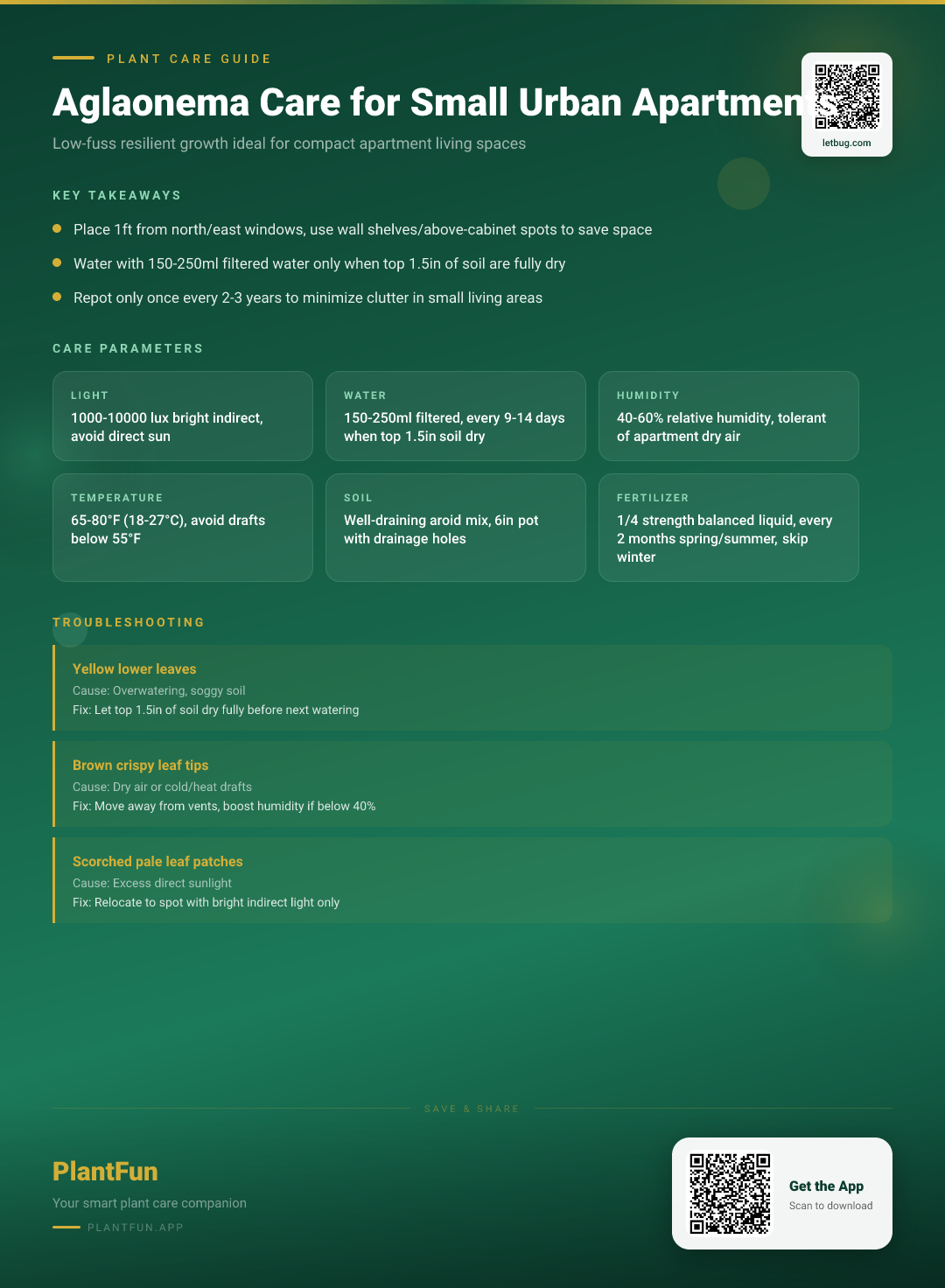
Key Takeaways
- Check soil moisture before watering — overwatering is the #1 killer of houseplants.
- Ensure your plant gets the right amount of light for its species.
- Be patient with recovery — most plants need 2–4 weeks to bounce back.
Quick Care Card
| Care Category | Small Apartment Specific Rule |
|---|---|
| Light | 1,000–10,000 lux bright indirect light, no more than 1 hour of early morning direct sun |
| Water | 150–250ml filtered water only when the top 1.5 inches of soil are completely dry, typically every 9–14 days |
| Humidity | 40–60% relative humidity, no need for expensive humidifiers for most apartment environments |
| Temperature | 65–80°F (18–27°C), avoid spots where temps drop below 55°F (13°C) |
| Soil | Well-draining aroid mix, store extra soil under your sink to save counter space |
| Fertilizer | 1/4 strength balanced liquid fertilizer once every 2 months in spring and summer, skip winter feeding entirely |
| Placement | Wall-mounted shelves, above kitchen cabinets, or 1ft from north/east-facing windows to save floor/counter space |
| Toxicity | Toxic to cats, dogs, and humans if ingested (ASPCA, 2026), place out of reach of pets and small children |
Why Aglaonema Is Perfect for Small Urban Apartments
If you’ve struggled to keep houseplants alive in your 500-700 sq ft apartment, Aglaonema (also called Chinese evergreen) is made for you. A common myth says you need sunny windowsills and lots of extra space to grow lush foliage, but the reality is Aglaonema’s compact growth habit (most stay under 12 inches tall when pruned regularly) and tolerance for fluctuating indoor conditions make it ideal for small space houseplant care.
It thrives in the low to medium bright indirect light common in most urban apartments, requires minimal upkeep, and even filters common indoor volatile organic compounds (VOCs) from paint and cleaning products (Ghate, 2016). This Aglaonema care checklist is tailored specifically to the unique constraints of small apartment living, with no generic, one-size-fits-all advice.
Step 1: Optimal Small-Space Placement for Maximum Light Exposure
Aglaonema light requirements sit between 1,000–10,000 lux of bright indirect light (NC State Extension, 2026), which is easy to achieve even with limited window space. The best spots for your plant are:
- 1ft away from north or east-facing windows, where it gets gentle morning light without harsh midday sun
- Wall-mounted floating shelves at eye level, which use unused vertical space and keep the plant out of reach of pets
- Above upper kitchen cabinets, where it gets reflected light from your ceiling and counter tops
Quick test: Download a free lux meter app on your phone and measure light at your chosen spot midday on a sunny day. If it’s under 1,000 lux, the spot is too dark, and if it’s over 10,000 lux, direct sun will burn the leaves. If you have no bright window spots, you can even grow Aglaonema in low light apartments with a 10W LED grow light mounted above your shelf.
Step 2: Exact Watering Schedule for Apartment Dry Air
Wondering how often to water Aglaonema in a forced-air heated or air-conditioned apartment? The answer depends on your space’s temperature and light levels, but the rule of thumb is to water with 150–250ml of filtered, room-temperature water only when the top 1.5 inches of soil are completely dry (NC State Extension, 2026). For most 500-700 sq ft apartments, this translates to every 9–14 days.
Quick test: Stick your index finger 1.5 inches into the soil. If it feels completely dry to the touch, it’s time to water. If it’s even slightly damp, wait 2–3 days and check again. If you run your heat constantly in winter or your AC all summer, you may need to water 1–2 days earlier than usual, as forced air dries out soil faster.
Step 3: Humidity & Temperature Thresholds for Apartment Microclimates
Aglaonema humidity needs are between 40–60% relative humidity, which is the average range for most heated and cooled urban apartments (NC State Extension, 2026). You only need to mist your plant once a week if you use a hygrometer and measure humidity below 35% for more than 3 days in a row.
Aglaonema temperature tolerance ranges from 65–80°F (18–27°C) during the day, and no lower than 55°F (13°C) at night (NC State Extension, 2026). Never place your plant within 2ft of drafty windows, exterior doors, heating vents, or AC units, as sudden temperature fluctuations will cause leaf drop and yellowing.
Step 4: Space-Saving Soil & Potting Tips
To avoid wasting valuable counter or storage space, follow these potting rules:
- Use a 6-inch wide terracotta or plastic pot with drainage holes for mature Aglaonemas. This size is small enough to fit on most shelves and prevents overwatering.
- Use a pre-mixed well-draining aroid soil, and store any leftover soil in a sealed 1-gallon bag under your kitchen or bathroom sink, so it doesn’t take up cabinet or counter space.
- Only size up your pot by 2 inches when repotting, to avoid wasting space on oversized pots that hold excess moisture and cause root rot.
Step 5: Low-Effort Fertilizing Routine for Busy Apartment Dwellers
Aglaonema is a slow-growing plant, so it doesn’t need frequent fertilizing to stay lush. For Aglaonema care for beginners, the simplest routine is to dilute a balanced liquid houseplant fertilizer to 1/4 of the recommended strength, and apply it once every 2 months only during spring and summer (NC State Extension, 2026). Skip all fertilizing in fall and winter, when the plant is dormant and won’t absorb extra nutrients.
Seasonal Care Calendar for Small Apartment Aglaonema
Adjust your care routine throughout the year to match your apartment’s changing microclimate:
- January–February (Winter): Aglaonema winter care requires watering every 14–18 days, no fertilizing, and keeping the plant at least 3ft away from heating vents to avoid leaf scorch.
- March–April (Spring): Increase watering to every 10–14 days, and apply your first fertilizer application when daytime hours extend to 12 hours or longer.
- May–August (Summer): Aglaonema summer watering falls every 8–12 days, and you should keep the plant 2ft away from AC units to avoid cold drafts.
- September–October (Fall): Reduce watering to every 12–16 days, and stop fertilizing when daytime hours drop below 11 hours.
- November–December (Early Winter): Water every 14–20 days, and move the plant away from drafty windows if nighttime temps drop below 55°F.
You only need to repot your Aglaonema once every 2–3 years, so you don’t have to make space for new pots annually.
Common Small-Apartment Aglaonema Mistakes to Avoid
- Mistake: Watering on a fixed weekly schedule instead of checking soil moisture first What happens: Overwatering is the top cause of yellow leaves and root rot in Aglaonemas, and weekly watering is too frequent for most low-light, cool apartment environments. Instead: Check the top 1.5 inches of soil every 7 days, and only water when it’s completely dry, using 150–250ml of filtered water per watering.
- Mistake: Placing your Aglaonema in dark hallways or corners with <500 lux of light What happens: Stunted growth, loss of variegation, and increased risk of fungus gnat infestations. Instead: Mount a floating shelf 1ft from a north or east-facing window, or use a low-wattage grow light if you have no bright window space.
- Mistake: Using an oversized 10+ inch pot to avoid repotting later What happens: The pot takes up valuable floor or counter space, and excess soil holds too much moisture leading to root rot. Instead: Stick to a 6-inch pot for mature plants, only sizing up by 2 inches when you repot every 2–3 years.
Frequently Asked Questions
Can I keep my Aglaonema on my tiny apartment windowsill that gets 1 hour of direct sun a day?
Yes, as long as the direct sun is early morning sun (before 10am). Afternoon direct sun is much stronger and will burn the edges of your Aglaonema’s leaves (NC State Extension, 2026). If your windowsill gets afternoon sun, hang a cheap sheer curtain to filter the light and keep lux levels under 10,000.
Why is my Aglaonema getting yellow leaves when I only water it once a week?
Weekly watering is almost always too frequent for Aglaonemas in small apartments, especially if your space has low light or cool temperatures. The top 1.5 inches of soil likely stays damp for longer than 7 days, leading to overwatering and root rot, which causes yellow leaves (NC State Extension, 2026). Let the soil dry out completely before your next watering, and make sure your pot has working drainage holes to let excess water escape.
How do I prune my Aglaonema to keep it compact for my small space?
Learning how to keep Aglaonema compact is simple: use clean, sharp scissors to cut overgrown stems at the base, just above the soil line. Remove any yellow or brown leaves as they appear, and cut off the top 2–3 inches of tall, leggy stems to encourage bushier, shorter growth. Regular pruning will keep your Aglaonema under 12 inches tall, so it fits easily on shelves or small windowsills without taking over your space.
References
- NC State Extension. (2026). The Complete Aglaonema Care — NC State Extension Gardener Plant Toolbox. https://plants.ces.ncsu.edu/plants/aglaonema-care/. Accessed 2026-03-05.
- Ghate, S. (2016). Assessment of Phytoremediating Potential of Aglaonema commutatum Schott for Indoor Pollutants. INTERNATIONAL JOURNAL OF PLANT AND ENVIRONMENT. https://doi.org/10.18811/ijpen.v2i1-2.6622. Accessed 2026-03-05.
- Šrámek, F. (1999). Vaughan, M.J.: The Complete Book on Cut Flower Care. Biologia plantarum. https://doi.org/10.1023/a:1001770114931. Accessed 2026-03-05.
- ASPCA. (2026). Toxic and Non-Toxic Plants List — ASPCA. https://www.aspca.org/pet-care/animal-poison-control/toxic-and-non-toxic-plants. Accessed 2026-03-05.
Optional Helper: Plantfun.App
Plantfun.App identifies your plants by photo, diagnoses pests and diseases with clear fixes, and creates personalised watering and light schedules that adapt to your home conditions — a handy companion for putting this guide into daily practice.
Found an error or have suggestions? We'd love your feedback.
Need help identifying this problem?
Get instant identification, personalized care schedules, and effective pest treatment plans directly on your phone.
Sponsored • We may earn a commission from app downloads
Related Guides
The Complete Aglaonema Care Guide for 1-Bedroom Apartments: Seasonal Tips for Resilient Growth
Grow a lush, hardy Aglaonema even in a small, low-light apartment. Get exact light, water, and humidity thresholds plus a 4-season care checklist to avoid yellow leaves and stunted growth.
Care GuideThe Complete Aglaonema Care Checklist for Small Urban Apartments Under $20 a Year
Grow lush, resilient Aglaonema in your small urban apartment without expensive specialty products. Follow our free 12-step checklist, exact care thresholds, and zero-waste budget tips to avoid yellow leaves and stunted growth.
Care GuideThe Complete Aglaonema Care Checklist for Resilient Growth in Small Apartments
Grow lush, low-fuss Aglaonema even in cramped city apartments with this science-backed checklist, including exact light, water, and soil parameters for resilient, pest-free growth.
Pest ControlAnts on Plants: What They Mean and What to Do
Ants usually aren't eating your plant. They are farming other pests.