
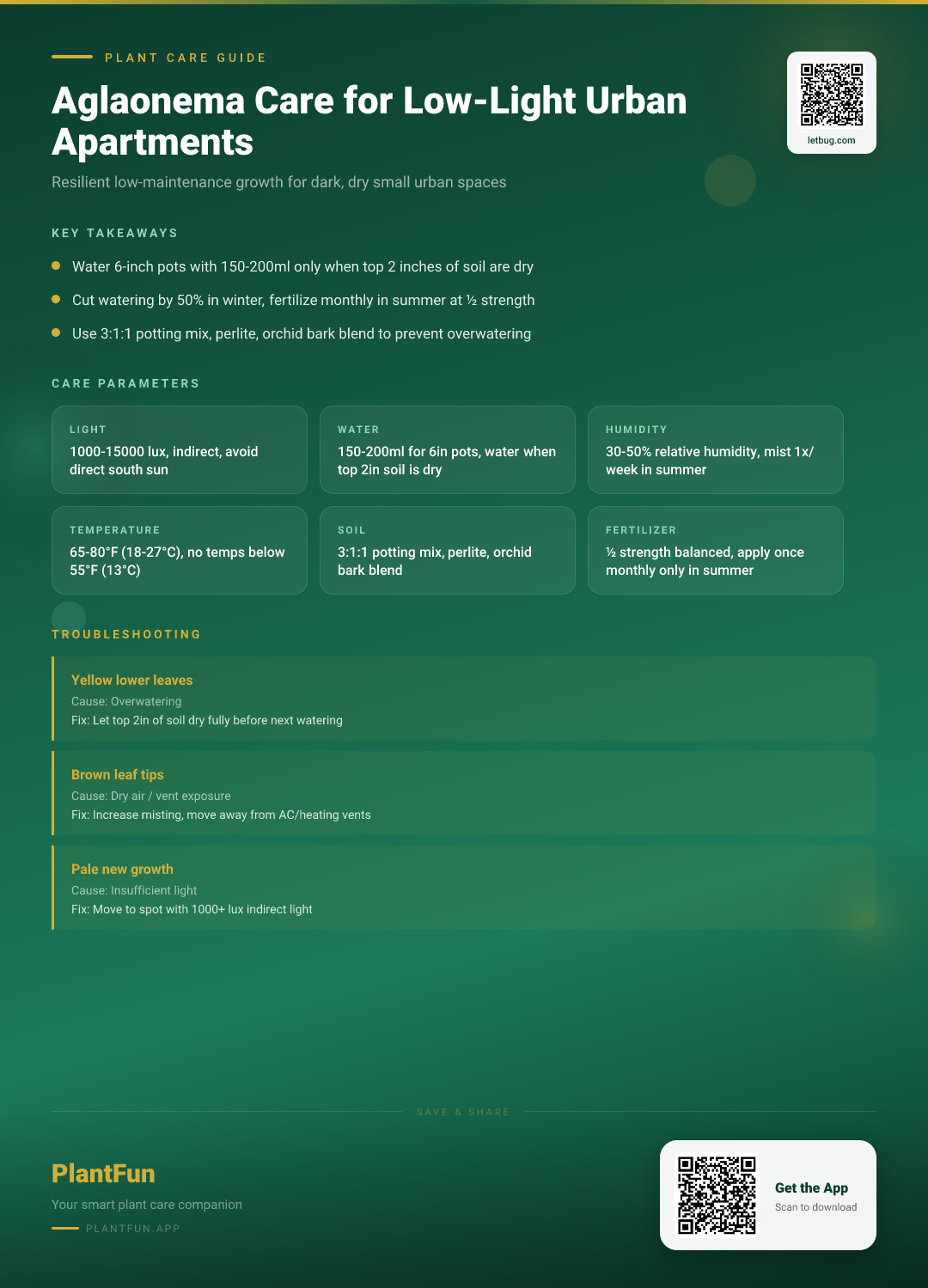
Key Takeaways
- Check soil moisture before watering — overwatering is the #1 killer of houseplants.
- Ensure your plant gets the right amount of light for its species.
- Be patient with recovery — most plants need 2–4 weeks to bounce back.
Quick Care Card
| Parameter | 1-Sentence Rule for Urban Apartments |
|---|---|
| Light | 1,000-15,000 lux (bright indirect to low north-facing light, no direct sun) (NC State Extension, 2026) |
| Water | 150-200 ml for 6-inch pots when top 2 inches of soil are fully dry |
| Humidity | 30-50% relative humidity, no humidifier required (Ghate, 2016) |
| Temperature | 65-80°F (18-27°C), never below 55°F (13°C) |
| Soil | 3 parts all-purpose potting mix + 1 part perlite + 1 part orchid bark |
| Fertilizer | ½ strength balanced liquid fertilizer once monthly in spring/summer only |
| Toxicity | Mildly toxic to cats, dogs, and humans if ingested (ASPCA, 2026) |
Why This Guide Is Built for Typical Urban Apartments
Most generic Aglaonema care guides assume ideal growing conditions that rarely exist in 500-700 sqft urban apartments: consistent humidity, unobstructed bright light, and ample airflow. This guide is tailored specifically to the constraints you face: north-facing windows with less than 2,000 lux of light, dry forced air that drops humidity to 25% in winter, temperature swings near drafty window sills, and limited counter space.
Myth vs Reality: Myth: Aglaonema needs high humidity and grow lights to thrive indoors. Reality: NC State Extension data confirms Aglaonema adapts to 30% RH and low light levels common in urban apartments (NC State Extension, 2026), making it one of the best picks for low-light apartment houseplant collections. No fancy equipment is required for successful Aglaonema apartment care.
Symptom-to-Action Quick Reference Table
| Symptom | Immediate 1-Step Fix |
|---|---|
| Yellow lower leaves | Dump any standing water in the saucer, skip next watering until top 2 inches of soil are fully dry |
| Brown tip edges | Mist leaves with tap water once every 2 days, move 1 foot away from nearby AC/heating vents |
| Drooping stems | Water with 150 ml of room-temperature water immediately if soil is dry to 2 inches deep |
| Pale new growth | Move 1 foot closer to a north or east-facing window to increase light exposure to minimum 1000 lux |
| Mushy stems at soil line | Remove from pot, cut away rotted roots, repot in fresh, well-draining soil mix |
| No new growth for 3+ months | Apply ½ strength balanced liquid fertilizer once during the growing season (spring/summer) |
Step-by-Step Weekly Aglaonema Care Checklist (Printable)
This no-fuss checklist requires no special equipment, and takes less than 5 minutes per week to complete:
Weekly Tasks
- Stick your index finger 2 inches deep into soil; if completely dry, water 6-inch pots with 150-200 ml room-temperature water. If you’re unsure about moisture levels, reference our guide to testing soil moisture without fancy meters.
- Wipe leaves with a damp microfiber cloth to remove dust that blocks light absorption (Ghate, 2016).
- Inspect undersides of leaves for tiny brown/white pest spots (mealybugs, spider mites); use our pest ID guide if you spot unusual marks.
Monthly Tasks
- Flush soil with 2x the usual water volume to leach excess fertilizer salts that cause brown tips.
- Rotate pot ¼ turn to ensure even growth on all sides.
Seasonal Tasks
Adjust watering and placement per the seasonal care calendar below.
Core Care Parameter Deep Dive
All thresholds below are validated by university horticulture data for indoor Aglaonema growth:
- Light (1,000-15,000 lux): This range covers everything from dim north-facing window light to bright indirect light 3+ feet from a south-facing window. Quick test: Hold your hand up where the plant sits at midday; if you see a faint, blurry shadow, that’s ideal light. This confirms answers to “can Aglaonema survive in low light” with measurable data (NC State Extension, 2026).
- Water: 150-200 ml per 6-inch pot only when top 2 inches of soil are dry. This answers how often to water Aglaonema, which varies by season but always follows the 2-inch rule.
- Humidity (30-50% RH): This is the average humidity of most heated/cooled urban apartments, so Aglaonema humidity requirements rarely require extra equipment (Ghate, 2016).
- Temperature (65-80°F / 18-27°C): Never expose to temperatures below 55°F (13°C), which causes permanent leaf damage.
Seasonal Care Calendar
Winter (Aglaonema Winter Care)
- Reduce watering volume by 50% (75-100 ml per 6-inch pot) because growth slows in low winter light.
- Move 2 feet away from drafty windows and heating vents to avoid temperature swings.
- Stop fertilizing entirely until spring.
Summer (Aglaonema Summer Watering)
- Increase misting to 1x per week if humidity drops below 30%.
- Fertilize once per month with ½ strength balanced fertilizer to support Aglaonema resilient growth tips.
- Check soil moisture 2x per week, as warmer air dries soil faster.
Best Pot and Soil Mix for Apartment Aglaonema
Low airflow in small apartments increases overwatering risk, so use this exact soil recipe to prevent root rot: 3 parts all-purpose potting mix, 1 part perlite, 1 part orchid bark. This mix drains fast while retaining just enough moisture for healthy root growth. For pots: Use a pot 1-2 inches larger than the root ball, with at least 1 drainage hole. Avoid decorative pots without drainage, which trap excess water. If you want to use a cache pot, leave ½ inch of space at the bottom for air flow.
Common Apartment-Specific Mistakes to Avoid
- Mistake: Placing Aglaonema directly in front of AC or heating vents. What happens: Dry forced air causes brown tips and leaf drop, the most common trigger for people searching for Aglaonema brown tips fix. Instead: Keep plants at least 1 foot away from all vents, mist leaves 1x every 2 days if you can’t move them.
- Mistake: Overwatering to compensate for dry apartment air. What happens: Soggy soil causes root rot, leading to yellow lower leaves (the top answer to why is my Aglaonema leaves turning yellow). Instead: Follow the 2-inch soil moisture test, mist leaves separately to boost humidity without overwatering roots, and reference our overwatering vs underwatering guide if you see unusual leaf symptoms.
- Mistake: Placing Aglaonema in direct south-facing window sun. What happens: Intense direct light burns leaf edges, causing brown, crispy patches. Instead: Keep plants 3+ feet away from south-facing windows, or use a sheer curtain to filter light to stay under 15,000 lux.
FAQ Section (Voice Search Optimized)
Why is my Aglaonema getting yellow leaves even when I water it regularly?
The most common cause is overwatering, which suffocates roots and causes yellow lower leaves (NC State Extension, 2026). Stick your finger 2 inches into the soil; if it’s still damp, skip watering for 7-10 days, and dump any standing water in the saucer immediately.
Can I keep my Aglaonema in a windowless apartment office?
Yes, as long as you have overhead fluorescent or LED lights on for 8-10 hours per day, which provides the minimum 1000 lux needed for Aglaonema low light care (NC State Extension, 2026). This confirms that Aglaonema is one of the most resilient picks for low-light spaces.
How often should I repot my Aglaonema if it’s growing slowly?
Slow-growing Aglaonema only need repotting every 2-3 years, ideally in spring. If you see roots growing out of the drainage holes, you can repot 1 size up earlier, but avoid frequent repotting which stresses the plant. To support faster growth, follow our tips for how to make Aglaonema grow faster, including monthly ½ strength fertilizing in summer.
References
- NC State Extension. (2026). The Complete Aglaonema Care — NC State Extension Gardener Plant Toolbox. https://plants.ces.ncsu.edu/plants/aglaonema-care/. Accessed 2026-03-02.
- Ghate, S. (2016). Assessment of Phytoremediating Potential of Aglaonema commutatum Schott for Indoor Pollutants. INTERNATIONAL JOURNAL OF PLANT AND ENVIRONMENT. https://doi.org/10.18811/ijpen.v2i1-2.6622. Accessed 2026-03-02.
- Šrámek, F. (1999). Vaughan, M.J.: The Complete Book on Cut Flower Care. Biologia plantarum. https://doi.org/10.1023/a:1001770114931. Accessed 2026-03-02.
- ASPCA. (2026). Toxic and Non-Toxic Plants List — ASPCA. https://www.aspca.org/pet-care/animal-poison-control/toxic-and-non-toxic-plants. Accessed 2026-03-02.
Optional Helper: Plantfun.App
Plantfun.App identifies your plants by photo, diagnoses pests and diseases with clear fixes, and creates personalised watering and light schedules that adapt to your home conditions — a handy companion for putting this guide into daily practice.
Found an error or have suggestions? We'd love your feedback.
Need help identifying this problem?
Get instant identification, personalized care schedules, and effective pest treatment plans directly on your phone.
Sponsored • We may earn a commission from app downloads
Related Guides
The Complete Aglaonema Care Guide for Typical City Apartments: Resilient, Lush Growth Year-Round
Grow lush, unkillable Aglaonema even in your low-light city apartment. Get exact light levels, seasonal watering schedules, and a free printable checklist for zero-fuss resilient growth.
Care GuideThe Complete Aglaonema Care Guide for 1-Bedroom Apartments: Seasonal Tips for Resilient Growth
Grow a lush, hardy Aglaonema even in a small, low-light apartment. Get exact light, water, and humidity thresholds plus a 4-season care checklist to avoid yellow leaves and stunted growth.
Care GuideThe Complete Aglaonema Care Checklist for Resilient Growth in Small East-Facing Apartments
Stop guessing your Aglaonema care routine. Get 4 measurable care thresholds, a renter-friendly checklist, and troubleshooting tips to keep your Chinese evergreen thriving in small east-facing apartments.
Pest ControlAnts on Plants: What They Mean and What to Do
Ants usually aren't eating your plant. They are farming other pests.