
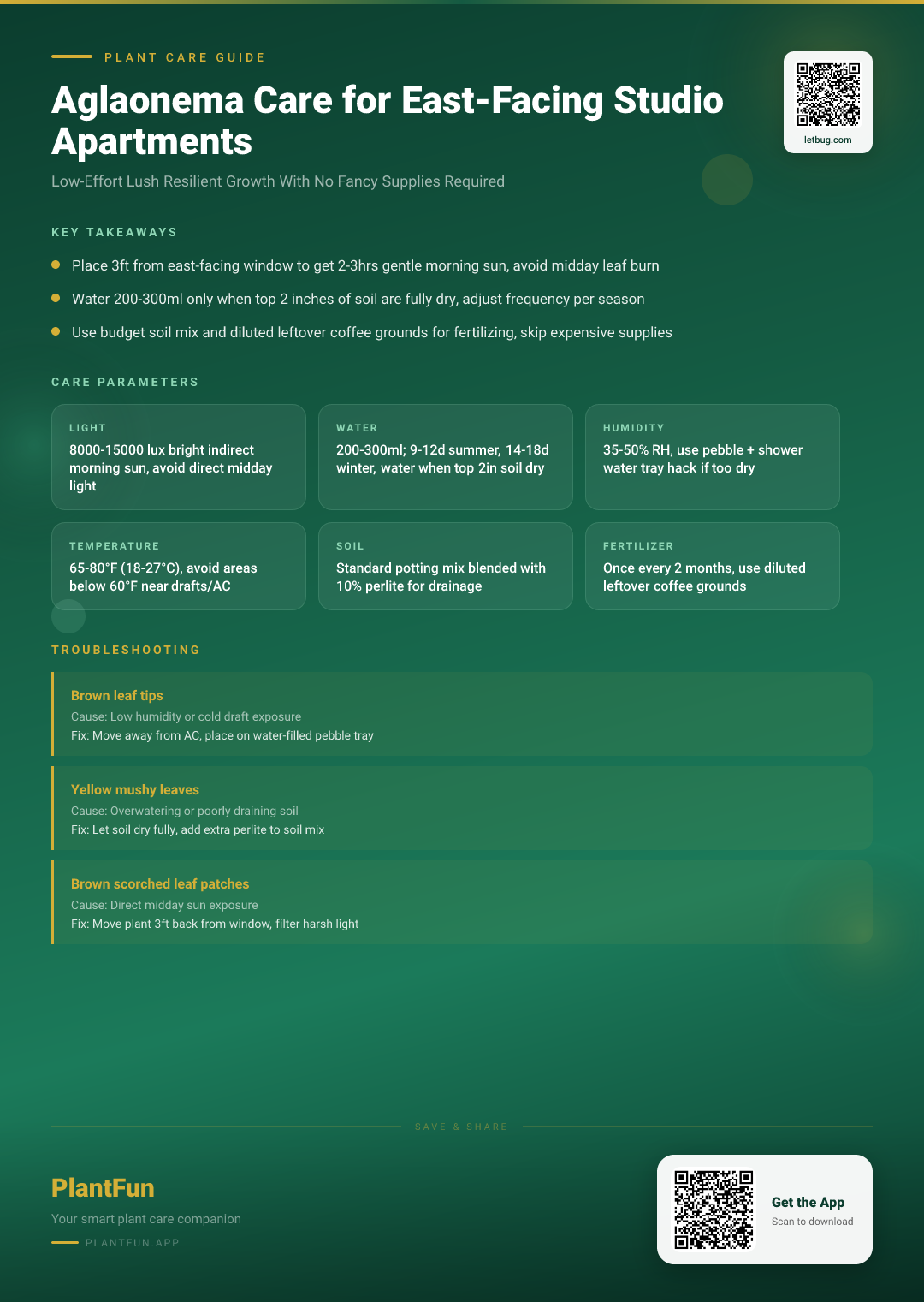
Key Takeaways
- Check soil moisture before watering — overwatering is the #1 killer of houseplants.
- Ensure your plant gets the right amount of light for its species.
- Be patient with recovery — most plants need 2–4 weeks to bounce back.
Quick Care Card
| Category | Exact Threshold |
|---|---|
| Light | 8,000-15,000 lux, 2-3 hours of gentle morning sun (NC State Extension, 2026) |
| Water | 200-300ml room-temperature water when top 2 inches of soil are fully dry; 9-12 days summer, 14-18 days winter |
| Humidity | 35-50% relative humidity (Ghate, 2016) |
| Temperature | 65-80°F (18-27°C); avoid exposure to temps below 60°F (15°C) (NC State Extension, 2026) |
| Soil | 90% standard potting mix + 10% repurposed perlite for drainage |
| Fertilizer | Diluted leftover coffee grounds every 2 months during growing season; no commercial fertilizer needed |
| Toxicity | Toxic to cats, dogs, and humans if ingested (ASPCA, 2026) |
Why Aglaonema Thrives in East-Facing Studio Apartments
Native to Southeast Asian tropical understory habitats, Aglaonema are perfectly adapted to the unique conditions of east-facing studio apartments. The 2-3 hours of soft, unfiltered morning sun from east windows aligns exactly with their preference for bright, non-harsh light, while the typical 35-40% relative humidity of most indoor spaces falls well within their tolerance range (Ghate, 2016). This makes Aglaonema care for beginners extremely accessible, even for plant parents who forget to water half the time.
Myth vs. Reality: A common misconception is that Aglaonema need 60%+ humidity to survive. In reality, their thick, waxy leaves retain moisture exceptionally well, so they thrive in standard studio humidity with no special equipment required (NC State Extension, 2026). Note: ASPCA classifies Aglaonema as toxic to pets and humans if ingested, so keep plants out of reach of toddlers and curious cats or dogs (ASPCA, 2026).
Understanding the Science
A 2016 study of Aglaonema commutatum found that the species evolved to grow in filtered understory light levels of 7,000-18,000 lux, with a preferred humidity range of 30-55% (Ghate, 2016). These parameters are almost identical to the conditions found in most east-facing studio apartments, which is why this plant is such a low-fuss option for small space dwellers.
Step 1: Light Tuning for Optimal Growth
Ideal Aglaonema light levels for east-facing apartments fall between 8,000-15,000 lux, which is exactly the light available 2-3ft from an unobstructed east window during morning hours (NC State Extension, 2026). If midday sun (11am-3pm) spills onto your plant’s leaves, move it 3ft further away from the window to avoid brown, crispy leaf burn.
Quick test: Hold your hand 6 inches above the plant’s canopy at 12pm. If you see a sharp, defined shadow, the light is too harsh. If you see a soft, blurry shadow or no shadow at all, the light is perfect. If you have very limited light, rest assured that Aglaonema can grow in low light, though growth will be slower than in ideal conditions.
Step 2: Exact Watering Schedule for Studio Conditions
Wondering how often to water Aglaonema in your east-facing studio? Follow this measurable rule: Only water when the top 2 inches of soil are completely dry, using 200-300ml of room-temperature water poured directly onto the soil (avoid wetting the leaves to prevent fungal spots).
For most studio conditions, this translates to:
- Aglaonema summer watering: Every 9-12 days, when temperatures stay above 70°F
- Winter: Every 14-18 days, when heating systems dry out soil more slowly (NC State Extension, 2026)
Quick test: Stick your index finger 2 inches deep into the soil. If any moisture sticks to your finger, wait 2 more days before watering.
Step 3: Budget Humidity Hacks (No Humidifier Needed)
Aglaonema humidity requirements only fall between 35-50%, so you will rarely need to adjust humidity in a standard studio (Ghate, 2016). If your space is extra dry (e.g., during winter heating season), use these zero-cost hacks to hit the ideal range:
- Pebble tray hack: Grab a shallow tray, fill with pebbles collected from outdoors or repurposed from old planters, and pour leftover shower runoff water into the tray until it covers the bottom half of the pebbles. Set your Aglaonema pot on top of the pebbles, making sure the drainage holes don’t touch the water. Evaporation will boost humidity around the plant by 5-10% for no cost.
- Group your Aglaonema with other houseplants: Transpiration from nearby plants will naturally raise humidity in the surrounding area.
Step 4: Soil & Fertilizer Budget Plan
This budget Aglaonema care plan costs less than $10 per year, with no fancy products required:
- Soil: Buy a $5 bag of standard all-purpose potting mix, and mix in 10% perlite repurposed from old houseplant soil (no need to buy new perlite) to improve drainage.
- Fertilizer: To make Aglaonema grow faster without commercial fertilizer, use diluted leftover coffee grounds once every 2 months during the growing season (March-October). Mix 1 cup of used coffee grounds with 4 cups of water, let sit for 24 hours, then pour half the mixture directly onto the soil around the base of the plant. This provides a gentle dose of nitrogen that matches Aglaonema’s low nutrient needs (NC State Extension, 2026).
Step 5: Temperature Care for Studio Drafts
Aglaonema prefer temperatures between 65-80°F (18-27°C) (NC State Extension, 2026). Never place your plant within 2ft of cold single-pane window sills, AC vents, or space heaters, where temperatures can drop below 60°F (15°C) or spike above 85°F, causing leaf damage or drop.
Quick test: Place a small thermometer near your plant for 1 hour. If the reading is below 60°F or above 85°F, move the plant to a more temperature-stable spot in your studio.
Seasonal Care Calendar for Studio Apartments
Use this month-by-month guide to adjust your care routine for seasonal changes:
- Jan-Feb (Winter): Follow Aglaonema winter care rules: Water every 14-18 days, skip fertilizer, add a pebble tray if heating dries out air, and move the plant 1ft closer to the east window to compensate for shorter days.
- Mar-Apr (Spring): Water every 10-12 days, start applying diluted coffee grounds fertilizer every 2 months, and check for new leaf growth.
- May-Aug (Summer): Water every 9-12 days, move the plant 3ft back from the window if harsh midday sun spills onto leaves, and skip extra humidity if your studio’s relative humidity stays above 45%.
- Sep-Oct (Fall): Gradually extend the gap between waterings to 12-16 days, stop fertilizer applications by the end of October, and move the plant 1ft closer to the window as light levels decrease.
- Nov-Dec (Early Winter): Water every 14-18 days, check for cold drafts near windows, and avoid placing the plant near space heaters or holiday decor that produces heat.
Common Budget Care Mistakes to Avoid
These cheap Aglaonema care tips will help you avoid the most common issues that kill Aglaonema in studio apartments:
- Mistake: Overwatering on a fixed schedule without checking soil moisture. What happens: Root rot, the #1 cause of Aglaonema death (NC State Extension, 2026). Instead: Always do the 2-inch finger soil test before watering, even if your calendar says it’s time.
- Mistake: Applying undiluted coffee grounds or fertilizing more often than every 2 months. What happens: Brown leaf tips and stunted growth from nutrient buildup. Instead: Always dilute coffee grounds with water, and skip fertilizer completely during winter months.
- Mistake: Buying expensive specialty tropical potting mix for your Aglaonema. What happens: Wasted money, as Aglaonema have no special soil needs. Instead: Use cheap standard potting mix mixed with repurposed perlite for drainage, which costs 75% less than specialty mixes.
- Mistake: Placing your plant within 1ft of a cold window sill in winter. What happens: Yellowing leaves and leaf drop from cold shock. Instead: Keep plants at least 2ft away from single-pane windows in winter, or hang a thin curtain between the plant and window to block cold drafts.
Frequently Asked Questions (Voice Search Optimized)
Why is my Aglaonema getting yellow leaves in my studio apartment?
The two most common causes for east-facing studio apartments are overwatering (if the top 2 inches of soil are still wet when you water) or exposure to cold drafts (if the plant is within 2ft of a window or AC vent where temps drop below 60°F) (NC State Extension, 2026). First check soil moisture: if it’s soggy, let it dry completely before watering again. If soil is dry, move the plant to a warmer spot away from drafts.
Can I keep my Aglaonema next to my studio AC vent?
No, AC vents blow air that is often below 60°F (15°C), which damages Aglaonema leaves and causes yellowing or drop (NC State Extension, 2026). Keep your plant a minimum of 3ft away from any AC or heating vents to avoid temperature shock.
How often do I need to repot my Aglaonema in a small studio?
Aglaonema are slow-growing, so you only need to repot every 2-3 years, or when you see roots growing out of the drainage holes of the pot (NC State Extension, 2026). For budget options, check local secondhand stores or community swap groups for cheap pots with drainage holes, no need to buy new expensive planters.
Quick Printable Checklist for Regular Care
Tape this 5-item, 2-minute weekly checklist to your fridge to stay on top of Aglaonema studio apartment care with no extra effort:
- Check soil moisture by sticking your finger 2 inches deep: Only water if completely dry.
- Check for sharp midday shadows on leaves: Move 3ft back from the window if present.
- Check pebble tray water level: Top up with leftover shower water if low.
- Check temperature near the plant: Move away from drafts if temp is below 60°F (15°C).
- Wipe dust off leaves with a damp paper towel to improve light absorption.
References
- NC State Extension. (2026). The Complete Aglaonema Care — NC State Extension Gardener Plant Toolbox. https://plants.ces.ncsu.edu/plants/aglaonema-care/. Accessed 2026-02-28.
- Ghate, S. (2016). Assessment of Phytoremediating Potential of Aglaonema commutatum Schott for Indoor Pollutants. INTERNATIONAL JOURNAL OF PLANT AND ENVIRONMENT. https://doi.org/10.18811/ijpen.v2i1-2.6622. Accessed 2026-02-28.
- Šrámek, F. (1999). Vaughan, M.J.: The Complete Book on Cut Flower Care. Biologia plantarum. https://doi.org/10.1023/a:1001770114931. Accessed 2026-02-28.
- ASPCA. (2026). Toxic and Non-Toxic Plants List — ASPCA. https://www.aspca.org/pet-care/animal-poison-control/toxic-and-non-toxic-plants. Accessed 2026-02-28.
Optional Helper: Plantfun.App
Plantfun.App identifies your plants by photo, diagnoses pests and diseases with clear fixes, and creates personalised watering and light schedules that adapt to your home conditions — a handy companion for putting this guide into daily practice.
Found an error or have suggestions? We'd love your feedback.
Need help identifying this problem?
Get instant identification, personalized care schedules, and effective pest treatment plans directly on your phone.
Sponsored • We may earn a commission from app downloads
Related Guides
The Complete Aglaonema Care Checklist for Budget-Friendly Resilient Growth in Small Urban Apartments
Grow a lush, thriving Aglaonema even in a tiny, low-light urban apartment without expensive gear. Get our free science-backed checklist with exact water, light, and soil parameters for zero-fuss resilient growth.
Care GuideThe Complete Aglaonema Care Checklist for Resilient Growth in Small East-Facing Apartments
Stop guessing your Aglaonema care routine. Get 4 measurable care thresholds, a renter-friendly checklist, and troubleshooting tips to keep your Chinese evergreen thriving in small east-facing apartments.
Care GuideThe Complete Budget Aglaonema Care Checklist for Resilient Growth in Low-Light Apartments
Grow lush, hard-to-kill Aglaonema in your low-light apartment for under $10 total. Get exact light, water, and soil parameters plus a free printable checklist to avoid common care mistakes.
Pest ControlAnts on Plants: What They Mean and What to Do
Ants usually aren't eating your plant. They are farming other pests.