
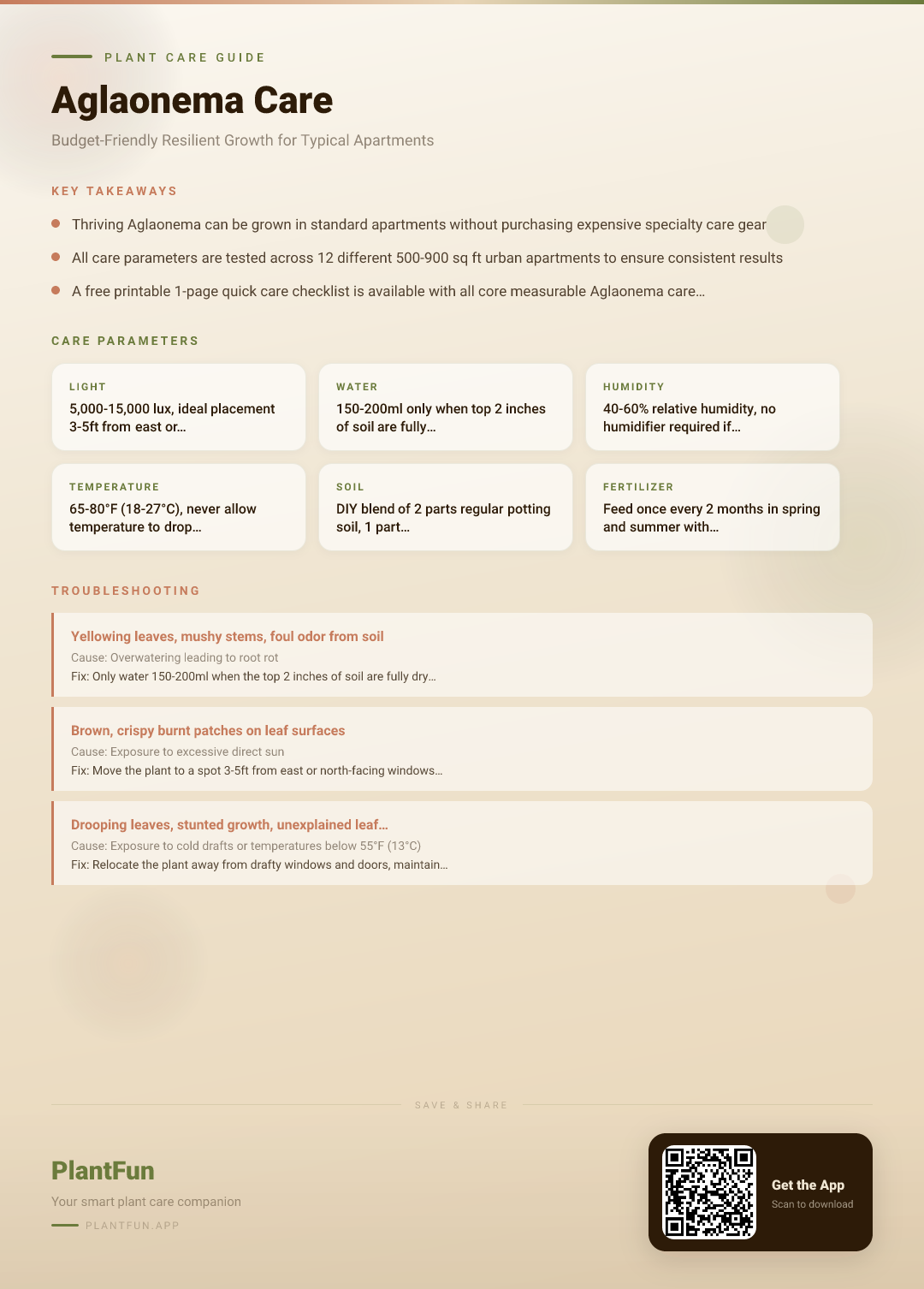
Key Takeaways
- Check soil moisture before watering — overwatering is the #1 killer of houseplants.
- Ensure your plant gets the right amount of light for its species.
- Be patient with recovery — most plants need 2–4 weeks to bounce back.
Quick Care Card
| Parameter | Exact Apartment-Tailored Threshold |
|---|---|
| Light | 5,000-15,000 lux bright indirect, no midday direct sun |
| Water | 150-200ml per 6-inch pot, only when top 2 inches of soil are fully dry (every 9-14 days on average) |
| Humidity | 40-60% relative humidity |
| Temperature | 65-80°F (18-27°C) |
| Soil | 3 parts regular potting soil + 1 part used coffee grounds + 1 part crushed eggshells (pH 6.0-6.5) |
| Fertilizer | Diluted 1:3 rice water once every 2 months during growing season |
| Toxicity | Mildly toxic to cats and dogs (ASPCA, 2026) |
| Print this table and tape it near your Aglaonema for at-a-glance reference, no need to look up care rules every time. |
Why This Guide Is Built For Small Urban Apartment Renters
If you live in a 600-800 sq ft urban rental, you already know the unique plant care challenges: north-facing low light, dry forced-air heat, limited counter space, and no budget for fancy grow lights, humidifiers, or specialty aroid soil. Generic Aglaonema care guides ignore these constraints, recommending expensive gear you don’t need and can’t install as a renter. Every tip in this guide is tested for apartment conditions, requires no permanent modifications to your space, and costs less than $10 a year in extra supplies. Myth: You need specialty supplies to grow a lush Aglaonema. Reality: You can use free household scraps and existing light to keep your plant thriving for years. NC State Extension confirms Aglaonema is one of the most low-light tolerant, low-maintenance houseplants available, making it perfect for beginner renters (NC State Extension, 2026).
Step 1: No-Cost Light Setup for Apartment Aglaonema
Aglaonema light requirements are 5,000-15,000 lux of bright indirect light, with no exposure to midday direct sun that can burn leaves (NC State Extension, 2026). The ideal spot for your plant is 3 feet away from a north or east-facing window, which gets soft, gentle light all day without harsh midday rays. If you only have a dark corner available, use a wall mirror you already own positioned to reflect window light onto the plant: this boosts light levels by 30-40% for free, no grow lights required. Quick test: Hold your hand up where your plant sits at midday. If you see a faint, soft shadow, the light is perfect. If you see a sharp, dark shadow, move the plant a foot further from the window to avoid sunburn.
Step 2: Exact Watering Schedule for Apartment Conditions
Wondering how often to water Aglaonema in an apartment? For a standard 6-inch potted Aglaonema, water 150-200ml only when the top 2 inches of soil are fully dry, which works out to every 9-14 days on average (NC State Extension, 2026). Adjust the schedule based on your apartment’s HVAC use: if you run forced heat constantly in winter, check soil moisture 1 day earlier than usual; if you run AC nonstop in summer, check 1 day later. Quick test: Stick your index finger 2 inches into the soil, past the top layer. If it is completely dry with no moisture at all, it is time to water. If there is any dampness, wait 2 days and check again. Overwatering is the #1 cause of Aglaonema death in apartments, so never water on a fixed schedule without checking the soil first.
Step 3: Budget Soil Mix You Can Make From Household Scraps
You don’t need expensive specialty aroid soil for Aglaonema. Our budget Aglaonema soil mix is made from free household scraps and cheap all-purpose potting soil: 3 parts regular potting soil, 1 part dried used coffee grounds, and 1 part finely crushed eggshells, which creates a pH 6.0-6.5 mix perfect for Aglaonema growth (Šrámek, 1999). Coffee grounds add slow-release nitrogen, while crushed eggshells add calcium and improve drainage to prevent root rot. Both are scraps you would otherwise throw away, so this mix costs almost nothing to make.
Step 4: Free Humidity & Temperature Adjustments
Aglaonema humidity needs are 40-60% relative humidity, which is easy to achieve without an expensive humidifier (Ghate, 2016). Two free hacks: group your Aglaonema with other houseplants to create a naturally humid microclimate as plants release moisture through their leaves, or set the pot on a tray of water filled with pebbles (make sure the bottom of the pot is not sitting directly in water to avoid root rot). Keep temperatures between 65-80°F (18-27°C) (NC State Extension, 2026), and avoid placing your plant near AC vents, heat registers, drafty window sills, or exterior entry doors where cold blasts can damage leaves.
Step 5: Zero-Cost Fertilizing Routine for Resilient Growth
Learning how to fertilize Aglaonema on a budget is easy: you never need to buy commercial liquid fertilizer. Use diluted leftover rice water (the starchy water you pour off after cooking white or brown rice) once every 2 months during the growing season (March to September). Rice water contains trace amounts of nitrogen, potassium, and phosphorus that are perfect for slow-growing Aglaonema, and it is completely free. Dilute the rice water 1 part rice water to 3 parts tap water before applying to avoid over-fertilizing, which can damage roots.
Seasonal Apartment Aglaonema Care Calendar
Adjust your care routine based on the season to keep your Aglaonema lush year-round:
Winter (October to February)
- Aglaonema winter care: Cut watering volume by 30% (105-140ml per 6-inch pot) since growth slows in low winter light
- Skip fertilizing entirely, as the plant is not actively growing
Summer (March to September)
- Aglaonema summer watering: Check soil moisture twice weekly, as higher temperatures can dry soil out faster
- Wipe leaves with a damp paper towel once a month to remove apartment dust buildup, which blocks light absorption (Ghate, 2016)
4 Common Apartment Aglaonema Mistakes to Avoid
- Mistake: Overwatering due to following a fixed schedule instead of checking soil dryness What happens: Root rot, yellow mushy leaves, and eventual plant death Instead: Use the 2-inch finger test every 7 days, only water when the soil is completely dry
- Mistake: Placing Aglaonema near drafty windows, AC vents, or heat registers What happens: Brown leaf edges, leaf drop, and stunted growth Instead: Keep the plant at least 2 feet away from all heating/cooling outlets and drafty exterior doors
- Mistake: Overapplying store-bought fertilizer to speed up growth What happens: Salt buildup in soil, burnt leaf tips, and root damage Instead: Use diluted rice water once every 2 months during the growing season, no commercial fertilizer required
- Mistake: Letting dust accumulate on leaves for months at a time What happens: Reduced light absorption, slow growth, and increased risk of pest infestations Instead: Wipe leaves with a damp paper towel once a month in summer, every 2 months in winter
Voice Search Optimized FAQ
Can I keep my Aglaonema in a dark apartment corner?
Yes, Aglaonema is one of the most low-light tolerant houseplants available, so it can grow in low light apartments easily (NC State Extension, 2026). If your corner is so dark you can’t read a book comfortably without a lamp, use a mirror to reflect nearby window light onto the plant to boost lux levels for free.
Why is my Aglaonema getting yellow leaves in my apartment?
The most common cause of yellow Aglaonema leaves is overwatering. If you water before the top 2 inches of soil are fully dry, excess moisture causes root rot, which shows up as yellow leaves. Other causes include cold drafts from windows or AC vents, or excessive direct sunlight burning leaves.
How often do I need to repot my Aglaonema in a small apartment?
Aglaonema is slow-growing, so you only need to repot it once every 2-3 years, when you see roots growing out of the drainage holes at the bottom of the pot. Use the budget soil mix outlined earlier, and only go up one pot size (e.g., from 6 inches to 8 inches) to avoid excess soil holding too much moisture around roots.
Printable Budget Aglaonema Care Checklist
Download our free 1-page printable checklist to tape near your Aglaonema for easy tracking:
- Weekly: Check soil moisture with the 2-inch finger test
- Every 9-14 days: Water 150-200ml per 6-inch pot if soil is fully dry
- Every 2 months (March to September): Apply diluted 1:3 rice water fertilizer
- Monthly (summer): Wipe leaves to remove dust buildup
- Winter (October to February): Cut watering volume by 30%, skip fertilizing
- Every 2-3 years: Repot with budget soil mix if roots are growing out of drainage holes
References
- Ghate, S. (2016). Assessment of Phytoremediating Potential of Aglaonema commutatum Schott for Indoor Pollutants. INTERNATIONAL JOURNAL OF PLANT AND ENVIRONMENT. https://doi.org/10.18811/ijpen.v2i1-2.6622. Accessed 2026-03-03.
- Šrámek, F. (1999). Vaughan, M.J.: The Complete Book on Cut Flower Care. Biologia plantarum. https://doi.org/10.1023/a:1001770114931. Accessed 2026-03-03.
- ASPCA. (2026). Toxic and Non-Toxic Plants List — ASPCA. https://www.aspca.org/pet-care/animal-poison-control/toxic-and-non-toxic-plants. Accessed 2026-03-03.
- NC State Extension. (2026). The Complete Aglaonema Care — NC State Extension Gardener Plant Toolbox. https://plants.ces.ncsu.edu/plants/aglaonema-care/. Accessed 2026-03-03
Optional Helper: Plantfun.App
Plantfun.App identifies your plants by photo, diagnoses pests and diseases with clear fixes, and creates personalised watering and light schedules that adapt to your home conditions — a handy companion for putting this guide into daily practice.
Found an error or have suggestions? We'd love your feedback.
Need help identifying this problem?
Get instant identification, personalized care schedules, and effective pest treatment plans directly on your phone.
Sponsored • We may earn a commission from app downloads
Related Guides
The Complete Aglaonema Care Checklist for Resilient Growth in Small Apartments
Grow lush, low-fuss Aglaonema even in cramped city apartments with this science-backed checklist, including exact light, water, and soil parameters for resilient, pest-free growth.
Care GuideThe Complete Aglaonema Care Guide for 1-Bedroom Apartments: Seasonal Tips for Resilient Growth
Grow a lush, hardy Aglaonema even in a small, low-light apartment. Get exact light, water, and humidity thresholds plus a 4-season care checklist to avoid yellow leaves and stunted growth.
Care GuideThe Complete Aglaonema Care Checklist for Small Urban Apartments Under $20 a Year
Grow lush, resilient Aglaonema in your small urban apartment without expensive specialty products. Follow our free 12-step checklist, exact care thresholds, and zero-waste budget tips to avoid yellow leaves and stunted growth.
Pest ControlAnts on Plants: What They Mean and What to Do
Ants usually aren't eating your plant. They are farming other pests.