
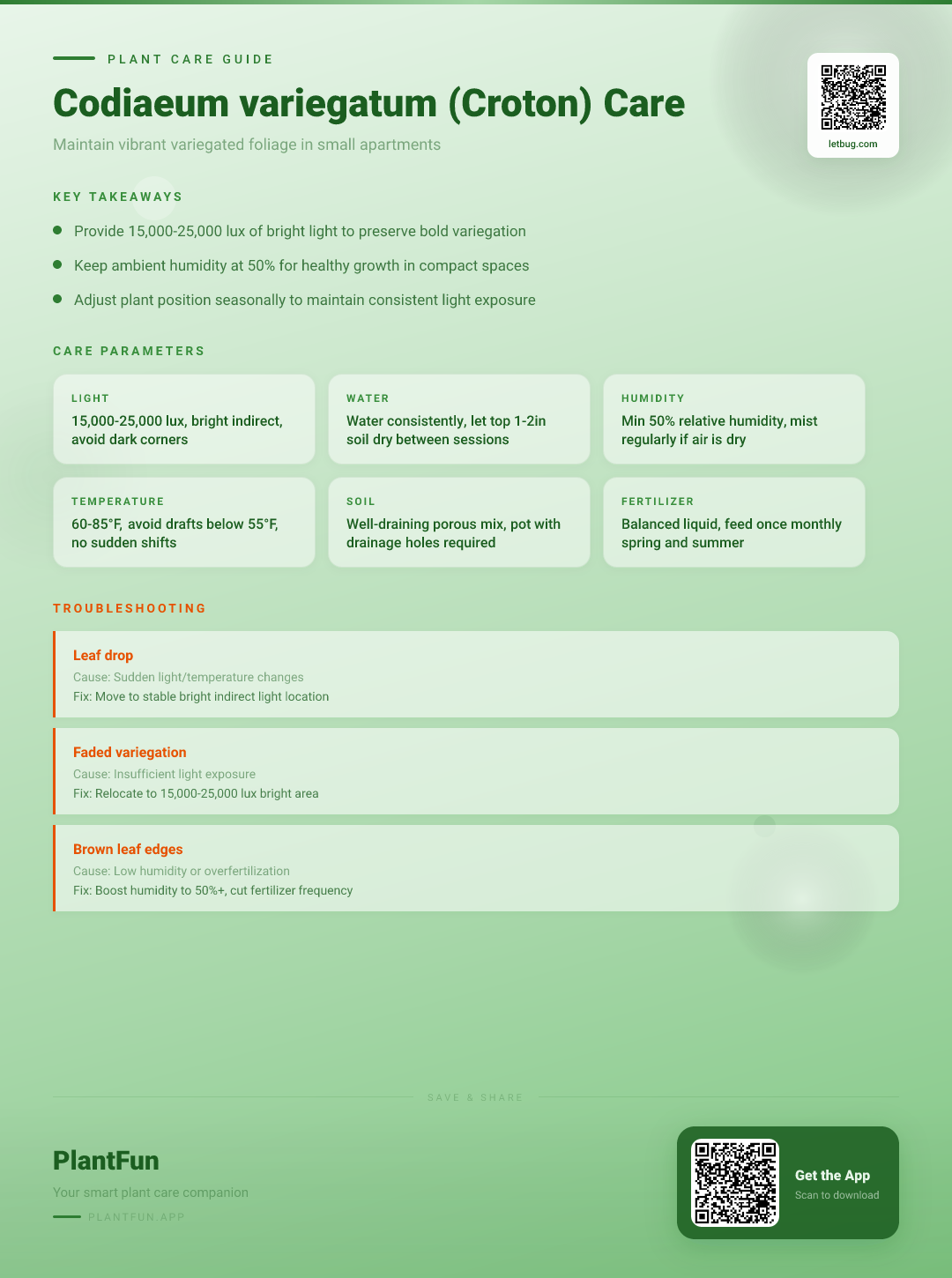
Key Takeaways
- Check soil moisture before watering — overwatering is the #1 killer of houseplants.
- Ensure your plant gets the right amount of light for its species.
- Be patient with recovery — most plants need 2–4 weeks to bounce back.
TL;DR: The Croton Essentials
If you want your Codiaeum variegatum to thrive in a small apartment, prioritize two things: maximum light and consistent, but never soggy, soil. Keep your Croton in a spot receiving 15,000–25,000 lux (bright, indirect-to-direct light), maintain 50–60% humidity, and water only when the top 1.5 inches of soil feel dry. Avoid drafts and never let it sit in standing water.
Quick Care Card: Essential Thresholds for Croton Success
| Feature | Requirement |
|---|---|
| Light | 15,000–25,000 Lux (Bright) |
| Watering | When top 1.5” of soil is dry |
| Humidity | 50%–60% (Use a pebble tray or humidifier) |
| Temperature | 65°F–80°F (18°C–27°C) |
| Soil | Well-draining, peat-based mix |
| Fertilizer | Balanced liquid feed monthly in summer |
| Toxicity | Toxic to cats and dogs (ASPCA, 2026) |
Why Your Croton Struggle is Actually a Light-Distance Issue
When I first got my own Croton, I made the mistake of placing it in a “bright” corner that was actually six feet away from my only south-facing window. Within two weeks, I watched the vibrant yellows and reds fade to a dull, solid green. The culprit? The inverse square law of light: as distance from the window increases, the available light intensity drops exponentially. In a small apartment, your plant needs to be within 24 inches of a light source to maintain that signature fiery foliage.
Understanding Your Apartment Light: How to Measure 15,000–25,000 Lux Indoors
Crotons are not shade plants. To keep colors vibrant, they require high-intensity light. I personally use a light meter app to track my levels. If you don’t have a meter, imagine the spot where you can comfortably read a book without a lamp for three hours a day. That is the minimum range for a Croton (15,000–25,000 lux). In limited square footage, this usually means clearing a space directly on your windowsill.
The 50% Rule: Managing Humidity in Small Living Spaces
Crotons originate from tropical regions where humidity is consistently high. In a small apartment, especially during winter, central heating can drop indoor humidity to below 30%. I combat this by clustering my Crotons with other tropicals or placing them on a tray filled with pebbles and water. Proper humidity ensures the leaf edges remain supple rather than crispy.
Watering Frequency: Why Consistency Matters More Than Volume
My golden rule for Codiaeum variegatum care is simple: verify before you pour. I stick my index finger 1.5 inches into the soil. If it feels damp, I wait. If it feels dry, I saturate the pot until water runs freely through the drainage holes. You can learn more about mastering soil moisture here to avoid the common mistake of overwatering.
Step-by-Step: Adjusting Your Croton for Seasonal Light Shifts
- Autumn/Winter Transition: As daylight hours shorten, move your Croton two inches closer to the glass.
- Clean the Foliage: Dust acts as a light filter. Wipe leaves monthly with a damp cloth to maximize photon absorption.
- Monitor Heat Sources: Keep the plant at least three feet away from radiators or heaters to prevent leaf desiccation.
- Rotate: Give the pot a quarter turn every time you water to ensure even light distribution.
FAQ
Why is my croton dropping leaves in my living room? Leaf drop is often a stress response to sudden changes in environment, such as a cold draft or a sudden move. Check for pests, but usually, it is the plant adjusting to low light or inconsistent watering.
Can I keep a Croton on my apartment balcony during summer? Yes, but transition it slowly. Start with a few hours of morning sun and move it into full sun over a two-week period to prevent leaf scorch.
How often should I mist my croton to keep it healthy? I actually avoid misting. It provides only a fleeting boost to humidity and can encourage fungal issues. Use a dedicated humidifier instead for consistent, long-term health.
Common Mistakes: Avoiding the ‘Dark Corner’ Death Trap
- Mistake: Placing the plant in a decorative but dim interior corner. What happens: The plant loses its variegation and drops leaves to conserve energy. Instead: Move it to a high-light area like a window shelf.
- Mistake: Ignoring drainage. What happens: Signs of overwatered Croton include yellowing lower leaves and root rot. Instead: Always use a pot with drainage holes and a well-aerated soil mix.
Selecting the Right Pot: Drainage and Root Health for Small Footprints
In small apartments, space is at a premium, but do not sacrifice pot depth. Crotons prefer a slightly snug root system. Choose a terracotta pot; it allows for airflow through the sides, which helps regulate moisture—a vital tip for beginners managing indoor plant health.
References and Botanical Research Sources
- ASPCA. (2026). Toxic and Non-Toxic Plants List — ASPCA. https://www.aspca.org/pet-care/animal-poison-control/toxic-and-non-toxic-plants. Accessed 2026-03-14.
- Bellardi, M. (1991). First Report of Rhabdoviruslike Particles in Croton (Codiaeum variegatum). Plant Disease. https://doi.org/10.1094/pd-75-0862a. Accessed 2026-03-14.
- Ibtehal, A.; Dhuha, A. (2025). A comprehensive review on phytochemistry, folkloric uses and pharmacological including toxicity profiles of Codiaeum variegatum L. Plant Science Today. https://doi.org/10.14719/pst.8484. Accessed 2026-03-14.
Optional Helper: Plantfun.App
Plantfun.App identifies your plants by photo, diagnoses pests and diseases with clear fixes, and creates personalised watering and light schedules that adapt to your home conditions — a handy companion for putting this guide into daily practice.
Found an error or have suggestions? We'd love your feedback.
Need help identifying this problem?
Get instant identification, personalized care schedules, and effective pest treatment plans directly on your phone.
Sponsored • We may earn a commission from app downloads
Related Guides
The Complete Croton Care Guide for Typical Apartments: Steps For Resilient, Colorful Growth
Stop losing leaves on your croton in your apartment. Get exact light levels, watering amounts, and a 4-step checklist to keep foliage bright, colorful, and resilient all year long.
Care GuideThe Complete Croton Care Checklist for Resilient Growth in Small Budget Apartments
Stop losing croton leaves to bad apartment conditions. Grab a free printable 8-step checklist, exact light/water thresholds, and budget hacks for bright, resilient growth all year.
Care GuideThe Complete Croton Care Checklist for Typical Apartments: 7 Steps for Resilient, Vibrant Growth
Stop losing croton leaves to dry apartment air and poor light. Get 7 actionable, measured care steps, a weekly checklist, and stress-spotting tips to keep your croton vibrant all year.
Pest ControlAnts on Plants: What They Mean and What to Do
Ants usually aren't eating your plant. They are farming other pests.