
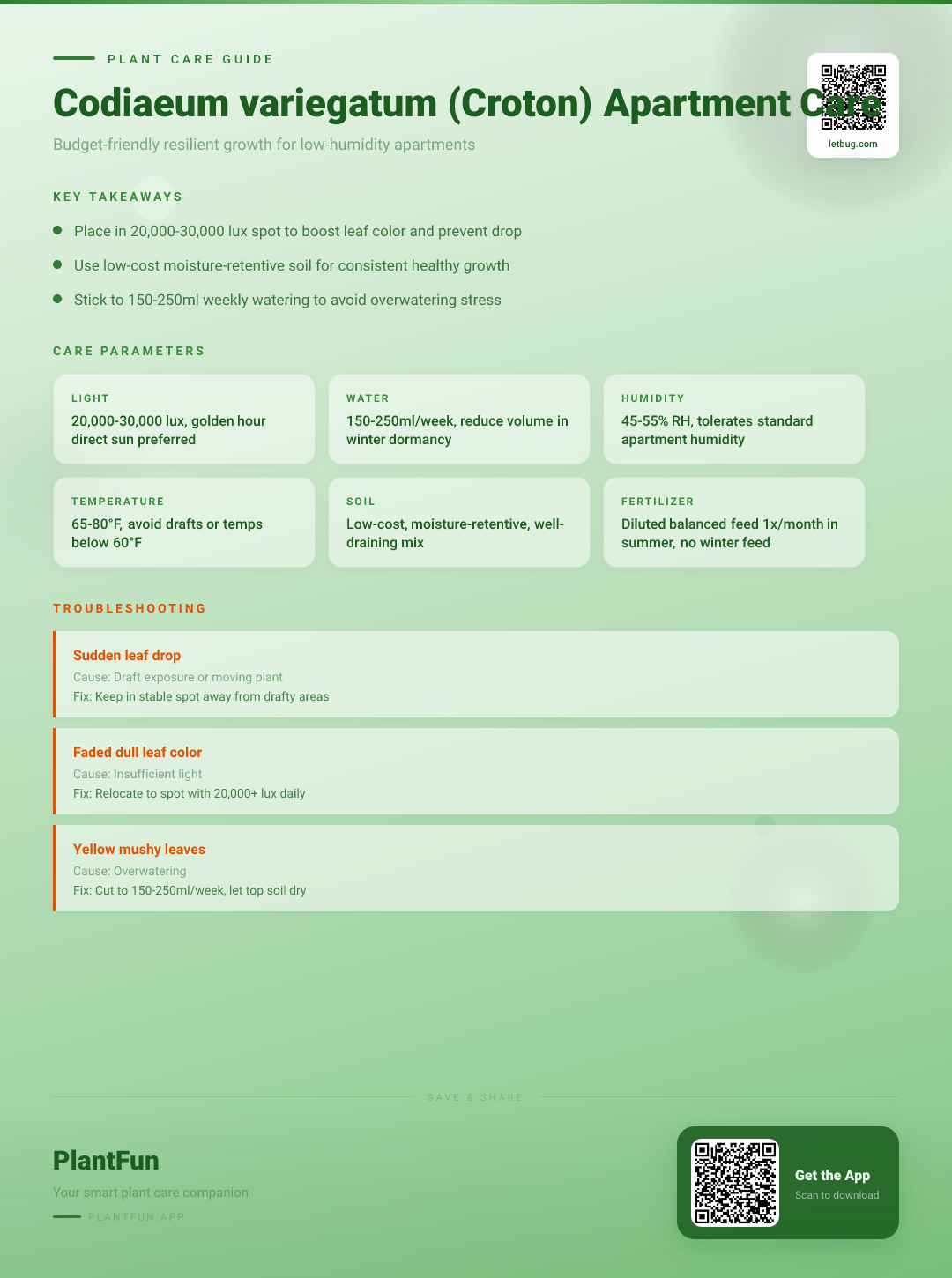
Key Takeaways
- Check soil moisture before watering — overwatering is the #1 killer of houseplants.
- Ensure your plant gets the right amount of light for its species.
- Be patient with recovery — most plants need 2–4 weeks to bounce back.
Quick Care Card: Essential Data
| Feature | Requirement |
|---|---|
| Light | 20,000–30,000 Lux (Bright, indirect to direct) |
| Water | 150–250ml per week (Soil moisture dependent) |
| Humidity | 45–55% (Tolerable with stable soil moisture) |
| Temperature | 65–80°F (18–27°C) |
| Soil | Well-draining, peat-based mix |
| Fertilizer | Balanced liquid feed, monthly during spring/summer |
| Toxicity | Toxic to cats and dogs (ASPCA, 2026) |
TL;DR: Why Your Croton is Actually an Apartment Warrior
Don’t believe the rumors—you don’t need a professional-grade humidifier to keep your Codiaeum variegatum thriving. By focusing on light intensity and consistent soil moisture, you can force this plant to adapt to apartment life. If you provide at least 20,000 Lux, your Croton will remain vibrant and upright even in dry, indoor air.
The ‘Apartment-Hardy’ Myth: Understanding the Croton’s Natural Metabolism
When I first brought home my first Croton, I treated it like a delicate fern. I misted it daily and kept it in a shaded corner. Within two weeks, it began dropping leaves. I later learned that Crotons are high-energy plants. They are not ‘fickle’; they are sunlight-dependent. According to NC State Extension (2026), these plants require bright light to maintain their signature leaf coloration. Without it, their metabolism slows down, leading to the dreaded leaf drop that terrifies many indoor gardeners.
Step 1: The ‘Golden Hour’ Placement Strategy for 20,000+ Lux
To keep your Croton resilient, light is your primary budget-free tool. You need to position the plant where it receives at least 20,000 Lux. In an apartment, this usually means placing it directly in a south or west-facing window.
- The Test: If you cannot read a newspaper comfortably in the spot where the plant sits, it is too dark.
- Rotation: Turn the pot 90 degrees every time you water to ensure even light distribution, which encourages a symmetrical growth habit.
Step 2: Soil Calibration: How to Mix Affordable Moisture-Retaining Substrate
I prefer a simple, cost-effective soil mix that balances aeration with moisture retention. You don’t need expensive specialty soils. Mix standard indoor potting soil with a handful of perlite or even rinsed coarse sand. This ensures that when you provide your 200ml weekly irrigation, the water reaches the roots without causing anaerobic conditions or root rot (NC State Extension, 2026).
Step 3: The Weekly Irrigation Cycle: Avoiding the 200ml Overload
Overwatering is the fastest way to kill a Croton. Instead of a set schedule, use the ‘finger test.’ Stick your finger two inches into the soil; if it feels dry, apply 150–250ml of water. This specific, measured approach prevents the soil from staying saturated, which is vital when humidity is low.
Seasonal Maintenance: Adapting Your Care from Summer Growth to Winter Dormancy
During winter, your apartment’s heating system will likely drop humidity levels significantly. Even if the air is dry, do not increase your watering frequency. Instead, observe the plant’s growth rate. If it slows down, reduce your water to the lower end of the 150ml range to accommodate the reduced transpiration rate of the leaves.
Common Mistakes: Why Moving Your Croton is Hurting Growth
- Mistake: Frequently moving the plant between rooms.
- What happens: The plant experiences ‘light shock,’ leading to immediate leaf abscission (dropping leaves).
- Instead: Select a bright, permanent home and leave it there to stabilize.
FAQ: Why is my Croton dropping leaves suddenly despite watering?
This is usually a reaction to light deprivation or temperature fluctuations. Ensure your plant is in the brightest spot possible and away from drafty doors or AC vents (NC State Extension, 2026).
FAQ: Can I keep my Croton in a drafty apartment hallway?
No. Crotons are sensitive to sudden temperature shifts. A drafty hallway will stress the plant, likely resulting in rapid leaf loss.
FAQ: How do I make my Croton leaves look more colorful without special lights?
Variegation is directly correlated with light exposure. By keeping your plant in a high-light (20,000+ Lux) environment, you naturally stimulate the production of the pigments that cause the vibrant reds and yellows you love.
Budget-Care Tools: Repurposing Household Items for Croton Success
- Measuring Cup: Use a plastic measuring cup to ensure you never exceed the 250ml threshold.
- Pebble Tray: Place the pot on a saucer filled with pebbles and a tiny amount of water (ensure the bottom of the pot never touches the water) to create a localized humidity bubble.
- Reflective Surfaces: Place a piece of white cardboard or a mirror near the plant to bounce more light onto the lower foliage.
References
- Bellardi, M. (1991). First Report of Rhabdoviruslike Particles in Croton (Codiaeum variegatum). Plant Disease. https://doi.org/10.1094/pd-75-0862a. Accessed 2026-03-18.
- Ibtehal, A.; Dhuha, A. (2025). A comprehensive review on phytochemistry, folkloric uses and pharmacological including toxicity profiles of Codiaeum variegatum L. Plant Science Today. https://doi.org/10.14719/pst.8484. Accessed 2026-03-18.
- ASPCA. (2026). Toxic and Non-Toxic Plants List — ASPCA. https://www.aspca.org/pet-care/animal-poison-control/toxic-and-non-toxic-plants. Accessed 2026-03-18.
- NC State Extension. (2026). Codiaeum variegatum Care — NC State Extension Gardener Plant Toolbox. https://plants.ces.ncsu.edu/plants/croton-care/. Accessed 2026-03-18.
Optional Helper: Plantfun.App
Plantfun.App identifies your plants by photo, diagnoses pests and diseases with clear fixes, and creates personalised watering and light schedules that adapt to your home conditions — a handy companion for putting this guide into daily practice.
Found an error or have suggestions? We'd love your feedback.
Need help identifying this problem?
Get instant identification, personalized care schedules, and effective pest treatment plans directly on your phone.
Sponsored • We may earn a commission from app downloads
Related Guides
Codiaeum Variegatum Care: A Proven Strategy for Vibrant Croton Leaves in Low-Light Apartments
Stabilize your Codiaeum variegatum and stop leaf drop with this 4-step apartment care guide. Get exact light, humidity, and water thresholds for healthy foliage.
Care GuideCodiaeum variegatum Care in Apartments: The Essential Guide for Vivid Leaves and Healthy Growth
Transform your dim apartment into a vibrant jungle. Learn the 4 precise thresholds for Croton care, including exact lux levels and watering schedules for success.
Care GuideCroton Care in a Drafty Apartment: A Seasonal Routine for Vibrant, Resilient Growth
Master your Croton care with our seasonal guide. Discover exact lux, watering routines, and draft-proofing tips to prevent leaf drop in your apartment today.
Pest ControlAnts on Plants: What They Mean and What to Do
Ants usually aren't eating your plant. They are farming other pests.