
Key Takeaways
- Check soil moisture before watering — overwatering is the #1 killer of houseplants.
- Ensure your plant gets the right amount of light for its species.
- Be patient with recovery — most plants need 2–4 weeks to bounce back.
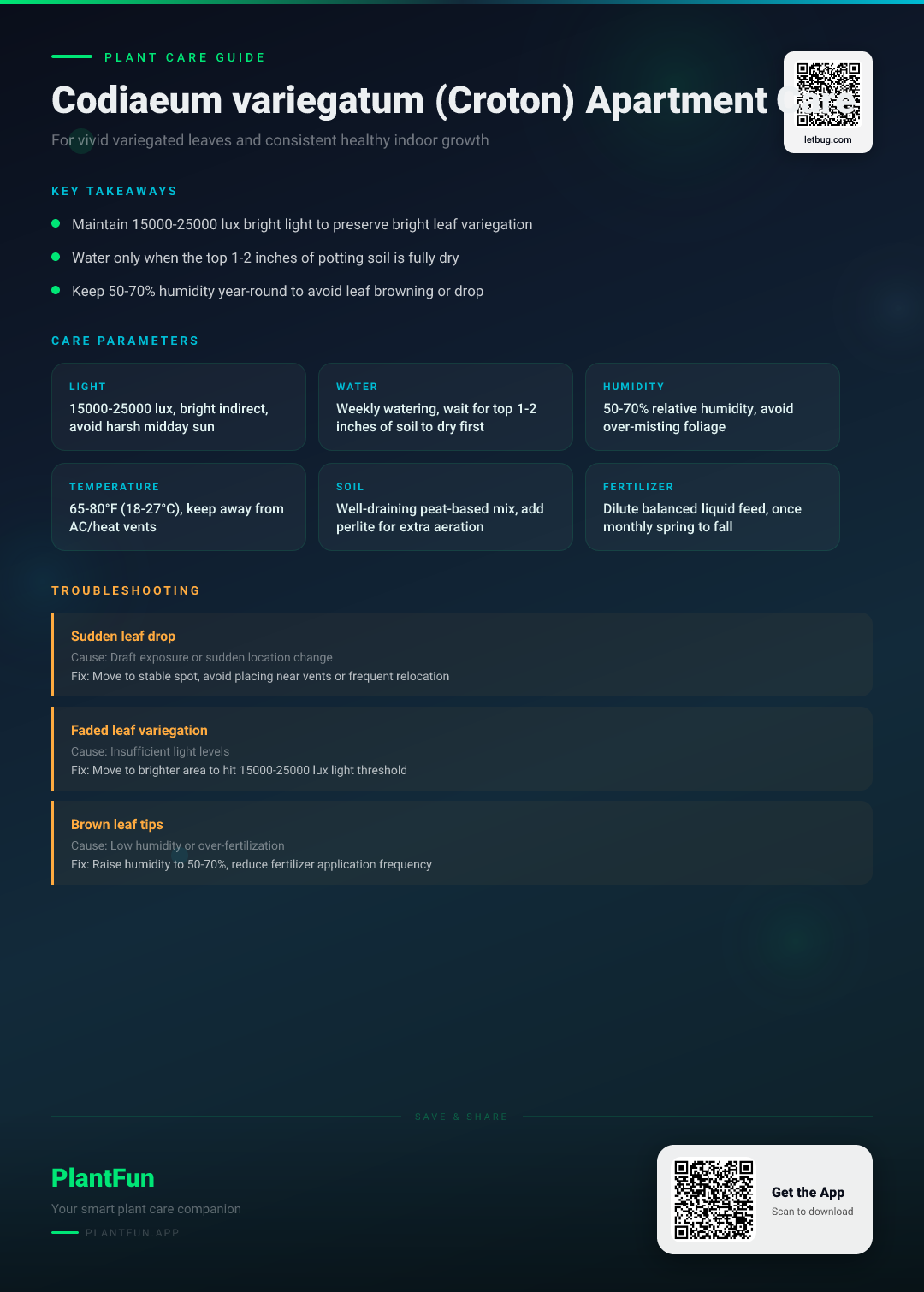
Quick Care Card: Essential Thresholds for Healthy Croton Growth
| Feature | Requirement |
|---|---|
| Light | 15,000–25,000 lux (bright, filtered light) |
| Water | When top 1–2 inches of soil are dry |
| Humidity | 50%–70% relative humidity |
| Temperature | 65°F–80°F (18°C–27°C) |
| Soil | Well-draining, peat-based mix |
| Fertilizer | Balanced liquid feed, monthly during spring/summer |
| Toxicity | Toxic to cats and dogs (ASPCA, 2026) |
TL;DR: The Croton Survival Cheat Sheet for Apartment Dwellers
Codiaeum variegatum thrives when treated as a high-intensity sun lover, not a standard houseplant. To prevent leaf drop, prioritize 15,000–25,000 lux of light and maintain consistent ambient humidity between 50%–70%. Water only when the top 1–2 inches of soil feel dry to the touch, and keep the plant away from drafty vents. Avoid moving the plant once it has acclimated to a specific light source.
Why Your Croton Needs More Than Just a Sunny Window
When I first brought home my Codiaeum variegatum, I made the common mistake of placing it in a “bright” spot that was actually a dark corner in disguise. My Croton immediately shed its lower leaves in protest. I learned quickly that these plants are physiologically evolved for high-light environments; in lower light, they simply cannot support their complex, variegated foliage (NC State Extension, 2026). Successful apartment care is less about “sunlight” and more about “light-intensity management.”
Decoding Light Requirements: Maintaining 15,000–25,000 Lux in Small Apartments
To achieve those signature fiery reds and yellows, you must target a light intensity of 15,000–25,000 lux. In an apartment, a south or west-facing window is usually your best bet. If your windows are obstructed, supplement with full-spectrum LED grow lights placed within 12–18 inches of the foliage.
Mastering the Moisture Balance: When to Water (Top 1–2 Inches Dry)
Overwatering is the fastest path to root rot, which often manifests as sudden yellowing. I use the “finger test”: push your finger into the soil up to the second knuckle. If the soil is still damp, wait two more days. According to NC State Extension (2026), ensuring the soil is well-draining is critical for preventing fungal issues.
Humidity Hack: Reaching 50–70% Without a Greenhouse Setup
Apartments are notorious for low humidity, especially in winter. To keep your plant in the 50%–70% range, group your plants together to create a microclimate or use a pebble tray. I have found that placing my Croton on a tray filled with water and river stones—ensuring the pot sits above the water line—consistently boosts the localized moisture levels.
Seasonal Care Calendar: Navigating Low Light in Winter vs. Peak Heat in Summer
- Spring/Summer: Growth is active. Increase water frequency slightly and apply a diluted balanced fertilizer.
- Autumn/Winter: Growth slows. Reduce watering significantly as evaporation rates drop. Move the plant closer to the glass (without touching it) to compensate for shorter day lengths.
Can I keep my Croton in a small bedroom near an AC vent?
No. Crotons are highly sensitive to sudden temperature fluctuations and cold drafts. Being near an AC vent will cause the stomata—microscopic pores on the leaf surface—to close prematurely, leading to severe leaf drop. Place the plant in a stable environment away from HVAC airflow.
Why is my Croton dropping leaves suddenly despite consistent watering?
Symptom: Rapid leaf drop following a change in location or environment.
Likely cause: Acclimation stress or a sudden shift in light intensity (NC State Extension, 2026).
Fix:
- Keep the plant in its current location.
- Increase light exposure gradually.
- Check for spider mites, which thrive in dry apartment air.
How do I know if my apartment has enough light for a variegated Croton?
If the new growth is coming in solid green rather than variegated, your plant is signaling it lacks the intensity required to produce its natural pigments. Move it closer to a window or augment with a grow light immediately.
Common Mistakes to Avoid: From Over-misting to Moving the Pot
- Mistake: Misting leaves to increase humidity. What happens: Creates favorable conditions for pathogens without actually raising ambient humidity. Instead: Use a humidifier or a pebble tray.
- Mistake: Frequently moving the plant. What happens: The plant wastes energy trying to re-orient its leaves to the new light source. Instead: Find one ideal spot and leave it there permanently.
References
- Bellardi, M. (1991). First Report of Rhabdoviruslike Particles in Croton (Codiaeum variegatum). Plant Disease. https://doi.org/10.1094/pd-75-0862a. Accessed 2026-03-14.
- Ibtehal, A.; Dhuha, A. (2025). A comprehensive review on phytochemistry, folkloric uses and pharmacological including toxicity profiles of Codiaeum variegatum L. Plant Science Today. https://doi.org/10.14719/pst.8484. Accessed 2026-03-14.
- ASPCA. (2026). Toxic and Non-Toxic Plants List — ASPCA. https://www.aspca.org/pet-care/animal-poison-control/toxic-and-non-toxic-plants. Accessed 2026-03-14.
- NC State Extension. (2026). Codiaeum variegatum Care — NC State Extension Gardener Plant Toolbox. https://plants.ces.ncsu.edu/plants/codiaeum-variegatum/. Accessed 2026-03-14.
Optional Helper: Plantfun.App
Plantfun.App identifies your plants by photo, diagnoses pests and diseases with clear fixes, and creates personalised watering and light schedules that adapt to your home conditions — a handy companion for putting this guide into daily practice.
Found an error or have suggestions? We'd love your feedback.
Need help identifying this problem?
Get instant identification, personalized care schedules, and effective pest treatment plans directly on your phone.
Sponsored • We may earn a commission from app downloads
Related Guides
Codiaeum Variegatum Croton in a Small Apartment: The Only Care Guide You’ll Need
Master Croton care in a small apartment with these 5 proven techniques. Achieve vivid foliage color, perfect 55% humidity, and avoid leaf drop starting today.
Care GuideCroton Care in a Drafty Apartment: A Seasonal Routine for Vibrant, Resilient Growth
Master your Croton care with our seasonal guide. Discover exact lux, watering routines, and draft-proofing tips to prevent leaf drop in your apartment today.
Care GuideCodiaeum Variegatum Care: A Proven Strategy for Vibrant Croton Leaves in Low-Light Apartments
Stabilize your Codiaeum variegatum and stop leaf drop with this 4-step apartment care guide. Get exact light, humidity, and water thresholds for healthy foliage.
Pest ControlAnts on Plants: What They Mean and What to Do
Ants usually aren't eating your plant. They are farming other pests.