
Key Takeaways
- Check soil moisture before watering — overwatering is the #1 killer of houseplants.
- Ensure your plant gets the right amount of light for its species.
- Be patient with recovery — most plants need 2–4 weeks to bounce back.
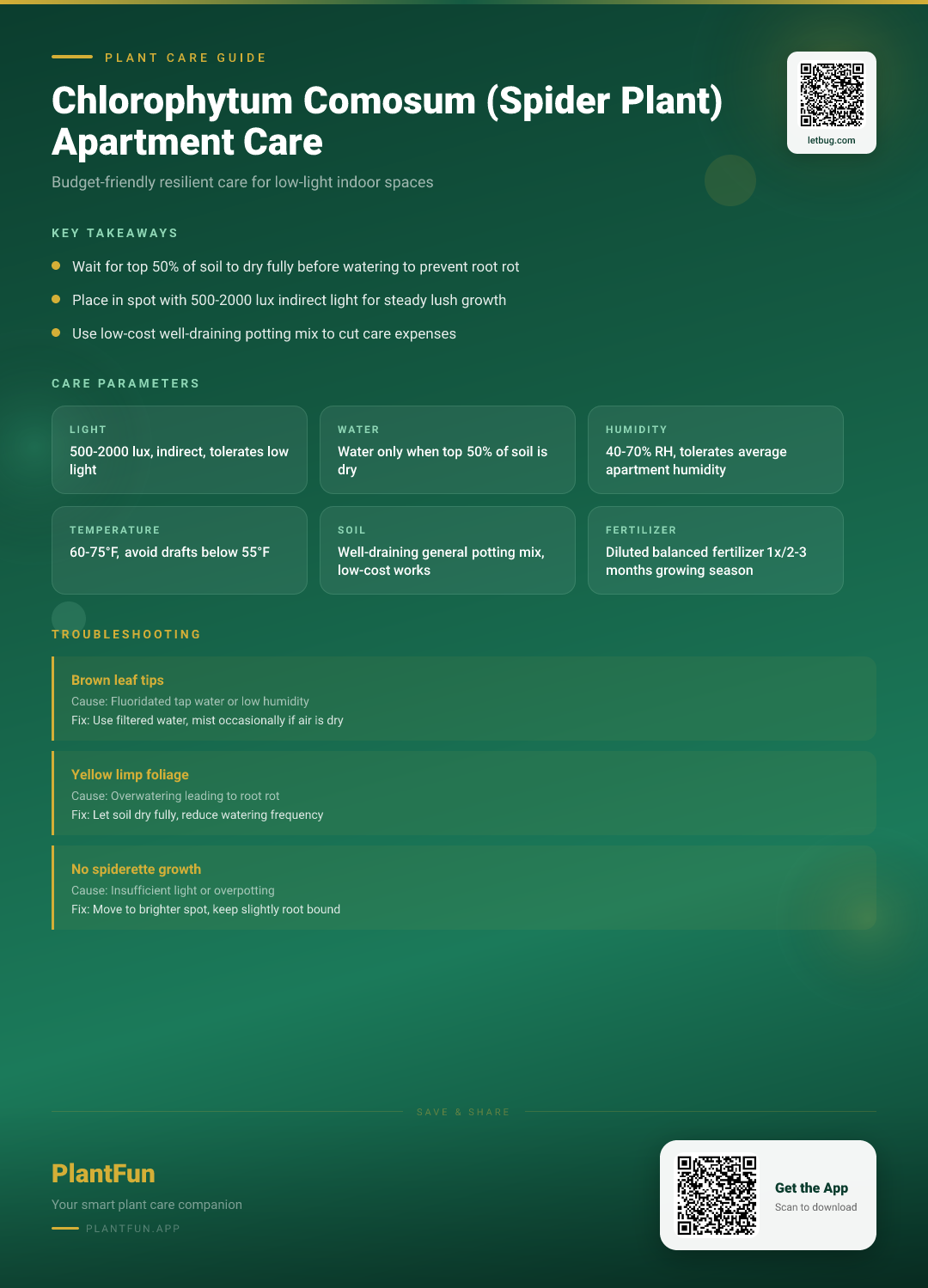
Quick Care Card: Essential Thresholds for Your Spider Plant
| Feature | Requirement |
|---|---|
| Light | 500–2,000 Lux (Bright indirect) |
| Water | Allow 50% of soil to dry before watering |
| Humidity | 40–50% (Standard home levels) |
| Temperature | 60–75°F (15–24°C) |
| Soil | Well-draining, peat-based potting mix |
| Fertilizer | Balanced liquid feed, diluted by half, monthly in summer |
| Toxicity | Non-toxic to cats and dogs (ASPCA, 2026) |
TL;DR: The Resilient Apartment Setup
To keep a Spider Plant thriving in an apartment, prioritize stable light (500–2,000 lux) and strictly avoid overwatering. Water only when the top 50% of the soil feels dry. These plants are exceptionally resilient, requiring minimal intervention. Use a standard, well-draining soil mix, and keep temperatures between 60–75°F. Propagate new ‘spiderettes’ easily by placing them in water once roots appear.
Understanding Your Plant: Why Chlorophytum Comosum Thrives on Neglect
When I first brought my Chlorophytum comosum home, I made the mistake of fussing over it too much. I treated it like a delicate fern, misting it daily and watering every three days. I quickly learned that this plant, often used for its air-purifying properties, prefers a “leave it alone” approach.
Botanically, Chlorophytum comosum is a perennial with fleshy, tuberous roots designed to store water, which is why it can survive periods of drought (NC State Extension, 2026). In an apartment setting, its ability to filter indoor pollutants—such as formaldehyde—is an added bonus for city living (Zhao et al., 2014).
Decoding Light: Positioning for 500-2,000 Lux Environments
Many owners assume “low light” means dark corners. In reality, your apartment’s “low light” is often dim enough to cause stretching (etiolation). I aim for a spot that receives bright, indirect light. If you don’t have a light meter, use the “shadow test”: if your plant casts a soft, blurry shadow during the day, it is receiving roughly 500–1,000 lux. Avoid direct sun, which can scorch the variegated leaves.
Watering Strategy: Preventing Root Rot with the 50% Soil Dryness Rule
Knowing how often to water a spider plant is the biggest challenge for beginners. Instead of a calendar, I use the physical feel of the soil.
- Insert your finger 2–3 inches into the soil.
- If it feels moist, wait.
- If it feels dry to the halfway point of the pot, it is time to water.
Overwatering is the primary cause of root rot, which manifests as yellowing leaves. In low-light apartment conditions, your plant uses water more slowly than in a greenhouse, so always err on the side of dryness (NC State Extension, 2026).
Humidity and Temperature: Keeping Your Plant Happy Between 60-75°F
Spider Plants are incredibly adaptable, but they perform best in moderate home temperatures between 60–75°F (15–24°C). If your apartment is drafty in the winter, keep the plant away from windows. While they enjoy humidity, a standard 40–50% range is sufficient. If you notice dry tips, it is often a sign of dry air rather than a lack of water.
Soil and Potting: The Budget-Friendly Mix for Apartment Growth
You do not need expensive boutique soils. I use a standard, well-draining potting mix. To ensure it drains quickly, I sometimes add a handful of perlite. When repotting, ensure the pot has at least one drainage hole. For more guidance, check out our guide on choosing the right container for your indoor space.
Seasonal Maintenance: Adjusting for Winter Heating and Summer Airflow
Winter heating systems drastically lower indoor humidity. I move my plants away from vents to prevent moisture loss. Conversely, in summer, increased airflow helps the plant manage gas exchange, which can assist in reducing carbon monoxide levels in your living space (Wicaksono et al., 2022).
Common Mistakes: Identifying Brown Tips and Limp Foliage
Yellowing Leaves
Symptom: Leaves turn yellow and become soft or mushy.
Likely cause: Overwatering leading to root suffocation.
Fix:
- Stop watering immediately.
- Ensure the pot has drainage holes and is not sitting in standing water.
Brown, Crispy Tips
Symptom: The ends of the leaves turn brown and brittle.
Likely cause: Low humidity or salt buildup in the water.
Fix:
- Increase humidity by grouping plants together.
- Use distilled or filtered water to reduce chemical deposits.
Drooping Foliage
Symptom: Leaves look limp and lose their turgor.
Likely cause: Underwatering or root-bound conditions.
Fix:
- Water thoroughly until liquid flows from the drainage hole.
- Check if the roots are circling the bottom of the pot.
FAQ: Why is my Spider Plant turning brown at the ends?
Brown tips are rarely a sign of disease; they are usually a reaction to tap water chemicals like fluoride or low ambient humidity. Try switching to filtered water or increasing the frequency of misting.
FAQ: How do I know when it’s time to repot my spider plant?
If you see thick, fleshy roots emerging from the drainage hole or pushing the plant upward out of the soil, it is time to upgrade. A slightly larger pot is sufficient to encourage new growth.
Advanced Care: Maximizing ‘Spiderette’ Production with Minimal Resources
Once your plant reaches maturity, it will produce “spiderettes” on long stalks. To propagate, simply leave the plantlet attached to the mother plant until it develops small, nubby root-like structures. Then, pin it to a small pot of soil while still attached, or snip it off and place the base in water. It is a cost-effective way to multiply your urban jungle. For more techniques, see our guide on successful plant propagation.
References
- Wicaksono, R.; Putri, M.; ., A. (2022). Investigation of indoor spider plant (Chlorophytum comosum) affecting the carbon monoxide and carboxyhemoglobin reduction. Ecology, Environment and Conservation. https://doi.org/10.53550/eec.2022.v28i01s.008. Accessed 2026-03-13.
- Zhao, X.; Zhang, N.; Shu, H. (2014). Study on the Purification Effect of Chlorophytum Comosum on Indoor Formaldehyde. Applied Mechanics and Materials. https://doi.org/10.4028/www.scientific.net/amm.675-677.229. Accessed 2026-03-13.
- ASPCA. (2026). Toxic and Non-Toxic Plants List — ASPCA. https://www.aspca.org/pet-care/animal-poison-control/toxic-and-non-toxic-plants. Accessed 2026-03-13.
- NC State Extension. (2026). Chlorophytum Comosum — NC State Extension Gardener Plant Toolbox. https://plants.ces.ncsu.edu/plants/chlorophytum-comosum/. Accessed 2026-03-13.
Optional Helper: Plantfun.App
Plantfun.App identifies your plants by photo, diagnoses pests and diseases with clear fixes, and creates personalised watering and light schedules that adapt to your home conditions — a handy companion for putting this guide into daily practice.
Found an error or have suggestions? We'd love your feedback.
Need help identifying this problem?
Get instant identification, personalized care schedules, and effective pest treatment plans directly on your phone.
Sponsored • We may earn a commission from app downloads
Related Guides
Chlorophytum Comosum in a Low-Light Apartment: The Complete Care Guide for Resilient Growth
Transform your dim apartment into a lush sanctuary. Master the exact light, water, and humidity thresholds needed for a thriving, vibrant Chlorophytum Comosum.
Care GuideSpider Plant Care in Low-Light Apartments: A Resilient Guide for Every City Dweller
Stop guessing with your Chlorophytum comosum. Learn the exact light thresholds and watering frequency to keep your Spider Plant lush and vibrant in any room.
Care GuideSpider Plant Care in Apartment Living: The Ultimate Resilient Growth Guide for Beginners
Revive your Spider Plant with this science-backed apartment guide. Learn exact watering frequencies, light thresholds, and growth hacks for 100% leaf health.
Pest ControlAnts on Plants: What They Mean and What to Do
Ants usually aren't eating your plant. They are farming other pests.