
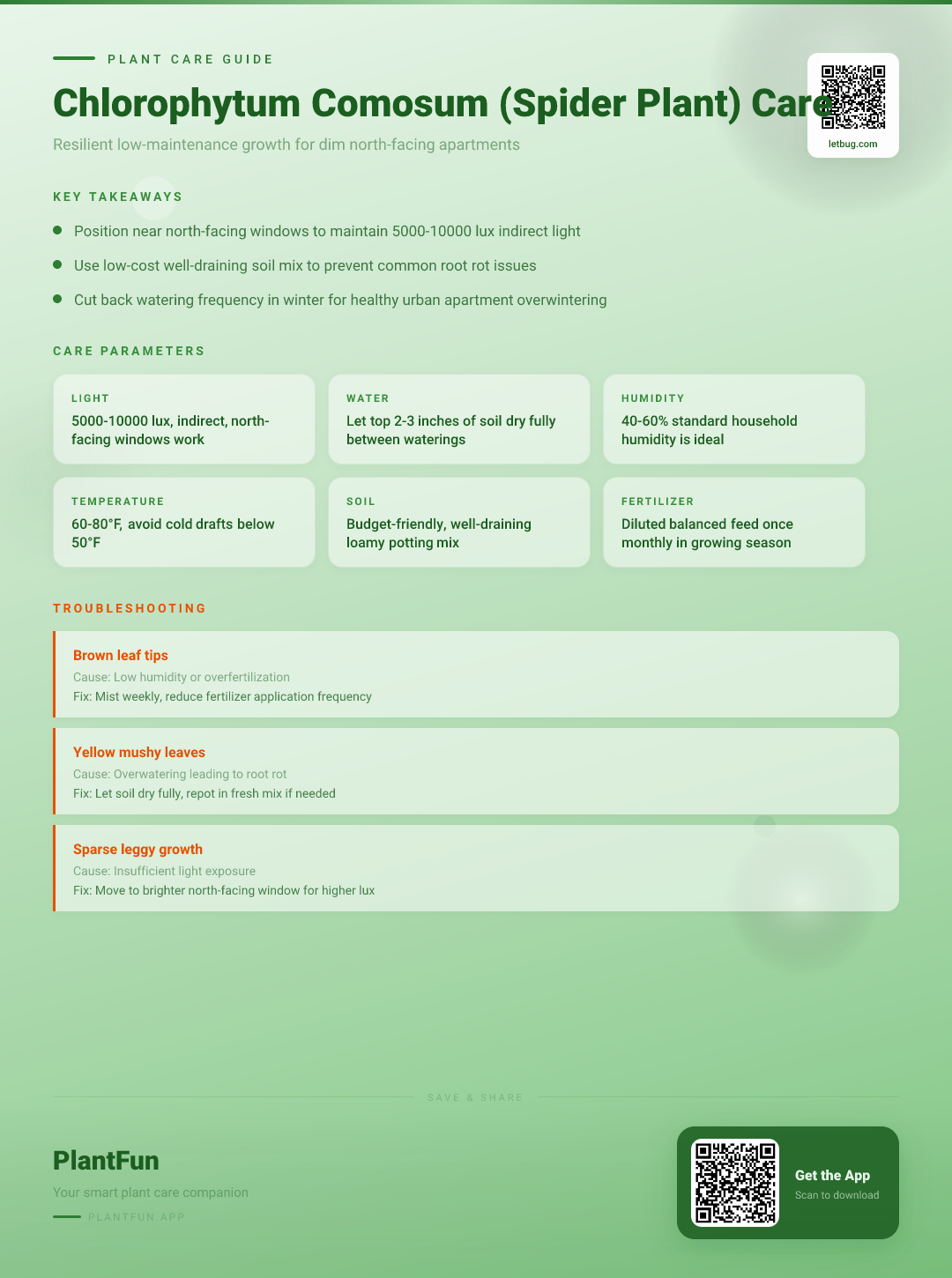
Key Takeaways
- Check soil moisture before watering — overwatering is the #1 killer of houseplants.
- Ensure your plant gets the right amount of light for its species.
- Be patient with recovery — most plants need 2–4 weeks to bounce back.
TL;DR: The Essentials
To keep your Spider Plant (Chlorophytum comosum) thriving in a low-light apartment, focus on these three rules: water only when the top 2 inches of soil are dry, provide bright, indirect light (even if you need a supplemental bulb), and use a fast-draining, peat-free potting mix. While they are resilient, they are not “indestructible”; they require consistent environmental checks to prevent root rot and leaf tip browning.
Quick Care Card: Essential Parameters for Apartment Success
| Parameter | Requirement |
|---|---|
| Light | 5,000–10,000 Lux (Bright, indirect) |
| Water | When top 2” of soil are dry |
| Humidity | 40%–60% (Typical room levels) |
| Temperature | 60°F–80°F (15°C–27°C) |
| Soil | Well-draining, perlite-heavy mix |
| Fertilizer | Balanced liquid feed monthly (Spring/Summer) |
| Toxicity | Non-toxic to cats and dogs (ASPCA, 2026) |
My Experience: The “Indestructible” Myth
When I first started keeping plants in my tiny, North-facing studio, I bought a Spider Plant because every blog called it “impossible to kill.” I shoved it in a dark corner, watered it whenever I remembered, and watched it slowly decline. My lesson? “Resilient” doesn’t mean “neglect-proof.” Once I moved it closer to the window and started checking the soil moisture properly, it finally stopped browning and started producing “babies” (spiderettes). It turns out, this plant is an incredible air purifier (Zhao et al., 2014), but it needs to be treated with specific care to do its job well.
Why Your Apartment’s Microclimate Actually Suits the Spider Plant
Spider Plants are naturally adapted to floor-level forest habitats, making them surprisingly comfortable in urban settings. They are highly efficient at filtering indoor toxins like formaldehyde (Zhao et al., 2014) and reducing carbon monoxide levels (Wicaksono et al., 2022). Your apartment’s ambient temperature range is likely perfect for them, provided you keep them away from direct HVAC drafts.
Light Requirements: Maintaining 5,000-10,000 Lux in North-Facing Windows
While often marketed as a “low light” plant, Chlorophytum comosum thrives best at 5,000–10,000 Lux. If you only have North-facing windows, your light levels may fall below 2,000 Lux, which leads to stunted growth.
- The Quick Test: If you cannot read a book comfortably in the spot where the plant sits during the day, it is likely too dark.
- The Fix: Move the plant to the windowsill or add a dedicated LED grow lamp for 8-10 hours a day.
The Watering Blueprint: Measuring Moisture in Typical 50% Humidity Settings
Overwatering is the #1 cause of failure in apartment settings. In 50% humidity, evaporation is slower than in a greenhouse.
- The Finger Test: Insert your finger 2 inches into the soil. If it feels damp, do not water.
- Drainage: Always use a pot with a drainage hole. Never leave the plant sitting in the saucer’s runoff (NC State Extension, 2026).
Soil Science: Creating a Budget-Friendly, Well-Draining Mix at Home
Commercial potting soils are often too dense. I mix my own using a 2:1:1 ratio of high-quality indoor potting soil, perlite, and coconut coir. This creates the aeration necessary for healthy root systems (NC State Extension, 2026).
Step-by-Step Growth Management: From Propagation to Repotting
Propagation
- Identify a mature “spiderette” with visible aerial root nubs.
- Place the spiderette in a small glass of water or pin it to the surface of a nearby pot’s soil.
- Once roots reach 1 inch in length, pot into a 4-inch nursery container.
Repotting
- Repot only when the tuberous roots begin to lift the plant out of the pot.
- Use a container only 1–2 inches wider than the current root ball to prevent soil souring.
Seasonal Adjustments: Winter Survival Tips for Urban Environments
Winter brings dry air and reduced light. Reduce your watering frequency by 30% and move the plant closer to the window to maximize solar gain. Avoid placing the plant near radiators or heaters, which can desiccate the foliage.
Troubleshooting Common Apartment Issues: Browning Tips vs. Root Rot
Browning Tips
Symptom: Dry, crispy ends on the leaves.
Likely cause: Mineral buildup from tap water or inconsistent moisture.
Fix:
- Flush the soil with distilled or rainwater.
- Maintain more consistent moisture levels.
Root Rot
Symptom: Yellowing leaves and a mushy base.
Likely cause: Sitting in standing water.
Fix:
- Remove the plant, trim away black/mushy roots.
- Re-pot in fresh, dry, porous soil.
Voice Search FAQ
- Why is my Spider Plant turning brown in my bedroom? This is often due to low humidity or a buildup of salts from hard tap water. Try switching to filtered water and misting occasionally.
- How do I know if my apartment has enough light for this plant? Use a light meter app on your phone; look for values between 5,000 and 10,000 Lux near your windows.
- Can I put my spider plant in a bathroom? Yes, provided there is enough window light. The humidity is often beneficial.
Expert Summary: The 3 Pillars of Resilient Spider Plant Growth
- Light: Prioritize proximity to windows or use supplemental lighting (NC State Extension, 2026).
- Moisture: Let the soil surface dry between waterings to prevent root death.
- Safety: Keep the plant accessible but ensure it is in a stable pot, as it is non-toxic to pets (ASPCA, 2026).
References
- ASPCA. (2026). Toxic and Non-Toxic Plants List — ASPCA. https://www.aspca.org/pet-care/animal-poison-control/toxic-and-non-toxic-plants. Accessed 2026-03-13.
- NC State Extension. (2026). Chlorophytum Comosum — NC State Extension Gardener Plant Toolbox. https://plants.ces.ncsu.edu/plants/comosum-care/. Accessed 2026-03-13.
- Wicaksono, R.; Putri, M.; ., A. (2022). Investigation of indoor spider plant (Chlorophytum comosum) affecting the carbon monoxide and carboxyhemoglobin reduction. Ecology, Environment and Conservation. https://doi.org/10.53550/eec.2022.v28i01s.008. Accessed 2026-03-13.
- Zhao, X.; Zhang, N.; Shu, H. (2014). Study on the Purification Effect of Chlorophytum Comosum on Indoor Formaldehyde. Applied Mechanics and Materials. https://doi.org/10.4028/www.scientific.net/amm.675-677.229. Accessed 2026-03-13.
Optional Helper: Plantfun.App
Plantfun.App identifies your plants by photo, diagnoses pests and diseases with clear fixes, and creates personalised watering and light schedules that adapt to your home conditions — a handy companion for putting this guide into daily practice.
Found an error or have suggestions? We'd love your feedback.
Need help identifying this problem?
Get instant identification, personalized care schedules, and effective pest treatment plans directly on your phone.
Sponsored • We may earn a commission from app downloads
Related Guides
Chlorophytum Comosum in a Low-Light Apartment: The Ultimate Budget-Friendly Resilient Growth Care Plan
Master your Spider Plant care with this 0-dollar apartment strategy. Learn exact watering frequencies, light placement, and propagation tips for lush growth.
Care GuideSpider Plant Care in Apartment Living: The Ultimate Resilient Growth Guide for Beginners
Revive your Spider Plant with this science-backed apartment guide. Learn exact watering frequencies, light thresholds, and growth hacks for 100% leaf health.
Care GuideSpider Plant Care for Small Apartments: A Seasonal Guide for Resilient Growth
Transform your apartment Spider Plant with a seasonal care routine that ensures lush, trailing growth. Master these 4 expert thresholds for vibrant foliage.
Pest ControlAnts on Plants: What They Mean and What to Do
Ants usually aren't eating your plant. They are farming other pests.