
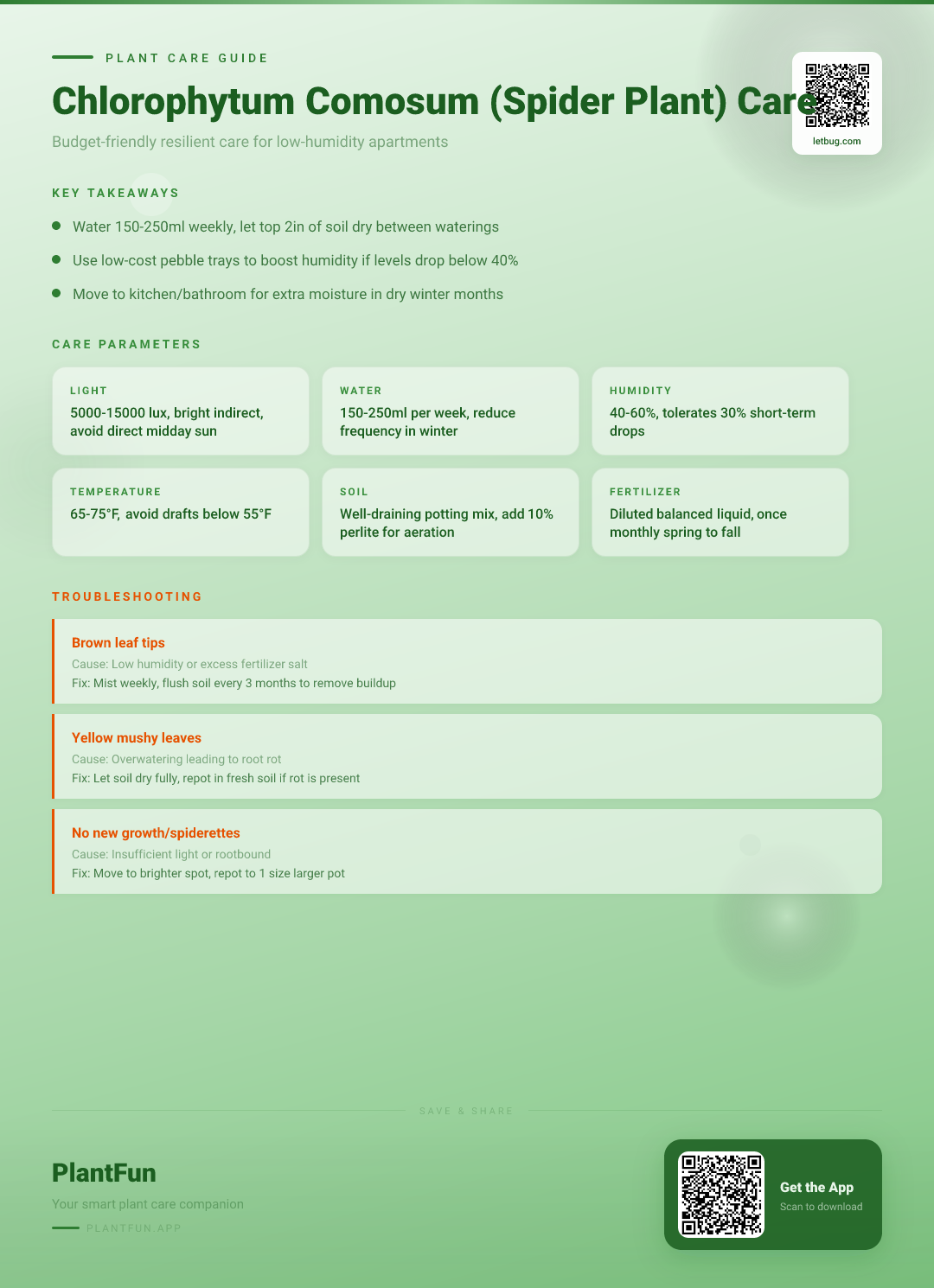
Key Takeaways
- Check soil moisture before watering — overwatering is the #1 killer of houseplants.
- Ensure your plant gets the right amount of light for its species.
- Be patient with recovery — most plants need 2–4 weeks to bounce back.
Quick Care Card: Essential Data
| Feature | Requirement |
|---|---|
| Light | 5,000–15,000 lux (bright, indirect) |
| Water | 150–250ml per week (check soil moisture) |
| Humidity | 40–60% (target range) |
| Temperature | 65–75°F (18–24°C) |
| Soil | Well-draining, peat-based potting mix |
| Fertilizer | Balanced liquid feed, monthly in summer |
| Toxicity | Non-toxic to pets (ASPCA, 2026) |
TL;DR: The Resilient Spider Plant Manifesto for Apartment Living
Chlorophytum comosum is the ultimate apartment survivor. It thrives in moderate light and adapts well to indoor environments. To keep it lush on a budget: provide bright, indirect light, water only when the top two inches of soil are dry, and increase ambient humidity using simple group-planting techniques rather than expensive hardware. It is pet-safe (ASPCA, 2026) and highly efficient at filtering common indoor pollutants (Zhao et al., 2014).
Why Apartments Challenge Spider Plants: Dry Air and Light Realities
When I first brought my Chlorophytum comosum home, I tucked it into a dark corner, thinking its reputation as a ‘low-light’ plant meant no light. I was wrong. Apartments often suffer from lower light levels than greenhouses, and the winter heating season zaps moisture. A common myth is that these plants don’t need care; in reality, they need consistency to maintain their signature arching leaves. My experience taught me that the “brown tip” issue is almost always a reaction to inconsistent water or air that is too dry for the plant’s transpiration rate.
Format A: The Complete Scenario Guide - Step-by-Step Maintenance
- Assessment: Check your light levels using a free smartphone light-meter app. Aim for 5,000–15,000 lux (bright, indirect).
- Watering: Use a measuring cup to apply 150ml of room-temperature water. If the soil is still damp after 7 days, wait until the top 2 inches feel dry to the touch.
- Placement: Position the plant 2–3 feet away from a window. Avoid direct afternoon sun, which can scorch leaves.
- Pruning: Use sterile scissors to snip off any brown tips, cutting at an angle to mimic the natural leaf shape.
Budget-Care Hacks: Creating Humidity Without Expensive Humidifiers
- Grouping: Cluster your spider plant with other foliage. This creates a “micro-climate” where plants share moisture released through transpiration.
- The Pebble Tray: Fill a shallow tray with stones and water. Set your pot on top, ensuring the bottom of the pot never touches the water to prevent root rot.
- Kitchen/Bathroom Rotation: If your living room is bone-dry, swap your plant into the bathroom for 24 hours after you shower. The residual steam is free, effective humidity.
Seasonal Care Calendar: Navigating Low Light in Winter vs. Growth in Summer
- Summer (Growth Phase): Increase watering slightly as temperatures rise. This is the time to propagate the “babies” (spiderettes) that emerge on long stems.
- Winter (Maintenance Phase): Light intensity drops. Move the plant closer to windows. Reduce watering frequency; the plant’s metabolism slows down, and overwatering is the fastest way to kill it.
Common Mistakes: Avoiding Brown Tips and Root Rot Symptoms
Brown Leaf Tips
Symptom: Dry, crispy ends on the foliage.
Likely cause: Low humidity or salt buildup from tap water.
Fix:
- Switch to filtered or rainwater for a month.
- Group the plant with others to increase local humidity.
Mushy, Yellowing Bases
Symptom: Yellow leaves at the base and a soft, decaying stem.
Likely cause: Root rot due to overwatering.
Fix:
- Immediately stop watering and check drainage holes.
- Repot into fresh, well-draining soil, trimming away black, mushy roots.
Voice FAQ
Why is my spider plant turning brown at the tips in my living room?
This is usually a signal of low humidity (below 40%) or mineral buildup. Try increasing humidity via group-planting and flush the soil with distilled water to remove excess salts.
How can I propagate my plant for free without special tools?
Simply snip a spiderette, place its base in a small glass of water until roots reach 1 inch, then pot it in standard indoor potting soil. It costs nothing but time.
Is it okay to move my spider plant to the kitchen for more moisture?
Yes, provided the kitchen offers at least 5,000 lux of light. The higher humidity levels in kitchens are perfect for Chlorophytum comosum recovery.
The Science of Resilience: Understanding Chlorophytum Comosum Nutrient Storage
Chlorophytum comosum possess thick, tuberous roots designed to store water and nutrients, which is why they are so resilient to short-term neglect. Research highlights their practical utility in indoor spaces, showing that these plants can contribute to the reduction of carbon monoxide and other volatile organic compounds in enclosed environments (Wicaksono et al., 2022). Furthermore, their ability to stabilize air quality is well-documented, making them more than just aesthetic additions to an apartment (Zhao et al., 2014).
References
- ASPCA. (2026). Toxic and Non-Toxic Plants List — ASPCA. https://www.aspca.org/pet-care/animal-poison-control/toxic-and-non-toxic-plants. Accessed 2026-03-13.
- Wicaksono, R.; Putri, M.; ., A. (2022). Investigation of indoor spider plant (Chlorophytum comosum) affecting the carbon monoxide and carboxyhemoglobin reduction. Ecology, Environment and Conservation. https://doi.org/10.53550/eec.2022.v28i01s.008. Accessed 2026-03-13.
- Zhao, X.; Zhang, N.; Shu, H. (2014). Study on the Purification Effect of Chlorophytum Comosum on Indoor Formaldehyde. Applied Mechanics and Materials. https://doi.org/10.4028/www.scientific.net/amm.675-677.229. Accessed 2026-03-13.
Optional Helper: Plantfun.App
Plantfun.App identifies your plants by photo, diagnoses pests and diseases with clear fixes, and creates personalised watering and light schedules that adapt to your home conditions — a handy companion for putting this guide into daily practice.
Found an error or have suggestions? We'd love your feedback.
Need help identifying this problem?
Get instant identification, personalized care schedules, and effective pest treatment plans directly on your phone.
Sponsored • We may earn a commission from app downloads
Related Guides
Spider Plant Care for Small Apartments: A 4-Season Guide to Lush, Resilient Growth
Transform your small apartment with a vibrant Chlorophytum comosum. Follow our 4-season routine with precise light, water, and humidity data for year-round growth.
Care GuideSpider Plant Care for Small Apartments: Mastering Resilient Growth in Limited Vertical Space
Transform your small apartment into a lush oasis. Master Spider Plant care with precise light, water, and humidity thresholds designed for compact living spaces.
Care GuideChlorophytum Comosum in a Low-Light Apartment: The Complete Care Guide for Resilient Growth
Revive your apartment Spider Plant with 3 simple adjustments. Learn exact light thresholds, watering schedules, and soil mixes to stop brown tips for good.
Pest ControlAnts on Plants: What They Mean and What to Do
Ants usually aren't eating your plant. They are farming other pests.