
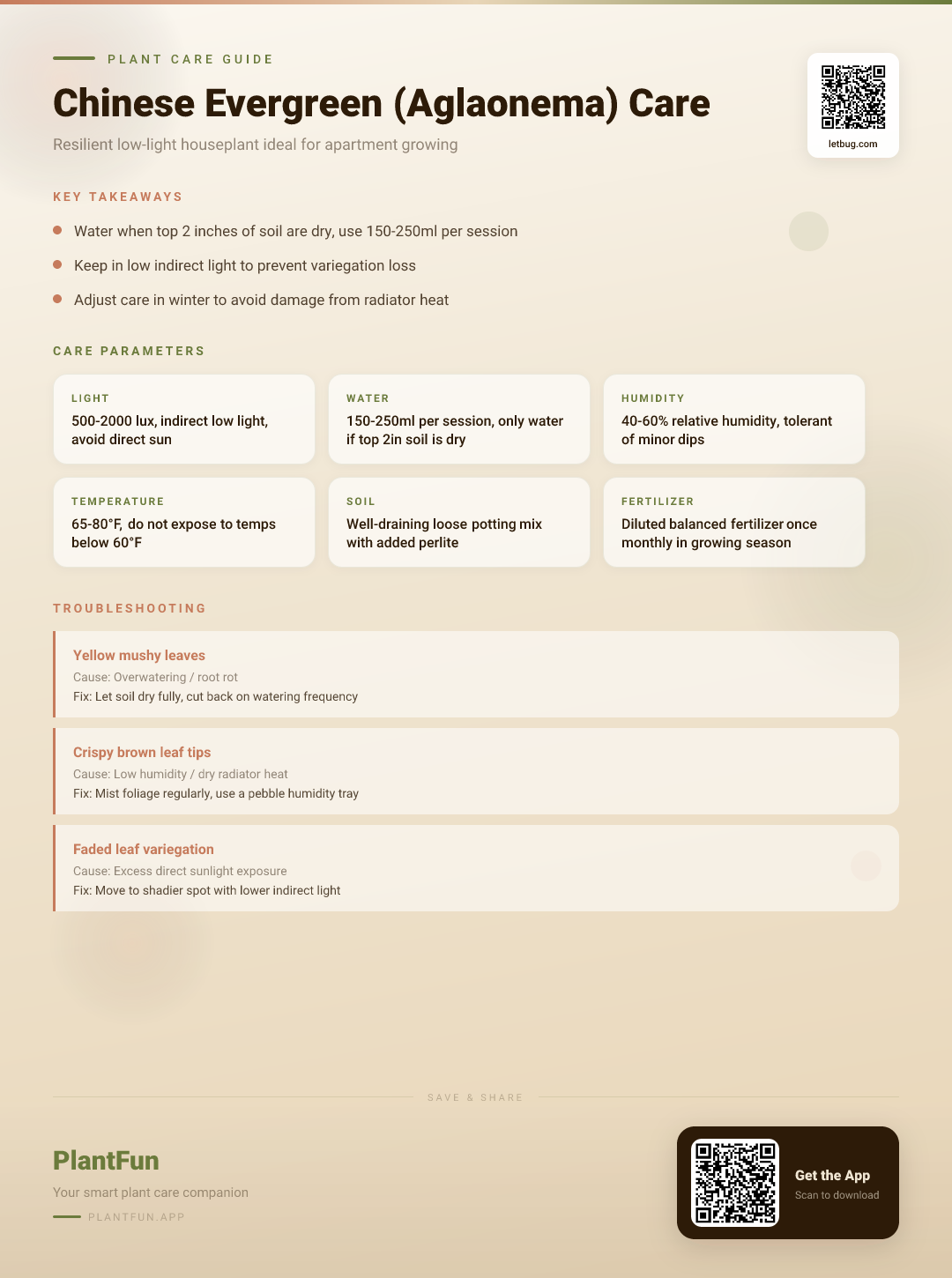
Key Takeaways
- Check soil moisture before watering — overwatering is the #1 killer of houseplants.
- Ensure your plant gets the right amount of light for its species.
- Be patient with recovery — most plants need 2–4 weeks to bounce back.
Quick Care Card: Essential Thresholds for Aglaonema Success
| Feature | Requirement |
|---|---|
| Light | 500–2,000 Lux (Bright, indirect) |
| Water | Allow top 2 inches to dry completely |
| Humidity | 40–60% (Moderate) |
| Temperature | 65–80°F (18–27°C) |
| Soil | Well-draining, peat-based mix |
| Fertilizer | Balanced liquid feed monthly (Spring/Summer) |
| Toxicity | Toxic to cats and dogs (ASPCA, 2026) |
TL;DR: The Low-Light Reality for Chinese Evergreens
While often marketed as “low-light” plants, Aglaonemas actually thrive in bright, filtered light. In a dim apartment, they will survive but rarely grow. To see real progress, place them within three feet of a window, avoid overwatering, and maintain steady temperatures above 65°F (NC State Extension, 2026). If your plant is yellowing, it is usually a sign of soil moisture imbalance or insufficient light to support its current leaf density.
Why Your Apartment Isn’t Actually ‘Low Light’ (Understanding Foot-Candles)
When I first started my indoor jungle in a north-facing studio, I bought several Aglaonemas, assuming the “low-light” tag meant they’d be happy in a dark corner. My plants barely grew for a year. I learned that what we perceive as “bright enough” in our homes is often dim compared to their natural environment.
Light is measured in foot-candles or lux. A dim corner might only offer 50–100 lux, whereas an Aglaonema needs at least 500 lux to initiate photosynthesis effectively. Think of your apartment like a forest understory; even in the shade, those plants receive filtered, indirect light from above (LIU et al., 2013). Move your plant closer to a window, even if it feels “too bright,” and you will see the difference.
Step-by-Step Watering: The 2-Inch Rule for Apartment Humidity
In a confined apartment, stagnant air can make soil stay damp for too long. My go-to method is the “finger test”:
- The Check: Stick your index finger 2 inches into the soil. If it feels dry, it is time to water.
- The Pour: Use 150–250ml of room-temperature water. Avoid cold tap water, which can shock the root system.
- The Drainage: Never let your pot sit in the saucer water; this leads to root suffocation.
Measurable Care Thresholds: Lux (500–2,000), Humidity (40–60%), Temp (65–80°F), and Volume (150-250ml)
Providing the right environment is about balancing these variables. Consistent humidity of 40–60% prevents crispy leaf edges, while temperatures between 65–80°F ensure the plant’s metabolic processes remain active. In nature, seedling distribution and growth are dictated by these exact environmental shifts (DU & MA, 2013).
Seasonal Care Calendar: Adjusting for Winter Radiator Heat
Winter in an apartment usually means forced-air heat, which zaps moisture. I keep a humidity tray (a tray of pebbles and water) near my Aglaonema to counteract the dryness. Reduce watering by 20% during these months, as the plant’s growth slows down significantly (NC State Extension, 2026).
Why is my Chinese Evergreen losing its variegation?
Variegation—those beautiful silver or red patterns—requires light to sustain. If your plant is turning solid green, it is “reverting” to optimize light absorption. Give it more brightness to encourage the colorful patterns to return.
Can I keep my Chinese Evergreen in a windowless bathroom?
While Aglaonemas handle humidity well, they cannot live without light. Even a bathroom needs a decent light source. If you have no windows, you must use a dedicated LED grow light to keep the plant alive.
How do I know if my Aglaonema has root rot?
Root rot signs in Chinese Evergreen include mushy, blackened stems at the base and a persistent sour smell coming from the soil. If you suspect this, gently remove the plant and inspect the roots—healthy ones are firm and pale; rotten ones are slimy and dark.
Common Mistakes: The Myth of the ‘Self-Sustaining’ Desk Plant
- Mistake: Putting the plant in a windowless cubicle. What happens: The plant eventually exhausts its stored energy and dies. Instead: Use a grow light or rotate the plant to a window.
- Mistake: Watering on a strict “every Monday” schedule. What happens: You will inevitably overwater during cloudy weeks. Instead: Water only when the top 2 inches of soil are dry.
Troubleshooting: From Crispy Tips to Mushy Stems
Leaf Yellowing
Symptom: Lower leaves turn yellow and drop.
Likely cause: Overwatering or poor drainage.
Fix:
- Check for standing water in the bottom of the pot.
- Repot into a container with drainage holes using a chunky, aerated soil mix.
Crispy Brown Edges
Symptom: Tips of leaves turn brown and dry.
Likely cause: Low humidity or mineral buildup from tap water.
Fix:
- Increase humidity by grouping plants or using a pebble tray.
- Use filtered or distilled water to flush salts out of the soil.
Stunted Growth
Symptom: Plant remains the same size for months.
Likely cause: Insufficient light or root-bound conditions.
Fix:
- Move the plant to a spot with more ambient light.
- Check if roots are circling the bottom of the pot; if so, repot in a container 1-2 inches larger.
Expert Tips for Encouraging New Leaf Growth
To make your plant grow faster, I recommend fertilizing with a balanced liquid houseplant food once a month during the active growing season. Additionally, gently wiping the leaves with a damp cloth every few weeks removes dust, which directly improves the leaf’s ability to photosynthesize (NC State Extension, 2026).
References
- LIU, J.; YANG, Q.; SONG, Q. (2013). Strategy of fine root expansion of Phyllostachys pubescens population into evergreen broad-leaved forest. Chinese Journal of Plant Ecology. https://doi.org/10.3724/sp.j.1258.2013.00023. Accessed 2026-03-12.
- DU, Y.; MA, K. (2013). Temporal and spatial variation of seedfall in a broad-leaved evergreen forest in Gutianshan Nature Reserve of Zhejiang Province, China. Chinese Journal of Plant Ecology. https://doi.org/10.3724/sp.j.1258.2012.00717. Accessed 2026-03-12.
- ASPCA. (2026). Toxic and Non-Toxic Plants List — ASPCA. https://www.aspca.org/pet-care/animal-poison-control/toxic-and-non-toxic-plants. Accessed 2026-03-12.
- NC State Extension. (2026). Chinese Evergreen — NC State Extension Gardener Plant Toolbox. https://plants.ces.ncsu.edu/plants/evergreen-care/. Accessed 2026-03-12.
Optional Helper: Plantfun.App
Plantfun.App identifies your plants by photo, diagnoses pests and diseases with clear fixes, and creates personalised watering and light schedules that adapt to your home conditions — a handy companion for putting this guide into daily practice.
Found an error or have suggestions? We'd love your feedback.
Need help identifying this problem?
Get instant identification, personalized care schedules, and effective pest treatment plans directly on your phone.
Sponsored • We may earn a commission from app downloads
Related Guides
Chinese Evergreen Care for Typical Apartments: A Resilient Growth Guide for Beginners
Revive your wilting Chinese Evergreen with precise care metrics. Learn the 3 golden rules for light, soil moisture, and humidity to ensure lush, vibrant growth.
Care GuideThe Complete Chinese Evergreen Care Checklist for Budget-Friendly Resilient Growth in Small Urban Apartments
Grow a lush, hardy Chinese Evergreen even in a dim small apartment with zero fancy supplies. Get our free 7-step budget checklist, exact care thresholds, and mistake fixes to avoid yellow leaves.
Care GuideChinese Evergreen Care Checklist for Resilient Growth in Small Low-Light Apartments
Grow a lush, low-fuss Chinese Evergreen even in your tiny, dim apartment. Get 8 actionable checklist items, exact light/water thresholds, and space-saving hacks to keep your plant thriving year-round.
Pest ControlAnts on Plants: What They Mean and What to Do
Ants usually aren't eating your plant. They are farming other pests.