
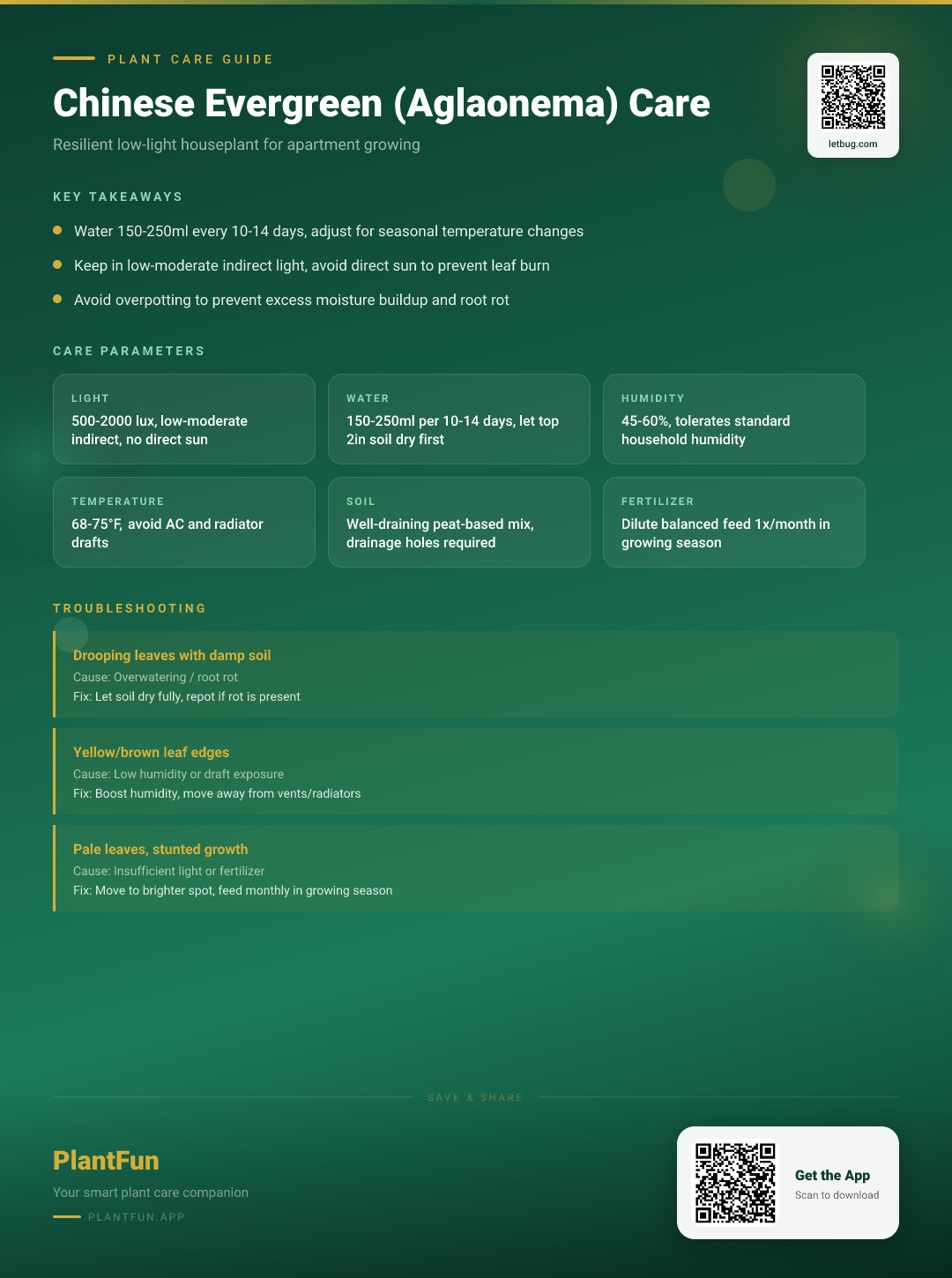
Key Takeaways
- Check soil moisture before watering — overwatering is the #1 killer of houseplants.
- Ensure your plant gets the right amount of light for its species.
- Be patient with recovery — most plants need 2–4 weeks to bounce back.
Quick Care Card: Essential Thresholds for Aglaonema
| Feature | Requirement |
|---|---|
| Light | 500-2,000 lux (Indirect, low to medium) |
| Water | 150-250ml per 10-14 days |
| Humidity | 45-60% |
| Temperature | 68-75°F (20-24°C) |
| Soil | Well-draining, peat-based mix |
| Fertilizer | Balanced liquid feed, monthly in spring/summer |
| Toxicity | Toxic to cats and dogs (ASPCA, 2026) |
TL;DR: The Apartment-Dweller’s Survival Summary
Aglaonema, or the Chinese Evergreen, is a master of adaptation, but ‘low light’ does not mean ‘no light.’ To keep yours thriving in an apartment, avoid overwatering by measuring your water volume (150-250ml) and ensuring your soil dries at least 50% deep before the next drink. Keep them away from direct AC vents and radiators, which desiccate foliage. When I first brought my first Aglaonema commutatum home, I made the mistake of placing it in a dark, stagnant corner; it quickly developed leaf-tip necrosis. I learned that even in low-light environments, consistent, gentle airflow and stable moisture levels are the secret to preventing common indoor plant stressors.
Why Your Apartment’s ‘Low Light’ Isn’t Just About Lack of Sun
Many assume that because Aglaonema survives in shaded forest floors, it thrives in a dark apartment corner. In reality, that “low light” is often accompanied by “stagnant air.” In dense forest ecosystems, even shaded areas benefit from the complex airflow and root interaction between neighboring flora (LIU, J.; YANG, Q.; SONG, Q., 2013). In your apartment, a dark corner often lacks this natural circulation, leading to fungal issues. Aim for a spot that receives soft, indirect glow—if you cannot read a book comfortably without a lamp, your Aglaonema likely isn’t getting enough light to photosynthesize effectively.
The 5-Step Resilient Care Protocol: From Soil to Drainage
- Substrate Selection: Use a coarse, peat-based potting mix amended with perlite or orchid bark to ensure root aeration (NC State Extension, 2026).
- The Finger Test: Before adding water, insert your finger two inches into the soil. If it feels cool or moist, wait two more days.
- Volume Control: Use a measuring cup. For a standard 6-inch pot, 200ml is usually the “sweet spot” for a 10-14 day cycle.
- Drainage Check: Ensure your pot has drainage holes. A soggy base leads to root rot, which is the primary cause of sudden indoor plant decline.
- Light Supplementation: If your apartment faces north or has limited window access, consider a simple, full-spectrum LED bulb kept 12-18 inches from the foliage.
Watering Science: Why 200ml Matters More Than a Calendar Date
Most plant owners water on a schedule (e.g., “every Monday”). However, photosynthesis rates fluctuate with seasonal light intensity (DU, Y.; MA, K., 2013). If your apartment is darker in winter, the plant consumes less water. Providing exactly 200ml prevents the waterlogging that often kills these tropical species. Adjust your volume downward in winter if the soil remains damp after 14 days.
Seasonal Adjustments: Managing Radiator Heat and AC Drafts
Apartment living means seasonal fluctuations. Radiators create localized “desert” conditions. I move my Aglaonema at least three feet away from any heat source during winter. Conversely, in summer, avoid placing them directly in the path of cold AC air, which can shock the plant and cause leaves to curl inward.
FAQ: Why is my Chinese Evergreen drooping despite the soil feeling damp?
This is likely the result of root rot. When roots are damaged by overwatering, they cannot transport water to the leaves, leading to wilting even when the soil is saturated. Check for a sour smell or mushy, brown roots (NC State Extension, 2026).
FAQ: Can I safely keep my Aglaonema in a windowless bathroom with only LED lighting?
Yes, Aglaonema is one of the few species that adapts well to artificial light. Ensure the LED is on for at least 8-10 hours a day, and keep an eye on humidity levels, which are typically high in bathrooms, potentially slowing the drying process of the soil.
FAQ: How do I know if my plant is getting too much or too little fertilizer?
Too much fertilizer often causes brown, crispy leaf edges due to salt buildup. Too little results in stunted growth and pale, yellowing leaves. A balanced, water-soluble fertilizer applied at half-strength during the growing season is the safest approach for apartment-grown plants.
Common Mistakes to Avoid: The Dangers of Over-Potting
- Mistake: Moving a plant into a pot 2-3 inches larger than its root ball.
- What happens: Excessive soil holds too much water, staying wet for too long and drowning the root system.
- Instead: Repot only when roots are visible through the drainage holes, increasing pot size by no more than 1 inch.
Troubleshooting Guide: Identifying Nutrient Deficiencies vs. Pest Stress
Yellowing Leaf Margins
Symptom: The edges of lower leaves are turning yellow while the center remains green.
Likely cause: Nitrogen deficiency or salt accumulation from tap water.
Fix:
- Flush the soil with filtered water to remove mineral buildup.
- Apply a balanced, liquid fertilizer at half-strength once per month.
Sudden Leaf Drop
Symptom: Healthy-looking leaves falling off without warning.
Likely cause: Cold draft or sudden temperature fluctuation.
Fix:
- Relocate the plant away from drafty windows or doors.
- Ensure the plant maintains a temperature above 65°F (18°C) (NC State Extension, 2026).
Sticky Residue on Stems
Symptom: A shiny, sticky substance found on the undersides of leaves.
Likely cause: Mealybug or scale infestation.
Fix:
- Wipe leaves with a damp cloth soaked in diluted neem oil.
- Inspect neighboring plants as these pests spread quickly in close-quarters apartments.
References and Botanical Data
- LIU, J.; YANG, Q.; SONG, Q. (2013). Strategy of fine root expansion of Phyllostachys pubescens population into evergreen broad-leaved forest. Chinese Journal of Plant Ecology. https://doi.org/10.3724/sp.j.1258.2013.00023. Accessed 2026-03-09.
- DU, Y.; MA, K. (2013). Temporal and spatial variation of seedfall in a broad-leaved evergreen forest in Gutianshan Nature Reserve of Zhejiang Province, China. Chinese Journal of Plant Ecology. https://doi.org/10.3724/sp.j.1258.2012.00717. Accessed 2026-03-09.
- ASPCA. (2026). Toxic and Non-Toxic Plants List — ASPCA. https://www.aspca.org/pet-care/animal-poison-control/toxic-and-non-toxic-plants. Accessed 2026-03-09.
- NC State Extension. (2026). Chinese Evergreen — NC State Extension Gardener Plant Toolbox. https://plants.ces.ncsu.edu/plants/evergreen-care/. Accessed 2026-03-09.
Optional Helper: Plantfun.App
Plantfun.App identifies your plants by photo, diagnoses pests and diseases with clear fixes, and creates personalised watering and light schedules that adapt to your home conditions — a handy companion for putting this guide into daily practice.
Found an error or have suggestions? We'd love your feedback.
Need help identifying this problem?
Get instant identification, personalized care schedules, and effective pest treatment plans directly on your phone.
Sponsored • We may earn a commission from app downloads
Related Guides
Chinese Evergreen Care for Apartment Living: A Low-Stress Guide to Resilient Growth
Master Aglaonema care with this apartment-tested guide. Learn the exact 10,000-lux threshold and watering schedule needed to keep your Chinese Evergreen thriving.
Care GuideThe Complete Chinese Evergreen Care Checklist for Resilient Growth in Typical Apartments
Grow a lush, hardy Chinese Evergreen even in a low-light city apartment. Get exact light levels, watering amounts, and a 4-season care routine to avoid yellow leaves and stunted growth.
Care GuideThe Complete Chinese Evergreen Care Checklist for Resilient Growth in Low-Light City Apartments
Grow lush, hardy Chinese Evergreens even in dark, dry apartments. Get exact light, water, humidity thresholds, a 12-point care checklist, and quick fixes for common leaf symptoms.
Pest ControlAnts on Plants: What They Mean and What to Do
Ants usually aren't eating your plant. They are farming other pests.