
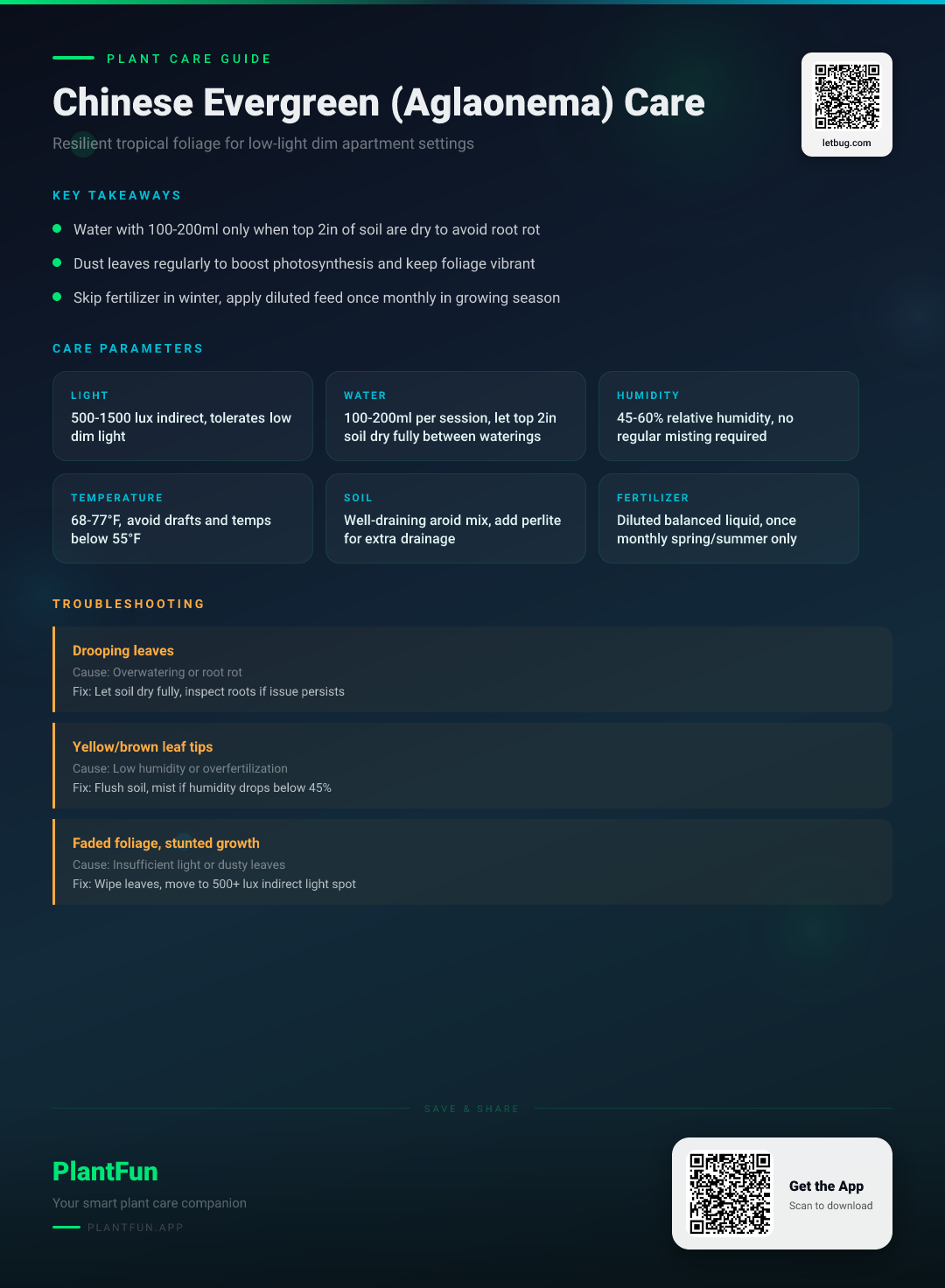
Key Takeaways
- Check soil moisture before watering — overwatering is the #1 killer of houseplants.
- Ensure your plant gets the right amount of light for its species.
- Be patient with recovery — most plants need 2–4 weeks to bounce back.
Quick Care Card: Essential Thresholds for Aglaonema Success
| Feature | Threshold |
|---|---|
| Light | 500–1,500 Lux (Low to Medium) |
| Water | Allow top 2 inches of soil to dry |
| Humidity | 45%–60% |
| Temperature | 68°F–77°F (20°C–25°C) |
| Soil | Well-draining, peat-based mix |
| Fertilizer | Balanced liquid 20-20-20 (monthly in summer) |
| Toxicity | Toxic to pets (ASPCA, 2026) |
TL;DR: The Reality of Keeping Aglaonema in Low-Light Apartments
If you have a dim corner, Aglaonema is likely your best bet for a thriving indoor jungle. They are incredibly resilient, requiring only modest light levels (500–1,500 lux) and consistent but infrequent watering. Avoid over-watering, which is the primary cause of decline, and keep temperatures stable. They are perfect for apartment living as long as you account for their toxicity to pets (ASPCA, 2026).
Why Chinese Evergreens Thrive Where Other Plants Fail
When I first got my Aglaonema years ago, I made the mistake of placing it in direct, scorching sun. It withered quickly. I soon learned that these plants are adapted to the forest floor of tropical ecosystems, where they thrive in dappled, filtered light (NC State Extension, 2026). Their broad, often variegated leaves are evolutionary tools designed to maximize photosynthesis in low-light conditions. Unlike sun-loving species that struggle when light is scarce, Chinese Evergreens maintain their structural integrity even in the shadows of an apartment corner.
Decoding Your Apartment Light: How to Measure and Utilize 500-1,500 Lux
In my experience, “low light” is a subjective term that leads to many failed plant parents. In botanical terms, Chinese Evergreens prefer 500 to 1,500 lux (NC State Extension, 2026).
- The Light Meter Test: Download a light meter app on your phone to measure the light at the leaf surface. If you are reading below 500 lux, your plant will survive but will not grow. Aim for the 1,000 lux mark for steady, lush leaf production.
- The Shadow Test: If you hold your hand 12 inches above the soil and see no shadow cast on the leaves, the light is likely too low for long-term health.
The Watering Science: Managing Hydration to Prevent Root Rot (Why 100-200ml Matters)
Watering is where most beginners go wrong. I typically suggest applying 100–200ml of water per plant, depending on the pot size, rather than dumping a large volume that saturates the root zone for days. Over-watering creates an anaerobic environment that promotes root rot.
- The Finger Test: Before watering, push your index finger 2 inches into the soil. If it feels damp, wait. If it feels dry, apply the measured 100–200ml dose slowly to allow even distribution.
- Drainage: Ensure your nursery pot has drainage holes. Standing water is the enemy of the root system (NC State Extension, 2026).
Environmental Factors: Humidity (45-60%) and Temperature (68-77°F)
Apartments can be notoriously dry, especially in winter. Aglaonema prefers 45–60% humidity (NC State Extension, 2026). If your apartment drops below 40%, you may notice brown leaf tips. I use a simple pebble tray with water to boost local humidity without needing a bulky humidifier. Keep the plant away from drafty windows or air conditioning vents to maintain a steady temperature range of 68–77°F (20°C–25°C).
Seasonal Care Calendar: Adjusting for Winter Light and Summer Growth
- Spring/Summer: Growth accelerates as light increases. Fertilize once a month with a balanced, water-soluble fertilizer at half-strength.
- Autumn/Winter: Growth slows significantly. Reduce watering frequency by 30-50% and pause all fertilization. The plant will enter a period of rest (NC State Extension, 2026).
Common Mistakes to Avoid: From Over-Fertilizing to Poor Drainage
- Mistake: Using non-draining decorative pots.
- What happens: Water pools at the bottom, causing fungal rot.
- Instead: Always use a plastic liner with holes inside your decorative cachepot.
- Mistake: Excessive fertilizing in low light.
- What happens: “Fertilizer burn” where salts accumulate because the plant cannot process the nutrients.
- Instead: Only feed during active growth seasons.
FAQ: Why is my Chinese Evergreen drooping?
Drooping is usually a sign of dehydration or root rot. Check the soil moisture; if the soil is bone dry, it needs a thorough drink. If it is soggy, you must inspect the roots for decay.
FAQ: Can I keep my Chinese Evergreen in a windowless room?
No, plants cannot perform photosynthesis in total darkness. While Aglaonema is hardy, it requires at least minimal ambient light. If you must keep it in a windowless bathroom, you will need to supplement with a grow light.
FAQ: How often should I dust the leaves to improve photosynthesis?
I make it a habit to wipe the leaves with a damp cloth every two weeks. Dust blocks the stomata, which significantly reduces the plant’s ability to photosynthesize (NC State Extension, 2026).
Expert Troubleshooting: A Symptom-to-Action Checklist
Yellowing Leaves
Symptom: Lower leaves turn yellow and eventually fall off.
Likely cause: Over-watering or poor soil drainage.
Fix:
- Check the drainage holes for blockages.
- Allow the soil to dry out completely before the next watering.
Brown Leaf Tips
Symptom: Crisp, brown edges on the foliage.
Likely cause: Low humidity or mineral buildup from tap water.
Fix:
- Increase ambient humidity using a pebble tray.
- Use filtered or distilled water if your tap water is high in salts.
Leggy Growth
Symptom: Large gaps between leaves and stems stretching.
Likely cause: Insufficient light intensity.
Fix:
- Move the plant to a spot with more ambient light.
- Rotate the plant every two weeks for even growth.
Wilting Despite Moist Soil
Symptom: The plant looks thirsty even after watering.
Likely cause: Root rot destroying the root system.
Fix:
- Remove the plant from its pot to inspect for black, mushy roots.
- Trim away dead roots and repot into fresh, well-draining soil.
References
- ASPCA. (2026). Toxic and Non-Toxic Plants List — ASPCA. https://www.aspca.org/pet-care/animal-poison-control/toxic-and-non-toxic-plants. Accessed 2026-03-18.
- DU, Y.; MA, K. (2013). Temporal and spatial variation of seedfall in a broad-leaved evergreen forest in Gutianshan Nature Reserve of Zhejiang Province, China. Chinese Journal of Plant Ecology. https://doi.org/10.3724/sp.j.1258.2012.00717. Accessed 2026-03-18.
- LIU, J.; YANG, Q.; SONG, Q. (2013). Strategy of fine root expansion of Phyllostachys pubescens population into evergreen broad-leaved forest. Chinese Journal of Plant Ecology. https://doi.org/10.3724/sp.j.1258.2013.00023. Accessed 2026-03-18.
- NC State Extension. (2026). Chinese Evergreen — NC State Extension Gardener Plant Toolbox. https://plants.ces.ncsu.edu/plants/evergreen-care/. Accessed 2026-03-18.
Optional Helper: Plantfun.App
Plantfun.App identifies your plants by photo, diagnoses pests and diseases with clear fixes, and creates personalised watering and light schedules that adapt to your home conditions — a handy companion for putting this guide into daily practice.
Found an error or have suggestions? We'd love your feedback.
Need help identifying this problem?
Get instant identification, personalized care schedules, and effective pest treatment plans directly on your phone.
Sponsored • We may earn a commission from app downloads
Related Guides
Chinese Evergreen Care for Typical Apartments: A Resilient Growth Guide for Beginners
Revive your wilting Chinese Evergreen with precise care metrics. Learn the 3 golden rules for light, soil moisture, and humidity to ensure lush, vibrant growth.
Care GuideChinese Evergreen in a Low-Light Apartment: The Only Care Guide You’ll Ever Need
Master your Aglaonema’s growth with specific lux requirements and a 3-step watering schedule. Stop the leaf yellowing and build a thriving urban jungle today.
Care GuideChinese Evergreen Care for Apartment Living: A Low-Stress Guide to Resilient Growth
Master Aglaonema care with this apartment-tested guide. Learn the exact 10,000-lux threshold and watering schedule needed to keep your Chinese Evergreen thriving.
Pest ControlAnts on Plants: What They Mean and What to Do
Ants usually aren't eating your plant. They are farming other pests.