
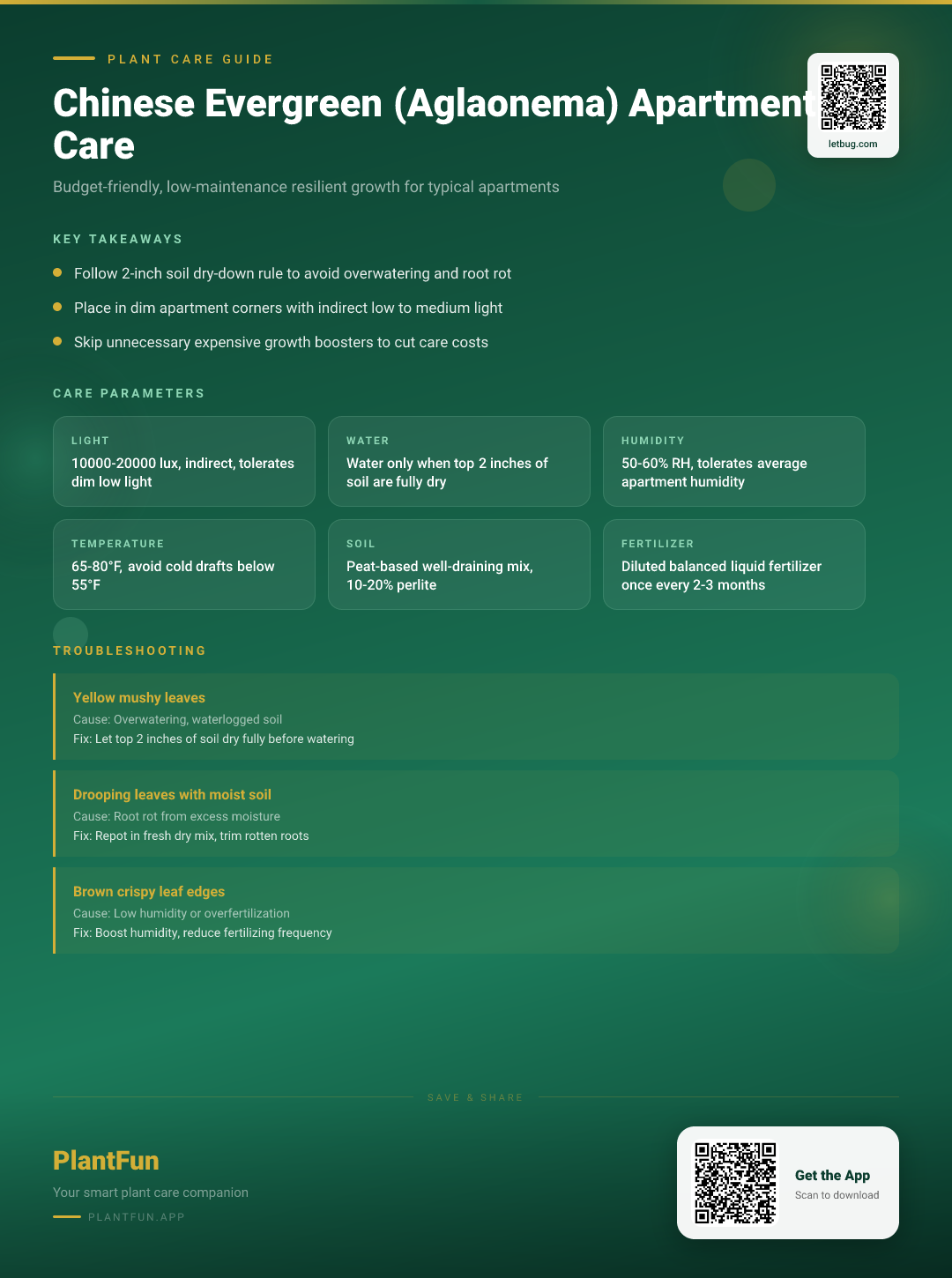
Key Takeaways
- Check soil moisture before watering — overwatering is the #1 killer of houseplants.
- Ensure your plant gets the right amount of light for its species.
- Be patient with recovery — most plants need 2–4 weeks to bounce back.
Quick Care Card: Essential Thresholds for Aglaonema
| Feature | Requirement |
|---|---|
| Light | 10k–20k lux (Moderate to Low) |
| Water | 2-inch dry-down rule |
| Humidity | 50–60% |
| Temperature | 65–80°F (18–27°C) |
| Soil | Well-draining, peat-based mix |
| Fertilizer | Balanced liquid feed, half-strength (monthly in summer) |
| Toxicity | Toxic to cats and dogs (ASPCA, 2026) |
TL;DR: The Low-Maintenance Philosophy for Chinese Evergreens
Aglaonemas are the ultimate apartment survivors. They thrive in moderate indirect light, require water only when the top 2 inches of soil are dry, and tolerate standard home temperatures. Avoid over-pampering; most “problems” in apartment settings are simply the result of over-watering or excessive fertilizer use.
Why Chinese Evergreens are the Ultimate Apartment Survivors
In my decade of working with indoor plants, I have found few species as forgiving as the Aglaonema. These tropical plants are native to the forest floors of Southeast Asia, which explains their resilience in typical indoor environments. Unlike high-maintenance fiddle leaf figs, Chinese Evergreens adapt to the fluctuating light levels found in most urban apartments (NC State Extension, 2026).
Understanding Your Apartment Light: Working with Dim Corners and Indirect Sun
When I first started my plant journey, I made the mistake of placing my Aglaonema in a window blasted by afternoon sun. The leaves scorched immediately. These plants prefer 10,000 to 20,000 lux. In practical terms, this means a spot a few feet away from a North or East-facing window, or a bright corner where the plant receives soft, diffused light.
How to test your light:
If you can read a book comfortably in your chosen spot without squinting, your Aglaonema will likely be happy there. Avoid deep, windowless bathrooms or hallways unless you supplement with a basic LED grow bulb.
Step-by-Step Watering: Avoiding the Common ‘Rot-by-Overcare’ Trap
Watering is where most owners fail. I follow the “finger test” religiously to prevent root rot.
- The Test: Insert your finger 2 inches into the soil. If it feels damp, wait another 3 days.
- The Pour: When the top 2 inches are dry, pour water until you see it exit the bottom drainage holes (NC State Extension, 2026).
- The Drain: Never let your pot sit in a saucer of standing water. If your decorative pot has no hole, use a plastic “nursery pot” inside of it to ensure excess water is discarded.
Budget-Friendly Humidity Hacks for Dry Apartment Air
Apartments are notorious for dry air, especially in winter. Instead of buying an expensive room humidifier, I use two cost-effective methods:
- Grouped Plants: Clustering your plants creates a micro-climate where their transpiration raises the local humidity.
- The Pebble Tray: Place your pot on a tray filled with pebbles and water, ensuring the bottom of the pot never touches the water directly.
Decoding Leaf Signals: What Your Aglaonema is Trying to Tell You
Yellowing Lower Leaves
Symptom: The oldest leaves near the base turn yellow and drop.
Likely cause: Natural aging or slight over-watering.
Fix: Check the soil moisture; if it’s consistently wet, let it dry out more between sessions.
Browning Tips
Symptom: Crisp, brown leaf tips.
Likely cause: Low humidity or mineral buildup from tap water.
Fix: Use filtered water and group the plant with others to improve local moisture levels.
Drooping Foliage
Symptom: The entire plant looks limp despite moist soil.
Likely cause: Root distress or severe temperature shifts.
Fix: Check the pot for proper drainage and move it away from drafty vents.
Seasonal Care Calendar: Shifting Your Strategy from Summer Growth to Winter Dormancy
- Spring/Summer: This is the growing season. Apply a balanced liquid fertilizer at half-strength once a month.
- Fall/Winter: Growth slows down significantly. Stop fertilizing entirely and wait for the soil to dry out an extra inch deeper than you would in summer. According to Stone (2010), maintaining a stable environment is key to indoor health regardless of the season (Stone, 2010).
Voice Search FAQ
Why is my Chinese Evergreen drooping despite the soil being moist? This is often a sign of root suffocation. If the soil is wet but the leaves are limp, the roots may have been sitting in water too long and are starting to rot. Check the roots; healthy ones are white and firm, while rotting roots are brown and mushy.
How do I know if my apartment has enough light for an Aglaonema? If you have a window that faces North or East, you have the perfect “apartment light.” If your home has only dark, windowless rooms, you will need an artificial light source to prevent the plant from becoming leggy.
Can I put my Aglaonema in a room with a cat? No. According to the ASPCA (2026), Chinese Evergreens are toxic to both cats and dogs. It is best to keep them on a high shelf or in a room your pets cannot access.
Common Mistakes: Stop Spending Money on Unnecessary Growth Boosters
- Mistake: Buying expensive “growth stimulant” sprays.
- What happens: You may over-fertilize, causing chemical burn on roots.
- Instead: Focus on light and consistent watering. These are the primary drivers of health.
- Mistake: Repotting immediately upon purchase.
- What happens: The plant experiences “transplant shock.”
- Instead: Let the plant acclimate to your apartment for at least 4 weeks before considering a new pot.
References
- Elderly Care. (1995). Indoor-outdoor wheelchair. https://doi.org/10.7748/eldc.7.5.32.s47. Accessed 2026-03-19.
- Stone, T. (2010). Indoor gardening. Child Care. https://doi.org/10.12968/chca.2010.7.2.46139. Accessed 2026-03-19.
- ASPCA. (2026). Toxic and Non-Toxic Plants List — ASPCA. https://www.aspca.org/pet-care/animal-poison-control/toxic-and-non-toxic-plants. Accessed 2026-03-19.
- NC State Extension. (2026). Chinese Evergreen Care — NC State Extension Gardener Plant Toolbox. https://plants.ces.ncsu.edu/plants/evergreen-care/. Accessed 2026-03-19.
Optional Helper: Plantfun.App
Plantfun.App identifies your plants by photo, diagnoses pests and diseases with clear fixes, and creates personalised watering and light schedules that adapt to your home conditions — a handy companion for putting this guide into daily practice.
Found an error or have suggestions? We'd love your feedback.
Need help identifying this problem?
Get instant identification, personalized care schedules, and effective pest treatment plans directly on your phone.
Sponsored • We may earn a commission from app downloads
Related Guides
Aglaonema in Low-Light Apartments: A Budget-Friendly Guide to Resilient, Lush Indoor Growth
Transform your low-light apartment with healthy Aglaonema plants. Get 4 specific care thresholds, a budget-friendly watering plan, and expert growth secrets now.
Care GuideChinese Evergreen Care for Typical Apartments: A Resilient Growth Guide for Beginners
Revive your wilting Chinese Evergreen with precise care metrics. Learn the 3 golden rules for light, soil moisture, and humidity to ensure lush, vibrant growth.
Care GuideAglaonema Chinese Evergreen in Low-Light Apartments: A Budget-Friendly Care Strategy for Vibrant Growth
Transform your dim studio into a jungle. Master Aglaonema care with exact light lux, watering schedules, and 3 budget hacks to keep your Chinese Evergreen lush.
Pest ControlAnts on Plants: What They Mean and What to Do
Ants usually aren't eating your plant. They are farming other pests.