
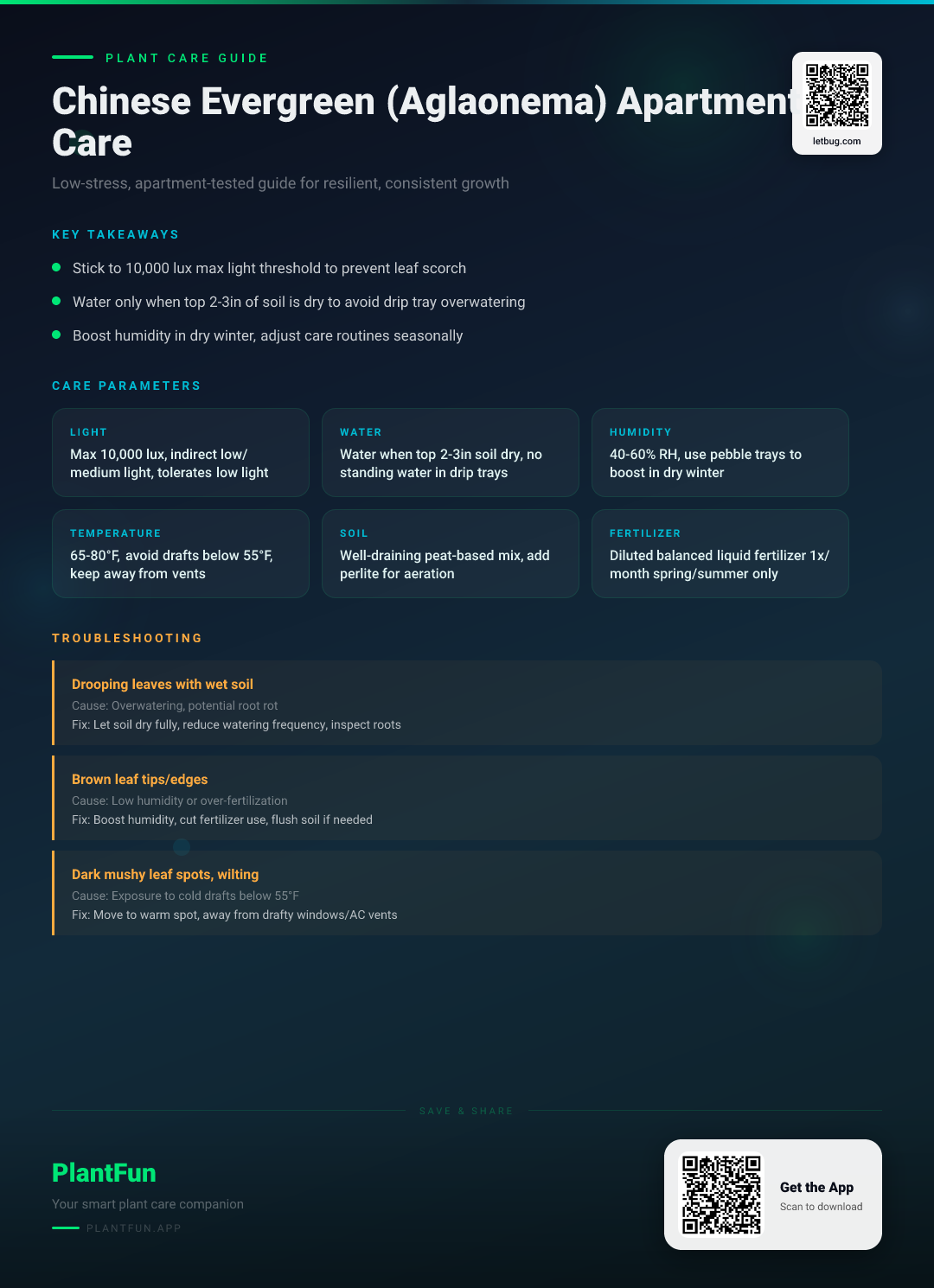
Key Takeaways
- Check soil moisture before watering — overwatering is the #1 killer of houseplants.
- Ensure your plant gets the right amount of light for its species.
- Be patient with recovery — most plants need 2–4 weeks to bounce back.
Quick Care Card: Snapshot of Light, Water, Soil, and Temp requirements
| Feature | Requirement |
|---|---|
| Light | Bright, indirect (10,000–15,000 lux) |
| Water | Allow top 50% of soil to dry |
| Humidity | 40%–60% (Moderate) |
| Temperature | 65°F–80°F (18°C–27°C) |
| Soil | Well-draining aroid mix |
| Fertilizer | Balanced liquid feed, monthly (Spring/Summer) |
| Toxicity | Toxic to cats and dogs (ASPCA, 2026) |
TL;DR: The Busy Apartment Owner’s Essential Summary
If you live in a low-light apartment, the Aglaonema is your best friend. To keep it happy, focus on two rules: never let it sit in standing water and avoid temperatures below 60°F. Water only when the top two inches of soil feel dry. These plants are slow growers, so resist the urge to over-fertilize. Most importantly, keep them away from cold drafts near windows or AC vents.
Why the Chinese Evergreen is the Ultimate Resilient Apartment Plant
When I first started collecting plants, I made the mistake of thinking every leafy green needed a south-facing window. I bought a finicky fern that promptly perished in my shaded studio. Then, I found the Chinese Evergreen. Unlike high-maintenance tropicals, Aglaonema species have evolved to thrive on the forest floor, making them exceptionally adaptable to the interior corners of urban apartments (NC State Extension, 2026). They don’t demand expensive grow lights or constant misting, offering a level of durability that makes them ideal for busy professionals.
Measurable Care Parameters: Setting Up Your Environment for Success
Success with Aglaonema care for beginners relies on consistent parameters. While these plants tolerate lower light, they perform best at approximately 10,000 to 15,000 lux. In my experience, if you can comfortably read a book in the spot, the light is sufficient for growth. Temperature stability is equally vital; avoid placing your plant near radiators or drafty doors where fluctuations exceed 10 degrees in a short period (Stone, 2010).
Step-by-Step Watering Protocol: Avoiding the ‘Drip Tray Trap’
Overwatering is the number one cause of death for indoor plants. Follow this protocol to ensure perfect hydration:
- The Finger Test: Insert your finger two inches into the soil. If it feels moist, wait. If it is dry, it is time to water.
- The Drench: Pour water until it flows freely from the drainage hole. Do not let the pot sit in the excess water; empty the tray within 15 minutes to prevent root rot.
- Volume: For a standard 6-inch pot, I generally use about 200ml to 300ml of water, but this varies based on your specific apartment humidity.
Lighting Strategies: Maximizing Low-Light Efficiency in Your Unit
While often categorized as “low light apartment plants,” Aglaonema will grow faster with brighter, indirect light. If your unit is particularly dim, place the plant on a bookshelf near a window rather than on the floor. Rotate the pot 90 degrees every two weeks to prevent lopsided growth, ensuring all foliage receives equal light exposure.
Budget-Friendly Humidity Hacks for Dry Winter Apartments
Apartments often have dry air due to central heating. Instead of buying expensive humidifiers, try these DIY methods:
- Grouped Plants: Clustering your Aglaonema with other plants creates a micro-climate where moisture is trapped between leaves.
- The Pebble Tray: Fill a shallow tray with stones and water, then set the plant pot on top (ensure the bottom of the pot is not touching the water).
Seasonal Maintenance Calendar: What to Adjust in Summer vs. Winter
- Spring/Summer: This is the growing season. Apply a balanced liquid fertilizer diluted to half strength once a month (NC State Extension, 2026).
- Fall/Winter: Growth slows down significantly. Stop fertilizing entirely and reduce watering frequency by 30% to account for reduced light levels and slower metabolic rates (Stone, 2010).
Voice FAQ: Why is my Chinese Evergreen drooping despite wet soil?
This usually signals root rot. Even if the soil feels wet, the roots may be unable to absorb water due to oxygen deprivation. Check the root ball; if it is dark, mushy, or smells foul, you need to prune the dead roots and repot in fresh, well-draining soil.
Voice FAQ: Can I keep my Chinese Evergreen in a windowless bathroom?
While these plants are resilient, they are not artificial. They require light for photosynthesis. Without any natural or supplemental light (like a dedicated LED grow bulb), the plant will eventually decline. Move it to a room with at least one window.
Common Mistakes to Avoid: From Over-Fertilizing to Cold Drafts
- Mistake: Over-fertilizing during winter. What happens: Fertilizer salts build up in the soil and burn the roots. Instead: Pause feeding from October to March.
- Mistake: Exposing the plant to cold drafts. What happens: Leaves develop brown, crispy edges or drop suddenly. Instead: Move the plant at least 3 feet away from drafty windows or doors.
References
- NC State Extension. (2026). Chinese Evergreen Care — NC State Extension Gardener Plant Toolbox. https://plants.ces.ncsu.edu/plants/evergreen-care/. Accessed 2026-03-13.
- ASPCA. (2026). Toxic and Non-Toxic Plants List — ASPCA. https://www.aspca.org/pet-care/animal-poison-control/toxic-and-non-toxic-plants. Accessed 2026-03-13.
- Stone, T. (2010). Indoor gardening. Child Care. https://doi.org/10.12968/chca.2010.7.2.46139. Accessed 2026-03-13.
- Elderly Care. (1995). Indoor-outdoor wheelchair. Elderly Care. https://doi.org/10.7748/eldc.7.5.32.s47. Accessed 2026-03-13.
Optional Helper: Plantfun.App
Plantfun.App identifies your plants by photo, diagnoses pests and diseases with clear fixes, and creates personalised watering and light schedules that adapt to your home conditions — a handy companion for putting this guide into daily practice.
Found an error or have suggestions? We'd love your feedback.
Need help identifying this problem?
Get instant identification, personalized care schedules, and effective pest treatment plans directly on your phone.
Sponsored • We may earn a commission from app downloads
Related Guides
Chinese Evergreen in a Low-Light Apartment: The Complete Care Guide for Resilient Growth
Revive your Chinese Evergreen in low light. Get exact watering volumes, humidity targets, and 5 expert steps to ensure vibrant, resilient growth all year round.
Care GuideChinese Evergreen Care for Typical Apartments: A Resilient Growth Guide for Beginners
Revive your wilting Chinese Evergreen with precise care metrics. Learn the 3 golden rules for light, soil moisture, and humidity to ensure lush, vibrant growth.
Care GuideChinese Evergreen in a Low-Light Apartment: The Only Care Guide You’ll Ever Need
Master your Aglaonema’s growth with specific lux requirements and a 3-step watering schedule. Stop the leaf yellowing and build a thriving urban jungle today.
Pest ControlAnts on Plants: What They Mean and What to Do
Ants usually aren't eating your plant. They are farming other pests.