
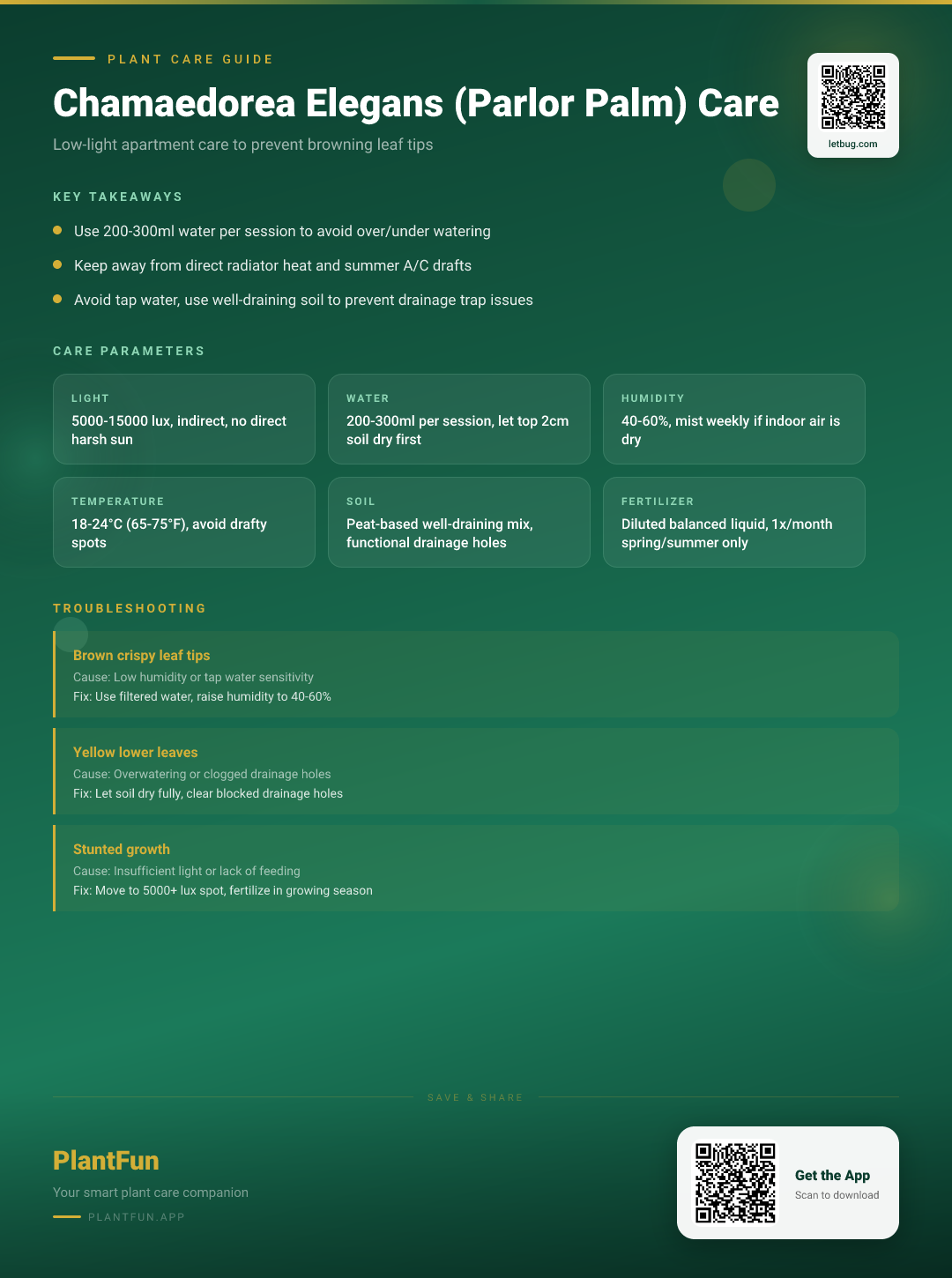
Key Takeaways
- Check soil moisture before watering — overwatering is the #1 killer of houseplants.
- Ensure your plant gets the right amount of light for its species.
- Be patient with recovery — most plants need 2–4 weeks to bounce back.
Quick Care Card: Essential Data for Chamaedorea Elegans Success
| Feature | Requirement |
|---|---|
| Light | 5,000–15,000 lux (bright, indirect) |
| Water | 200–300ml when top 2 inches are dry |
| Humidity | 40–60% constant |
| Temperature | 18–24°C (65–75°F) |
| Soil | Well-draining, peat-based mix |
| Fertilizer | Balanced liquid feed, monthly (Spring/Summer) |
| Toxicity | Non-toxic (ASPCA, 2026) |
TL;DR: The Apartment Reality for Parlor Palms
Parlor Palms (Chamaedorea elegans) are often marketed as indestructible, but they are sensitive to the specific dry air and poor light of modern apartments. Browning tips usually result from low humidity (below 40%) or mineral buildup from tap water. To save yours, stop relying on a set schedule—water only when the top 5cm of soil is dry, maintain at least 40% ambient humidity, and flush the soil monthly to remove salt buildup.
My Experience: The Apartment Trap
When I first brought home my own Parlor Palm, I treated it like a “set and forget” desk plant. I placed it in a dark corner of my studio and watered it whenever I remembered. Within a month, the beautiful, feathery fronds were crispy at the tips. I realized the hard way that while these palms tolerate low light, they do not thrive in stagnant, dry air. It took a systematic change in my watering routine—shifting to a “soak and dry” method—to finally see new, healthy growth.
Why Your Apartment Environment Causes Browning Leaf Tips
Browning leaf tips are the plant’s way of signaling stress. In an apartment, your palm is likely battling two primary enemies: low humidity and root zone salt accumulation. Unlike their native rainforest floor habitats, apartments often fall below 30% humidity during heating seasons (Pérez-Portilla & Geissert-Kientz, 2004). This causes the palm to lose moisture through its leaves faster than its roots can pull it from the soil.
Measurement Thresholds: Defining the Perfect Environment
To move beyond generic advice, you must manage your environment by the numbers:
- Light: 5,000–15,000 lux. If you don’t have a light meter, imagine a spot where you can comfortably read a book without eye strain but never see direct, harsh sunbeams on the leaves.
- Humidity: 40–60%. I use a basic digital hygrometer to monitor this. If you drop below 40%, expect browning tips.
- Temperature: 18–24°C. Avoid placing these near radiators or A/C vents, as rapid temperature fluctuations cause physiological stress (Mora-Aguilar & Rodríguez-Pérez, 2003).
- Water Volume: Use 200–300ml of filtered or distilled water for a standard 6-inch pot. Overwatering remains the number one cause of root rot (NC State Extension, 2026).
Format A: Step-by-Step Care for Low-Light Living
- Test the Substrate: Insert your finger 5cm (2 inches) into the soil. If it feels damp, do not water. If it is dry, proceed.
- Use Filtered Water: Tap water often contains chlorine and fluoride, which accumulate in the tips of palms. Switch to filtered or distilled water.
- Flush the Pot: Every third watering, run clear water through the soil for two minutes to flush out accumulated fertilizer salts.
- Monitor Light: Move the plant slightly closer to a window if the stems appear “leggy” or thin.
- Clean the Foliage: Dust acts as a barrier to photosynthesis. Wipe leaves with a damp cloth every two weeks.
Seasonal Care Calendar: Transitioning from Radiator Heat to Summer A/C
- Winter (Radiator Season): Humidity drops. Group plants together to create a micro-climate or use a pebble tray. Move plants at least 2 meters away from heat sources.
- Spring/Summer (Growth Season): Light intensity increases. If your windows face south, move the plant back to prevent leaf scorch. Increase watering frequency but never let the pot sit in standing water.
Common Mistakes to Avoid
- Mistake: Using a pot without drainage holes.
- What happens: Water pools at the bottom, rotting the delicate root system.
- Instead: Always use a nursery pot inside a decorative cachepot.
- Mistake: Using tap water immediately.
- What happens: Mineral deposits cause necrotic (dead) brown tips.
- Instead: Let water sit out for 24 hours to dissipate chlorine, or use a basic carbon filter.
Voice Search FAQ
Why is my Parlor Palm getting brown crispy tips even when I water it? It is likely a humidity issue or salt buildup. Even with regular watering, dry apartment air pulls moisture from the leaf tips. Try misting the area around the plant or using a humidifier.
Can I really grow a Parlor Palm in a room with no windows? No. While Chamaedorea elegans is classified as one of the best low light indoor plants, it still requires some light. If you have no windows, you will need a full-spectrum LED grow light set for 8–10 hours a day.
Are these palms safe for my curious cat? Yes. The ASPCA lists the Parlor Palm as non-toxic to both cats and dogs, making it a perfect pet-friendly plant.
Advanced Care: When to Repot and Why Your Palm Hates Disturbance
Palms have sensitive root systems that do not like being moved. Only repot every 2–3 years when the roots start circling the bottom of the pot. When you do, use a high-quality, peat-based potting mix that allows for oxygen exchange. For more details on the perfect environment, check out our guide to indoor palm plant care.
Optional Helper: Plantfun.App
Plantfun.App identifies your plants by photo, diagnoses pests and diseases with clear fixes, and creates personalised watering and light schedules that adapt to your home conditions — a handy companion for putting this guide into daily practice.
Summary: Cultivating Resilient Growth in Small Spaces
Success with the Parlor Palm in an apartment is about consistency rather than constant attention. Monitor your humidity, filter your water, and respect the light requirements to prevent the common aesthetic damage that many indoor gardeners face. By controlling these variables, you can enjoy this classic palm for years.
References and Botanical Notes
- ASPCA. (2026). Toxic and Non-Toxic Plants List — ASPCA. https://www.aspca.org/pet-care/animal-poison-control/toxic-and-non-toxic-plants. Accessed 2026-03-10.
- Mora-Aguilar, R.; Rodríguez-Pérez, J. (2003). RESPUESTA DE Chamaedorea elegans Mart. A TRATAMIENTOS DE PREGERMINACIÓN. Revista Chapingo Serie Horticultura. https://doi.org/10.5154/r.rchsh.2001.08.048. Accessed 2026-03-10.
- NC State Extension. (2026). Chamaedorea Elegans — NC State Extension Gardener Plant Toolbox. https://plants.ces.ncsu.edu/plants/palm-care/. Accessed 2026-03-10.
- Pérez-Portilla, E.; Geissert-Kientz, D. (2004). DISTRIBUCIÓN POTENCIAL DE PALMA CAMEDOR (Chamaedorea elegans Mart.) EN EL ESTADO DE VERACRUZ, MÉXICO. Revista Chapingo Serie Horticultura. https://doi.org/10.5154/r.rchsh.2003.01.012. Accessed 2026-03-10.
Found an error or have suggestions? We'd love your feedback.
Need help identifying this problem?
Get instant identification, personalized care schedules, and effective pest treatment plans directly on your phone.
Sponsored • We may earn a commission from app downloads
Related Guides
The Budget Parlor Palm Care Checklist for Resilient Growth in Small Urban Apartments
Skip overpriced plant supplies and get your parlor palm thriving on a tight budget. This scenario-specific checklist has exact light, water, and humidity rules for small urban apartments, no guesswork required.
Care GuideParlor Palm Care in Dim Apartments: The Complete Guide for Lush, Resilient Growth
Revive your struggling Parlor Palm. Master exact watering intervals, light positioning, and humidity hacks to keep your foliage lush in low-light apartments.
Care GuideThe Complete Parlor Palm Care Guide for Small Apartments: Seasonal Tips for Resilient Growth
Keep your parlor palm lush year-round in a small apartment. Get exact light, water, and humidity thresholds, plus a free seasonal care checklist to avoid yellow leaves and stunted growth.
Safety GuideParlor Palm in Low-Light Playrooms: Non-Toxic Care & Placement Guide for Pet & Child Safety
Keep your playroom green and safe for toddlers and cats with this parlor palm care guide. Get exact light, water, and placement tips to avoid toxic exposure and keep your plant lush long-term.