
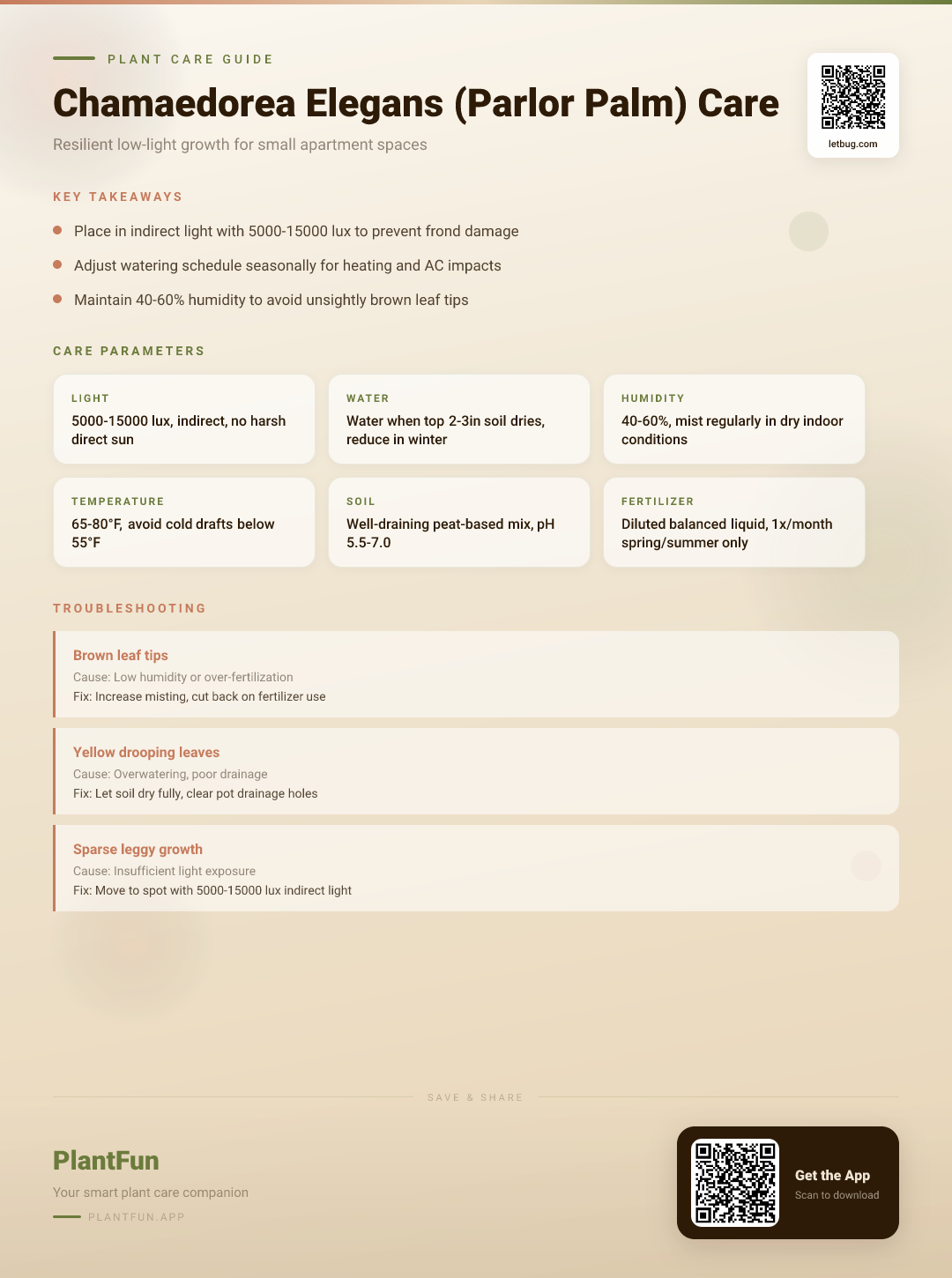
Key Takeaways
- Check soil moisture before watering — overwatering is the #1 killer of houseplants.
- Ensure your plant gets the right amount of light for its species.
- Be patient with recovery — most plants need 2–4 weeks to bounce back.
Quick Care Card
| Feature | Requirement |
|---|---|
| Light | 5,000–15,000 lux (bright, indirect) |
| Water | Allow top 2 inches of soil to dry |
| Humidity | 40–60% constant |
| Temperature | 65–80°F (18–27°C) |
| Soil | Well-draining, peat-based mix |
| Fertilizer | Balanced liquid feed, monthly in spring/summer |
| Toxicity | Non-toxic to cats and dogs (ASPCA, 2026) |
TL;DR: Why Your Parlor Palm Thrives in Tight Quarters
The Chamaedorea elegans is the ultimate apartment companion because it is evolutionarily adapted to the dark, crowded understory of tropical rainforests. It requires minimal direct sun—in fact, direct sun often scorches its fronds—and thrives in the stable, climate-controlled environments typical of modern apartments. By maintaining a 5,000–15,000 lux light range and avoiding overwatering, you can keep this palm lush for years in even the smallest living space.
Understanding the Habitat: How Chamaedorea Elegans Adapts to Indoor Light
In my experience, the secret to mastering Chamaedorea elegans care lies in understanding its origins. Native to the rainforests of Mexico and Guatemala, this plant spends its life beneath a thick canopy, receiving only filtered light (Pérez-Portilla & Geissert-Kientz, 2004).
When I first started keeping palms, I made the mistake of placing mine in a sunny south-facing window. The fronds bleached within a week. I learned that this plant is a specialist in low-light efficiency; it doesn’t need to photosynthesize at high rates to survive, which makes it perfect for those of us living in apartments where natural light is a luxury. If you are struggling with apartment plant lighting, remember that “low light” does not mean “no light.”
Step-by-Step Care: Light, Water, and Soil for Apartment Living
Growing palms in small spaces requires a disciplined approach to your indoor palm plant care guide routines:
- Soil Selection: Use a high-quality peat-based mix amended with perlite to ensure aeration. Proper germination and root development are sensitive to substrate density (Mora-Aguilar & Rodríguez-Pérez, 2003).
- Moisture Management: Use the “finger test.” Stick your index finger 2 inches into the soil. If it feels damp, do not water.
- Placement: Position your palm at least 3–5 feet away from south-facing windows to avoid heat stress.
The 5,000–15,000 Lux Threshold: Finding the Perfect Apartment Nook
While many consider this a “low light” plant, it actually performs best at a specific threshold. I use a simple light meter app to ensure my plant is hitting at least 5,000 lux. In the dim corners of a city apartment, you might find your palm sitting at 1,000 lux, which leads to slow decline. If your plant is stagnant, move it closer to an east-facing window where it can receive gentle morning rays without the intense midday heat.
Seasonal Watering Logic: How to Adjust for Winter Heating and Summer Air Conditioning
Apartment microclimates shift drastically with the seasons. During winter, central heating dries out the air, which can cause brown tips (NC State Extension, 2026). During summer, air conditioning can similarly desiccate foliage. I adjust my watering cycle by reducing frequency in winter—when metabolic activity slows—and increasing it during the warmer growing season.
Humidity Hacks: Keeping Fronds Green in Dry Indoor Environments
Palms crave ambient moisture. To meet the 40–60% humidity requirement:
- Group plants: Placing your palm near other foliage creates a localized micro-climate.
- Pebble trays: Fill a shallow tray with pebbles and water; sit the pot on top, ensuring the bottom of the pot never touches the water itself.
Common Mistakes: Avoiding Overwatering and Improper Fertilization
- Mistake: Overwatering the plant because it looks “droopy.”
- What happens: Root rot occurs rapidly in dense soil, leading to yellowing lower fronds.
- Instead: Verify soil dryness before adding water; the palm prefers to be slightly dry than waterlogged.
Voice Search FAQ
- Why is my Parlor Palm turning brown at the tips? This is almost always a sign of low humidity or chemical buildup from tap water. Try using filtered water and increasing humidity.
- How often should I water my Parlor Palm in a small apartment? Generally every 7–10 days, but always check the top 2 inches of soil first.
- Can I put my Parlor Palm in a windowless room? No. While tolerant of low light, it still requires ambient light to photosynthesize. It will eventually die in a room without windows.
Troubleshooting Guide
Yellowing Leaves
Symptom: Lower, older leaves turn yellow and eventually drop.
Likely cause: Natural aging or overwatering.
Fix:
- Check soil moisture; if saturated, let it dry completely.
- Trim yellow fronds at the base with sterilized shears.
Brown, Crispy Tips
Symptom: Tips of the fronds are brown and papery.
Likely cause: Low humidity or inconsistent watering.
Fix:
- Increase humidity via a pebble tray or room humidifier.
- Maintain a consistent watering schedule.
Stunted Growth
Symptom: The plant hasn’t produced a new spear in months.
Likely cause: Insufficient light or root-bound pot.
Fix:
- Move to a brighter location (closer to an east window).
- Repot into a container only 1–2 inches larger than the current one.
References
- Mora-Aguilar, R.; Rodríguez-Pérez, J. (2003). RESPUESTA DE Chamaedorea elegans Mart. A TRATAMIENTOS DE PREGERMINACIÓN. Revista Chapingo Serie Horticultura. https://doi.org/10.5154/r.rchsh.2001.08.048. Accessed 2026-03-15.
- Pérez-Portilla, E.; Geissert-Kientz, D. (2004). DISTRIBUCIÓN POTENCIAL DE PALMA CAMEDOR (Chamaedorea elegans Mart.) EN EL ESTADO DE VERACRUZ, MÉXICO. Revista Chapingo Serie Horticultura. https://doi.org/10.5154/r.rchsh.2003.01.012. Accessed 2026-03-15.
- ASPCA. (2026). Toxic and Non-Toxic Plants List — ASPCA. https://www.aspca.org/pet-care/animal-poison-control/toxic-and-non-toxic-plants. Accessed 2026-03-15.
- NC State Extension. (2026). Chamaedorea Elegans — NC State Extension Gardener Plant Toolbox. https://plants.ces.ncsu.edu/plants/chamaedorea-elegans/. Accessed 2026-03-15.
Optional Helper: Plantfun.App
Plantfun.App identifies your plants by photo, diagnoses pests and diseases with clear fixes, and creates personalised watering and light schedules that adapt to your home conditions — a handy companion for putting this guide into daily practice.
Found an error or have suggestions? We'd love your feedback.
Need help identifying this problem?
Get instant identification, personalized care schedules, and effective pest treatment plans directly on your phone.
Sponsored • We may earn a commission from app downloads
Related Guides
Chamaedorea Elegans in Low-Light Apartments: 5 Steps to Stop Browning Leaf Tips
Stop the heartbreak of crispy, brown Parlor Palm leaves. Get precise water volumes, humidity hacks, and light thresholds to keep your palm thriving indoors.
Care GuideThe Complete Parlor Palm Care Checklist for Resilient Growth in Typical Urban Apartments
Stop guessing at parlor palm care for your apartment. Get measurable light, water, and humidity targets, plus a printable checklist to keep your plant lush and stress-free year-round.
Care GuideThe Budget Parlor Palm Care Checklist for Resilient Growth in Small Urban Apartments
Skip overpriced plant supplies and get your parlor palm thriving on a tight budget. This scenario-specific checklist has exact light, water, and humidity rules for small urban apartments, no guesswork required.
Safety GuideParlor Palm in Low-Light Playrooms: Non-Toxic Care & Placement Guide for Pet & Child Safety
Keep your playroom green and safe for toddlers and cats with this parlor palm care guide. Get exact light, water, and placement tips to avoid toxic exposure and keep your plant lush long-term.