
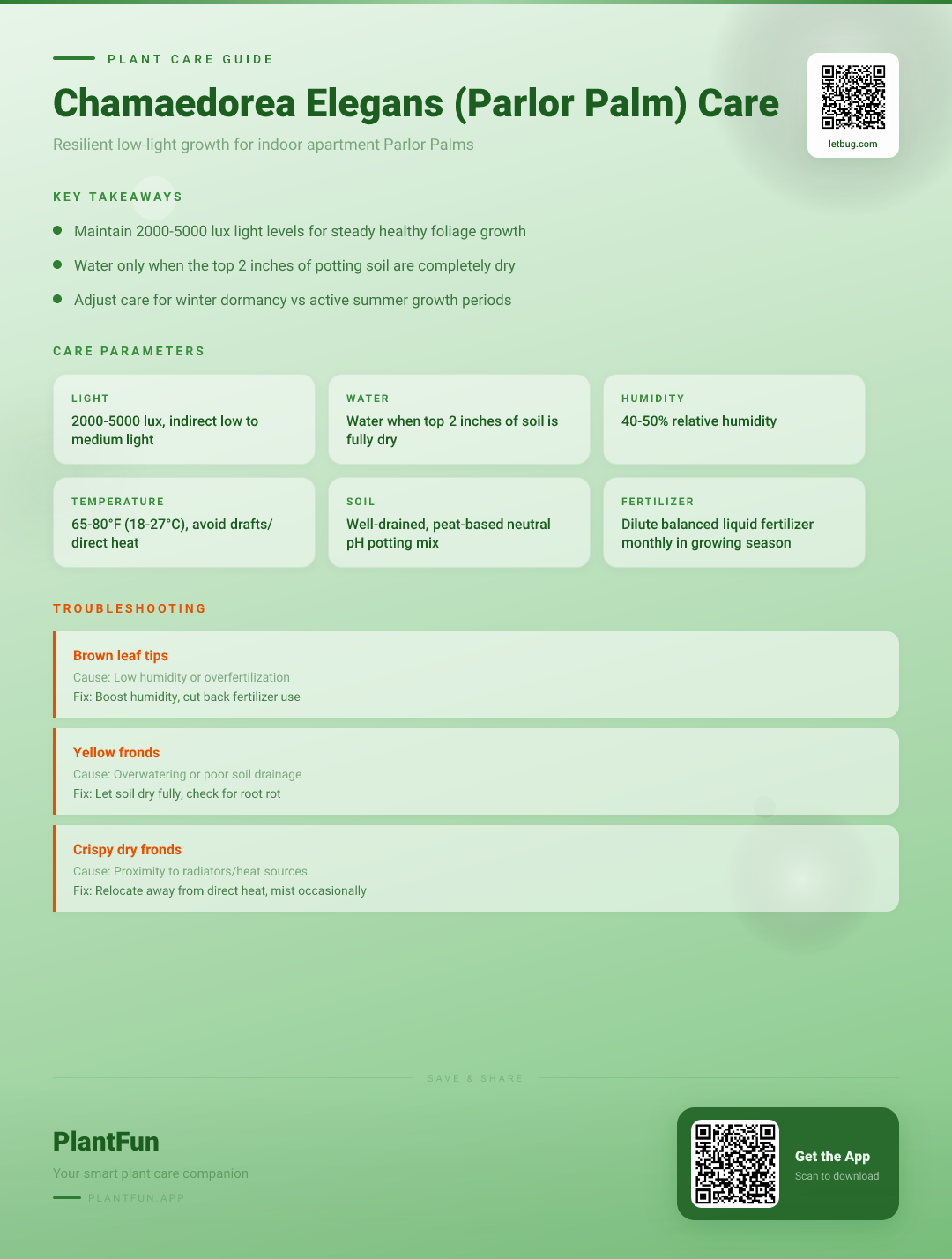
Key Takeaways
- Check soil moisture before watering — overwatering is the #1 killer of houseplants.
- Ensure your plant gets the right amount of light for its species.
- Be patient with recovery — most plants need 2–4 weeks to bounce back.
Quick Care Card: Measuring Light, Water, and Temperature for Chamaedorea Elegans
| Feature | Requirement |
|---|---|
| Light | 2,000–5,000 lux (Bright, indirect) |
| Water | When top 2 inches of soil are dry |
| Humidity | 40–50% (Ambient or pebble tray) |
| Temperature | 65–80°F (18–27°C) |
| Soil | Well-draining, peat-based mix |
| Fertilizer | Balanced liquid 10-10-10 (diluted) |
| Toxicity | Non-toxic (ASPCA, 2026) |
TL;DR: The Reality of Parlor Palms in Low-Light Apartments
If you are struggling with Chamaedorea elegans, you are likely overwatering or starving it of light. These palms thrive in consistent, indirect light—aim for 2,000 to 5,000 lux. Water only when the top 2 inches of soil are dry to the touch, and avoid placing them near drafty windows or heat sources. They are pet-friendly and remarkably resilient if you mimic their native forest understory environment.
My Experience: The “Nursery Shock” Moment
When I first brought home my own Parlor Palm, I assumed its “low-light” reputation meant it could live in a dark, windowless corner. Within a month, the lower fronds turned yellow and mushy. I learned the hard way that “low-light tolerance” isn’t the same as “no-light survival.” I had to move it three feet closer to an east-facing window and dial back my watering frequency by 40%. Once I treated it as a tropical understory plant rather than a desert cactus, it began producing healthy new fronds.
Why Your Apartment Environment Needs This Specific Protocol
Apartment microclimates are often arid and subject to temperature spikes. According to NC State Extension (2026), Chamaedorea elegans thrives in stable conditions that mimic its natural habitat. By following a structured, climate-controlled approach, you prevent the common pitfalls of root rot and salt buildup that often occur in smaller, less ventilated living spaces.
Light Requirements: Maintaining 2,000–5,000 lux for Steady Foliage Growth
Many indoor gardeners mistake “low light” for darkness. In reality, these plants need 2,000 to 5,000 lux to maintain a healthy growth rate (NC State Extension, 2026). If you cannot read a book comfortably without turning on a lamp in your chosen spot, it is likely too dark for your palm to photosynthesize effectively.
Watering Strategy: Precise ml Calculations Based on Soil Dryness (Top 2 Inches)
I recommend a ‘finger test’ over a schedule. If your finger comes out clean after probing 2 inches deep, it is time to hydrate. For a standard 8-inch pot, I typically use 250-300ml of water, ensuring the soil is evenly moist without being waterlogged. Always empty your saucer 15 minutes after watering to prevent root suffocation.
Humidity & Temperature: Keeping Your Palm Between 65-80°F (18-27°C) and 40-50% Humidity
These palms despise dry, stagnant air. While most apartments hover near 30% humidity, your palm prefers 40-50% (NC State Extension, 2026). If you notice dry edges, consider using a humidifier nearby. Temperature stability is equally critical; avoid placing your plant near AC vents or, worse, direct heaters.
Step-by-Step Care Guide: From Weekly Watering to Monthly Cleaning
- Weekly Check: Assess soil moisture using the 2-inch depth rule.
- Dusting: Wipe leaves with a damp cloth monthly. This improves light absorption by removing indoor dust buildup.
- Seasonal Fertilizing: Apply a balanced, diluted 10-10-10 fertilizer only during the peak growing months (May through August).
- Rotation: Turn the pot 90 degrees every month to ensure even growth toward the light source.
Voice Search FAQ: Why is my Parlor Palm getting brown tips in my living room?
Brown tips are almost always a response to low humidity or inconsistent watering. If the tips are crispy, your apartment air is likely too dry. If they are mushy, you are overwatering. Ensuring proper drainage in your best soil for indoor palms is key to correcting this.
Voice Search FAQ: Can I keep my Parlor Palm near a radiator or heater?
No. Radiators create rapid, localized moisture loss, which will cause your palm to drop leaves prematurely. Keep it at least 6 feet away from any heat source to maintain proper plant health.
Seasonal Calendar: How to Adjust Care Between Winter Dormancy and Summer Growth
- Spring/Summer: Increase watering as the plant enters its active growth phase.
- Autumn/Winter: Growth slows significantly. Reduce water frequency by 50% and halt all fertilization, as the plant is in a state of relative dormancy (NC State Extension, 2026).
Common Mistakes: Avoiding Overwatering and Improper Fertilizer Ratios
- Mistake: Watering on a strict day-of-the-week schedule.
- What happens: Saturated soil prevents root aeration, leading to root rot.
- Instead: Water only when the top 2 inches of soil are dry.
- Mistake: Using high-nitrogen “boosters” in winter.
- What happens: Fertilizer burn on roots.
- Instead: Only feed during active growth months.
References: Botanical Standards for Chamaedorea Elegans
- Mora-Aguilar, R.; Rodríguez-Pérez, J. (2003). RESPUESTA DE Chamaedorea elegans Mart. A TRATAMIENTOS DE PREGERMINACIÓN. Revista Chapingo Serie Horticultura. https://doi.org/10.5154/r.rchsh.2001.08.048. Accessed 2026-03-18.
- Pérez-Portilla, E.; Geissert-Kientz, D. (2004). DISTRIBUCIÓN POTENCIAL DE PALMA CAMEDOR (Chamaedorea elegans Mart.) EN EL ESTADO DE VERACRUZ, MÉXICO. Revista Chapingo Serie Horticultura. https://doi.org/10.5154/r.rchsh.2003.01.012. Accessed 2026-03-18.
- ASPCA. (2026). Toxic and Non-Toxic Plants List — ASPCA. https://www.aspca.org/pet-care/animal-poison-control/toxic-and-non-toxic-plants. Accessed 2026-03-18.
- NC State Extension. (2026). Chamaedorea Elegans — NC State Extension Gardener Plant Toolbox. https://plants.ces.ncsu.edu/plants/palm-care/. Accessed 2026-03-18.
Optional Helper: Plantfun.App
Plantfun.App identifies your plants by photo, diagnoses pests and diseases with clear fixes, and creates personalised watering and light schedules that adapt to your home conditions — a handy companion for putting this guide into daily practice.
Found an error or have suggestions? We'd love your feedback.
Need help identifying this problem?
Get instant identification, personalized care schedules, and effective pest treatment plans directly on your phone.
Sponsored • We may earn a commission from app downloads
Related Guides
Chamaedorea Elegans in Low-Light Apartments: 5 Steps to Stop Browning Leaf Tips
Stop the heartbreak of crispy, brown Parlor Palm leaves. Get precise water volumes, humidity hacks, and light thresholds to keep your palm thriving indoors.
Care GuideParlor Palm Care in Dim Apartments: The Complete Guide for Lush, Resilient Growth
Revive your struggling Parlor Palm. Master exact watering intervals, light positioning, and humidity hacks to keep your foliage lush in low-light apartments.
Care GuideParlor Palm Care for Low-Light Apartments: The 5-Step Guide to Thriving Greenery
Revitalize your Parlor Palm with precise light and water metrics. Learn the 5-step maintenance routine that guarantees resilient, deep-green growth every time.
Safety GuideParlor Palm in Low-Light Playrooms: Non-Toxic Care & Placement Guide for Pet & Child Safety
Keep your playroom green and safe for toddlers and cats with this parlor palm care guide. Get exact light, water, and placement tips to avoid toxic exposure and keep your plant lush long-term.