
Key Takeaways
- Check soil moisture before watering — overwatering is the #1 killer of houseplants.
- Ensure your plant gets the right amount of light for its species.
- Be patient with recovery — most plants need 2–4 weeks to bounce back.
TL;DR: The Essentials
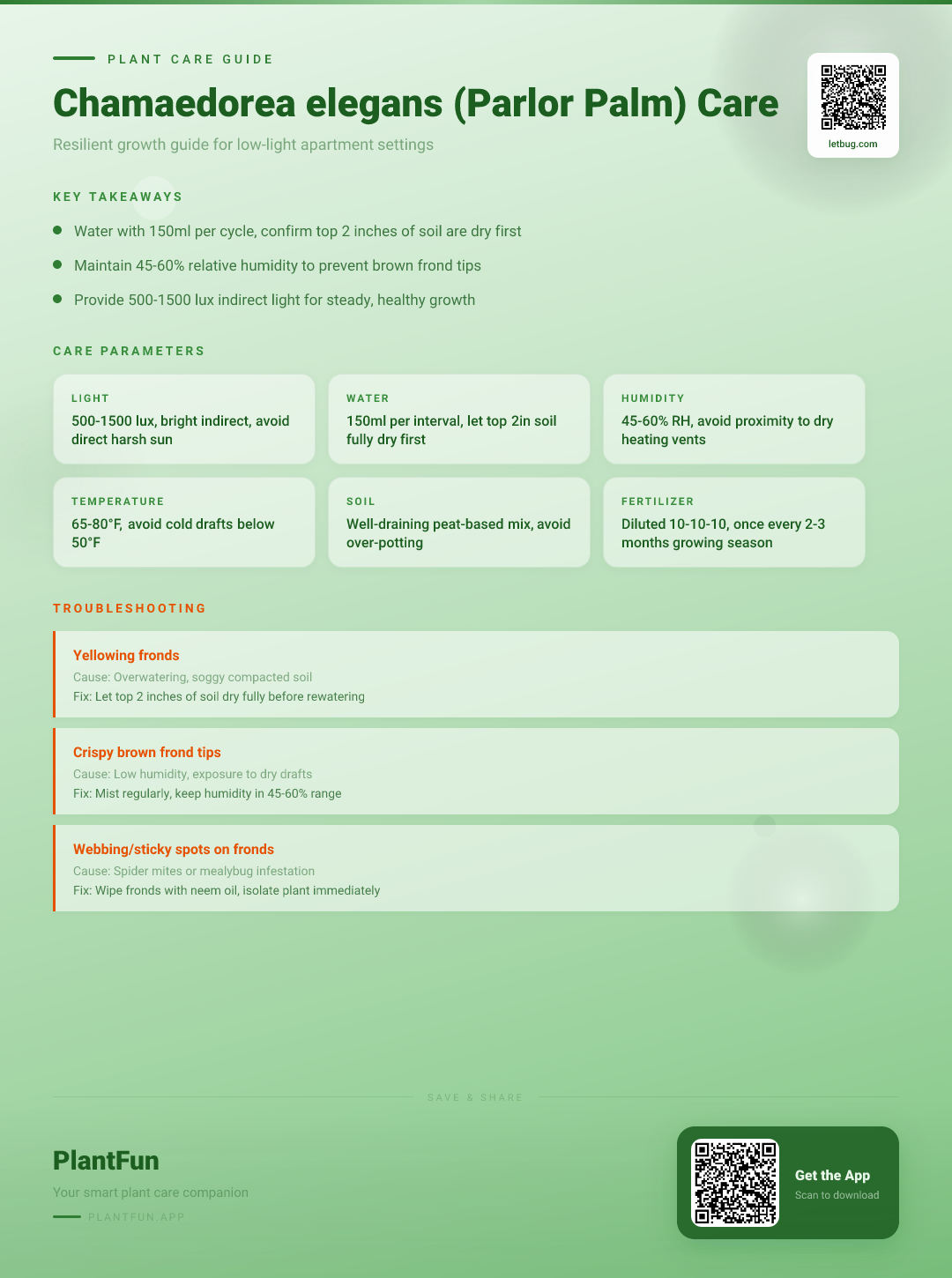
If you want your Chamaedorea elegans to thrive, stop treating it like a desert cactus. This palm demands consistent moisture, not constant soaking, and prefers a stable “Goldilocks” zone of 45-60% humidity. Place it in a spot receiving 500-1,500 lux, water with roughly 150ml when the top 2 inches of soil feel dry, and keep it away from direct afternoon sun to prevent scorched fronds.
My Experience: The “Unkillable” Myth
When I first brought home my Chamaedorea elegans, I fell for the “unkillable” marketing hook. I tucked it into a dark corner of my bedroom and watered it whenever I remembered. Within three months, the edges were crispy and the growth had stalled. I learned the hard way that while this plant is remarkably resilient, it is not a plastic decoration. It needs specific environmental cues to thrive, not just survive.
Quick Care Card: Essential Thresholds
| Metric | Requirement |
|---|---|
| Light | 500–1,500 lux (bright, indirect) |
| Water | ~150ml when top 2” of soil are dry |
| Humidity | 45–60% (optimal range) |
| Temperature | 65–80°F (18–27°C) |
| Soil | Well-draining, peat-based mix |
| Fertilizer | Balanced liquid feed at half-strength (monthly in summer) |
| Toxicity | Non-toxic to cats and dogs (ASPCA, 2026) |
The Reality of Apartment Light
Many apartments suffer from low light, which is where the Parlor Palm excels. Unlike high-energy tropicals, this species has evolved to grow in the understory of rainforests (Pérez-Portilla & Geissert-Kientz, 2004). To optimize growth, avoid placing it in a window with direct sun, which can bleach the foliage. Aim for 500–1,500 lux; if you can comfortably read a book in the spot, the light is generally sufficient for maintenance.
Watering by the Clock vs. Soil Moisture
Do not water on a rigid calendar. Because indoor air can be stagnant, your plant’s transpiration rate varies. Use the “2-inch rule”: stick your index finger 2 inches into the soil. If it feels dry, apply about 150ml of water. Over-watering is the fastest path to root rot, which is particularly common in low-light conditions where the soil takes longer to dry out (NC State Extension, 2026).
The Humidity Myth
While some claim Parlor Palms need 80% humidity, that’s tropical greenhouse territory. In an apartment, 45-60% is your target. Anything below 40% usually leads to crispy brown tips on the fronds. If you find your air is too dry, use a humidifier rather than misting, as misting only provides transient moisture and doesn’t improve the ambient environment.
Format A: The Complete Apartment Scenario Guide
- Placement: Select a spot 3–5 feet away from an east-facing window. This provides enough indirect light to support slow, steady growth.
- Monitoring: Check soil moisture once a week. If the top 2 inches are dry, hydrate with 150ml of room-temperature, filtered water to prevent salt buildup.
- Cleansing: Wipe fronds with a damp cloth every 14 days to clear dust, which improves photosynthetic efficiency.
Seasonal Care Calendar
- Summer (High Transpiration): Growth is active. Increase water frequency to keep soil lightly moist. Ensure high-quality, diluted liquid fertilizer is applied monthly (Mora-Aguilar & Rodríguez-Pérez, 2003).
- Winter (Central Heating): Heating systems dry out the air. Shift your palm away from heat vents and focus on consistent humidity (45-60%). Reduce water to account for slower metabolic rates.
Why is my Parlor Palm getting brown tips even though I water it?
Brown tips are rarely just a water issue. They are often a symptom of low humidity or salt buildup from tap water. Try using distilled water and maintaining humidity levels above 45%.
How do I know if my palm is getting enough light in my living room?
If your plant is stretching, leaves are becoming pale, or it’s losing its deep green color, it’s starving for light. Move it closer to a source of bright, indirect light.
Common Mistakes to Avoid
- Mistake: Using a pot that is too large. What happens: Excess soil stays soggy, leading to root rot. Instead: Use a pot only 1-2 inches wider than the root ball.
- Mistake: Fertilizing in winter. What happens: Fertilizer burn as the plant isn’t consuming nutrients. Instead: Cease feeding from October to March.
Troubleshooting Guide
Yellowing Fronds
Symptom: Lower, older fronds turning yellow before fading to brown.
Likely cause: Often natural senescence or consistent over-watering.
Fix:
- Check the soil moisture; if saturated, let it dry out completely.
- Gently trim the yellowed frond at the base with sterilized shears.
Crispy Leaf Edges
Symptom: The tips of the fronds become brown, dry, and brittle.
Likely cause: Low humidity or inconsistent watering schedules.
Fix:
- Group with other plants to create a micro-climate.
- Invest in a simple room humidifier to hold steady at 50%.
Mealybug Infestation
Symptom: Tiny white, cotton-like masses in the leaf axils.
Likely cause: Low airflow or neighboring infested plants.
Fix:
- Isolate the plant immediately to prevent spread.
- Dab the spots with a cotton swab dipped in isopropyl alcohol.
References
- Mora-Aguilar, R.; Rodríguez-Pérez, J. (2003). RESPUESTA DE Chamaedorea elegans Mart. A TRATAMIENTOS DE PREGERMINACIÓN. Revista Chapingo Serie Horticultura. https://doi.org/10.5154/r.rchsh.2001.08.048. Accessed 2026-03-18.
- Pérez-Portilla, E.; Geissert-Kientz, D. (2004). DISTRIBUCIÓN POTENCIAL DE PALMA CAMEDOR (Chamaedorea elegans Mart.) EN EL ESTADO DE VERACRUZ, MÉXICO. Revista Chapingo Serie Horticultura. https://doi.org/10.5154/r.rchsh.2003.01.012. Accessed 2026-03-18.
- ASPCA. (2026). Toxic and Non-Toxic Plants List — ASPCA. https://www.aspca.org/pet-care/animal-poison-control/toxic-and-non-toxic-plants. Accessed 2026-03-18.
- NC State Extension. (2026). Chamaedorea elegans — NC State Extension Gardener Plant Toolbox. https://plants.ces.ncsu.edu/plants/palm-care/. Accessed 2026-03-18.
Optional Helper: Plantfun.App
Plantfun.App identifies your plants by photo, diagnoses pests and diseases with clear fixes, and creates personalised watering and light schedules that adapt to your home conditions — a handy companion for putting this guide into daily practice.
Found an error or have suggestions? We'd love your feedback.
Need help identifying this problem?
Get instant identification, personalized care schedules, and effective pest treatment plans directly on your phone.
Sponsored • We may earn a commission from app downloads
Related Guides
The Complete Parlor Palm Care Guide for Small Apartments: Seasonal Tips for Resilient Growth
Keep your parlor palm lush year-round in a small apartment. Get exact light, water, and humidity thresholds, plus a free seasonal care checklist to avoid yellow leaves and stunted growth.
Care GuideChamaedorea Elegans in Low-Light Apartments: 5 Steps to Stop Browning Leaf Tips
Stop the heartbreak of crispy, brown Parlor Palm leaves. Get precise water volumes, humidity hacks, and light thresholds to keep your palm thriving indoors.
Care GuideThe Budget Parlor Palm Care Checklist for Resilient Growth in Small Urban Apartments
Skip overpriced plant supplies and get your parlor palm thriving on a tight budget. This scenario-specific checklist has exact light, water, and humidity rules for small urban apartments, no guesswork required.
Safety GuideParlor Palm in Low-Light Playrooms: Non-Toxic Care & Placement Guide for Pet & Child Safety
Keep your playroom green and safe for toddlers and cats with this parlor palm care guide. Get exact light, water, and placement tips to avoid toxic exposure and keep your plant lush long-term.