
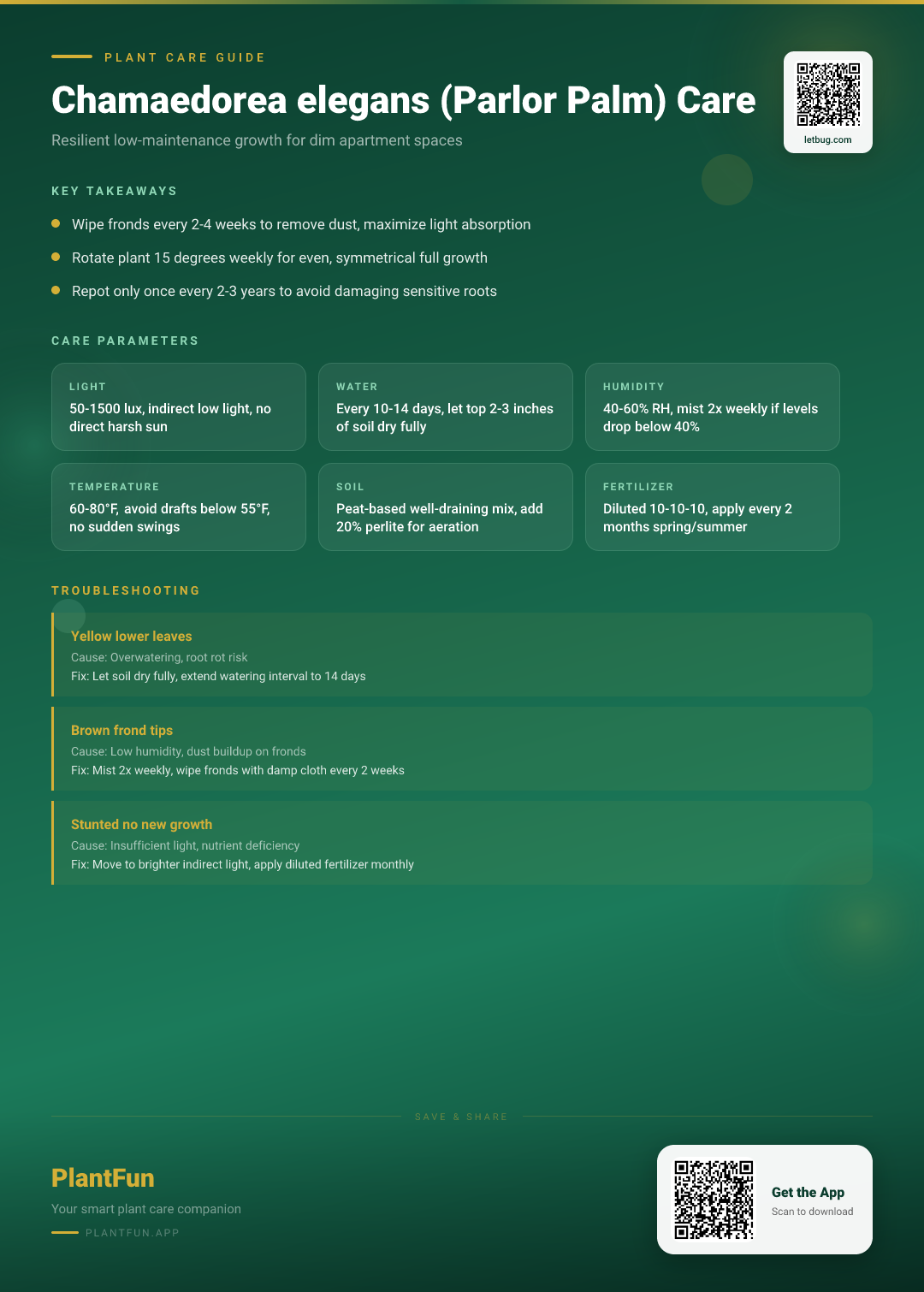
Key Takeaways
- Check soil moisture before watering — overwatering is the #1 killer of houseplants.
- Ensure your plant gets the right amount of light for its species.
- Be patient with recovery — most plants need 2–4 weeks to bounce back.
TL;DR: The Parlor Palm (Chamaedorea elegans) thrives in apartments because it tolerates lower light than most indoor palms. To succeed, provide consistent, indirect light (avoiding direct sun which scorches leaves), keep soil moist but never waterlogged, and maintain ambient humidity above 50%. Most failures stem from overwatering in low-light, stagnant air environments. If you see browning tips, check your tap water salinity and soil moisture first.
Quick Care Card: Essential Thresholds for Chamaedorea elegans
| Requirement | Threshold |
|---|---|
| Light | 500–1,500 Lux (Bright, indirect) |
| Watering | When top 2 inches of soil are dry |
| Humidity | 50%–60% (Use a pebble tray) |
| Temperature | 65°F–80°F (18°C–27°C) |
| Soil | Well-draining, peat-based mix |
| Fertilizer | Balanced liquid (10-10-10) monthly in growing season |
| Toxicity | Non-toxic to cats and dogs (ASPCA, 2026) |
My Experience: The “Dim Corner” Reality
When I first brought home my first Chamaedorea elegans, I made the classic mistake of placing it in a dark, windowless hallway, thinking it was a “low-light superplant.” Within two weeks, the lower fronds turned yellow, and the soil stayed soggy for nearly a month. I learned the hard way that ‘low light tolerance’ does not mean ‘no light.’ My palm only started thriving once I moved it within 3 feet of a north-facing window and adjusted my watering to match the lower evaporation rates of my apartment.
Why Your Parlor Palm Struggles in Typical Apartments
Most apartments suffer from two major issues: low airflow and inconsistent temperatures. Because Chamaedorea elegans is native to the understory of rainforests (Pérez-Portilla & Geissert-Kientz, 2004), it prefers stable conditions. When we move them into climate-controlled apartments, the lack of natural ventilation can cause soil moisture to persist too long, leading to root suffocation.
Decoding the ‘Dim Light’ Myth: Understanding Lux Requirements
While this species is known for its low-light tolerance, growth is significantly slower in darker corners. “Dim” to a plant is not “dim” to our eyes. To achieve healthy growth, aim for at least 500–1,500 lux. You can use a free light-meter app on your phone to verify this. If your meter reads below 300 lux, your plant is merely surviving, not thriving.
The 50% Rule: Why Humidity Matters More Than You Think
In typical indoor environments, humidity often drops below 30% in winter. This is the primary culprit behind crispy, brown-tipped fronds. According to NC State Extension (2026), maintaining adequate humidity is essential for leaf health. I use a simple pebble tray setup to increase localized moisture without risking overwatering.
Watering Mastery: Preventing Root Rot in Low-Light Corners
My rule for watering is simple: never guess. Stick your finger two inches into the soil. If it feels cool or damp, wait. In a dim apartment, a palm may only need water every 10–14 days. Remember, the physiological response of the plant relies on the root system’s ability to breathe; if the soil is permanently wet, root rot is inevitable.
Seasonal Maintenance: Adapting to Apartment Temperature Flux
As seasons change, keep your palm away from radiator vents or drafty window panes. The plant enters a slow-growth phase in winter; reduce fertilizer intake by half and water less frequently. If your room temperature drops below 60°F, be extra cautious with moisture, as cold, wet soil is a recipe for disaster.
Step-by-Step Recovery: Diagnosing Browning Tips and Yellowing Leaves
Brown Leaf Tips
Symptom: The very ends of the fronds are dry, brittle, and brown.
Likely cause: Low humidity or high salt buildup in the soil.
Fix:
- Increase humidity with a humidifier or pebble tray.
- Flush the soil with filtered water to wash out mineral salts.
Yellowing Leaves (Lower Fronds)
Symptom: Older, lower fronds turn yellow and eventually die off.
Likely cause: Overwatering or natural aging.
Fix:
- Inspect the base; if the stem is firm, it is likely just natural aging.
- If the soil smells sour, repot into a fresh, well-draining indoor potting mix and trim away rotten roots.
FAQ
Can I keep my Parlor Palm in a windowless bathroom?
No. While they enjoy the humidity, they require photosynthesis to survive. Without at least 500 lux of light, the plant will eventually starve. Consider using a full-spectrum grow light to compensate.
Why is my Parlor Palm turning brown at the ends despite regular watering?
This is often due to ‘hard’ tap water containing fluoride or chlorine. Try switching to distilled or rainwater and check if your humidity is at least 50%.
How do I know when my palm is finally dry enough for a soak?
Use the finger test. If the top 2 inches feel dry and the pot feels noticeably lighter when lifted, it is ready for a thorough soak.
Common Mistakes to Avoid
- Mistake: Crowding the plant in a corner with no airflow.
- What happens: Fungal issues and pests like spider mites thrive in stagnant air.
- Instead: Ensure the plant is at least 6 inches away from walls to allow for air circulation.
- Mistake: Letting the plant sit in a saucer of water.
- What happens: Roots suffocate, leading to yellowing and rot.
- Instead: Always empty the saucer 30 minutes after watering.
- Mistake: Accumulating dust on leaves.
- What happens: Dust blocks pores, hindering the plant’s ability to breathe and collect light.
- Instead: Wipe leaves down with a damp cloth monthly.
References
- Mora-Aguilar, R.; Rodríguez-Pérez, J. (2003). RESPUESTA DE Chamaedorea elegans Mart. A TRATAMIENTOS DE PREGERMINACIÓN. Revista Chapingo Serie Horticultura. https://doi.org/10.5154/r.rchsh.2001.08.048. Accessed 2026-03-19.
- Pérez-Portilla, E.; Geissert-Kientz, D. (2004). DISTRIBUCIÓN POTENCIAL DE PALMA CAMEDOR (Chamaedorea elegans Mart.) EN EL ESTADO DE VERACRUZ, MÉXICO. Revista Chapingo Serie Horticultura. https://doi.org/10.5154/r.rchsh.2003.01.012. Accessed 2026-03-19.
- ASPCA. (2026). Toxic and Non-Toxic Plants List — ASPCA. https://www.aspca.org/pet-care/animal-poison-control/toxic-and-non-toxic-plants. Accessed 2026-03-19.
- NC State Extension. (2026). Chamaedorea elegans — NC State Extension Gardener Plant Toolbox. https://plants.ces.ncsu.edu/plants/chamaedorea-elegans/. Accessed 2026-03-19.
Optional Helper: Plantfun.App
Plantfun.App identifies your plants by photo, diagnoses pests and diseases with clear fixes, and creates personalised watering and light schedules that adapt to your home conditions — a handy companion for putting this guide into daily practice.
Found an error or have suggestions? We'd love your feedback.
Need help identifying this problem?
Get instant identification, personalized care schedules, and effective pest treatment plans directly on your phone.
Sponsored • We may earn a commission from app downloads
Related Guides
Chamaedorea Elegans in Low-Light Apartments: The Complete Care Guide for Resilient Growth
Transform your dim apartment into a lush oasis. Master Parlor Palm care with exact lux thresholds, watering cycles, and humidity tips for resilient indoor growth.
Care GuideChamaedorea Elegans in Low-Light Apartments: 5 Steps to Stop Browning Leaf Tips
Stop the heartbreak of crispy, brown Parlor Palm leaves. Get precise water volumes, humidity hacks, and light thresholds to keep your palm thriving indoors.
Care GuideChamaedorea elegans in a Low-Light Apartment: The Complete Care Guide for Resilient Growth
Master Parlor Palm care in your apartment with our 4-point success checklist. Learn precise light levels and watering triggers to keep your foliage lush today.
Safety GuideParlor Palm in Low-Light Playrooms: Non-Toxic Care & Placement Guide for Pet & Child Safety
Keep your playroom green and safe for toddlers and cats with this parlor palm care guide. Get exact light, water, and placement tips to avoid toxic exposure and keep your plant lush long-term.