
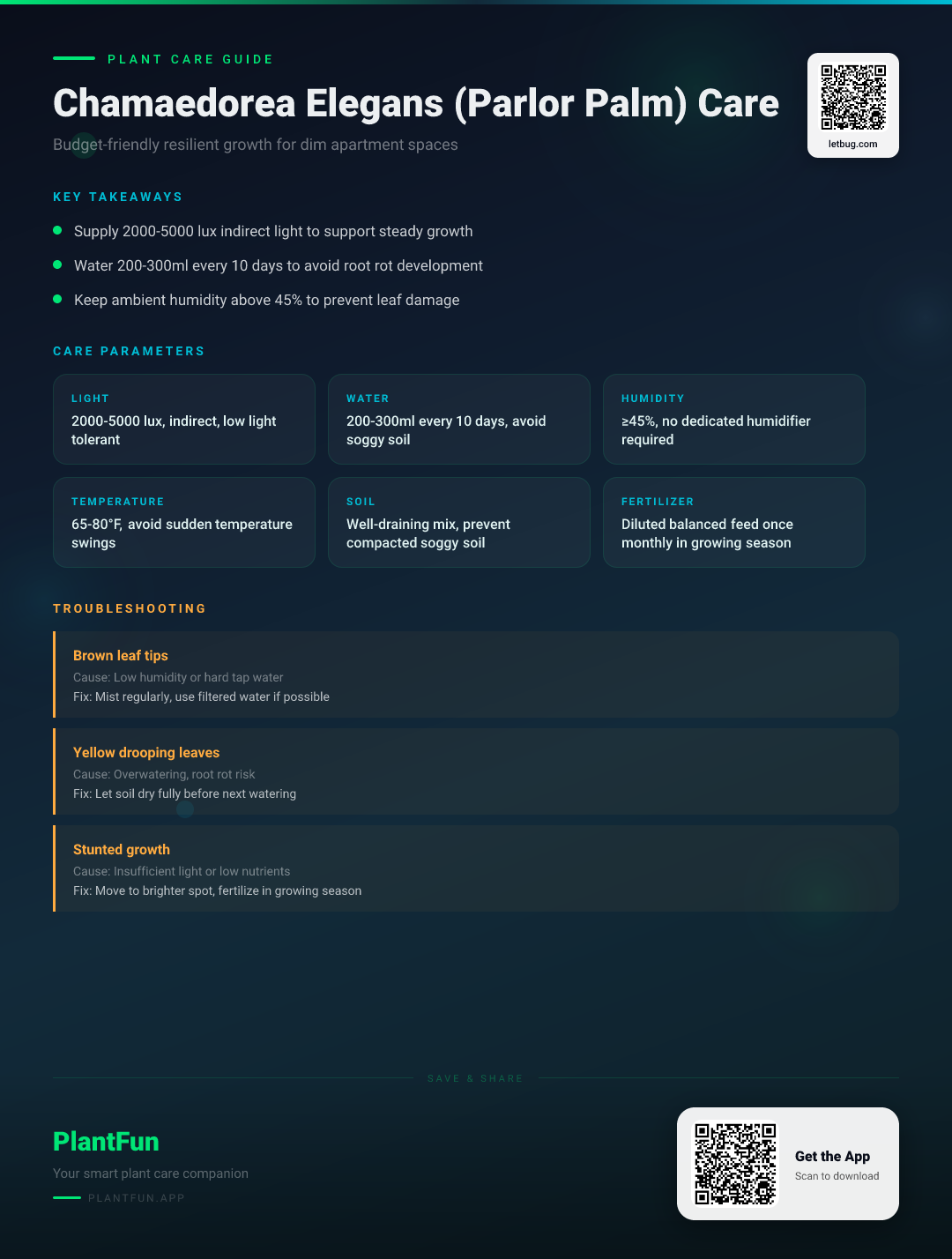
Key Takeaways
- Check soil moisture before watering — overwatering is the #1 killer of houseplants.
- Ensure your plant gets the right amount of light for its species.
- Be patient with recovery — most plants need 2–4 weeks to bounce back.
TL;DR: Keep your Parlor Palm thriving in a dark apartment by maintaining 2,000–5,000 lux of indirect light and watering with 200–300ml of water only when the top two inches of soil are dry. Avoid tap water with high mineral content to prevent brown tips, and keep temperatures strictly between 65–80°F. It is pet-safe (ASPCA, 2026).
Quick Care Card: Essential Thresholds for Chamaedorea elegans
| Factor | Requirement |
|---|---|
| Light | 2,000–5,000 Lux (Bright Indirect) |
| Water | 200-300ml every 10 days (approx.) |
| Humidity | 45%–60% |
| Temperature | 65°F–80°F |
| Soil | Well-draining, peat-based mix |
| Fertilizer | Balanced 10-10-10, monthly (spring/summer) |
| Toxicity | Non-toxic to cats and dogs (ASPCA, 2026) |
My Experience: The “Apartment Sog” Lesson
When I first brought home my Chamaedorea elegans years ago, I treated it like a thirsty tropical fern. I watered it on a strict calendar regardless of the soil moisture and kept it in a dark corner far from any window. Within a month, the lower fronds turned yellow and mushy. I learned the hard way that in an apartment, the lack of airflow means soil stays wet much longer than in a greenhouse. My transition to a ‘moisture-check-first’ routine saved the plant, and it has been thriving in that same corner ever since.
Why the Parlor Palm is the Ultimate Urban Apartment Survivor
The Parlor Palm is a staple for a reason. Unlike many other indoor palms that demand high-intensity light, Chamaedorea elegans is naturally adapted to the forest understory (Pérez-Portilla & Geissert-Kientz, 2004). This evolutionary history makes it remarkably resilient to the lower light levels found in most urban apartments.
Understanding Your Light: Surviving on 2,000-5,000 Lux
While the Parlor Palm is often labeled a ‘low-light’ plant, this is a bit of a misnomer. It survives in low light, but it thrives when provided with consistent, indirect illumination.
- The Lux Threshold: Aim for 2,000 to 5,000 lux. You can use a basic light meter app on your phone to gauge this. If you cannot read a book comfortably without turning on a lamp, your palm isn’t getting enough energy to sustain new growth.
- Placement Strategy: Place it within 3-5 feet of an east-facing window. Avoid direct southern exposure, which can scorch the delicate fronds.
The Watering Science: Why 200ml-300ml Every 10 Days Matters
Consistency is the enemy of root rot. According to (NC State Extension, 2026), these palms prefer moist but well-drained soil.
- The Finger Test: Never water by the calendar alone. Stick your finger two inches into the soil. If it feels damp, wait two more days.
- Precision Watering: For a standard 6-inch pot, 200ml-300ml is usually sufficient to saturate the root ball without leaving the pot sitting in a “swamp” of excess water.
Humidity Hacks: Keeping Your Palm Above 45% Without a Humidifier
Dry apartment air is the primary cause of crispy brown tips. You don’t need a pricey humidifier. Create a pebble tray: place your plant saucer on a bed of stones filled with water. As the water evaporates, it creates a micro-climate around the fronds. Ensure the pot sits on the pebbles, not in the standing water.
Temperature Sensitivity: Why You Must Keep It Between 65-80°F
Chamaedorea elegans is sensitive to sudden temperature fluctuations (Mora-Aguilar & Rodríguez-Pérez, 2003). Keep it away from AC vents, radiator heaters, and drafty window sills. Steady temperatures between 65°F and 80°F prevent unnecessary stress.
Step-by-Step Soil Management: Avoiding the ‘Apartment Sog’ Trap
- Inspect Drainage: Ensure your pot has at least 3 drainage holes.
- Amend the Mix: If your store-bought soil looks too dense, mix in 20% perlite to ensure the roots receive oxygen.
- Repotting: Only move up one pot size (1-2 inches larger) at a time to prevent the soil from retaining too much water.
Seasonal Care Calendar: Adapting to Apartment Temperature Swings
- Spring/Summer: Increase watering slightly as temperatures rise. Apply a diluted 10-10-10 fertilizer once a month.
- Autumn/Winter: Growth slows significantly. Reduce water frequency by 30-50% and withhold fertilizer entirely.
FAQ: Troubleshooting and Tips
Why is my Parlor Palm getting brown tips in my bedroom?
Symptom: Dry, crispy tips on the fronds.
Likely cause: Low humidity or mineral buildup from tap water.
Fix: Move the plant to a pebble tray and switch to filtered or distilled water for a month to see if the new growth improves.
Can I use tap water for my Parlor Palm if my city water is hard?
Symptom: General yellowing or browning of leaf edges.
Likely cause: Chlorine or fluoride buildup in the soil.
Fix: Let your tap water sit in an open container for 24 hours to allow chlorine to evaporate, or invest in a simple water filter pitcher.
How often to water Parlor Palm in winter?
Symptom: Soil staying wet for weeks.
Likely cause: The plant is dormant and not photosynthesizing.
Fix: Only water when the top 3 inches of soil are dry; you may only need to water once every 3-4 weeks.
Common Mistakes: Stop Doing These Three Things Today
- Mistake: Using a pot without holes. What happens: Root rot occurs as water pools at the bottom. Instead: Always use a cache pot or drill drainage holes.
- Mistake: Misting the leaves daily. What happens: This provides only temporary humidity and can encourage fungal issues. Instead: Use a pebble tray for consistent, long-term humidity.
- Mistake: Placing it in a dark hallway. What happens: The plant will eventually weaken and lose fronds. Instead: Move it to a spot with ambient daylight, even if it is indirect.
References
- Mora-Aguilar, R.; Rodríguez-Pérez, J. (2003). RESPUESTA DE Chamaedorea elegans Mart. A TRATAMIENTOS DE PREGERMINACIÓN. Revista Chapingo Serie Horticultura. https://doi.org/10.5154/r.rchsh.2001.08.048. Accessed 2026-03-17.
- Pérez-Portilla, E.; Geissert-Kientz, D. (2004). DISTRIBUCIÓN POTENCIAL DE PALMA CAMEDOR (Chamaedorea elegans Mart.) EN EL ESTADO DE VERACRUZ, MÉXICO. Revista Chapingo Serie Horticultura. https://doi.org/10.5154/r.rchsh.2003.01.012. Accessed 2026-03-17.
- ASPCA. (2026). Toxic and Non-Toxic Plants List — ASPCA. https://www.aspca.org/pet-care/animal-poison-control/toxic-and-non-toxic-plants. Accessed 2026-03-17.
- NC State Extension. (2026). Chamaedorea elegans — NC State Extension Gardener Plant Toolbox. https://plants.ces.ncsu.edu/plants/palm-care/. Accessed 2026-03-17.
Optional Helper: Plantfun.App
Plantfun.App identifies your plants by photo, diagnoses pests and diseases with clear fixes, and creates personalised watering and light schedules that adapt to your home conditions — a handy companion for putting this guide into daily practice.
Found an error or have suggestions? We'd love your feedback.
Need help identifying this problem?
Get instant identification, personalized care schedules, and effective pest treatment plans directly on your phone.
Sponsored • We may earn a commission from app downloads
Related Guides
Chamaedorea Elegans in Low-Light Apartments: 5 Steps to Stop Browning Leaf Tips
Stop the heartbreak of crispy, brown Parlor Palm leaves. Get precise water volumes, humidity hacks, and light thresholds to keep your palm thriving indoors.
Care GuideThe Complete Parlor Palm Care Checklist for Resilient Growth in Typical Urban Apartments
Stop guessing at parlor palm care for your apartment. Get measurable light, water, and humidity targets, plus a printable checklist to keep your plant lush and stress-free year-round.
Care GuideThe Complete Parlor Palm Care Guide for 1-Bedroom Apartments: Budget Tips for Resilient Growth
Skip expensive plant gadgets and grow a lush, full Parlor Palm in your standard apartment. Get exact light levels, watering amounts, and a free printable checklist to avoid common care mistakes.
Safety GuideParlor Palm in Low-Light Playrooms: Non-Toxic Care & Placement Guide for Pet & Child Safety
Keep your playroom green and safe for toddlers and cats with this parlor palm care guide. Get exact light, water, and placement tips to avoid toxic exposure and keep your plant lush long-term.