
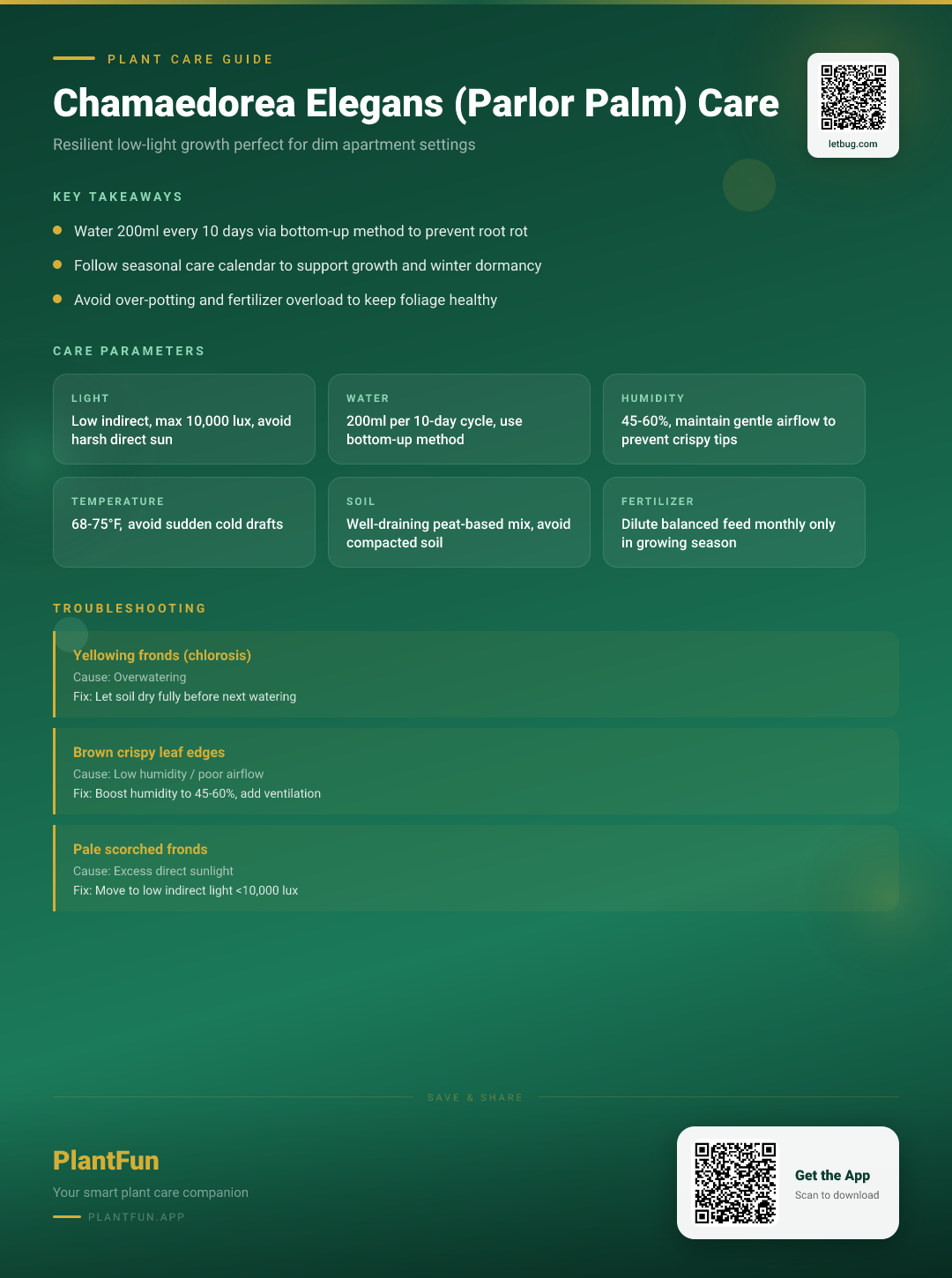
Key Takeaways
- Check soil moisture before watering — overwatering is the #1 killer of houseplants.
- Ensure your plant gets the right amount of light for its species.
- Be patient with recovery — most plants need 2–4 weeks to bounce back.
Quick Care Card: Measurable Thresholds
| Feature | Requirement |
|---|---|
| Light | 10,000 lux (bright, indirect) |
| Water | ~200ml per 10-day cycle |
| Humidity | 45–60% |
| Temperature | 68–75°F (20–24°C) |
| Soil | Well-draining, peat-based mix |
| Fertilizer | Balanced 10-10-10 (monthly in spring/summer) |
| Toxicity | Non-toxic to cats and dogs (ASPCA, 2026) |
TL;DR: The Essentials for Apartment Success
To keep your Chamaedorea elegans thriving, focus on consistency. Provide bright, indirect light—avoid direct sun that scorches leaves. Water only when the top two inches of soil feel dry, typically using about 200ml of room-temperature water every 10 days depending on your home’s evaporation rate. Maintain humidity above 45% to prevent the notorious brown tip issue, and ensure your pot has adequate drainage to protect delicate roots from rot. Keep temperatures steady, as this palm dislikes cold drafts.
My Experience: The “Unkillable” Myth
When I first brought home my Chamaedorea elegans, I treated it like a plastic decoration. I shoved it in a dark corner and ignored it until the fronds turned crispy. I realized that while it is a “low-light” plant, low light in nature is vastly different from a windowless basement. My turnaround came when I moved it to a spot receiving 10,000 lux and started bottom-watering. If you are struggling, know that you are likely under-watering or lacking the ambient humidity these rainforest natives crave.
Understanding Your Chamaedorea elegans: Why This Palm Thrives in Low Light
Native to the shaded understory of rainforests in Mexico and Guatemala, Chamaedorea elegans evolved to maximize photosynthesis in minimal light (Pérez-Portilla & Geissert-Kientz, 2004). Unlike desert palms, it does not possess the cellular structure to withstand high-intensity solar radiation. Understanding this evolutionary history—that it is a forest floor dweller—is key to successful Chamaedorea elegans care.
Light Requirements: Balancing Ambient Room Light vs Direct Sun Intensity
While these plants tolerate low-light houseplants conditions, growth will significantly slow down. Aim for bright, indirect light. If you can read a book comfortably without turning on a lamp in that spot, it is generally bright enough. Avoid direct south-facing sun rays, which can cause leaf scorch (NC State Extension, 2026).
The Watering Science: Why ‘Bottom-Up’ Moisture Prevents Root Rot
Watering from the top often leads to uneven moisture distribution and compaction. I prefer bottom-watering: place your nursery pot in a tray with 200ml of water for 30 minutes. This allows the root system to draw up exactly what it needs via capillary action, keeping the crown of the plant dry and preventing fungal issues.
Humidity & Airflow: Solving the ‘Crispy Tip’ Problem in Heated Units
Apartment heating in winter often drops humidity below 30%, which is the primary cause of why is my Parlor Palm turning brown at the edges. Use a pebble tray or a humidifier to maintain 45-60% humidity. Proper airflow is also essential; stale air encourages spider mites, which thrive on stressed palms.
Step-by-Step: Your Seasonal Care Calendar
- Spring Growth: Increase watering frequency to every 7-10 days as temperatures rise. Apply a balanced, diluted fertilizer once a month (Mora-Aguilar & Rodríguez-Pérez, 2003).
- Summer Maintenance: Ensure the palm avoids direct heat spikes. Check soil moisture twice weekly.
- Autumn Transition: Reduce watering as growth slows. Stop all fertilization by late September.
- Winter Dormancy: Maintain consistent temperatures of 68-75°F. Increase humidity to compensate for dry radiator heat.
Common Mistakes to Avoid
- Mistake: Using generic garden soil.
- What happens: Poor drainage causes root asphyxiation.
- Instead: Use a mix of coco coir, perlite, and pine bark.
- Mistake: Fertilizer overload.
- What happens: Salt buildup burns delicate root hairs.
- Instead: Use half-strength liquid fertilizer only during active growing months.
- Mistake: Over-potting.
- What happens: Excess wet soil traps moisture, leading to root rot.
- Instead: Keep the palm in a snug container to focus energy on foliage.
Troubleshooting Guide
[Chlorosis (Yellowing Leaves)]
Symptom: The fronds lose their vibrant green color and appear pale or yellow.
Likely cause: Nutrient deficiency or over-exposure to light.
Fix:
- Test your soil pH; if too high, nutrients are locked out.
- Move the plant to a slightly dimmer spot to see if color returns.
[Leaf Scorch]
Symptom: Brown, scorched spots appearing on the leaves facing the window.
Likely cause: Exposure to direct, intense sunlight.
Fix:
- Move the palm at least 3-5 feet away from the window.
- Use a sheer curtain to diffuse light during midday hours.
[Root Rot]
Symptom: A mushy, black base or a foul smell emanating from the pot.
Likely cause: Waterlogged soil and poor drainage.
Fix:
- Trim away blackened roots with sterilized scissors.
- Repot into a high-drainage mix and ensure the pot has drainage holes.
Voice Search FAQ
- Why is my Parlor Palm getting brown crispy edges? This is almost always due to low humidity in your apartment. Try placing your palm on a tray of water and pebbles, ensuring the bottom of the pot does not touch the water directly.
- How do I know if my apartment is too dark for a Parlor Palm? If your palm displays “stretching” (long, weak stems with significant gaps between leaves), it is desperate for more light. Move it closer to a window or augment with a full-spectrum LED bulb.
- Is my Parlor Palm dying? If the fronds are turning brown and brittle, check your soil moisture. If it’s bone-dry, it’s thirsty. If it’s soggy, it’s suffocating. Adjust your watering routine to the 10-day cycle recommended here.
Expert Tips for Promoting Steady, Resilient Foliage Growth
Clean the leaves with a damp microfiber cloth every two weeks. Dust blocks the stomata (the pores used for gas exchange), effectively starving your plant of oxygen and carbon dioxide. A clean leaf is a more efficient photosynthesizer.
References
- Mora-Aguilar, R.; Rodríguez-Pérez, J. (2003). RESPUESTA DE Chamaedorea elegans Mart. A TRATAMIENTOS DE PREGERMINACIÓN. Revista Chapingo Serie Horticultura. https://doi.org/10.5154/r.rchsh.2001.08.048. Accessed 2026-03-12.
- Pérez-Portilla, E.; Geissert-Kientz, D. (2004). DISTRIBUCIÓN POTENCIAL DE PALMA CAMEDOR (Chamaedorea elegans Mart.) EN EL ESTADO DE VERACRUZ, MÉXICO. Revista Chapingo Serie Horticultura. https://doi.org/10.5154/r.rchsh.2003.01.012. Accessed 2026-03-12.
- ASPCA. (2026). Toxic and Non-Toxic Plants List — ASPCA. https://www.aspca.org/pet-care/animal-poison-control/toxic-and-non-toxic-plants. Accessed 2026-03-12.
- NC State Extension. (2026). Chamaedorea elegans — NC State Extension Gardener Plant Toolbox. https://plants.ces.ncsu.edu/plants/palm-care/. Accessed 2026-03-12.
Optional Helper: Plantfun.App
Plantfun.App identifies your plants by photo, diagnoses pests and diseases with clear fixes, and creates personalised watering and light schedules that adapt to your home conditions — a handy companion for putting this guide into daily practice.
Found an error or have suggestions? We'd love your feedback.
Need help identifying this problem?
Get instant identification, personalized care schedules, and effective pest treatment plans directly on your phone.
Sponsored • We may earn a commission from app downloads
Related Guides
Parlor Palm Care for Low-Light Apartments: The 5-Step Guide to Thriving Greenery
Revitalize your Parlor Palm with precise light and water metrics. Learn the 5-step maintenance routine that guarantees resilient, deep-green growth every time.
Care GuideChamaedorea Elegans in Low-Light Apartments: 5 Steps to Stop Browning Leaf Tips
Stop the heartbreak of crispy, brown Parlor Palm leaves. Get precise water volumes, humidity hacks, and light thresholds to keep your palm thriving indoors.
Care GuideChamaedorea elegans in a Low-Light Apartment: The Complete Care Guide for Resilient Growth
Master Parlor Palm care in your apartment with our 4-point success checklist. Learn precise light levels and watering triggers to keep your foliage lush today.
Safety GuideParlor Palm in Low-Light Playrooms: Non-Toxic Care & Placement Guide for Pet & Child Safety
Keep your playroom green and safe for toddlers and cats with this parlor palm care guide. Get exact light, water, and placement tips to avoid toxic exposure and keep your plant lush long-term.