
Key Takeaways
- Check soil moisture before watering — overwatering is the #1 killer of houseplants.
- Ensure your plant gets the right amount of light for its species.
- Be patient with recovery — most plants need 2–4 weeks to bounce back.
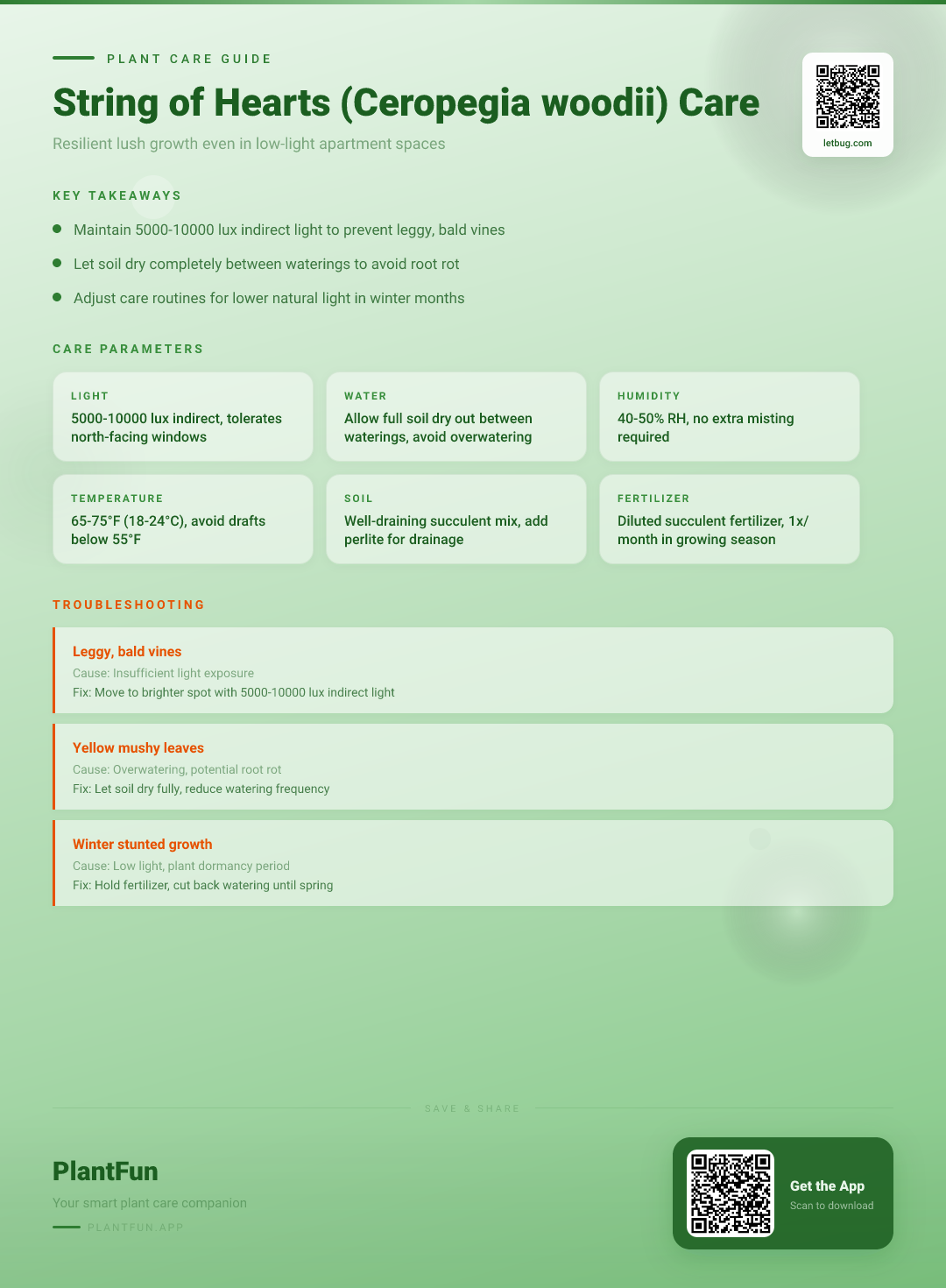
Quick Care Card: The Data Behind Thriving Ceropegia woodii
| Feature | Requirement |
|---|---|
| Light | 5,000–10,000 Lux (Bright, indirect) |
| Watering | Allow 75% of soil depth to dry |
| Temperature | 65–75°F (18–24°C) |
| Humidity | 40–50% RH |
| Soil | Well-draining cactus/succulent mix |
| Toxicity | Non-toxic (ASPCA, 2026) |
TL;DR: The 30-Second String of Hearts Reality Check
To keep your Ceropegia woodii thriving in an apartment, prioritize three things: place it in your brightest window, avoid overwatering by checking the soil depth, and prune sparse vines to encourage fullness. If your plant is losing leaves at the base, it is likely screaming for more light or dealing with root suffocation. Do not let it sit in damp soil, as this plant thrives on wet-dry cycles (Tiemann et al., 1994).
My Experience: Why Apartments Challenge the String of Hearts
When I first brought home my Ceropegia woodii, I placed it on a bookshelf six feet away from a window. Within a month, I was staring at long, naked vines with leaves only at the very tips. I had essentially created a “bald vine” situation. My mistake was assuming it could handle “low light” just because it is a popular hanging plant. The reality is that Ceropegia woodii requires significant light to maintain its compact, heart-shaped foliage. I learned that in an apartment, every inch closer to the glass matters.
Light Intensity: Reaching 5,000-10,000 Lux Without a Greenhouse
Most apartments lack the intense light of a greenhouse, but you can bridge the gap. I measure my apartment light using a basic digital meter to ensure I hit the 5,000-10,000 lux threshold. If you don’t have a meter, use the “shadow test”: if the plant casts a sharp, defined shadow on the floor during the day, the light is likely sufficient. If the shadow is blurry or non-existent, you are likely under 3,000 lux, which will lead to etiolation (stretching).
Watering Mastery: Soil Dryness Thresholds and Avoiding Root Rot
Overwatering is the fastest way to kill a Ceropegia woodii. I use a simple tactile test: I stick my finger at least two inches into the soil. If it feels damp, I wait. Because this species often forms symbiotic relationships with mycorrhizal fungi in its native habitat, its root system is highly sensitive to moisture saturation (Tiemann et al., 1994). Always ensure your pot has drainage holes, as stagnant water is the enemy of succulent vines.
Temperature & Humidity: Keeping it 65-75°F (18-24°C) with 40-50% RH
Apartments often fluctuate in temperature, especially near drafty windows. While these plants are resilient, they prefer a stable 65-75°F (18-24°C) (NC State Extension, 2026). In winter, keep your plant away from heating vents, which can sap humidity and dry out the leaves too quickly. A standard home humidity of 40-50% is generally sufficient, provided you aren’t blasting the AC or heater directly on the foliage.
The ‘Bald Vine’ Diagnosis: Why Your Plant is Stretching
Leggy Growth
Symptom: Long distances between leaves on the vine.
Likely cause: Insufficient light preventing the plant from photosynthesizing efficiently.
Fix:
- Move the plant to a window with direct morning sun.
- Prune the long, bare stems to “reset” the growth.
Yellowing Leaves
Symptom: Lower leaves turn yellow and drop off.
Likely cause: Overwatering leading to root stress.
Fix:
- Check the drainage holes for blockages.
- Switch to a grittier soil mix with more perlite or pumice.
Frequently Asked Questions
Can I put my String of Hearts in a north-facing apartment window? It is difficult, but possible if the window is unobstructed. You will likely need to supplement with a grow light to reach the required lux levels.
How often should I water my Ceropegia woodii? Instead of a schedule, use a moisture test. Water only when the top 75% of the soil feels dry. In summer, this might be once a week, while in winter, it could be once a month.
Is the plant safe for my cats? According to the ASPCA (2026), Ceropegia woodii is non-toxic to cats and dogs, making it a safe choice for pet owners.
Seasonal Care: Adjusting Your Routine for Winter Light Drops
During winter, the sun’s angle drops, and day length shortens. I significantly reduce my watering frequency to match the plant’s metabolic slow-down. If you notice your plant struggling, consider propagating your string of hearts to start a new, smaller pot that is easier to manage in lower light.
Common Mistakes: Potting Mixes and Drainage Essentials
- Mistake: Using standard potting soil without amendments. What happens: The soil holds too much moisture, suffocating the roots. Instead: Mix 50% standard potting soil with 50% perlite or pumice to ensure rapid drainage.
- Mistake: Keeping the plant in a decorative pot without a nursery liner. What happens: Water pools at the bottom, leading to silent rot. Instead: Always use a nursery pot with drainage holes inside your decorative cachepot.
References
- Al‐Kalemji, A.; Paulsen, E. (2007). Allergic occupational dermatitis due to Ceropegia woodii (string of hearts). Contact Dermatitis. https://doi.org/10.1111/j.1600-0536.2006.01068.x. Accessed 2026-03-16.
- Tiemann, C.; Demuth, K.; Weber, H. (1994). Zur Symbiose von Cynanchum vincetoxicum (L.) Pers., Asclepias curassavica L. und Ceropegia woodii Schl. (Asclepiadaceae) mit Mycorrhiza-Pilzen (VAM). Flora. https://doi.org/10.1016/s0367-2530(17)30563-7. Accessed 2026-03-16.
- ASPCA. (2026). Toxic and Non-Toxic Plants List — ASPCA. https://www.aspca.org/pet-care/animal-poison-control/toxic-and-non-toxic-plants. Accessed 2026-03-16.
- North Carolina State University Extension. (2026). Ceropegia woodii — NC State Extension Gardener Plant Toolbox. https://plants.ces.ncsu.edu/plants/hearts-care/. Accessed 2026-03-16.
Optional Helper: Plantfun.App
Plantfun.App identifies your plants by photo, diagnoses pests and diseases with clear fixes, and creates personalised watering and light schedules that adapt to your home conditions — a handy companion for putting this guide into daily practice.
Found an error or have suggestions? We'd love your feedback.
Need help identifying this problem?
Get instant identification, personalized care schedules, and effective pest treatment plans directly on your phone.
Sponsored • We may earn a commission from app downloads
Related Guides
String of Hearts in a Low-Light Apartment: A Resilient Care Strategy for Lush Growth
Transform your Ceropegia woodii into a sprawling masterpiece. Master exact 15,000-lux positioning, strict watering intervals, and 3 signs of healthy root growth.
Care GuideThe Complete String of Hearts Care Checklist for Thriving Growth in Small City Apartments
Grow lush trailing String of Hearts in your apartment without fancy gear. Grab our free printable care checklist with exact light, water, and humidity thresholds for resilient, low-fuss, year-round growth.
Care GuideString of Hearts in an Apartment: The Budget-Friendly Guide to Resilient, Trailing Growth
Grow lush, trailing vines in your apartment with this budget-friendly String of Hearts care plan. Discover exact watering schedules and light hacks for growth.
Pest ControlAnts on Plants: What They Mean and What to Do
Ants usually aren't eating your plant. They are farming other pests.