
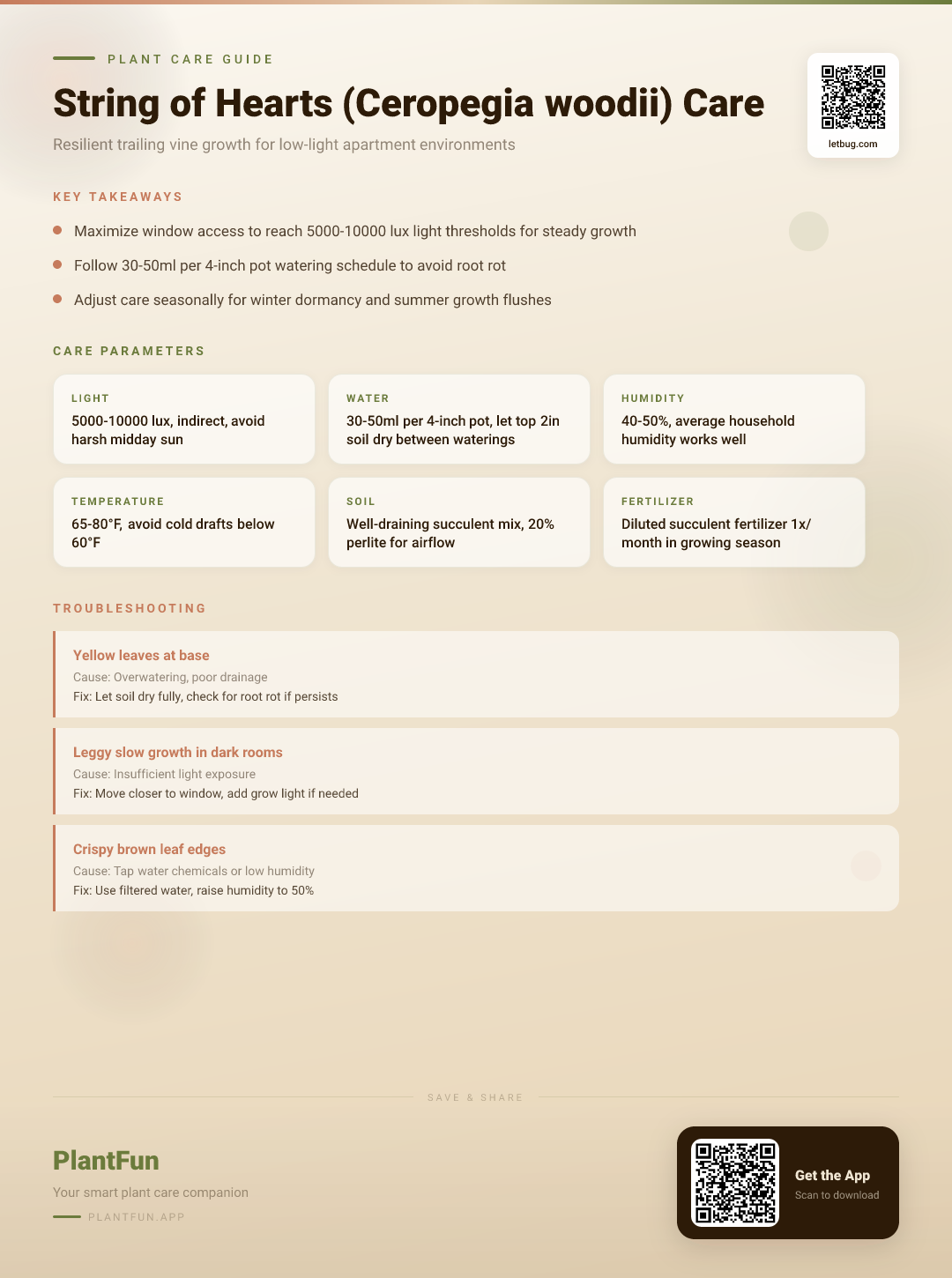
Key Takeaways
- Check soil moisture before watering — overwatering is the #1 killer of houseplants.
- Ensure your plant gets the right amount of light for its species.
- Be patient with recovery — most plants need 2–4 weeks to bounce back.
TL;DR: The Reality of Growing Ceropegia woodii in Typical Apartments
Contrary to popular belief, you do not need a conservatory to thrive with Ceropegia woodii. In an apartment, success comes from discipline rather than intensity. To stop the decline, you must provide a minimum of 5,000 lux of light and follow a strict, volumetric watering regimen of 30-50ml per 4-inch pot. By avoiding over-potting and mimicking their natural semi-dormant cycles, you can maintain healthy, trailing vines even in north-facing or recessed living spaces.
Quick Care Card: Essential Data
| Feature | Requirement |
|---|---|
| Light | 5,000–10,000 lux |
| Water | 30–50ml per 4-inch pot |
| Humidity | 40–50% |
| Temp | 65–80°F |
| Soil | Well-draining succulent mix |
| Fertilizer | Balanced liquid, half-strength (monthly) |
| Toxicity | Non-toxic to cats and dogs (ASPCA, 2026) |
Why This Matters: Understanding the ‘Hearts’ Growth Cycle in Limited Light
When I first brought home my Ceropegia woodii, I treated it like a thirsty fern. The result? A rapidly balding plant with yellowing leaves. I learned the hard way that these plants are specialized succulents that store water in their tubers. Because apartment living often limits ambient airflow and light, the plant’s metabolic rate slows down. Understanding this, I now treat the plant as a desert dweller rather than a tropical climber. My approach now mirrors the conditions outlined by the NC State Extension (2026), prioritizing the health of the root system over immediate vine length.
Step 1: Calibrating Your Light Exposure (Maximizing Window Access)
In an apartment, light is your most valuable resource. My light meter consistently reads between 5,000 and 10,000 lux in my preferred placement—directly on a windowsill. If you are struggling with legginess (large gaps between leaves), your plant is searching for energy.
- Move the plant within 12 inches of a south or west-facing window.
- If you only have north-facing light, consider a dedicated full-spectrum LED bulb, keeping it 6-8 inches from the foliage.
- Rotate the pot weekly to ensure the top tubers receive light, which prevents the base of the plant from going bald.
Step 2: The Precision Watering Method: Avoiding Root Rot in Apartments
In my experience, 90% of failures in apartments occur because owners water based on a calendar rather than plant need. In lower light, the soil remains damp for too long, leading to rot.
- Use a syringe or graduated measuring tool: deliver exactly 30-50ml per 4-inch pot.
- Perform the ‘Finger Test’: Insert your finger 2 inches into the soil. If there is any moisture, do not water (NC State Extension, 2026).
- Drainage is non-negotiable; I always ensure my pots have at least one large drainage hole.
Step 3: Seasonal Care Calendar: Adjusting for Winter Dormancy and Summer Flushes
I treat my Ceropegia differently depending on the sun cycle.
- Summer Flushes: As days lengthen, the plant enters active growth. I increase my watering frequency to once every 10–14 days.
- Winter Dormancy: Growth slows significantly. I pull back to once every 3–4 weeks. Keeping the plant cool (around 65°F) during this time encourages a stronger spring flush.
Voice Search FAQ: Why is my String of Hearts turning yellow at the base?
Symptom: Leaves closest to the soil start yellowing and dropping.
Likely cause: Overwatering leading to root suffocation or poor airflow.
Fix:
- Check for soggy, dark soil.
- Repot into a high-perlite, fast-draining mix.
- Ensure the pot is not too large for the root ball.
Voice Search FAQ: How do I make my String of Hearts grow faster in a dark room?
Symptom: The plant is surviving but showing no new vine growth.
Likely cause: Insufficient photosynthetically active radiation.
Fix:
- Supplement with a small clip-on grow light.
- Increase ambient temperature to 75°F to stimulate metabolic activity.
Voice Search FAQ: Can I use tap water for my Ceropegia woodii?
Yes, provided the water isn’t heavily chlorinated. If you live in an area with hard water, I recommend letting the water sit out for 24 hours to allow chlorine to dissipate. Note that Ceropegia woodii has specialized symbiotic relationships with mycorrhizal fungi (Tiemann et al., 1994), so avoid harsh chemical treatments in your soil.
Common Mistakes to Avoid: The Dangers of Over-Potting and Low Airflow
- Mistake: Planting in a pot too large for the root system.
- What happens: Excess soil holds water that the roots cannot absorb, leading to rot.
- Instead: Keep the plant slightly root-bound; it actually prefers the snug fit.
- Mistake: Neglecting hygiene near the vines.
- What happens: Dust accumulation blocks limited light intake.
- Instead: Gently wipe the heart-shaped leaves with a damp cloth monthly.
Advanced Care Technique: How to Propagate ‘Leggy’ Strands to Thicken Your Canopy
If you have long, bare vines, don’t prune them away. Instead, coil the leggy strand back onto the surface of the soil. Use small U-shaped wire pins to hold the nodes (the bumps where leaves grow) against the moist soil. These nodes will root into the pot, creating new vines and a fuller, bushier plant over time.
References
- Al‐Kalemji, A.; Paulsen, E. (2007). Allergic occupational dermatitis due to Ceropegia woodii (string of hearts). Contact Dermatitis. https://doi.org/10.1111/j.1600-0536.2006.01068.x. Accessed 2026-03-09.
- Tiemann, C.; Demuth, K.; Weber, H. (1994). Zur Symbiose von Cynanchum vincetoxicum (L.) Pers., Asclepias curassavica L. und Ceropegia woodii Schl. (Asclepiadaceae) mit Mycorrhiza-Pilzen (VAM). Flora. https://doi.org/10.1016/s0367-2530(17)30563-7. Accessed 2026-03-09.
- ASPCA. (2026). Toxic and Non-Toxic Plants List — ASPCA. https://www.aspca.org/pet-care/animal-poison-control/toxic-and-non-toxic-plants. Accessed 2026-03-09.
- NC State Extension. (2026). Ceropegia woodii — NC State Extension Gardener Plant Toolbox. https://plants.ces.ncsu.edu/plants/hearts-care/. Accessed 2026-03-09.
Optional Helper: Plantfun.App
Plantfun.App identifies your plants by photo, diagnoses pests and diseases with clear fixes, and creates personalised watering and light schedules that adapt to your home conditions — a handy companion for putting this guide into daily practice.
Found an error or have suggestions? We'd love your feedback.
Need help identifying this problem?
Get instant identification, personalized care schedules, and effective pest treatment plans directly on your phone.
Sponsored • We may earn a commission from app downloads
Related Guides
The Complete String of Hearts Care Checklist for Resilient Growth in Typical Apartments
Grab a foolproof String of Hearts care checklist tailored to typical apartment conditions, with exact light, water, and humidity levels to grow lush, trailing vines without frustrating leaf drop.
Care GuideThe Complete String of Hearts Care Guide for Typical Apartments: Grow Fuller, Resilient Vines Fast
Stop struggling with leggy, yellowing String of Hearts vines. Get a 10-point apartment-specific checklist, exact light, water, and humidity levels to grow lush, trailing growth year-round.
Care GuideString of Hearts Care in Dim Apartments: The 5-Step Path to Thriving Long Vines
Transform your leggy String of Hearts into a lush, full vine. Get exact light thresholds, watering schedules, and 5 simple steps to spark resilient apartment growth.
Pest ControlAnts on Plants: What They Mean and What to Do
Ants usually aren't eating your plant. They are farming other pests.