
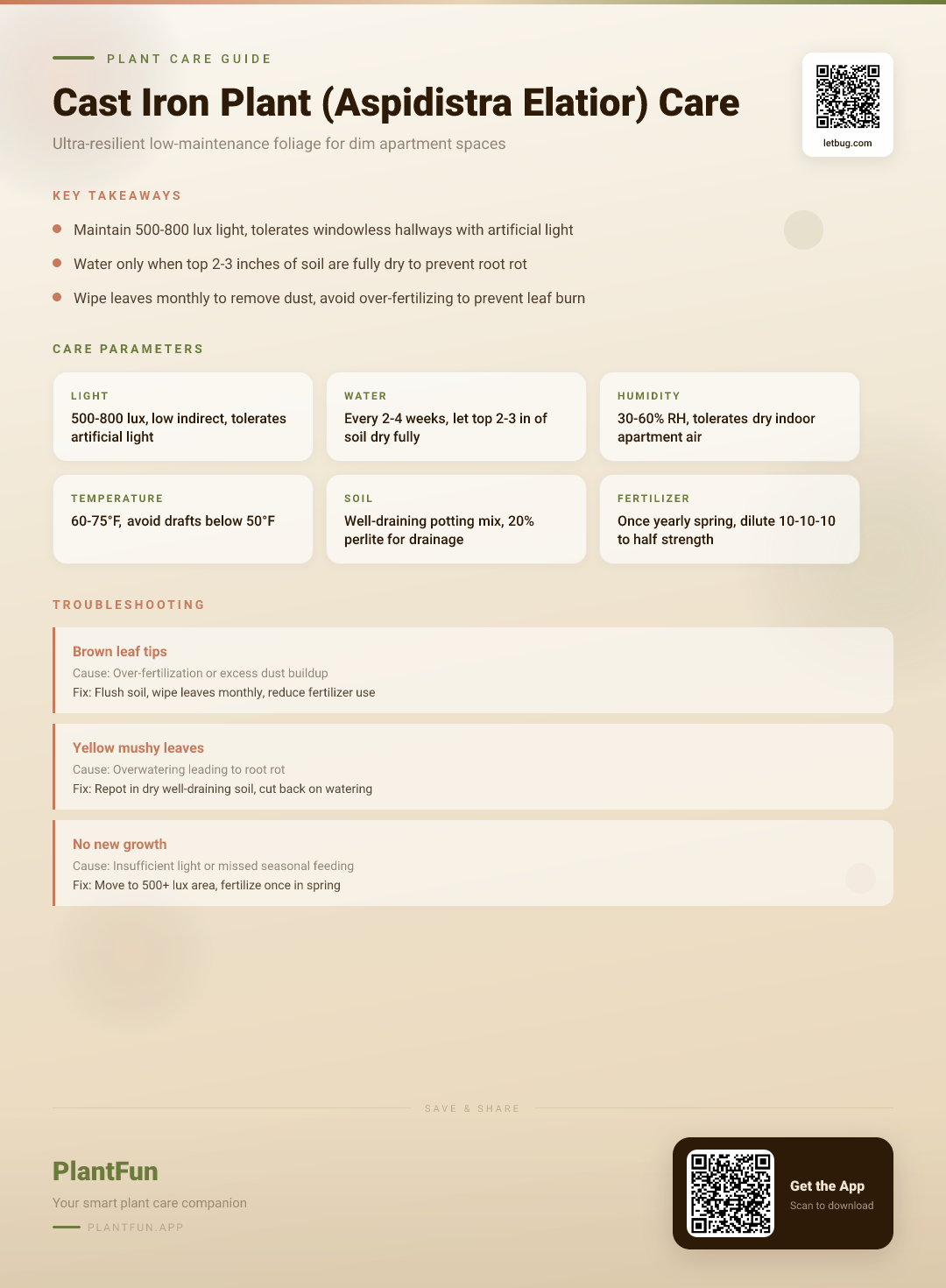
Key Takeaways
- Check soil moisture before watering — overwatering is the #1 killer of houseplants.
- Ensure your plant gets the right amount of light for its species.
- Be patient with recovery — most plants need 2–4 weeks to bounce back.
TL;DR: Why the Cast Iron Plant is the Ultimate Apartment Survivor
The Aspidistra elatior, or Cast Iron Plant, is a near-indestructible choice for urban living. Unlike finicky tropicals, it thrives in low-light environments (500–800 lux) and tolerates the stagnant air and temperature fluctuations common in apartments. It is a slow-growing, non-toxic companion that requires infrequent watering—often thriving on neglect rather than over-attentiveness (NC State Extension, 2026).
Quick Care Card: Essential Thresholds for Success
| Feature | Requirement |
|---|---|
| Light | 500–800 lux (Low, indirect) |
| Water | Allow top 50% of soil to dry out |
| Humidity | Average indoor (30%–50%) |
| Temperature | 50°F to 85°F (10°C–29°C) |
| Soil | Well-draining, peat-based potting mix |
| Fertilizer | Balanced liquid feed, monthly in summer |
| Toxicity | Non-toxic to cats and dogs (ASPCA, 2026) |
Understanding Your Environment: Low Light vs. No Light
When I first bought my Aspidistra, I tucked it into a corner I assumed was ‘dim enough.’ I quickly realized that ‘dim’ and ‘windowless’ are two different things. While the Cast Iron Plant is incredibly hardy, it is not a plastic decoration. It needs ambient light to photosynthesize. If your apartment has a north-facing window or a corner near a dim hallway, your plant will survive. However, I’ve found that even the toughest foliage will begin to yellow if kept in total darkness for months. Aim for a spot where you can comfortably read a book without turning on an overhead light—that is your 500-800 lux threshold (Gilman, 2014).
Watering Mastery: Avoiding the Most Common Apartment Killer
When I first started keeping plants, I made the mistake of watering on a calendar schedule. In an apartment with central heating, the soil might dry out in four days; in a humid basement, it might take fourteen. The Cast Iron Plant prefers to be underwatered rather than overwatered.
The Finger Test: Stick your index finger into the soil up to the second knuckle. If you feel even a hint of moisture, wait three more days. If it feels bone dry, provide a deep soak until water runs out of the drainage holes. According to standard horticultural practices, poor drainage is the primary cause of root failure in these specimens (NC State Extension, 2026).
Step-by-Step Guide: Soil Selection and Potting for Drainage
- Select a Pot: Always choose a container with at least one drainage hole. I prefer terracotta for apartment dwellers as it helps wick excess moisture away from the roots.
- Mix Your Soil: Use a high-quality peat-based potting mix. To ensure proper aeration, I mix in 20% perlite, which helps prevent the soil from compacting in the stagnant air of an apartment.
- Potting: Fill the bottom third of the pot with your mix, place the plant, and fill around the root ball. Ensure the plant sits at the same depth it did in its nursery container.
- Placement: Place in a stable location where it won’t be brushed against by pets or high-traffic walking paths.
Seasonal Care Calendar: Adapting to Apartment Temperature Swings
- Spring/Summer: This is the primary growth rate season. You may notice new, delicate spears emerging. Increase water frequency slightly if your apartment becomes very warm.
- Autumn/Winter: Growth slows significantly. Keep the plant away from drafty radiators or air conditioner vents. Abrupt shifts in temperature can lead to shock (Gilman, 2014).
Why is my Cast Iron Plant getting brown tips? (Voice Search FAQ)
Brown tips are almost always a result of low humidity or mineral buildup from tap water. Try using filtered water and gently misting the foliage if your apartment air is excessively dry due to indoor heating.
Can I keep my Cast Iron Plant in a windowless hallway? (Voice Search FAQ)
No. While they are hardy, they need some light to maintain their cellular structure. If you have a windowless space, the plant will eventually exhaust its stored energy and die. I recommend rotating your plants into a lit area periodically.
How do I clean the leaves without damaging the plant? (Voice Search FAQ)
Dust accumulation prevents light absorption. Once a month, I use a damp, soft microfiber cloth to gently wipe the top and underside of each leaf. Avoid harsh leaf-shine sprays.
Common Mistakes to Avoid: Fertilizer Overdose and Dust Accumulation
- Mistake: Over-fertilizing during the winter months. What happens: Fertilizer salt builds up in the soil, which can burn the roots. Instead: Only feed during the active growth phase (April through August).
- Mistake: Letting dust build up on leaves. What happens: The plant cannot effectively photosynthesize in low-light conditions. Instead: Establish a routine cleaning schedule using a damp cloth.
Troubleshooting: Recognizing Early Signs of Root Rot and Pests
Yellowing Leaves
Symptom: Lower leaves turn yellow and feel mushy.
Likely cause: Overwatering or standing water in the saucer.
Fix:
- Check the soil moisture immediately.
- Remove the plant from its pot and inspect the roots for a slimy texture or dark discoloration.
Brown Leaf Margins
Symptom: Crisp, dry, brown edges on the leaves.
Likely cause: Low humidity or salt buildup.
Fix:
- Switch to distilled or filtered water.
- Increase ambient humidity with a pebble tray.
Stunted Growth
Symptom: The plant looks healthy but produces no new leaves for a year.
Likely cause: Extremely low light or root-bound pot.
Fix:
- Move to a brighter location (while still indirect).
- Repot into a container one size larger if roots are circling the base.
References: Botanical Standards for Aspidistra Elatior
- ASPCA. (2026). Toxic and Non-Toxic Plants List — ASPCA. https://www.aspca.org/pet-care/animal-poison-control/toxic-and-non-toxic-plants. Accessed 2026-03-12.
- Gilman, E. (2014). Aspidistra elatior Cast Iron Plant. EDIS. https://doi.org/10.32473/edis-fp053-1999. Accessed 2026-03-12.
- NC State Extension. (2026). Cast Iron Plant — NC State Extension Gardener Plant Toolbox. https://plants.ces.ncsu.edu/plants/plant-care/. Accessed 2026-03-12.
- Banfield, R.; Gaskell, D. (1966). Cast Iron Failures in Sulphuric Acid Plant. Anti-Corrosion Manual. https://doi.org/10.1108/eb006715. Accessed 2026-03-12.
Optional Helper: Plantfun.App
Plantfun.App identifies your plants by photo, diagnoses pests and diseases with clear fixes, and creates personalised watering and light schedules that adapt to your home conditions — a handy companion for putting this guide into daily practice.
Found an error or have suggestions? We'd love your feedback.
Need help identifying this problem?
Get instant identification, personalized care schedules, and effective pest treatment plans directly on your phone.
Sponsored • We may earn a commission from app downloads
Related Guides
The Complete Cast Iron Plant Care Checklist for Budget-Friendly Resilient Growth in Low-Light Apartments
Grow a lush Cast Iron Plant without spending extra on fancy supplies. Get our free printable checklist with exact light, water, and soil parameters made for typical low-light apartments.
Care GuideThe Complete Cast Iron Plant Care Checklist for Resilient Growth in Low-Light Apartments
Keep your Cast Iron Plant thriving even in dim apartment corners. Get exact light, water, and humidity thresholds plus a 12-month care calendar to avoid stress and boost lush growth.
Care GuideCast Iron Plant Care Checklist for Low-Light Apartments: Tips for Lush, Resilient Growth
Keep your cast iron plant thriving even in dim, dry typical apartments. Grab our free printable checklist, exact light, water, and soil parameters, plus quick fixes for yellow leaves and stunted growth.
Pest ControlAnts on Plants: What They Mean and What to Do
Ants usually aren't eating your plant. They are farming other pests.