
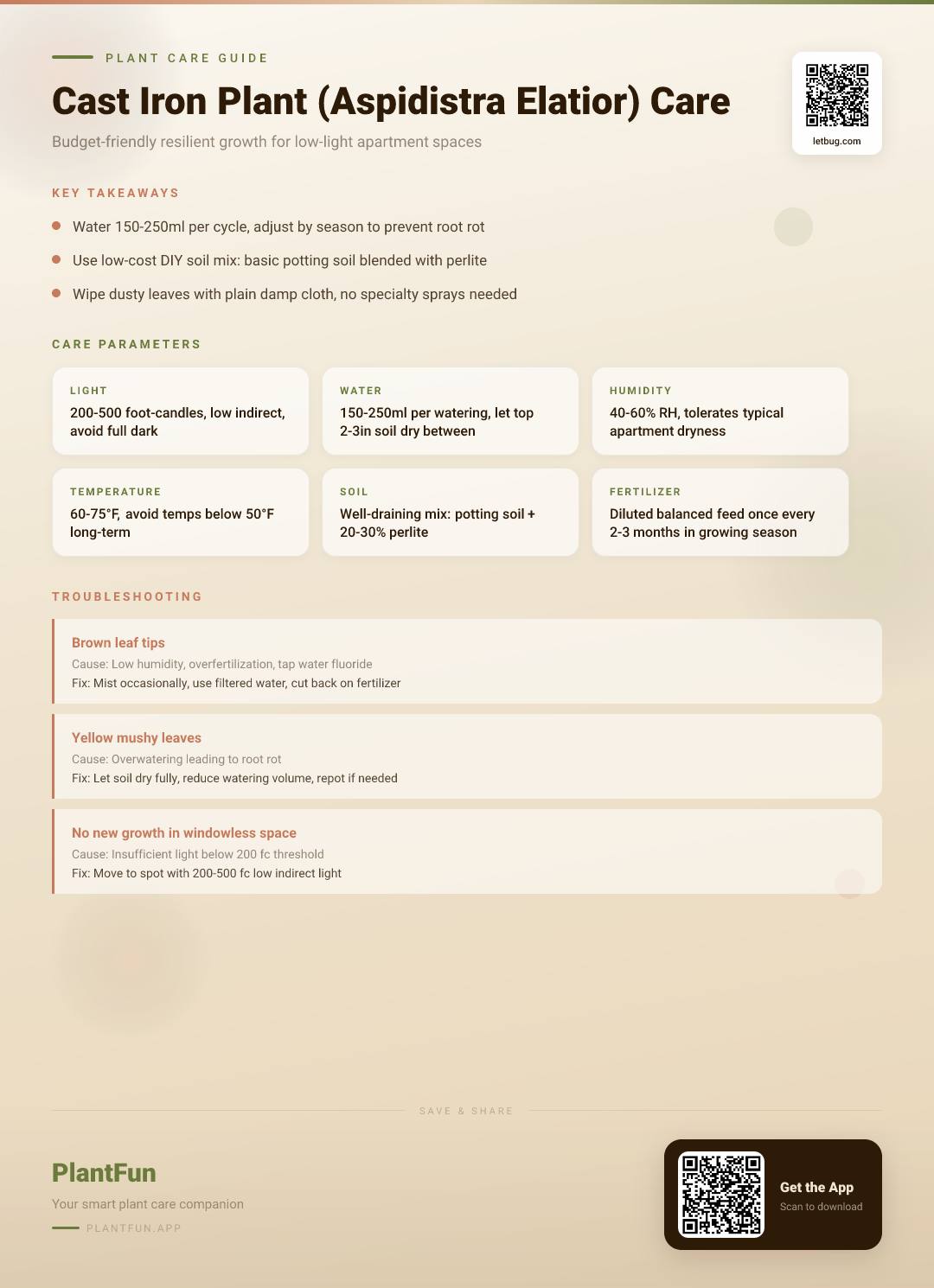
Key Takeaways
- Check soil moisture before watering — overwatering is the #1 killer of houseplants.
- Ensure your plant gets the right amount of light for its species.
- Be patient with recovery — most plants need 2–4 weeks to bounce back.
Quick Care Card: Essential Parameters
| Feature | Requirement |
|---|---|
| Light | 200–500 foot-candles (low to medium indirect) |
| Water | 150–250ml when top 2 inches of soil are dry |
| Humidity | 40–60% (average household level) |
| Temperature | 60°F–75°F (15°C–24°C) |
| Soil | Well-draining, peat-based mix with 20% perlite |
| Fertilizer | Balanced liquid feed at half-strength, monthly in spring/summer |
| Toxicity | Non-toxic to cats and dogs (ASPCA, 2026) |
TL;DR: The Low-Maintenance Secret for Aspidistra Elatior
The Aspidistra elatior is famously resilient, but “resilient” does not mean “neglectable.” In apartment settings, success relies on mimicking its native forest floor environment: consistent, low-intensity light, and strictly avoiding waterlogged roots. If you provide a drainage-optimized potting mix and water only when the top 2 inches of soil are dry (NC State Extension, 2026), your plant will thrive for years.
Why Your Cast Iron Plant Struggles in a Typical Apartment
When I first brought home my first Aspidistra, I made the mistake of placing it in a dark corner and watering it whenever I remembered. It sat there, sulking, with yellowing leaves and stagnant growth. I realized then that while this plant tolerates neglect, it thrives on routine. Most apartments suffer from low ambient light and poor air circulation, which can cause standard potting soil to remain wet for too long, leading to root rot—the number one killer of these resilient plants.
Light Thresholds: Navigating Low-Light vs. No-Light (Targeting 200-500 foot-candles)
Contrary to popular belief, the Cast Iron Plant is not a “no-light” plant. While it tolerates deep shade better than most species, it requires at least 200 to 500 foot-candles to maintain cellular vitality (Gilman, 2014).
- The Test: If you cannot comfortably read a book in the spot where you intend to place your plant, it is likely too dark for long-term health.
- The Placement: A north-facing window or a spot about 5-8 feet away from an east-facing window is ideal. Avoid direct, harsh afternoon sun, which can scorch the foliage.
Watering by the Numbers: How to Avoid Root Rot with 150-250ml Seasonal Cycles
I treat my Aspidistra like a drought-tolerant species. In an apartment, you should never water on a calendar schedule. Instead, use the “finger test”: stick your finger 2 inches into the soil. If it feels damp, wait.
- Spring/Summer: Use approximately 250ml of room-temperature water every 10–14 days.
- Autumn/Winter: Reduce to 150ml and extend the interval to 3–4 weeks (NC State Extension, 2026).
- Pro Tip: Always discard excess water in the saucer to prevent the roots from sitting in moisture, which is the primary cause of decay.
Soil Science on a Budget: DIY Aeration Mixes Using Basic Potting Soil and Perlite
Most pre-bagged potting soils are too dense for indoor Aspidistra care. To prevent the root suffocations that often lead to stunted growth, I create my own mix using a 4:1 ratio of standard indoor potting soil to coarse perlite. This addition of inorganic material increases oxygen availability in the root zone (NC State Extension, 2026), mirroring the well-draining forest soil this plant prefers.
Temperature & Humidity Requirements: Keeping 40-60% Humidity in Drafty Living Spaces
Aspidistra is remarkably adaptable, tolerating temperature fluctuations between 60°F and 75°F (Gilman, 2014). However, dry apartment air—especially near heaters or AC vents—can stress the plant. Keeping the plant away from direct drafts is key. If you find your indoor humidity dropping below 40%, a simple room humidifier or a pebble tray can create a localized microclimate to support the leaves.
FAQ 1: Why are my Cast Iron Plant leaves turning brown at the tips?
Symptom: The edges and tips of your leaves are turning dry and brown.
Likely cause: This is almost always due to low humidity or inconsistent watering schedules.
Fix:
- Increase your watering consistency by setting a monthly reminder to check soil moisture.
- Boost humidity by grouping plants together or using a small humidifier nearby.
FAQ 2: Can I keep my Cast Iron Plant in a windowless bathroom?
Symptom: You want to place your plant in a bathroom without natural light.
Likely cause: Plants require light to perform photosynthesis; without it, the plant will eventually starve.
Fix:
- If your bathroom lacks a window, use a low-wattage full-spectrum LED bulb on a 12-hour timer to provide the necessary 200 foot-candles.
FAQ 3: How do I clean dust off those wide leaves without buying expensive sprays?
Symptom: The broad, dark green leaves are covered in dust, inhibiting light absorption.
Likely cause: Dust accumulation is a common issue for indoor plants that aren’t regularly maintained.
Fix:
- Gently wipe each leaf with a damp, lint-free microfiber cloth.
- Support the leaf from underneath to prevent cracking as you wipe.
Seasonal Growth Calendar: A Month-by-Month Care Strategy
- March–May: Growth kicks in. Begin fertilizing with half-strength liquid fertilizer once a month.
- June–August: Keep an eye on soil moisture as heat increases evaporation. Ensure the plant is not in direct sunlight.
- September–November: Growth slows. Cease fertilization and pull back on watering frequency.
- December–February: Dormancy period. Focus on keeping the plant clean and free of dust. Only water when the soil is completely dry.
Common Mistakes to Avoid: The ‘Set It and Forget It’ Trap
- Mistake: Using a pot without drainage holes.
- What happens: Water collects at the bottom, leading to root rot (Banfield & Gaskell, 1966).
- Instead: Ensure every container has at least one large drainage hole.
- Mistake: Over-fertilizing.
- What happens: Salt buildup occurs in the soil, which leads to leaf-tip burn.
- Instead: Use half-strength fertilizer only during the active growing season.
References
- Gilman, E. (2014). Aspidistra elatior Cast Iron Plant. https://doi.org/10.32473/edis-fp053-1999. Accessed 2026-03-11.
- Banfield, R.; Gaskell, D. (1966). Cast Iron Failures in Sulphuric Acid Plant. Anti-Corrosion Manual. https://doi.org/10.1108/eb006715. Accessed 2026-03-11.
- ASPCA. (2026). Toxic and Non-Toxic Plants List — ASPCA. https://www.aspca.org/pet-care/animal-poison-control/toxic-and-non-toxic-plants. Accessed 2026-03-11.
- NC State Extension. (2026). Cast Iron Plant Care — NC State Extension Gardener Plant Toolbox. https://plants.ces.ncsu.edu/plants/plant-care/. Accessed 2026-03-11.
Optional Helper: Plantfun.App
Plantfun.App identifies your plants by photo, diagnoses pests and diseases with clear fixes, and creates personalised watering and light schedules that adapt to your home conditions — a handy companion for putting this guide into daily practice.
Found an error or have suggestions? We'd love your feedback.
Need help identifying this problem?
Get instant identification, personalized care schedules, and effective pest treatment plans directly on your phone.
Sponsored • We may earn a commission from app downloads
Related Guides
The Complete Cast Iron Plant Care Checklist for Resilient Growth in Low-Light Apartments
Keep your Cast Iron Plant thriving even in dim apartment corners. Get exact light, water, and humidity thresholds plus a 12-month care calendar to avoid stress and boost lush growth.
Care GuideThe Complete Cast Iron Plant Care Checklist for Budget-Friendly Resilient Growth in Low-Light Apartments
Grow a lush Cast Iron Plant without spending extra on fancy supplies. Get our free printable checklist with exact light, water, and soil parameters made for typical low-light apartments.
Care GuideCast Iron Plant in Low-Light Apartments: The Only Care Guide You’ll Ever Need
Master Cast Iron Plant care in your apartment with 4 simple environmental checks. Learn the exact watering frequency and light levels to keep leaves glossy.
Pest ControlAnts on Plants: What They Mean and What to Do
Ants usually aren't eating your plant. They are farming other pests.