
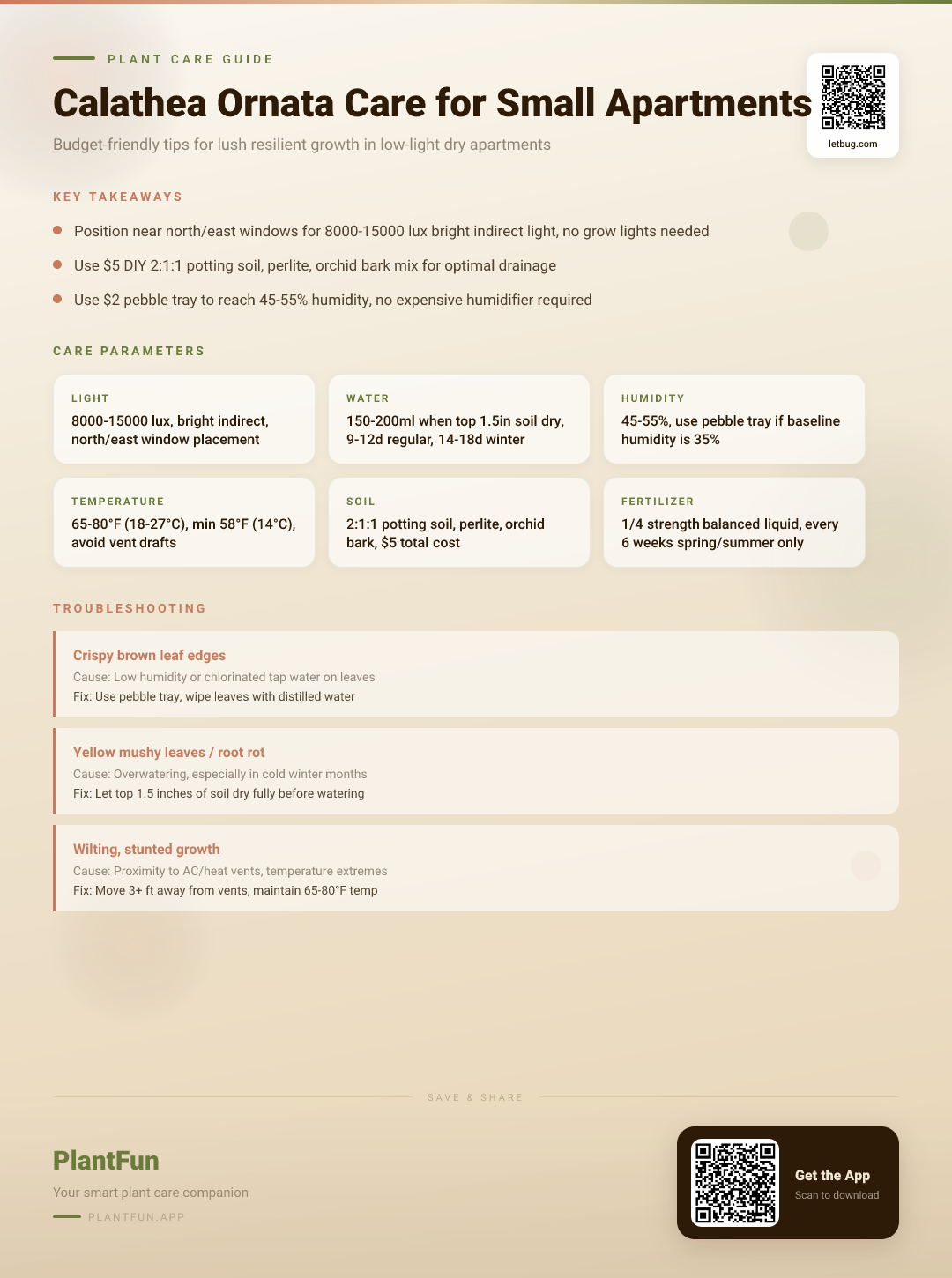
Key Takeaways
- Check soil moisture before watering — overwatering is the #1 killer of houseplants.
- Ensure your plant gets the right amount of light for its species.
- Be patient with recovery — most plants need 2–4 weeks to bounce back.
Quick Care Card
| Parameter | Exact Threshold for Apartment Calathea Ornata |
|---|---|
| Light | 8,000-15,000 lux bright indirect (north/east window placement, no grow lights needed) |
| Water | 150-200ml per 6-inch pot when top 1.5 inches of soil is dry; 9-12 days summer, 14-18 days winter |
| Humidity | 45-55% local humidity (achievable with $2 pebble tray) |
| Temperature | 65-80°F (18-27°C), never below 58°F (14°C) |
| Soil | 2 parts regular potting soil + 1 part perlite + 1 part orchid bark |
| Fertilizer | 1/4 strength balanced liquid fertilizer every 6 weeks spring/summer; no feeding fall/winter |
| Toxicity | Non-toxic to cats, dogs, and humans (ASPCA, 2026) |
| Weekly time commitment: 10 minutes for soil check, leaf wipe, and pebble tray top-off. |
Why This Guide Is Built For Small Apartment Renters
Calathea ornata are native to tropical South American understories, where they get dappled sunlight and consistent 60%+ humidity. Standard small apartments, by contrast, rarely exceed 45% baseline humidity, only have north or east-facing window light, and come with renter restrictions that ban drilling, permanent modifications, or even loud electronics like whole-room humidifiers. A 2007 University of Florida study on Marantaceae acclimation found that these plants can thrive in as little as 40% humidity if adjusted gradually, debunking the common myth that you need ultra-high 60%+ humidity for healthy growth. This guide uses that research to deliver renter friendly Calathea care that costs less than $20 total, no expensive equipment required. If you’re new to tropical plant care, check out our beginner’s guide to low-fuss tropical houseplants for more foundational tips.
Step 1: No-Drill Light Placement Hack
Calathea ornata low light care requires an exact 8,000-15,000 lux of bright indirect light (NC State Extension, 2026), which is easily achievable with no grow lights or drilling. For north-facing windows: place your plant on an existing bookcase or floating shelf 1-2 feet away from the glass, where it will get consistent soft light all day. For east-facing windows: place 2-3 feet away from the glass, so it only gets gentle morning sun and is protected from harsher midday rays that can burn leaves. Quick test: Hold your hand at the plant’s intended spot at midday. If you see a faint, blurry shadow, the light level is perfect. If the shadow is sharp and dark, move the plant further back; if there’s no shadow at all, move it closer to the window.
Step 2: Exact Watering Schedule To Avoid Root Rot
Wondering how often to water Calathea ornata in a temperature-stable apartment? Give a 6-inch potted plant 150-200ml of room-temperature filtered water only when the top 1.5 inches of soil feels completely dry, which works out to every 9-12 days in spring and summer (NC State Extension, 2026). Quick test: Stick your index finger 1.5 inches into the soil. If it comes out completely dry with no clinging soil particles, it’s time to water. If it’s even slightly damp, wait 2-3 days and test again. Overwatering is the top cause of why is my Calathea ornata curling, yellowing leaves, and root rot, so sticking to this exact schedule eliminates guesswork. For more tips on avoiding common watering errors, read our guide to houseplant watering mistakes.
Step 3: $2 Humidity Hack That Beats Expensive Humidifiers
Learning how to boost humidity for Calathea cheap is the key to stopping Calathea ornata brown edges in dry apartments, and you don’t need a $50+ humidifier to do it. This $2 pebble tray method raises local humidity around the plant by 10-15%, bringing it to the 45-55% sweet spot even if your apartment’s baseline humidity is only 35%:
- Grab a $2 bag of plain pebbles from your local dollar store and a plastic tray that’s 1-2 inches wider than your plant’s pot.
- Fill the tray 1 inch deep with pebbles, then add tap water until it reaches halfway up the pebbles.
- Set your plant’s pot on top of the pebbles, making sure the drainage hole at the bottom of the pot is not sitting directly in standing water. Top off the water in the tray once a week during your 10-minute care check. This renter-approved hack uses no electricity, makes no noise, and won’t damage your furniture. This method is perfect for Calathea ornata low humidity care, per the 2007 Marantaceae acclimation study.
Step 4: Budget Soil Mix (Total Cost $5)
You don’t need to buy expensive specialty Calathea soil for proper drainage. This Calathea ornata soil mix costs roughly $5 total if you buy ingredients in small discount bags from your local garden center: 2 parts regular all-purpose potting soil, 1 part perlite, 1 part orchid bark (NC State Extension, 2026). This mix drains excess water quickly to avoid root rot, while still holding enough moisture to feed the plant’s shallow, sensitive roots. For more low-cost soil recipes, check out our guide to budget soil hacks for renters.
Step 5: Low-Cost Feeding Schedule For Steady Growth
These budget Calathea care tips include a low-dose feeding schedule that avoids overfertilization, which causes brown leaf tips:
- In spring and summer: Feed once every 6 weeks with 1/4 strength balanced 10-10-10 NPK liquid fertilizer. A $3 bottle of generic liquid fertilizer will last 2+ years for a single Calathea ornata.
- In fall and winter: Skip fertilizing entirely, as the plant goes dormant and doesn’t need extra nutrients.
Seasonal Care Calendar For Apartments
Adjust your care routine for seasonal changes to keep your plant healthy year-round:
Summer (Calathea ornata summer watering)
- Stick to the 9-12 day watering schedule, checking soil moisture weekly.
- Keep plants 3+ feet away from AC vents to avoid dry draft exposure.
Winter (Calathea ornata winter care)
- Reduce watering to every 14-18 days, as cooler temperatures slow soil evaporation.
- Keep plants 3+ feet away from heater vents, which blast dry air that damages leaves in 24-48 hours.
- Maintain a consistent 65-80°F (18-27°C) temperature, never letting it drop below 58°F (14°C) (NC State Extension, 2026). If your apartment gets cold at night, wrap the pot in a spare wool sock for free root insulation. For more cold-weather tips, see our winter houseplant survival guide for renters.
3 Common Small Apartment Calathea Mistakes To Avoid
- Mistake: Placing your Calathea near AC or heater vents. What happens: Fast-moving dry air strips moisture from leaves quickly, leading to curling leaves and brown edges. Instead: Keep plants at least 3 feet away from all HVAC vents, and use a cheap foam draft stopper near leaky windows if needed.
- Mistake: Overwatering during cold winter months. What happens: Soil stays saturated for weeks, leading to root rot, yellowing leaves, and eventual plant death. Instead: Cut watering frequency in half in winter, and only water when the top 2 inches of soil is completely dry.
- Mistake: Wiping leaves or watering with unprocessed chlorinated tap water. What happens: Chlorine and fluoride build up on leaf edges over time, causing crispy brown tips even if your humidity levels are correct. Instead: Use filtered or rain water, or let tap water sit out in an open container for 24 hours before use to let chlorine evaporate.
FAQ
Why is my Calathea ornata getting brown edges in my apartment?
The three most common causes are baseline humidity below 40%, placement near an HVAC vent, or buildup of chlorine/fluoride from tap water (NC State Extension, 2026). First test your apartment’s humidity with a $1 dollar store hygrometer, then move your plant away from any vents, and switch to filtered water for watering and leaf cleaning.
Can I keep a Calathea ornata in my north-facing bedroom?
Yes! Can Calathea grow in north facing rooms easily, as long as you place it 1-2 feet away from the window to get 8,000-15,000 lux of bright indirect light, which is enough for steady, healthy growth (NC State Extension, 2026). North-facing rooms have no harsh direct sun, which is actually ideal for preventing leaf burn on Calathea ornata.
How often do I need to repot my apartment Calathea ornata?
Only repot every 2-3 years, when you see roots growing out of the pot’s drainage holes. Calatheas prefer to be slightly root bound, so repotting too often can stress the plant and slow growth. When you do repot, only go up one pot size (max 2 inches wider than the current pot) and use the budget soil mix outlined earlier.
Free Printable Budget Care Checklist
We’ve created a 1-page, no-sign-up required printable checklist that you can tape to your fridge or plant shelf for quick weekly reference. It includes all measurable care thresholds, 10-minute weekly check steps, and seasonal adjustment notes to make Calathea ornata care for beginners totally stress-free. Download the free checklist here.
References
- ASPCA. (2026). Toxic and Non-Toxic Plants List — ASPCA. https://www.aspca.org/pet-care/animal-poison-control/toxic-and-non-toxic-plants. Accessed 2026-03-09.
- NC State Extension. (2026). Calathea Ornata Care Checklist — NC State Extension Gardener Plant Toolbox. https://plants.ces.ncsu.edu/plants/calathea-ornata/. Accessed 2026-03-09.
- Podwyszyńska, M. (1997). Micropropagation of Calathea ornata Koern. Biologia plantarum. https://doi.org/10.1023/a:1000376400006. Accessed 2026-03-09.
- Kennedy, H. (1995). CALATHEA ORNATA AND RELATIVES, AN ORNATE CONFUSION. Acta Horticulturae. https://doi.org/10.17660/actahortic.1995.413.26. Accessed 2026-03-09.
Optional Helper: Plantfun.App
Plantfun.App identifies your plants by photo, diagnoses pests and diseases with clear fixes, and creates personalised watering and light schedules that adapt to your home conditions — a handy companion for putting this guide into daily practice.
Found an error or have suggestions? We'd love your feedback.
Need help identifying this problem?
Get instant identification, personalized care schedules, and effective pest treatment plans directly on your phone.
Sponsored • We may earn a commission from app downloads
Related Guides
The Complete Calathea Ornata Care Checklist for Thriving Growth in Small Urban Apartments
Stop dealing with crispy Calathea leaves. Get our 12-step printable care checklist, exact light, water, and humidity thresholds to keep your Calathea ornata thriving in small urban apartments.
Care GuideThe Complete Calathea Ornata Care Guide for Small Urban Apartments: No Crispy Leaves Guaranteed
Stop dealing with crispy, curled Calathea ornata leaves in your small urban apartment. Get exact light levels, water amounts, and 7 space-saving hacks for lush, resilient growth all year.
Care GuideThe Complete Calathea Ornata Care Guide for Small North-Facing Apartments: Grow Lush Leaves Without Extra Space
Stop struggling with crispy Calathea ornata leaves in your small apartment. Get exact light levels, watering amounts, and space-saving hacks to grow lush, striped foliage year-round.
Pest ControlAnts on Plants: What They Mean and What to Do
Ants usually aren't eating your plant. They are farming other pests.