
Key Takeaways
- Check soil moisture before watering — overwatering is the #1 killer of houseplants.
- Ensure your plant gets the right amount of light for its species.
- Be patient with recovery — most plants need 2–4 weeks to bounce back.
If you’ve ever watched your Calathea orbifolia develop crispy brown edges or droop overnight despite following generic care advice, you’re not alone. This guide is tailored exclusively to standard urban apartment conditions, with measurable parameters and early diagnosis tips to keep your plant healthy long-term, no guesswork required. It is pet-safe, per ASPCA (2026), making it a great pick for households with cats, dogs, or small children.
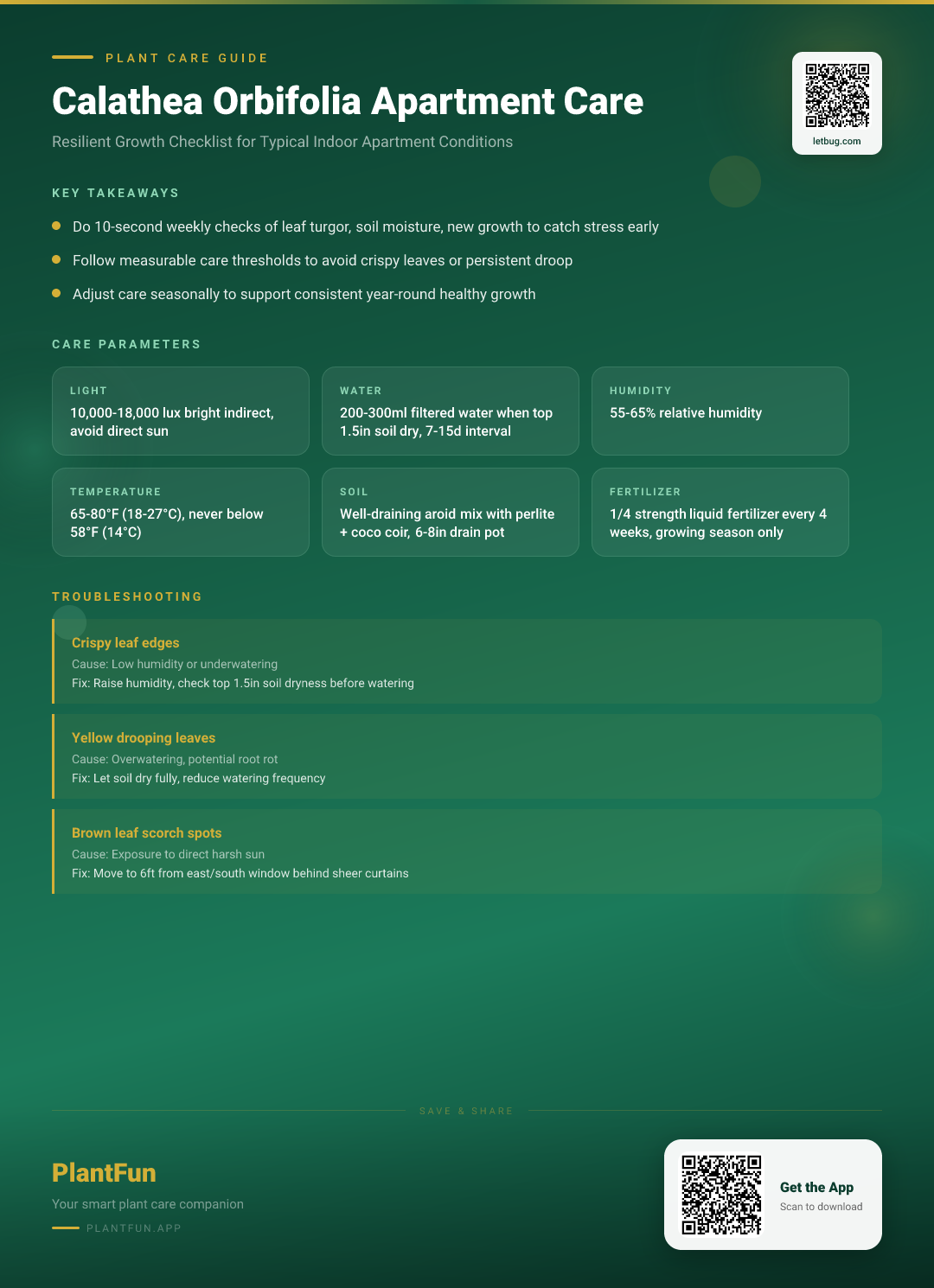
Quick Care Card: At-a-glance printable table with all measurable care thresholds for Calathea orbifolia in typical apartments for easy weekly reference
| Care Parameter | Exact Apartment Threshold |
|---|---|
| Light | 10,000-18,000 lux bright indirect light |
| Water | 200-300ml filtered room-temperature water when top 1.5 inches of soil is dry; 7-9 days summer, 12-15 days winter |
| Humidity | 55-65% relative humidity (RH) |
| Temperature | 65-80°F (18-27°C); never below 58°F/14°C |
| Soil | Well-draining aroid mix (60% coco coir, 25% perlite, 15% orchid bark) |
| Fertilizer | 1/4 strength liquid houseplant fertilizer every 4 weeks, only in spring/summer growing season |
| Toxicity | Non-toxic to cats, dogs, and humans (ASPCA, 2026) |
Why Calathea Orbifolia Struggles in Most Apartments
Native to the dappled, humid understory of Bolivian tropical rainforests, Calathea orbifolia evolved to thrive in consistent warm temperatures, filtered light, and steady moisture. Standard urban apartments are the opposite of this habitat: forced heating and cooling drops indoor humidity to 30-40% RH in most months, light levels swing dramatically from bright midday sun to dark winter afternoons, and drafty vents create sudden temperature shifts. A 2008 study found Calathea orbifolia has thin, high-surface-area leaves adapted to retain moisture in stable humid conditions, so they lose water rapidly in dry apartment air (Yang & Yeh, 2008). If you’re new to growing tropical plants in apartments, our guide to adjusting indoor conditions for tropical species has more tips for setting up your space.
Diagnosis First: 3 Easy 10-Second Weekly Checks to Catch Issues Early
Calathea orbifolia damage (like crispy brown edges) is permanent, so catching stress signs early is the best way to keep your plant looking full and healthy. Add these 3 checks to your weekly plant routine for a complete Calathea orbifolia care checklist:
- Leaf turgor check: Gently squeeze the edge of a fully unfurled mature leaf. It should feel firm and springy. Limp, papery leaves are the first sign of underwatering or low humidity, 3-5 days before brown edges appear.
- Soil moisture check: Stick your index finger 1.5 inches into the soil near the edge of the pot (not next to the central stem). If it’s completely dry, it’s time to water. If damp, hold off.
- New growth check: Look at the tightly rolled new leaves at the center of the plant. They should be bright pale green with no brown edges or stunting. Stunted new growth is the first sign of root stress or nutrient deficiency, before older leaves show damage.
Exact Light Requirements for Apartment Placement
Calathea orbifolia light needs fall in the 10,000-18,000 lux bright indirect range (NC State Extension, 2026). If you don’t have a light meter, use this quick test: hold your hand up at plant height at midday. A soft, fuzzy shadow means you’re in the ideal light range.
- Ideal spots: 6 feet away from an east or south-facing window, behind a sheer curtain to filter direct midday sun.
- Spots to avoid: Within 3 feet of unobstructed west or south-facing windows (direct sun will scorch leaves in 2 hours), and dark hallways or corners with less than 5,000 lux (leaves will fade and growth will stop completely). If you need help measuring light levels in your space, check out our beginner’s guide to houseplant light testing.
Measured Watering Schedule to Avoid Root Rot or Crispy Leaves
Wondering how often to water Calathea orbifolia? Forget fixed generic schedules: adjust based on soil moisture and season. Follow these exact rules:
- Water with 200-300ml of filtered, room-temperature water only when the top 1.5 inches of soil is completely dry.
- Typical frequency: 7-9 days for Calathea orbifolia summer watering, 12-15 days for Calathea orbifolia winter care (NC State Extension, 2026).
- Myth vs Reality: Myth: You should water Calathea once a week no matter what. Reality: Soil dryness changes with temperature, humidity, and light, so always test the soil first to avoid overwatering (the #1 cause of Calathea death).
- Pro tip: Pour water slowly around the edge of the pot, not directly on the central crown, to avoid crown rot. Empty the saucer 10 minutes after watering so roots don’t sit in standing water.
Humidity & Temperature Thresholds for Consistent Growth
Calathea orbifolia humidity requirements are 55-65% RH (Yang & Yeh, 2008). For temperature, keep it in the 65-80°F (18-27°C) range, and never expose it to temperatures below 58°F/14°C, which will cause sudden leaf drop. Easy DIY humidity hacks for dry apartments:
- Group it with other tropical plants to create a moisture-trapping microclimate
- Place a pebble tray with water under the pot (make sure the pot is sitting on pebbles, not directly in the water)
- Use a small desktop humidifier near the plant to maintain consistent humidity levels Avoid placing it near heating, AC vents, or drafty window sills, as these blast dry air that can cause crispy edges in 24 hours.
Soil & Potting Requirements for Apartment-Grown Calathea Orbifolia
The best soil for Calathea orbifolia is a well-draining aroid mix: 60% coco coir, 25% perlite, 15% orchid bark (NC State Extension, 2026). This mix retains just enough moisture without getting soggy, which prevents root rot. Pot rules:
- Use a 6-8 inch pot with 2+ drainage holes, preferably terracotta to wick away excess moisture
- Repot only every 2-3 years, when you see roots growing out of the drainage holes. Calathea hate root disturbance, so repotting too often is a common cause of drooping, which answers the common question of “why is my Calathea orbifolia drooping?” for many new owners. When repotting, only move up to a pot 1-2 inches larger than the current one.
Seasonal Care Calendar for Year-Round Resilience
Adjust your care routine with the seasons to keep your Calathea thriving year-round:
- Spring (March-May): Start fertilizing with 1/4 strength liquid houseplant fertilizer every 4 weeks, check soil moisture more often as temperatures rise, wipe leaves with a damp cloth to remove dust that blocks light absorption.
- Summer (June-August): Follow the 7-9 day watering schedule, move the plant 1 foot further from south windows if midday sun becomes too intense, monitor humidity closely during heatwaves.
- Fall (September-November): Stop fertilizing completely, gradually extend time between waterings as light levels drop, move away from drafty windows as temperatures cool.
- Winter (December-February): Follow the 12-15 day watering schedule, avoid placing near heating vents, use a full-spectrum grow light if light levels drop below 10,000 lux.
5 Most Common Apartment Care Mistakes to Avoid
- Mistake: Overwatering without testing soil first What happens: Soggy soil leads to root rot, which causes yellowing leaves and droop, and can kill the plant in 2 weeks Instead: Test soil moisture with your finger every week, only water when the top 1.5 inches is completely dry
- Mistake: Exposing to direct midday sun What happens: Scorched leaves with large brown patches that never heal Instead: Place behind sheer curtains or 6+ feet away from unobstructed south/west windows
- Mistake: Placing near AC/heating vents or drafty windows What happens: Sudden temperature swings and dry air cause crispy leaf edges almost overnight Instead: Keep the plant at least 3 feet away from all vents and drafty window sills
- Mistake: Using high-fluoride or chlorinated tap water What happens: Mineral buildup in the soil burns leaf edges, leading to persistent Calathea orbifolia crispy leaves even with correct watering Instead: Use filtered, rain, or distilled water for all watering
- Mistake: Repotting every year or using too large a pot What happens: Excess soil holds too much moisture, causing root rot, and root disturbance leads to drooping and stunted growth Instead: Repot only every 2-3 years, into a pot only 1-2 inches larger than the current one
FAQ: Can I keep my Calathea orbifolia in a north-facing apartment?
Yes, you absolutely can, but you’ll need to supplement light to meet minimum Calathea orbifolia light needs. North-facing windows only provide 2,000-8,000 lux of light, so use a full-spectrum grow light placed 12 inches above the plant for 12 hours a day during the growing season to hit the 10,000 lux minimum (NC State Extension, 2026). Avoid placing it more than 3 feet away from the north window, as light levels drop off drastically further back. If you need help picking a grow light, our guide to affordable grow lights for apartment plants has tested recommendations for low-light spaces.
FAQ: Why is my Calathea orbifolia getting crispy edges even when I water it?
This is one of the most common Calathea orbifolia apartment care issues, and there are 3 likely causes: First, your indoor humidity is below 50% RH, which causes the thin leaf edges to lose moisture faster than the roots can replace it. Second, you’re using tap water with high fluoride or chlorine, which burns the leaf tips. Third, it’s exposed to cold or hot drafts from vents. For a fast Calathea orbifolia brown edges fix, first test your humidity with a cheap hygrometer, switch to filtered water, and move it away from any vents.
FAQ: How often should I mist my Calathea orbifolia in my dry apartment?
Misting only provides temporary humidity (it lasts less than 30 minutes), so it’s not a replacement for consistent 55-65% RH. If you do mist, do it once a day in the morning, using filtered water, and only mist the top of the leaves, not the undersides (wet undersides can lead to fungal anthracnose growth, per Khuna et al, 2025). For better results, use a pebble tray or small humidifier instead, which will maintain consistent humidity levels 24/7.
References
- NC State Extension. (2026). Calathea Orbifolia — NC State Extension Gardener Plant Toolbox. https://plants.ces.ncsu.edu/plants/calathea-orbifolia/. Accessed 2026-03-05.
- Yang, S.; Yeh, D. (2008). In vitro leaf anatomy, ex vitro photosynthetic behaviors and growth of Calathea orbifolia (Linden) Kennedy plants obtained from semi-solid medium and temporary immersion systems. Plant Cell, Tissue and Organ Culture. https://doi.org/10.1007/s11240-008-9363-3. Accessed 2026-03-05.
- Khuna, S.; Hongsanan, S.; Thitla, T. (2025). First Report of Leaf Anthracnose Caused by <i>Colletotrichum fructicola</i> on <i>Calathea orbifolia</i> in China. Plant Disease. https://doi.org/10.1094/pdis-03-25-0501-pdn. Accessed 2026-03-05.
- ASPCA. (2026). Toxic and Non-Toxic Plants List — ASPCA. https://www.aspca.org/pet-care/animal-poison-control/toxic-and-non-toxic-plants. Accessed 2026-03-05.
Optional Helper: Plantfun.App
Plantfun.App identifies your plants by photo, diagnoses pests and diseases with clear fixes, and creates personalised watering and light schedules that adapt to your home conditions — a handy companion for putting this guide into daily practice.
Found an error or have suggestions? We'd love your feedback.
Need help identifying this problem?
Get instant identification, personalized care schedules, and effective pest treatment plans directly on your phone.
Sponsored • We may earn a commission from app downloads
Related Guides
The Complete Calathea Orbifolia Care Checklist for Resilient Growth in Typical Central AC Apartments
Skip expensive plant gadgets to grow a lush Calathea orbifolia. Get exact light levels, watering amounts, and a free printable checklist for resilient growth in your typical apartment.
Care GuideThe Complete Calathea Orbifolia Care Checklist for Resilient Growth in 1-Bed City Apartments
Grow a lush, crisp Calathea orbifolia even in dry city apartments. Get exact light levels, humidity targets, and a seasonal care checklist for year-round resilient, pest-free growth.
Care GuideThe Complete Calathea Orbifolia Care Checklist for Resilient Growth in 1-Bedroom Apartments
Stop dealing with curling, browning Calathea leaves. Get exact light lux levels, water amounts, humidity hacks, and a seasonal checklist for resilient growth in standard apartments.
Pest ControlAnts on Plants: What They Mean and What to Do
Ants usually aren't eating your plant. They are farming other pests.