
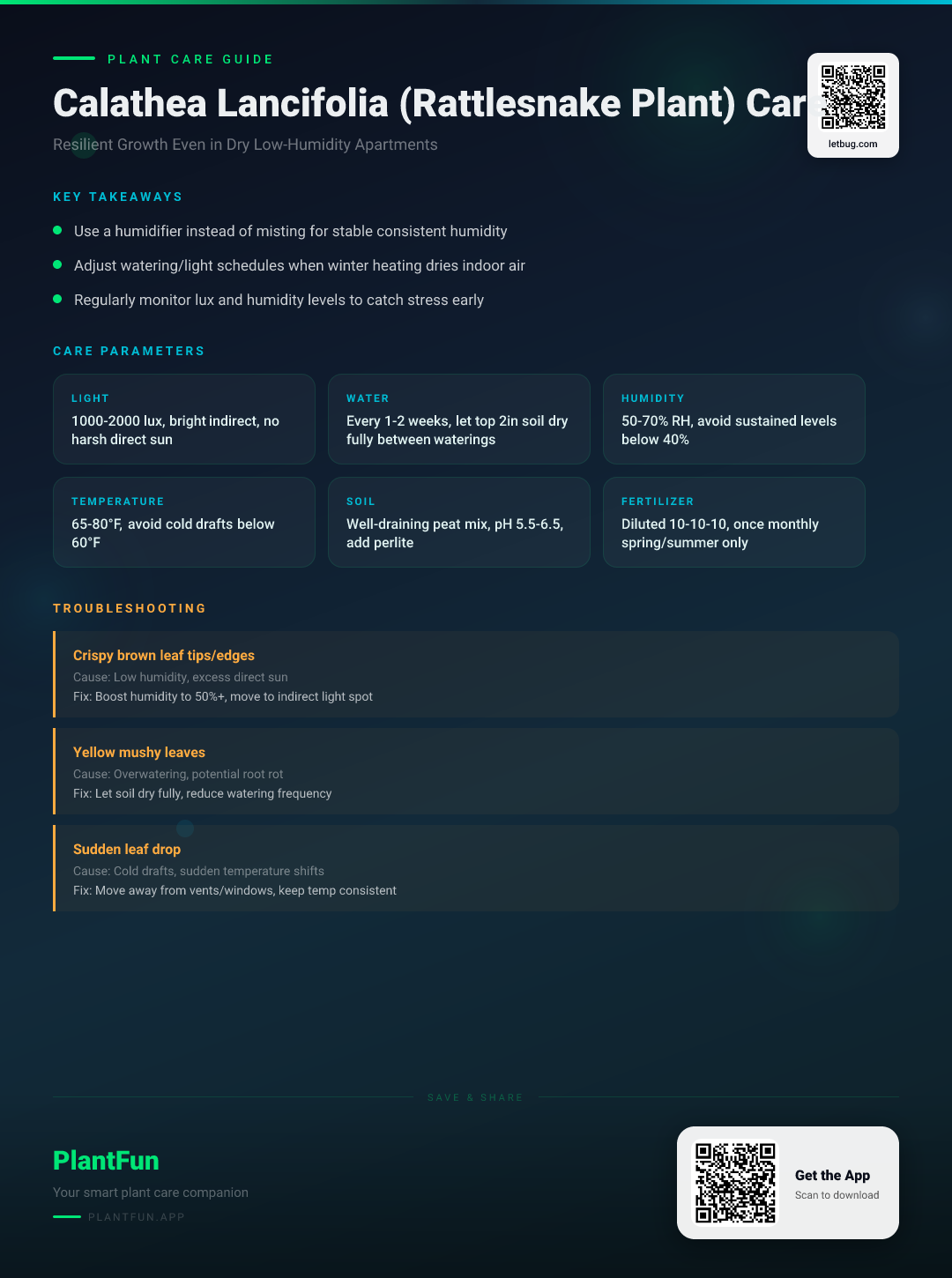
Key Takeaways
- Check soil moisture before watering — overwatering is the #1 killer of houseplants.
- Ensure your plant gets the right amount of light for its species.
- Be patient with recovery — most plants need 2–4 weeks to bounce back.
Quick Care Card: Essential Thresholds for Calathea lancifolia
| Feature | Requirement |
|---|---|
| Light | Bright, indirect light (2,000–5,000 lux) |
| Water | Keep moist, not soggy; use filtered water |
| Humidity | 50%–70% (Crucial) |
| Temperature | 65°F–80°F (18°C–27°C) |
| Soil | Well-draining, peat-based mix |
| Fertilizer | Balanced liquid feed at half-strength, monthly |
| Toxicity | Non-toxic to cats and dogs (ASPCA, 2026) |
TL;DR: The Reality of Calathea in Dry Apartments
Calathea lancifolia, the Rattlesnake plant, thrives in high-humidity environments. In dry apartments (below 40% humidity), they struggle with transpiration imbalances, leading to crispy brown edges. To save your plant, focus on stabilizing the root zone moisture and creating a localized micro-climate rather than relying on inconsistent misting. Aim for 60% humidity and water when the top 1-2 inches of soil feel dry to the touch.
Why Your Rattlesnake Calathea is Struggling: A Root Cause Analysis
When I first started my indoor gardening journey, I placed a beautiful Rattlesnake Calathea directly over a radiator. Within two weeks, the foliage turned papery and brown. I learned the hard way that these plants are adapted to the forest floor of Brazil (NC State Extension, 2026). In an urban apartment, your plant is fighting against HVAC systems that strip moisture from the air, forcing the plant to transpire faster than it can draw water from the soil.
Measuring Your Environment: Lux and Humidity Benchmarks
To succeed, you must move from guessing to measuring.
- Lux: Use a light meter app or device to ensure your plant receives 2,000–5,000 lux. Anything lower leads to leggy growth; anything higher causes leaf burn.
- Humidity: Use a digital hygrometer. If your reading is consistently below 50%, your Calathea lancifolia is under chronic stress (Gilman, 2007).
The 5-Step Resilient Growth Recovery Plan
- Isolate: Move the plant away from drafts, heaters, or AC vents.
- Hydrate the Soil: Use room-temperature filtered water to prevent chemical buildup, which causes tip burn.
- Cluster: Place the plant near other foliage to create a “transpiration bubble” where plants increase local humidity levels.
- Humidify: Use a dedicated ultrasonic humidifier within 3 feet of the plant to maintain a consistent 60% RH (relative humidity).
- Monitor: Check the soil every 3 days by sticking your finger 2 inches into the substrate. If it is dry, irrigate until water flows from the drainage holes.
Seasonal Shifts: Adjusting Water and Light for Winter Heating
In winter, the heating creates an arid desert-like micro-climate. I reduce my watering frequency because the lower light levels slow down plant metabolism (Podwyszyńska, 1997). During winter, I also ensure my plant is not resting against cold glass, as low temperatures coupled with dry air can lead to root cold-shock.
Myth-Busting: Why Misting is Not the Answer for Humidity
Many people think misting leaves increases humidity. The reality? Misting only provides a temporary surface wetness that evaporates in minutes. Worse, lingering water on leaves can invite fungal spores. Focus on ambient humidity or a pebble tray (for minor gains) instead of the spray bottle.
Troubleshooting Guide: Identifying Leaf Drop vs. Crisp Edges
Chronic Tip Burn
Symptom: Dry, brown, crispy edges spreading inward.
Likely cause: Low humidity or salt buildup in the soil from hard water.
Fix:
- Flush the soil with distilled water to remove mineral salts.
- Increase ambient humidity to 60%.
Sudden Yellowing
Symptom: Entire leaves turning yellow rapidly.
Likely cause: Overwatering leading to root hypoxia.
Fix:
- Remove the plant from the pot and inspect roots for mushiness.
- Repot into a chunkier, well-draining soil mix.
Drooping Leaves
Symptom: The plant looks wilted despite the soil being damp.
Likely cause: Temperature shock or low ambient humidity.
Fix:
- Move the plant to a more stable environment.
- Use a humidifier to prevent rapid moisture loss.
Voice Search FAQ: Why is my Calathea lancifolia turning brown at the tips?
This is typically a response to low ambient humidity or water toxicity. According to NC State Extension (2026), these plants require consistent moisture. If your water contains heavy minerals, switch to filtered or rainwater to stop the browning.
Voice Search FAQ: How do I know if my apartment is too dry for my plant?
If your hygrometer consistently shows humidity levels below 45%, your apartment is too dry. You will notice the edges of the leaves beginning to curl or crisp within 14 days of exposure (Gilman, 2007).
Voice Search FAQ: Can I use a pebble tray to boost humidity effectively?
Yes, but with caveats. A pebble tray provides marginal localized humidity. Place pebbles in a shallow tray, add water, and sit the pot on top, ensuring the bottom of the pot does not touch the water. It is a helpful tool for beginner indoor plant care, but a humidifier is better for long-term health.
Long-Term Prevention: Beyond the Basics
Long-term success involves mimicking a tropical understory. Because this plant is non-toxic to pets, you can safely place it on low plant stands. Keep the leaves clean with a damp cloth to maximize photosynthesis and ensure you are using well-draining soil to prevent the root suffocation that often plagues this genus.
References
- Podwyszyńska, M. (1997). Micropropagation of Calathea ornata Koern. Biologia plantarum. https://doi.org/10.1023/a:1000376400006. Accessed 2026-03-11.
- Gilman, E. (2007). Calathea makoyana Peacock Plant. EDIS. https://doi.org/10.32473/edis-fp086-1999. Accessed 2026-03-11.
- ASPCA. (2026). Toxic and Non-Toxic Plants List — ASPCA. https://www.aspca.org/pet-care/animal-poison-control/toxic-and-non-toxic-plants. Accessed 2026-03-11.
- NC State Extension. (2026). Calathea lancifolia — NC State Extension Gardener Plant Toolbox. https://plants.ces.ncsu.edu/plants/calathea-lancifolia/. Accessed 2026-03-11.
Optional Helper: Plantfun.App
Plantfun.App identifies your plants by photo, diagnoses pests and diseases with clear fixes, and creates personalised watering and light schedules that adapt to your home conditions — a handy companion for putting this guide into daily practice.
Found an error or have suggestions? We'd love your feedback.
Need help identifying this problem?
Get instant identification, personalized care schedules, and effective pest treatment plans directly on your phone.
Sponsored • We may earn a commission from app downloads
Related Guides
Calathea Lancifolia in a Low-Humidity Apartment: The Ultimate Care Guide for Resilient Growth
Stop the browning leaves on your Calathea lancifolia. Learn precise humidity hacks, watering schedules, and light adjustments to keep your plant lush and vibrant.
Care GuideCalathea Lancifolia in a Low-Humidity Apartment: The Only Care Guide You’ll Ever Need
Revive your Calathea Lancifolia with expert care tips for dry apartments. Master the exact humidity, light, and water ratios to prevent brown edges for good.
Care GuideCalathea lancifolia in an Average Apartment: The Resilient Care Guide for Lush Foliage
Transform your Calathea lancifolia into a resilient, vibrant centerpiece. Master exact humidity, watering, and light thresholds for thriving apartment growth.
Pest ControlAnts on Plants: What They Mean and What to Do
Ants usually aren't eating your plant. They are farming other pests.