
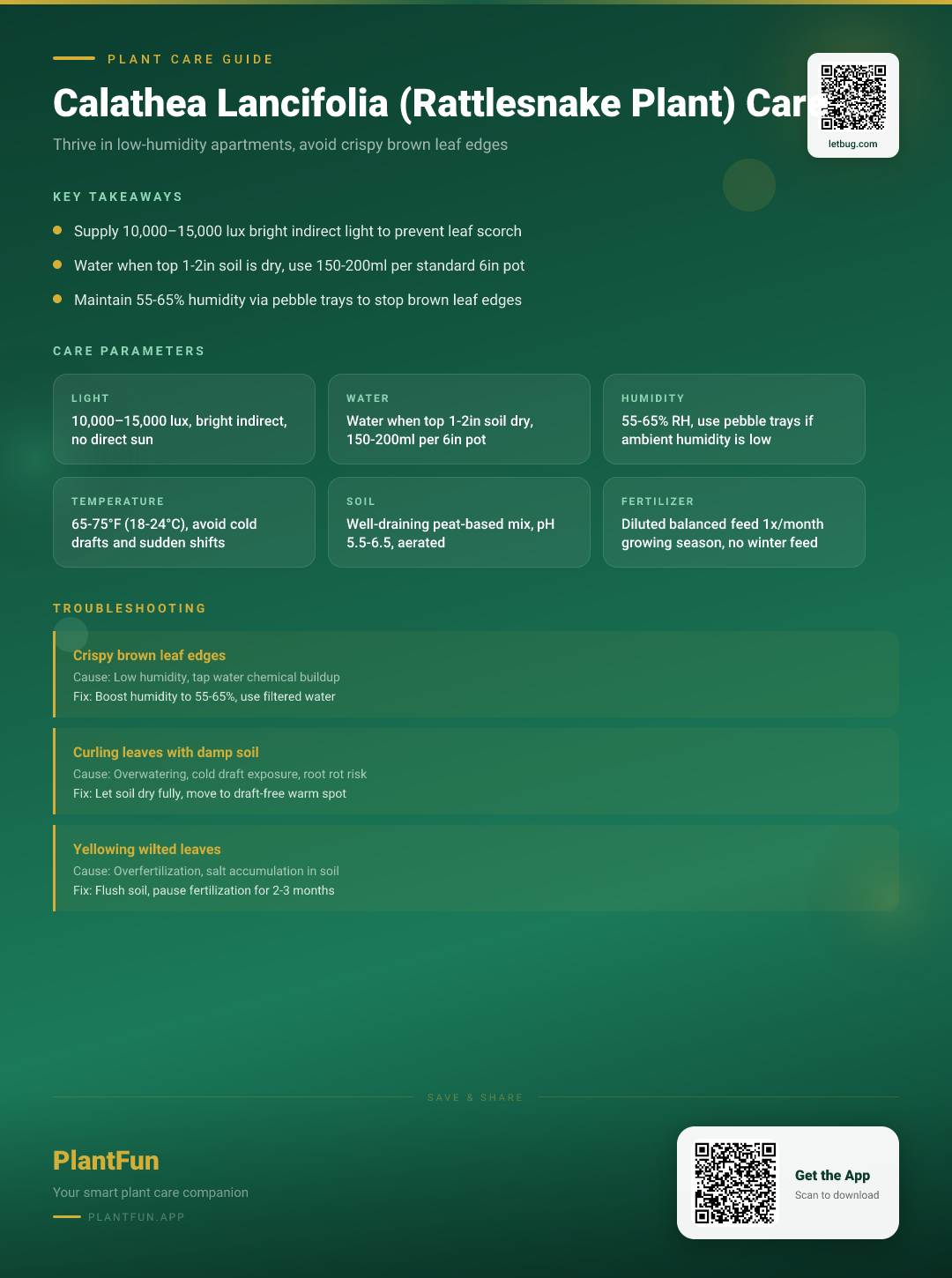
Key Takeaways
- Check soil moisture before watering — overwatering is the #1 killer of houseplants.
- Ensure your plant gets the right amount of light for its species.
- Be patient with recovery — most plants need 2–4 weeks to bounce back.
TL;DR: Quick Fixes for Your Rattlesnake Plant
If your Calathea lancifolia has crispy brown edges, you are likely battling low humidity combined with inconsistent soil moisture. To rescue your plant: immediately group it with other plants to create a microclimate, switch to filtered or distilled water to avoid mineral buildup, and aim for a consistent 55-65% relative humidity. Ensure your light levels are bright but indirect—direct sun will scorch the foliage, while too little light leads to weak, drooping stems. Consistency is the secret to success in apartment environments.
Quick Care Card: Essential Data for Calathea Lancifolia
| Feature | Requirement |
|---|---|
| Light | 10,000–15,000 lux (Bright, indirect) |
| Water | Keep evenly moist; let top 1-2” dry |
| Humidity | 55-65% relative humidity |
| Temperature | 65-75°F (18-24°C) |
| Soil | Well-draining, peat-based mix |
| Fertilizer | Balanced liquid, diluted 1/2 strength |
| Toxicity | Non-toxic to cats and dogs (ASPCA, 2026) |
My Experience
When I first brought home my Calathea lancifolia, I made the mistake of placing it directly on a windowsill in my dry, centrally-heated apartment. Within two weeks, those iconic, wavy-edged leaves began to turn brown and brittle. I learned the hard way that Calathea lancifolia care isn’t just about sticking to a watering schedule; it is about managing the atmospheric microclimate of your living space. By adjusting my setup to prioritize humidity and water quality, I transformed my struggling plant into a thriving centerpiece.
Why Your Apartment Is Stressing Out Your Rattlesnake Plant
Most modern apartments suffer from forced-air heating, which plummets indoor humidity levels to below 30% during winter months. As a tropical forest floor inhabitant, the Rattlesnake plant relies on higher ambient moisture to facilitate proper transpiration. When humidity is low, the plant loses water through its leaves faster than its roots can supply it, resulting in the classic “crispy edge” symptom (NC State Extension, 2026).
Measuring the Damage: Distinguishing Thirst from Root Rot
Before you adjust your care, inspect the soil and roots. If the plant is dry throughout the pot and the leaves are curling inward, it is thirsty. If the soil is waterlogged and the edges are turning brown/black with a mushy texture, you are dealing with root rot. Always verify moisture by sticking your finger 2 inches into the soil; if it feels damp, do not water, regardless of what the calendar says.
Step 1: Calibrating Light (10,000–15,000 lux requirement)
These plants need consistent, soft light. If you are in a north-facing apartment, a spot near a window is usually sufficient. In brighter rooms, use a sheer curtain to diffuse the light.
- Use a light meter or a smartphone app to verify light levels.
- Target a range of 10,000–15,000 lux.
- If levels exceed 20,000 lux, move the plant 2 feet further from the window to prevent photo-oxidation of the leaves.
Step 2: Hydration Science (Watering when top 1-2 inches are dry, approx. 150-200ml depending on pot size)
Consistent moisture is vital. For an average 6-inch pot, use approximately 150-200ml of water, but always ensure the container has drainage holes to avoid stagnant water around the roots (Gilman, 2007). Avoid tap water high in chlorine or salts, as these accumulate in leaf tips and cause necrosis.
Step 3: Humidity Management (Targeting 55-65% relative humidity through tray methods)
Increasing humidity for houseplants in a small apartment is best achieved by placing the pot on a tray filled with pebbles and water. Ensure the bottom of the nursery pot sits above the water line to prevent root rot. This creates a local zone of higher evaporation around the plant foliage.
Step 4: Temperature Control (Maintaining 65-75°F / 18-24°C; avoiding drafts)
Keep your plant away from heating vents, AC units, or drafty doorways. Sudden temperature fluctuations can cause the plant to drop leaves in an attempt to conserve energy (Podwyszyńska, 1997).
Common Mistake: The Over-Fertilization Trap
- Mistake: Applying fertilizer during winter months.
- What happens: The plant enters a period of slower metabolic activity; excess salts build up in the soil and burn the roots.
- Instead: Only fertilize during the active growing season (spring and summer) at half the recommended dosage.
FAQ
FAQ 1: Why is my Calathea lancifolia curling its leaves even when the soil feels damp?
This is a classic “Calathea leaf curling treatment” diagnostic. If the soil is damp but the leaves are curling, the plant is likely suffering from shock due to a cold draft or low humidity. The roots may be unable to transport water fast enough to counteract the dry air.
FAQ 2: Can I keep my Rattlesnake Plant in a bedroom with a heater running all night?
It is risky. Heaters dry out the air rapidly. If you must keep it in the bedroom, use a localized humidifier to keep the immediate area around the plant at 55% humidity.
FAQ 3: How do I know if my brown edges are caused by tap water chemicals?
If the brown edges are accompanied by yellow halos or if you notice a white, crusty buildup on the surface of your soil, your tap water is likely too hard or contains high chlorine levels. Switch to filtered water for three weeks to see if the progression of brown tips stops.
Seasonal Maintenance Calendar: Adjusting for Apartment Microclimates
- Spring/Summer: Increase watering frequency as evaporation rates rise. Begin light fertilization.
- Autumn/Winter: Reduce watering. Monitor humidity levels daily as apartment heating systems activate. Shift the plant away from windows if night temperatures drop below 60°F.
References
- Podwyszyńska, M. (1997). Micropropagation of Calathea ornata Koern. Biologia plantarum. https://doi.org/10.1023/a:1000376400006. Accessed 2026-03-17.
- Gilman, E. (2007). Calathea makoyana Peacock Plant. EDIS. https://edis.ifas.ufl.edu/publication/FP086. Accessed 2026-03-17.
- ASPCA. (2026). Toxic and Non-Toxic Plants List — ASPCA. https://www.aspca.org/pet-care/animal-poison-control/toxic-and-non-toxic-plants. Accessed 2026-03-17.
- NC State Extension. (2026). Calathea lancifolia — NC State Extension Gardener Plant Toolbox. https://plants.ces.ncsu.edu/plants/calathea-lancifolia/. Accessed 2026-03-17.
Optional Helper: Plantfun.App
Plantfun.App identifies your plants by photo, diagnoses pests and diseases with clear fixes, and creates personalised watering and light schedules that adapt to your home conditions — a handy companion for putting this guide into daily practice.
Found an error or have suggestions? We'd love your feedback.
Need help identifying this problem?
Get instant identification, personalized care schedules, and effective pest treatment plans directly on your phone.
Sponsored • We may earn a commission from app downloads
Related Guides
Calathea Lancifolia in a Low-Humidity Apartment: The Ultimate Care Guide for Resilient Growth
Stop the browning leaves on your Calathea lancifolia. Learn precise humidity hacks, watering schedules, and light adjustments to keep your plant lush and vibrant.
Care GuideCalathea lancifolia in Your Dry Apartment: The 5-Step Resilient Growth Recovery Plan
Rescue your crispy Calathea lancifolia today. Learn the 5-step strategy for managing dry apartment air with precise humidity, light, and watering protocols.
Care GuideCalathea Lancifolia in a Low-Humidity Apartment: The Only Care Guide You’ll Ever Need
Revive your Calathea Lancifolia with expert care tips for dry apartments. Master the exact humidity, light, and water ratios to prevent brown edges for good.
Pest ControlAnts on Plants: What They Mean and What to Do
Ants usually aren't eating your plant. They are farming other pests.