
Key Takeaways
- Check soil moisture before watering — overwatering is the #1 killer of houseplants.
- Ensure your plant gets the right amount of light for its species.
- Be patient with recovery — most plants need 2–4 weeks to bounce back.
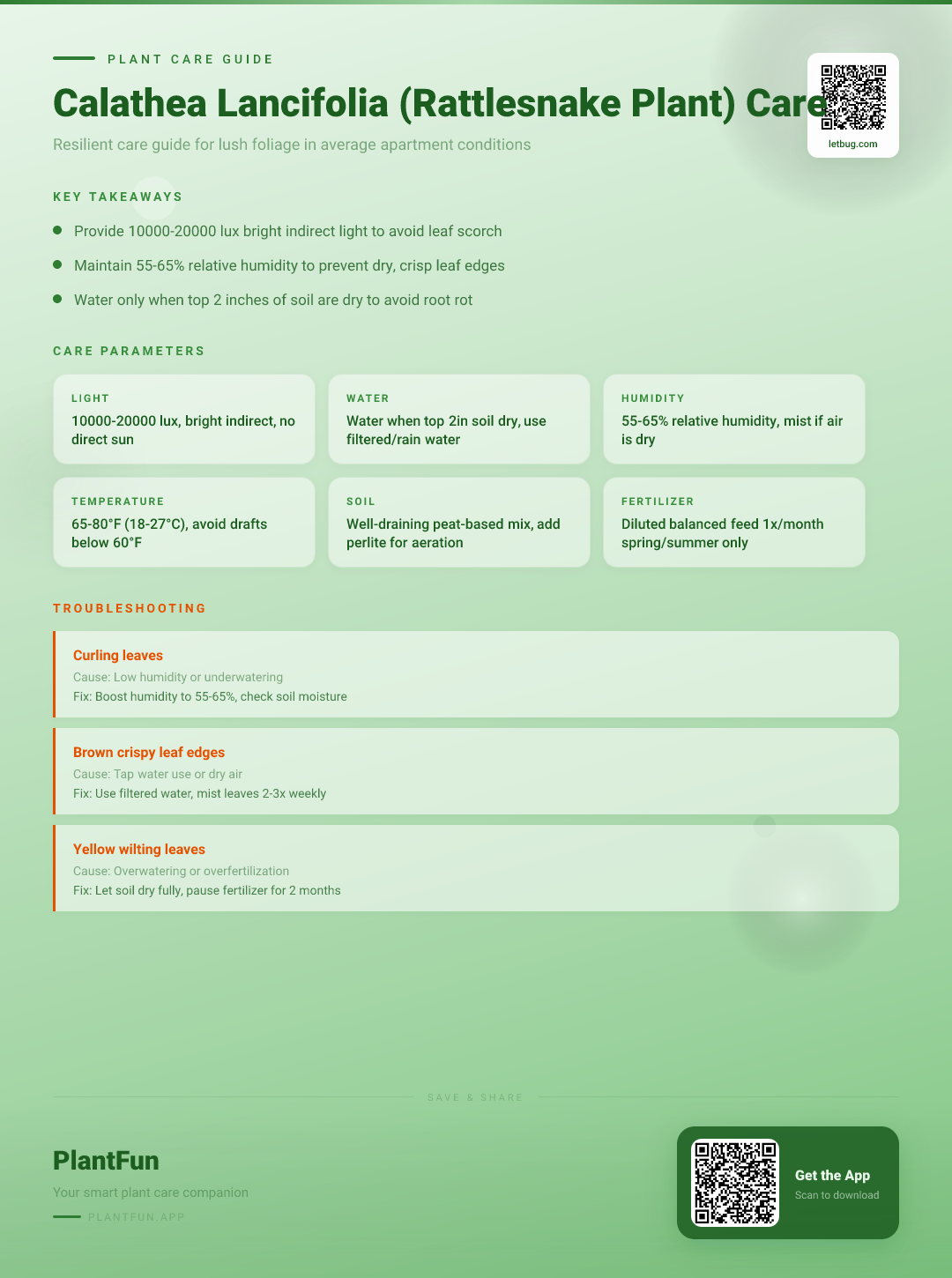
TL;DR: The Rattlesnake plant (Calathea lancifolia) thrives by mimicking its native forest floor. Keep humidity above 55%, maintain ambient light between 10,000-20,000 lux, and use distilled or rainwater to prevent mineral buildup. Avoid cold drafts and allow only the top inch of soil to dry before watering.
Quick Care Card: Essential Thresholds for Success
| Feature | Requirement |
|---|---|
| Light | Bright, indirect (10,000-20,000 lux) |
| Water | Keep evenly moist; do not let dry out completely |
| Humidity | 55-65% (critical for foliage health) |
| Temperature | 65-80°F (18-27°C) |
| Soil | Well-draining, peat-based mix |
| Fertilizer | Balanced liquid feed at half-strength (monthly) |
| Toxicity | Non-toxic to cats and dogs (ASPCA, 2026) |
Why the Rattlesnake Calathea Struggles in Typical Apartment Air
When I first brought home my Calathea lancifolia, I made the mistake of placing it on a sunny windowsill next to a radiator. Within a week, the iconic spotted leaves began to curl and develop brown, crispy margins.
The issue is that apartment environments are essentially “deserts” compared to the tropical rainforests where these plants originate. In their natural habitat, they grow in the humid, filtered light of the understory (NC State Extension, 2026). In an apartment, the combination of low humidity and inconsistent watering triggers a defensive mechanism where the plant curls its leaves to conserve moisture—a telltale sign of environmental stress.
Format A: The Complete Scenario Guide for Urban Dwellers
To keep your Calathea resilient, think of your plant as a micro-climate unit. Do not place it in an open, drafty room if you cannot control the ambient humidity. I recommend using a “cluster method”: place your Calathea among other moisture-loving plants to create a localized humidity bubble.
Decoding Your Apartment Light: Achieving 10,000-20,000 Lux Without Scorching
While often labeled as “low light” plants, Calathea actually require decent light to maintain their stunning patterned foliage.
- The Sweet Spot: Use a light meter app to aim for 10,000-20,000 lux.
- The Reality: If your room feels dim, your plant will eventually lose its variegation and stop producing new growth. However, direct afternoon sun is the enemy; it will bleach the leaves and cause permanent tissue damage (Gilman, 2007).
Precision Irrigation: How to Measure and Time Watering for Optimal Turgor
I treat my watering schedule like a precise chore. Use your finger to check the soil; once the top 1-2 inches feel dry to the touch, it is time to irrigate.
- Use distilled or filtered water to prevent leaf tip necrosis caused by salts and chlorine.
- Ensure your pot has adequate drainage holes.
- Pour water until it flows freely from the bottom, then discard any excess from the saucer to prevent root rot.
Managing the Humidity Gap: Sustaining 55-65% Relative Humidity Indoors
Humidity is the primary factor in preventing the dreaded “crispy edge” syndrome. If your apartment drops below 50% relative humidity, your Calathea will struggle.
- Quick Tip: I use a small digital hygrometer next to my plant.
- Action: If levels drop, run a humidifier nearby. Pebble trays are often ineffective for the high volume of moisture these plants require.
Temperature Control: Why 65-80°F (18-27°C) is Your Golden Range
Maintaining a stable temperature is vital. As noted in research on plant micropropagation (Podwyszyńska, 1997), stable conditions lead to more robust development. Avoid placing your plant near AC vents in summer or heating units in winter, as rapid temperature fluctuations cause shock.
Seasonal Care Calendar: Adapting to Central Heating and Summer Flux
- Winter: Central heating dries the air aggressively. Increase your humidifier output and reduce fertilizer significantly.
- Summer: Higher light intensity may require you to move the plant slightly further back from the window to avoid heat stress.
Voice Search FAQ: Why is my Calathea lancifolia leaf curling?
Symptom: Leaves roll inward toward the central vein.
Likely cause: The plant is signaling that it is losing water faster than it can take it up, usually due to low humidity or dry soil.
Fix:
- Check the soil moisture immediately; water if dry.
- Move the plant away from drafty windows or heating vents.
- Increase the ambient humidity by grouping it with other plants or using a humidifier.
Voice Search FAQ: Can I use tap water for my Calathea plant?
While some owners get away with it, I strongly advise against it if your tap water is “hard.” Tap water often contains chlorine and fluoride, which accumulate in the leaf margins, causing brown, crispy tips. Using distilled water or rainwater is the safest way to ensure long-term health.
Common Mistakes: Avoiding Over-Fertilization and Cold Drafts
- Mistake: Heavy fertilization. What happens: Salt buildup in the soil leads to chemical burn on roots. Instead: Use a balanced houseplant fertilizer diluted to 50% strength once a month during the growing season.
- Mistake: Placing on a cold floor. What happens: Cold drafts can cause the foliage to wilt instantly. Instead: Keep the plant on a stand or table to ensure air circulation and stable warmth.
References & Further Reading
- Podwyszyńska, M. (1997). Micropropagation of Calathea ornata Koern. Biologia plantarum. https://doi.org/10.1023/a:1000376400006. Accessed 2026-03-14.
- Gilman, E. (2007). Calathea makoyana Peacock Plant. EDIS. https://doi.org/10.32473/edis-fp086-1999. Accessed 2026-03-14.
- ASPCA. (2026). Toxic and Non-Toxic Plants List — ASPCA. https://www.aspca.org/pet-care/animal-poison-control/toxic-and-non-toxic-plants. Accessed 2026-03-14.
- NC State Extension. (2026). Calathea lancifolia — NC State Extension Gardener Plant Toolbox. https://plants.ces.ncsu.edu/plants/calathea-lancifolia/. Accessed 2026-03-14.
Optional Helper: Plantfun.App
Plantfun.App identifies your plants by photo, diagnoses pests and diseases with clear fixes, and creates personalised watering and light schedules that adapt to your home conditions — a handy companion for putting this guide into daily practice.
Found an error or have suggestions? We'd love your feedback.
Need help identifying this problem?
Get instant identification, personalized care schedules, and effective pest treatment plans directly on your phone.
Sponsored • We may earn a commission from app downloads
Related Guides
Calathea Lancifolia in a Low-Humidity Apartment: The Ultimate Care Guide for Resilient Growth
Stop the browning leaves on your Calathea lancifolia. Learn precise humidity hacks, watering schedules, and light adjustments to keep your plant lush and vibrant.
Care GuideCalathea lancifolia in Your Dry Apartment: The 5-Step Resilient Growth Recovery Plan
Rescue your crispy Calathea lancifolia today. Learn the 5-step strategy for managing dry apartment air with precise humidity, light, and watering protocols.
Care GuideCalathea ornata in a Typical Apartment: The Complete Care Guide for Resilient Growth
Transform your Calathea ornata from finicky to flourishing. Discover the exact lux levels, water ratios, and humidity hacks needed for a vibrant indoor garden.
Pest ControlAnts on Plants: What They Mean and What to Do
Ants usually aren't eating your plant. They are farming other pests.