
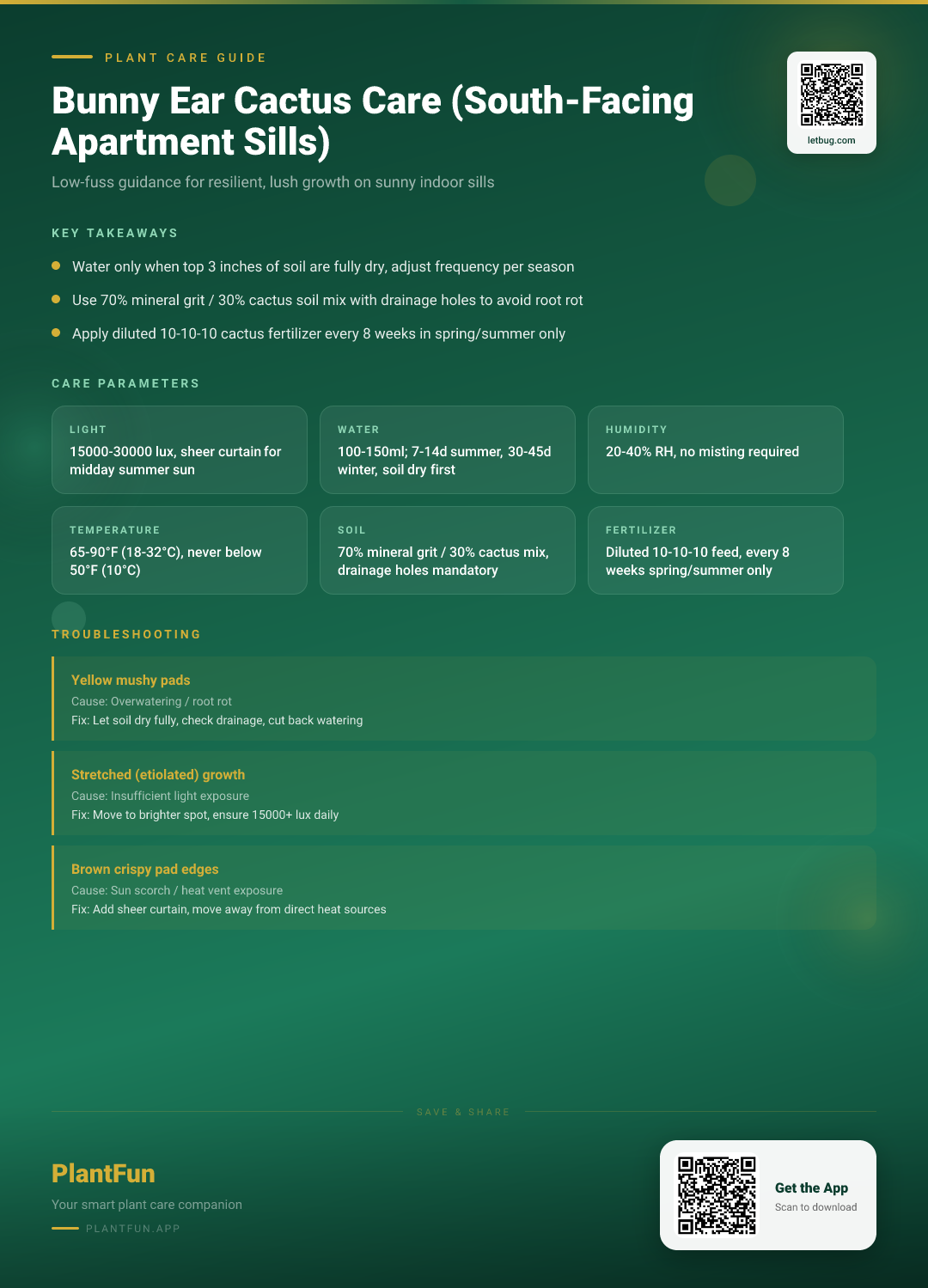
Key Takeaways
- Check soil moisture before watering — overwatering is the #1 killer of houseplants.
- Ensure your plant gets the right amount of light for its species.
- Be patient with recovery — most plants need 2–4 weeks to bounce back.
Quick Care Card
| Care Parameter | Measurable Threshold for South-Facing Apartment Sills |
|---|---|
| Light | 15,000-30,000 lux; sheer curtain for midday summer sun over 35,000 lux |
| Water | 100-150ml when top 3 inches of soil are fully dry; 7-14 day frequency summer, 30-45 day winter |
| Humidity | 20-40% RH; no misting required |
| Temperature | 65-90°F (18-32°C) ideal; never expose to temps below 50°F (10°C) |
| Soil | 70% mineral grit (perlite/pumice/coarse sand) / 30% organic cactus soil |
| Fertilizer | ½ strength 10-10-10 cactus fertilizer every 8 weeks, spring and summer only |
| Toxicity | Non-toxic to cats, dogs, and humans per ASPCA (2026); glochids cause skin/mouth irritation |
Why Your South-Facing Windowsill Is Both Perfect and Risky for Bunny Ear Cacti
Native to the sun-drenched Chihuahuan Desert, Opuntia microdasys (Bunny Ear Cactus) thrives in the bright, direct light that south-facing apartment sills provide 8+ hours a day (NC State Extension, 2026). But this spot comes with hidden stressors unique to indoor environments: unfiltered midday summer sun that can hit 100°F+ on the sill surface, dry forced-air heat from vents directly below the ledge, and cold winter drafts from poorly sealed window frames. This guide cuts through generic desert cactus advice to address these exact stressors, so even Bunny Ear Cactus care for beginners is simple and low-guesswork.
Step 1: Light Adjustment for Consistent Growth
Your target light level is 15,000-30,000 lux, measured with a free smartphone light meter app held at the height of your cactus paddles (Wagner, 2007).
- Summer (June-August): If midday light (10am-3pm) exceeds 35,000 lux, hang a sheer white curtain between the window and cactus to filter harsh rays and avoid sunburn. Acclimate new cacti to full sill light over 3 days to prevent shock.
- Winter (December-February): Remove all light filters to maximize exposure. If light drops below 10,000 lux for more than 3 days in a row, place a small grow light 6 inches above the cactus for 8 hours a day to prevent etiolation (stretchy, pale new growth).
Step 2: Exact Watering Schedule for Apartment Dry Air
Wondering how often to water Bunny Ear Cactus on a south-facing sill? Follow these measurable rules to avoid overwatering, the #1 cause of cactus death for beginners:
- Use 100-150ml of room-temperature water per watering for 4-6 inch pots.
- Only water when the top 3 inches of soil are completely dry: test by sticking a wooden skewer 3 inches deep into the soil. If it comes out completely clean with no damp soil stuck to it, it’s time to water.
- Summer frequency: 7-14 days, depending on how quickly your soil dries out from the sun and heat.
- Winter frequency: 30-45 days, as the cactus goes dormant and forced-air heat dries surface soil faster than deeper root zone soil (Hammond & Lillie, 2010).
Myth vs Reality: You don’t need to fully drench the pot every time you water. For small apartment pots, 100-150ml is enough to moisten the root zone without trapping excess moisture that causes rot.
Step 3: Soil and Potting Rules to Prevent Root Rot
The right Bunny Ear Cactus soil mix and pot setup eliminates 90% of root rot risk:
- Use a mix of 70% mineral grit (perlite, pumice, or coarse horticultural sand) and 30% organic cactus potting soil. This mix drains fast and mimics the rocky desert soil this species evolved in.
- Only use pots with mandatory drainage holes. Never use decorative pots without holes, even if you add a layer of rocks at the bottom (this only traps moisture closer to roots).
- Terracotta pots are preferred over plastic, as they wick excess moisture away from roots and regulate soil temperature better on hot sunny sills.
Step 4: Temperature and Humidity Thresholds for Apartment Conditions
Stick to these Bunny Ear Cactus temperature range rules for year-round health (NC State Extension, 2026):
- Ideal range: 65-90°F (18-32°C). Never leave your cactus exposed to temps below 50°F (10°C) for more than 2 hours, as this causes permanent cell damage to paddles.
- If your sill is directly above a heat vent, place a 1-inch tall ceramic riser under the pot to lift it off the hot sill surface and prevent root scorch.
- Can Bunny Ear Cactus survive low humidity? Yes: 20-40% relative humidity is perfect, which matches the dry air of most heated or air-conditioned apartments. No misting is ever required.
How to Safely Handle and Repot Your Bunny Ear Cactus
Bunny Ear Cacti are covered in tiny, hair-like spines called glochids that stick to skin and cause itchy irritation, so follow these steps when handling or repotting:
- Wear thick leather work gloves, or wrap the paddles in 2 layers of newspaper to avoid direct contact with glochids.
- Repot only every 2-3 years, in early spring, when you see roots growing out of the drainage holes or growth slows down for no other reason.
- Only size up to a pot that is 1 inch larger in diameter than the current root ball. Oversized pots hold extra unused soil that stays damp for weeks, causing rot.
- After repotting, wait 7 full days before watering to let any small root wounds heal, which prevents infection.
If glochids get stuck to your skin, press a piece of duct tape firmly to the area and pull it off quickly to lift the spines out.
Step 5: Fertilizing Routine for Steady Paddle Growth
Wondering how to get Bunny Ear Cactus to grow new paddles? Follow this simple fertilizing schedule:
- Use a balanced 10-10-10 cactus fertilizer, diluted to ½ the strength recommended on the product label.
- Apply once every 8 weeks only in spring and summer, when the cactus is actively growing.
- Never fertilize in fall or winter, when the cactus is dormant. Fertilizing during dormancy causes weak, leggy growth and burnt root tips (Wagner, 2007).
Seasonal Care Calendar for Year-Round Resilience
This calendar is tailored to apartment heating and cooling cycles for south-facing sills:
- Spring (March-May): Remove winter light filters, acclimate cactus to full sun over 3 days. Apply first fertilizer of the year. Check if repotting is needed. Water every 10-14 days as temps rise.
- Summer (June-August): Hang sheer curtain if midday light exceeds 35,000 lux. Follow Bunny Ear Cactus summer watering schedule of every 7-10 days. Apply second fertilizer dose in mid-July. Check for mealybugs every 2 weeks.
- Fall (September-November): Remove sheer curtain as light intensity drops. Gradually stretch watering frequency to 20-30 days. Stop fertilizing entirely. Check window seals for cold drafts.
- Winter (December-February): Follow Bunny Ear Cactus winter care rules: keep cactus 6 inches away from cold glass, water every 30-45 days only when top 3 inches of soil are fully dry. Maximize light exposure with no filters. Keep away from direct heat vent airflow.
5 Most Common Bunny Ear Cactus Mistakes (And Fast Fixes)
- Mistake: Overwatering on a fixed schedule without checking soil moisture, especially in winter. What happens: Mushy roots, yellow paddles, base rot. Instead: Test soil moisture with a skewer every 2 weeks, only water when completely dry, use 100-150ml max per watering. This is the core of how to save an overwatered Bunny Ear Cactus.
- Mistake: Leaving cactus exposed to unfiltered midday summer sun over 100°F. What happens: Brown, crispy sunburn spots that never heal. Instead: Hang a sheer curtain between 10am and 3pm in peak summer. This is the simplest Bunny Ear Cactus sunburn fix to prevent further damage.
- Mistake: Using regular potting soil or an oversized pot with no drainage holes. What happens: Trapped moisture leads to root rot in as little as 2 weeks. Instead: Use the 70/30 grit/cactus soil mix, only use pots with drainage holes, size up only 1 inch when repotting.
- Mistake: Handling cactus with bare hands or thin fabric gloves. What happens: Glochids stick to skin and cause irritation for days. Instead: Use thick leather gloves or newspaper wraps when handling. Use duct tape to remove any glochids that get stuck to skin.
- Mistake: Fertilizing in fall or winter, or using full-strength fertilizer. What happens: Weak, etiolated growth, burnt root tips, stunted new paddles. Instead: Only fertilize in spring and summer, dilute to ½ strength, apply once every 8 weeks max.
FAQ (Voice Search Optimized)
Why is my Bunny Ear Cactus turning mushy at the base?
This is almost always root rot from overwatering, either from too frequent watering, wrong soil mix, or a pot with no drainage holes. To fix: gently remove the cactus from its pot, cut away all mushy brown roots with sterile scissors, let the base dry for 3-5 days in a bright shaded spot, then repot in fresh 70/30 soil mix in a pot with drainage holes. Wait 10 days before watering again.
Can I leave my Bunny Ear Cactus on my windowsill during winter?
Yes, as long as the window seal is airtight and temps on the sill never drop below 50°F (10°C). Keep the cactus at least 6 inches away from cold glass, which can get much colder than room temperature. If your sill gets drafty during cold snaps, move it 1 foot back from the window to a bright spot until temps rise.
How often do Bunny Ear Cacti grow new paddles?
Healthy cacti grown in optimal south-facing sill conditions will grow 2-4 new paddles per year, usually in late spring and early summer. If your cactus isn’t growing new paddles, check that it’s getting over 15,000 lux of light, you’re fertilizing twice a year in growing season, and you’re not overwatering.
Troubleshooting Quick Lookup Table
| Symptom | Root Cause | 24-Hour Fix Step |
|---|---|---|
| Yellow, mushy lower paddles | Overwatering / root rot | Remove from pot, trim all mushy roots, leave cactus on a paper towel to dry in a bright, shaded spot |
| Brown, crispy patches on top of paddles | Sunburn from unfiltered midday summer sun | Hang a sheer curtain over the window, move cactus 1 foot back from the glass for 2 weeks to recover |
| Stretchy, pale new paddles (etiolation) | Insufficient light in winter or early spring | Move to the brightest spot on the sill, remove any light filters, add a grow light 6 inches above the cactus for 8 hours a day if light is below 10,000 lux |
| White fuzzy spots on paddle joints | Mealybug infestation | Dab spots with a cotton swab dipped in 70% isopropyl alcohol, wipe away all visible bugs, check surrounding plants for infestation |
| Stunted growth, no new paddles for over 1 year | Under-fertilizing, root bound, or insufficient light | Check soil moisture, confirm light is above 15,000 lux, apply ½ strength 10-10-10 fertilizer if in growing season |
References
- NC State Extension. (2026). Bunny Ear Cactus Care — NC State Extension Gardener Plant Toolbox. https://plants.ces.ncsu.edu/plants/cactus-care/. Accessed 2026-02-23.
- Hammond, P.; Lillie, S. (2010). Bunny fun! Child Care. https://doi.org/10.12968/chca.2010.7.7.48746. Accessed 2026-02-23.
- Wagner, D. (2007). LITHOPS from seed to scanner bed. Cactus and Succulent Journal. https://doi.org/10.2985/0007-9367(2007)79[264:lfstsb]2.0.co;2. Accessed 2026-02-23.
- ASPCA. (2026). Toxic and Non-Toxic Plants List — ASPCA. https://www.aspca.org/pet-care/animal-poison-control/toxic-and-non-toxic-plants. Accessed 2026-02-23.
Optional Helper: Plantfun.App
Plantfun.App identifies your plants by photo, diagnoses pests and diseases with clear fixes, and creates personalised watering and light schedules that adapt to your home conditions — a handy companion for putting this guide into daily practice.
Found an error or have suggestions? We'd love your feedback.
Need help identifying this problem?
Get instant identification, personalized care schedules, and effective pest treatment plans directly on your phone.
Sponsored • We may earn a commission from app downloads
Related Guides
Bunny Ear Cactus Care Checklist: Resilient Growth for Dry South-Facing Apartment Windowsills
Stop stunting your bunny ear cactus growth. Get a 12-point care checklist, exact light, water, and soil parameters, and stress sign cheat sheet for your south-facing apartment windowsill.
Care GuideBunny Ear Cactus Apartment Care Checklist: Budget Tips for Resilient Year-Round Growth
Keep your bunny ear cactus thriving in your apartment for under $10 a year. Get exact light, water, and soil thresholds plus a printable care checklist to avoid common growing mistakes.
Care GuideBunny Ear Cactus Care Guide for Small Low-Light Apartments: Resilient Growth On A Budget
Grow a thriving bunny ear cactus in your small low-light apartment without expensive supplies. Get exact light, water, and soil specs, plus a free weekly checklist for resilient, low-fuss growth.
Pest ControlAnts on Plants: What They Mean and What to Do
Ants usually aren't eating your plant. They are farming other pests.