
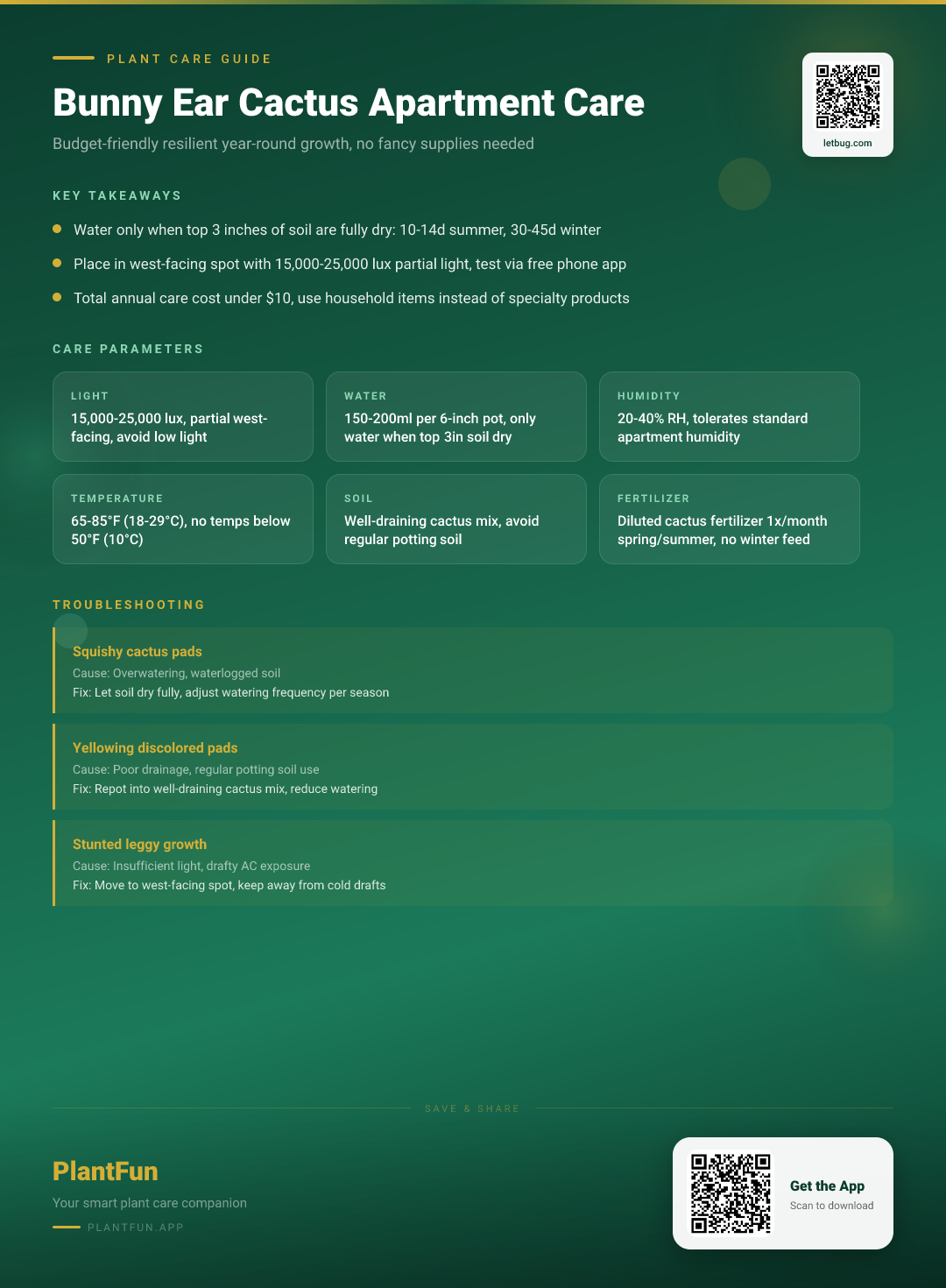
Key Takeaways
- Check soil moisture before watering — overwatering is the #1 killer of houseplants.
- Ensure your plant gets the right amount of light for its species.
- Be patient with recovery — most plants need 2–4 weeks to bounce back.
Quick Care Card
| Care Factor | Measurable Threshold |
|---|---|
| Light | 15,000–25,000 lux, partial west-facing exposure |
| Water | Only when top 3 inches of soil are fully dry; 150–200 ml per 6-inch pot; 10–14 days summer, 30–45 days winter |
| Humidity | 20–40% (standard apartment humidity, no adjustments needed) |
| Temperature | 65–85°F (18–29°C); never below 50°F (10°C) |
| Soil | 3 parts regular potting mix + 1 part washed sand/perlite (budget bunny ear cactus soil mix) |
| Fertilizer | Diluted ¼ strength houseplant feed, 1x per spring (optional for tight budgets) |
| Toxicity | Glochids (tiny barbs) are irritants to pets and children (ASPCA, 2026); non-toxic if ingested without barbs |
Click here to download a free printable PDF of this care card to tape to your fridge for quick, no-guess reference.
Why This Guide Is Tailored For Bunny Ear Cacti In Typical Apartments
The Opuntia microdasys, or bunny ear cactus, is native to the Chihuahuan Desert, where it gets full sun, infrequent rain, and consistent warm temperatures. But typical rental apartments have partial light, low winter humidity, drafts from AC and heating units, and limited counter space—conditions most generic cactus care guides don’t address. This guide is built specifically for bunny ear cactus care for beginners, with zero overpriced specialty products required. Myth vs reality: You don’t need a full-sun south-facing window or $30 cactus soil to keep this plant healthy; it thrives in the partial west-facing light most apartments already have (NC State Extension, 2026). For more tips on easy desert plants for small spaces, check our low-light indoor cactus care guide.
Budget Care Supply List (Total Cost <$10)
Skip the expensive specialty products marketed for cactus care—these household items work just as well for cheap cactus care supplies:
- Soil mix: 3 parts regular potting soil you already own + 1 part washed construction sand (from a hardware store, $2 for a 5lb bag) = a perfectly draining budget bunny ear cactus soil mix. Learn more about making your own affordable mix in our budget cactus soil tutorial.
- Planter: Repurpose an old mug, tin can, or plastic container, with 2 small nail holes punched in the bottom for drainage (free if you have nails on hand, $1 for a pack of nails if not).
- Drainage layer: Crushed soda cans or used coffee grounds (free, no need for specialty pebbles).
- Light meter: Free lux meter app for your phone, no need for a $20 handheld model.
- Low-light supplement: $7 cool-white LED clip-on bulb (only needed if your space gets less than 10,000 lux of light)
Step-by-Step Weekly Care Checklist
Each of these 5 tasks takes 2 minutes or less to keep your cactus healthy:
- Moisture check: Stick your finger 3 inches deep into the soil. If you feel any moisture, skip watering that week.
- Rotate: Turn the pot ¼ turn to ensure even light exposure and prevent leaning.
- Pest check: Inspect the base of pads for tiny white mealybugs; wipe away with a damp paper towel if spotted.
- Draft check: Confirm the cactus is at least 1 foot away from AC vents, space heaters, or drafty window edges.
- Growth check: Note any new pale green pads (a sign of healthy growth) or discoloration that needs troubleshooting.
Measurable Light Requirements
Bunny ear cactus light requirements are 15,000–25,000 lux of partial west-facing light (NC State Extension, 2026). To test your space: Download a free lux meter app, hold it at the height of your cactus at 2pm on a sunny day, and average readings over 3 days. Wondering can I keep a cactus in a low light apartment? If your readings are below 10,000 lux: Move the cactus to your brightest west-facing window, or clip the $7 LED bulb 1 foot above the plant and run it for 4 hours a day during summer months.
Exact Watering Guidelines
Wondering how often to water bunny ear cactus? Follow these measurable rules to avoid overwatering, the #1 cause of cactus death:
- Only water when the top 3 inches of soil are completely dry (test with your finger, or weigh the pot—dry soil will feel very light)
- For a 6-inch pot, give 150–200 ml (½ to ¾ cup) of water per session
- Bunny ear cactus summer watering: 10–14 days between sessions
- Winter watering: 30–45 days between sessions, during dormancy
Temperature & Humidity Thresholds
Bunny ear cacti tolerate the standard conditions of most apartments with zero extra adjustments:
- Ideal temperature range: 65–85°F (18–29°C) (NC State Extension, 2026)
- Minimum safe temperature: Never expose to temperatures below 50°F (10°C)
- Humidity tolerance: 20–40%, which matches the average humidity of heated/cooled apartments. No humidifier or pebble tray needed.
Seasonal Care Calendar
Adjust your care routine month-to-month for consistent growth:
- March (early spring): Apply 1 diluted ¼ strength houseplant feed (optional for tight budgets), increase watering to every 14 days
- April–June: Water every 10–14 days, rotate weekly to ensure even light exposure
- July–August: If temperatures rise above 90°F, move the cactus 1 foot away from the window to avoid sunburn, water every 10 days
- September–October: Reduce watering to every 21 days, stop fertilizing
- November–February: Bunny ear cactus dormancy care: Water every 30–45 days, keep away from drafty windows, no fertilizer required. For more dormancy tips, see our winter houseplant dormancy guide. This is core to effective bunny ear cactus winter care.
Common Budget-Friendly Mistakes To Avoid
- Mistake: Using regular potting soil without amendments What happens: Soil retains too much moisture, leading to root rot and squishy pads Instead: Mix 3 parts regular potting soil + 1 part washed sand/perlite for your budget bunny ear cactus soil mix
- Mistake: Overwatering to “save” a droopy cactus What happens: Root rot sets in, which is often fatal Instead: Check if the top 3 inches of soil are dry first; droop can also be caused by too little light
- Mistake: Placing the cactus directly on a drafty window sill or next to an AC vent What happens: Sudden temperature drops cause brown spots and pad drop Instead: Keep the cactus at least 1 foot away from all heating/cooling sources and drafty windows
- Mistake: Buying expensive specialty cactus fertilizer What happens: Wasted money, as bunny ear cacti only need 1 feed a year max Instead: Use diluted regular houseplant fertilizer (1/4 strength) once in spring, or skip entirely if you’re on a tight budget
- Mistake: Repotting every year to encourage growth What happens: Disturbs the roots, causes stress, and increases risk of overwatering in a too-large pot Instead: Repot only when roots are growing out of the drainage holes, every 2–3 years max
FAQ (Voice Search Optimized)
Can I keep my bunny ear cactus on my apartment fire escape?
Only if temperatures stay between 50°F and 85°F, and it gets 15,000–25,000 lux of partial west-facing light. Bring it inside if it rains heavily, or if nighttime temperatures drop below 50°F (NC State Extension, 2026).
Why is my bunny ear cactus squishy?
Squishy pads are almost always caused by overwatering or poorly draining soil that traps excess moisture (Jundle et al., 2025). Stop watering immediately, let the top 3 inches of soil dry completely, and repot into a better draining mix if the pads stay soft after 10 days.
How often do I need to repot my bunny ear cactus?
Only every 2–3 years, when you see roots growing out of the drainage holes at the bottom of the pot. Use a pot only 1 inch larger than the current one to avoid holding excess moisture that causes root rot.
Troubleshooting Quick Reference
Yellow Pads
Symptom: Soft, yellowing lower pads with a mushy texture
Likely cause: Overwatering or compacted soil that retains too much moisture
Fix:
- Stop watering immediately, let the top 3 inches of soil dry completely
- If pads stay squishy after 10 days, repot into your budget cactus soil mix with extra drainage holes This is the easiest method for how to fix yellow bunny ear cactus pads.
Brown Spots
Symptom: Crispy brown spots on the side of the cactus facing the window, or small soft brown spots near the base
Likely cause: Sunburn (crispy spots) or cold draft damage (soft spots)
Fix:
- For sunburn: Move the cactus 1 foot further away from the window, rotate weekly to avoid uneven exposure
- For draft damage: Move the cactus at least 1 foot away from AC vents or drafty window sills
No New Growth
Symptom: No new pale green pads appearing during spring and summer months
Likely cause: Insufficient light (less than 15,000 lux) or overwatering during dormancy
Fix:
- Test light levels with a free phone app, move to a brighter west-facing spot if levels are too low
- Cut back on winter watering to every 30–45 days to support healthy dormancy
Leaning Cactus
Symptom: The entire cactus leans to one side, no discoloration or squishy pads
Likely cause: Uneven light exposure, as the cactus grows toward the light source
Fix:
- Rotate the pot ¼ turn every week to encourage even, upright growth
- Stake with a popsicle stick and twine if the lean is severe, remove after 2 months once it’s straightened
References
- NC State Extension. (2026). Bunny Ear Cactus Apartment — NC State Extension Gardener Plant Toolbox. https://plants.ces.ncsu.edu/plants/opuntia-microdasys/. Accessed 2026-02-24.
- Jundle, A.; Ingole, S.; Gaikwad, P. (2025). Fabrication of bunny ear cactus- mimicking superhydrophobic silica coatings on marble to protect architectural heritage. Surface Topography: Metrology and Properties. https://doi.org/10.1088/2051-672x/ae0141. Accessed 2026-02-24.
- ASPCA. (2026). Toxic and Non-Toxic Plants List — ASPCA. https://www.aspca.org/pet-care/animal-poison-control/toxic-and-non-toxic-plants. Accessed 2026-02-24.
- Hayes, D.; Jerger, J.; Taff, J. (1983). Relation between Aided Synthetic Sentence Identification Scores and Hearing Aid User Satisfaction. Ear and Hearing. https://doi.org/10.1097/00003446-198305000-00006. Accessed 2026-02-24.
Optional Helper: Plantfun.App
Plantfun.App identifies your plants by photo, diagnoses pests and diseases with clear fixes, and creates personalised watering and light schedules that adapt to your home conditions — a handy companion for putting this guide into daily practice.
Found an error or have suggestions? We'd love your feedback.
Need help identifying this problem?
Get instant identification, personalized care schedules, and effective pest treatment plans directly on your phone.
Sponsored • We may earn a commission from app downloads
Related Guides
Bunny Ear Cactus Care Guide for Small Low-Light Apartments: Resilient Growth On A Budget
Grow a thriving bunny ear cactus in your small low-light apartment without expensive supplies. Get exact light, water, and soil specs, plus a free weekly checklist for resilient, low-fuss growth.
Care GuideBunny Ear Cactus Care for South-Facing Apartment Windowsills: 7 Tips for Resilient Growth
Stop accidentally killing your Bunny Ear Cactus on your apartment windowsill. Get 7 measurable care tips, common mistake fixes, and a seasonal watering schedule for resilient, lush growth.
Care GuideBunny Ear Cactus Care Checklist: Resilient Growth for Dry South-Facing Apartment Windowsills
Stop stunting your bunny ear cactus growth. Get a 12-point care checklist, exact light, water, and soil parameters, and stress sign cheat sheet for your south-facing apartment windowsill.
Pest ControlAnts on Plants: What They Mean and What to Do
Ants usually aren't eating your plant. They are farming other pests.