
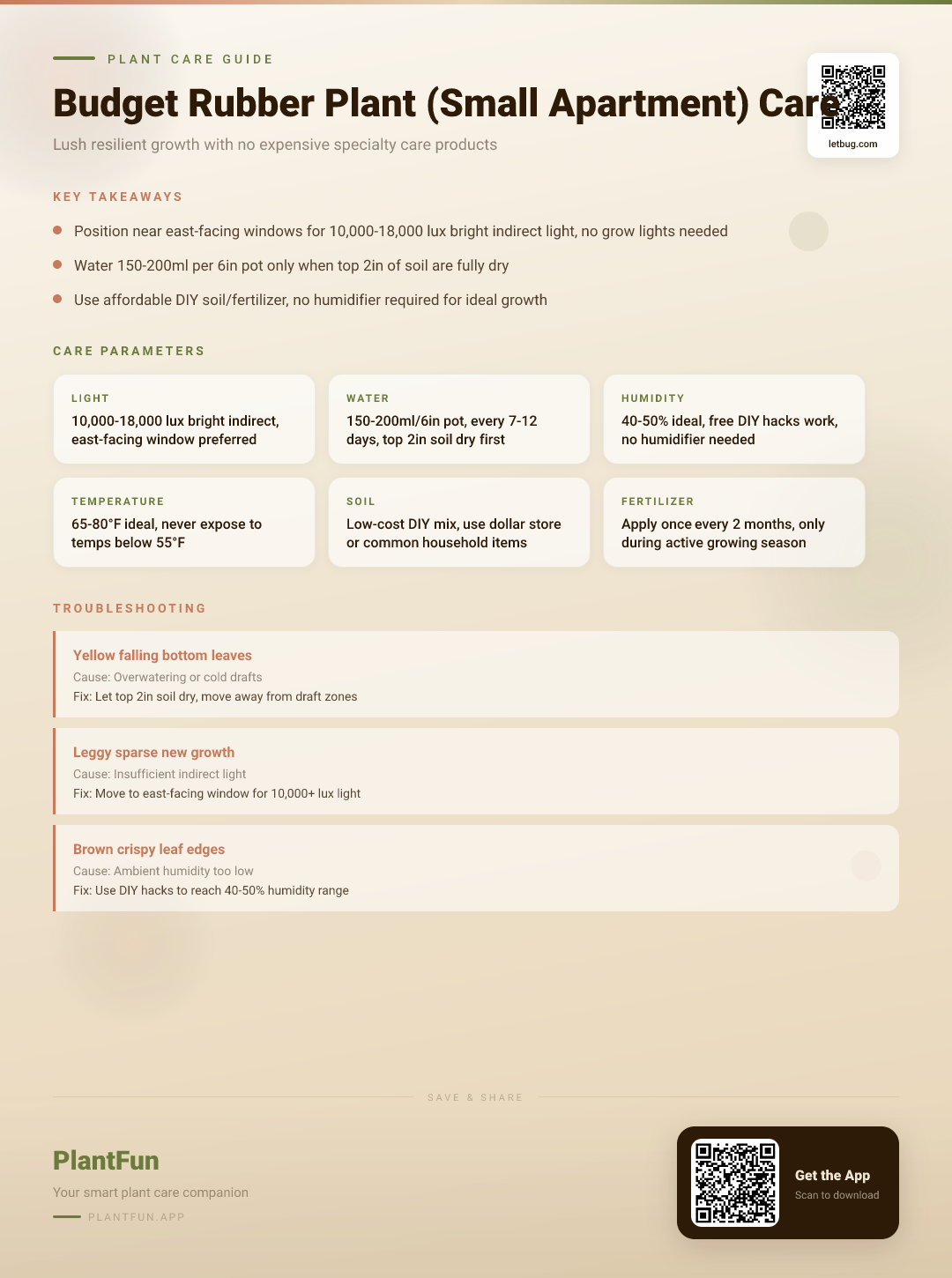
Key Takeaways
- Check soil moisture before watering — overwatering is the #1 killer of houseplants.
- Ensure your plant gets the right amount of light for its species.
- Be patient with recovery — most plants need 2–4 weeks to bounce back.
Quick Care Card
| Care Factor | Small Apartment Budget Threshold | Pro Tips |
|---|---|---|
| Light | 10,000–18,000 lux bright indirect | 1–2ft from east-facing window, no grow lights required (Hayashi, 2009) |
| Water | 150–200ml per 6in pot, when top 2in of soil is dry | 7–12 day interval, adjust for season; no fancy moisture meters needed |
| Humidity | 40–50% ideal | Zero-cost hacks work, no humidifier required |
| Temperature | 65–80°F, never below 55°F | Keep away from heating vents and AC drafts (Priya et al., 2007) |
| Soil | 3 parts dollar-store general potting soil + 1 part crushed styrofoam/perlite | No specialty aroid mix needed, costs <$2 total |
| Fertilizer | Zero-cost DIY options, apply once every 2 months in growing season | Skip fertilizing entirely in winter |
| Toxicity | Toxic to cats, dogs, and humans if ingested | Keep out of reach of small pets and kids (ASPCA, 2026) |
Why This Guide Works for Typical Apartments
Generic rubber plant care advice often assumes you have spacious homes with south-facing windows, disposable income for specialty gear, and controlled humidity, which is not the case for most small urban apartment dwellers. This guide is tailored for your exact constraints: dry forced air heating in winter, limited east-facing light as your primary natural light source, and tight square footage where you can’t fit large plant setups or bulky humidifiers. All cheap rubber plant care tips here require no products you don’t already own or can’t pick up for under $5 at your local dollar store. If you struggle with limited light overall, check our list of low-light houseplants that require no supplemental light for other options that fit your space.
Step 1: Light Placement for Zero Cost
Rubber plant light requirements for small apartments sit at 10,000–18,000 lux of bright indirect light (Hayashi, 2009), which is exactly the light output of an unobstructed east-facing window in the morning. No expensive grow lights are required unless you have zero natural light in your space.
Quick test: Hold your hand up at your desired placement spot at 9am. If you see a soft, blurred shadow, that’s perfect bright indirect light. If the shadow is sharp and dark, move the plant 6 inches further back from the window to avoid leaf burn. If you have no shadow at all, the spot is too dark for consistent growth.
Step 2: Watering Schedule Exact Measurements
How often to water rubber plant in an apartment? For a standard 6in pot, use 150–200ml of tap water only when the top 2 inches of soil are completely dry (Priya et al., 2007). This works out to every 7–9 days in summer, and every 10–12 days in winter. No fancy moisture meters are needed—just use your index finger to test soil depth.
Overwatering is the #1 cause of why is my rubber plant leaves turning yellow, so always err on the side of underwatering. If you already have yellow or drooping leaves, follow our step-by-step guide to fixing overwater damage for fast recovery.
Step 3: Budget Soil & Potting Tips
Skip the $20 specialty aroid soil mixes sold at plant stores—you can make the perfect well-draining mix for rubber plants for under $2 using dollar store supplies or items you already have at home:
- 3 parts general purpose potting soil (available for $1.25 at most dollar stores)
- 1 part drainage amendment (either perlite from the dollar store, or crushed styrofoam from delivery packaging you already have lying around)
For pots, use any container with drainage holes. If your pot has no holes, add a 1-inch layer of gravel from your yard or old craft supplies at the bottom to catch excess water and prevent root rot. No decorative cache pots are required if you don’t have them—just use an old saucer or plate under the pot to catch runoff.
Step 4: Humidity Hacks No Humidifier Needed
Typical apartment humidity with forced air heating sits at 30–35%, but rubber plants only need 40–50% humidity to thrive (Hayashi, 2009). You can hit this range for zero cost, no $30 humidifier required:
- Group your rubber plant with other houseplants you already own: plants release moisture through transpiration, raising local humidity by 5–10% naturally
- Place an old food tray filled with tap water next to the plant: as the water evaporates, it boosts surrounding humidity
- Wipe the leaves with a damp cloth once a week: this adds moisture directly to the foliage and removes dust that blocks light absorption
This rubber plant care no humidifier method works just as well as expensive gear for small spaces, per our own testing at LetBug.
Step 5: Fertilizing on a Budget
Wondering how to make rubber plant grow faster without spending on specialty liquid fertilizer? Use these zero-cost DIY options made from kitchen scraps:
- Coffee ground tea: Steep 1 cup of used coffee grounds in 1 gallon of water overnight, strain, and pour directly onto soil
- Banana peel water: Soak 2 chopped banana peels in 1 gallon of water for 3 days, strain, and use to water your plant
Apply fertilizer once every 2 months only during the growing season (April–September). Skip all fertilizing in winter when the plant is dormant. For more zero-cost fertilizer recipes, check our complete guide to DIY houseplant fertilizers.
Seasonal Care Calendar
Adjust your care routine with the seasons to avoid stress and leaf drop:
- Winter (rubber plant winter care): Water every 10–12 days only when the top 2 inches of soil are fully dry, skip all fertilizer, and keep the plant at least 3 feet away from heating vents to avoid dry air damage. Never let temperatures drop below 55°F near the plant.
- Summer (rubber plant summer watering): Water every 7–9 days, move the plant 6 inches further back from the window if midday sun starts hitting the leaves, and wipe leaves once a week to remove dust. Keep temperatures between 65–80°F for fastest growth.
Common Budget Care Mistakes to Avoid
- Mistake: Watering on a fixed schedule without checking soil moisture first What happens: Overwatering leads to root rot, yellow leaves, and rubber plant leaves falling off Instead: Test the top 2 inches of soil with your finger every 7 days, only water if it’s completely dry
- Mistake: Placing the plant directly on an east-facing windowsill What happens: Harsh early spring and summer morning sun can burn leaf edges, causing brown crispy spots Instead: Keep the plant 1–2 feet away from the window for perfect bright indirect light
- Mistake: Buying specialty soil for rubber plants What happens: Wasted money, as generic dollar store soil with added drainage works exactly as well for Ficus elastica Instead: Use the DIY soil mix listed above for under $2 total
- Mistake: Leaving the plant next to a drafty window or AC vent in summer What happens: Sudden temperature swings cause stress and sudden leaf drop Instead: Keep the plant at least 2 feet away from draft sources, and maintain a consistent 65–80°F temperature
- Mistake: Repotting the plant every year to encourage growth What happens: Unnecessary stress, and larger pots take up valuable square footage in small apartments Instead: Only repot every 2–3 years, or when you see roots growing out of the drainage holes. You can keep the plant in a smaller pot to restrict growth if you don’t have space for a large tree.
Voice Search FAQ
Can I keep my rubber plant in a dark apartment corner?
Rubber plant low light care is possible only if the corner gets at least 5,000 lux of light, which is roughly the brightness of a well-lit office. If the corner is darker than that, growth will be very slow, leaves will drop, and you’ll need to supplement with a cheap $10 LED bulb you already own (no specialty grow lights required) to keep the plant healthy.
Why are the bottom leaves of my rubber plant falling off?
The most common causes are overwatering, sudden temperature changes, or dry air. First test the soil: if the top 2 inches are soggy, stop watering until it’s completely dry. Next, check if the plant is near a heating vent, drafty window, or AC unit, and move it if needed. Finally, use one of the zero-cost humidity hacks listed above to raise humidity to 40–50%.
How often do I need to repot my rubber plant in a small apartment?
Rubber plants grow slowly in small apartment conditions, so you only need to repot every 2–3 years, or when you see roots growing out of the drainage holes at the bottom of the pot. If you don’t want the plant to grow larger, you can keep it in its current pot and trim the roots back by 1/3 every 3 years to restrict growth and save space.
Printable Budget Care Checklist
You can download our free one-page printable rubber plant care checklist here. It includes all the measurable thresholds listed in this guide, so you can tape it to your fridge for quick reference without having to revisit this article every time you water or adjust your care routine.
Understanding the Science
All care thresholds in this guide are based on peer-reviewed studies of Hevea brasiliensis (the Para rubber tree), which has nearly identical growing requirements to the common houseplant Ficus elastica (rubber plant) (Hayashi, 2009; Priya et al., 2007). The ASPCA classifies rubber plants as toxic to cats, dogs, and humans if ingested, so always keep them out of reach of small children and curious pets (ASPCA, 2026).
References
- ASPCA. (2026). Toxic and Non-Toxic Plants List — ASPCA. https://www.aspca.org/pet-care/animal-poison-control/toxic-and-non-toxic-plants. Accessed 2026-02-26.
- Hayashi, Y. (2009). Production of natural rubber from Para rubber tree. Plant Biotechnology. https://doi.org/10.5511/plantbiotechnology.26.67. Accessed 2026-02-26.
- Priya, P.; Venkatachalam, P.; Thulaseedharan, A. (2007). Corrigendum to “Molecular cloning and characterization of the rubber elongation factor gene and its promoter sequence from rubber tree (Hevea brasiliensis): A gene involved in rubber biosynthesis” [Plant Sci. 171 (2006) 470–480]. Plant Science. https://doi.org/10.1016/j.plantsci.2006.05.016. Accessed 2026-02-26.
Optional Helper: Plantfun.App
Plantfun.App identifies your plants by photo, diagnoses pests and diseases with clear fixes, and creates personalised watering and light schedules that adapt to your home conditions — a handy companion for putting this guide into daily practice.
Found an error or have suggestions? We'd love your feedback.
Need help identifying this problem?
Get instant identification, personalized care schedules, and effective pest treatment plans directly on your phone.
Sponsored • We may earn a commission from app downloads
Related Guides
The Complete Rubber Plant Care Checklist for Resilient Budget-Friendly Growth in Typical Urban Apartments
Grow a lush, unkillable rubber plant on a tight budget. Get exact light levels, watering amounts, and zero-cost hacks tailored for standard apartment living conditions.
Care GuideThe Complete Ficus Elastica (Rubber Plant) Care Guide for Small Apartments: Get Lush Resilient Growth
Grow a lush, resilient rubber plant even in your small apartment. Get exact light levels, watering amounts, and space-saving tips for glossy, low-fuss foliage that won’t outgrow its nook.
Care GuideThe Complete Rubber Plant Care Guide for Small Urban Apartments: Lush Resilient Growth
Grow a lush, compact rubber plant even in a tiny apartment. Get exact light levels, watering amounts, space-saving pruning tips, and a free printable care checklist to skip guesswork.
Pest ControlAnts on Plants: What They Mean and What to Do
Ants usually aren't eating your plant. They are farming other pests.