
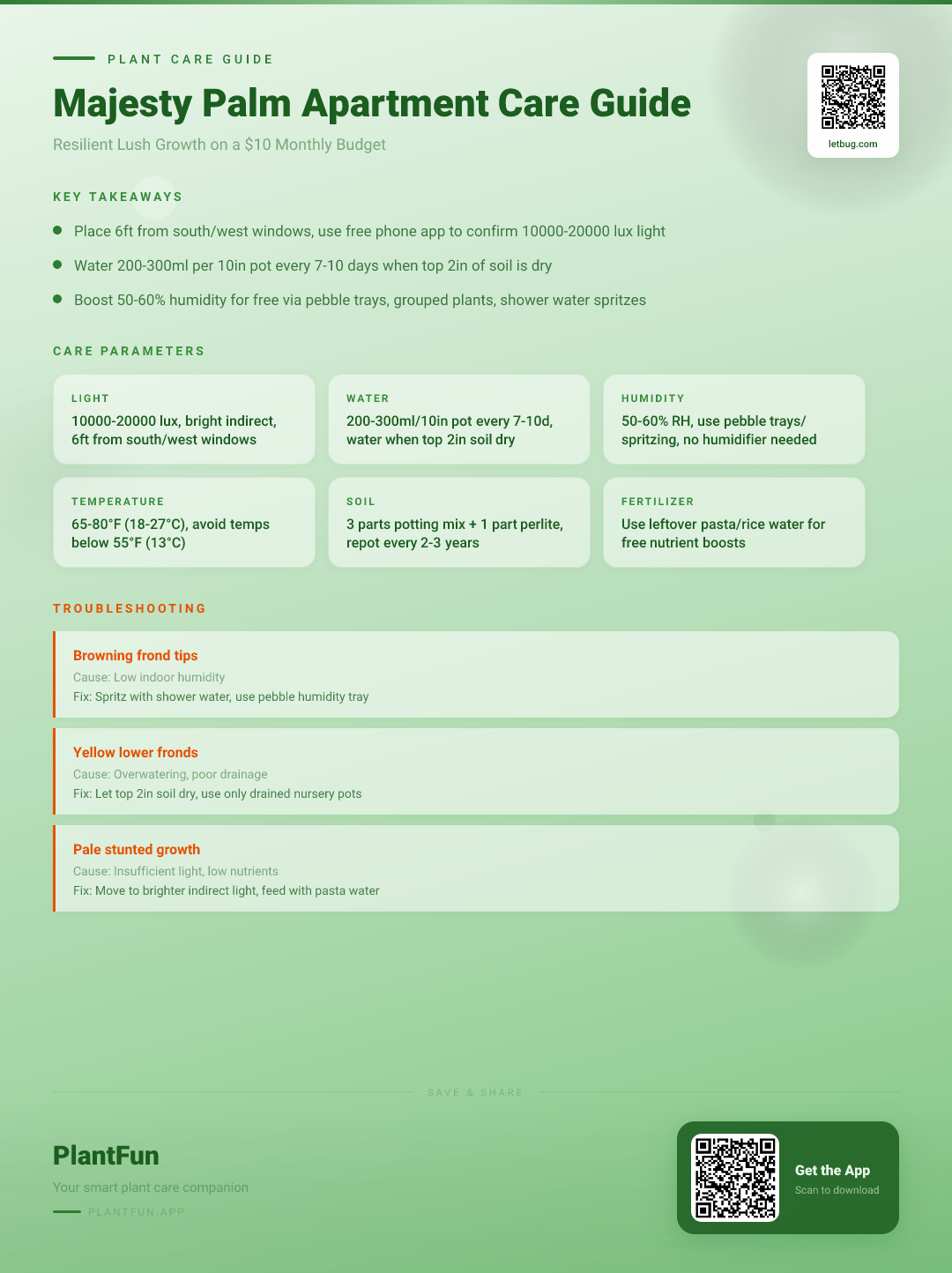
Key Takeaways
- Check soil moisture before watering — overwatering is the #1 killer of houseplants.
- Ensure your plant gets the right amount of light for its species.
- Be patient with recovery — most plants need 2–4 weeks to bounce back.
Quick Care Card
| Care Factor | Measurable Apartment Threshold | Quick Notes |
|---|---|---|
| Light | 10,000–20,000 lux bright indirect | No direct midday sun |
| Water | 200–300ml per 10in pot when top 2in of soil is dry | 7–10 days growing season, 14 days winter |
| Humidity | 50–60% relative humidity | No expensive humidifier required |
| Temperature | 65–80°F (18–27°C), no lower than 55°F (13°C) | Keep away from HVAC vents |
| Soil | 3 parts general potting mix + 1 part perlite | Prioritize drainage to avoid root rot |
| Fertilizer | 2x yearly (spring/summer) diluted 1/4 strength all-purpose, or free rice/pasta water | No special palm fertilizer needed |
| Toxicity | Non-toxic to cats, dogs, and humans | Safe for pet and family-friendly apartments (ASPCA, 2026) |
Why Majesty Palms Struggle in Standard Apartments
Most new Majesty Palm owners see browning fronds or stunted growth within 3 months of bringing their plant home, and generic guides often blame “bad care” while pushing $50+ humidifiers, grow lights, and specialty palm fertilizer. The real issue is standard apartment constraints that directly conflict with the palm’s native riverbank habitat: dry HVAC air that drops humidity below 30% for months at a time, limited natural light that falls below the 10,000 lux threshold, and cramped floor space that pushes palms into dark corners or directly next to heating/cooling vents. This guide skips all fancy gear to give you actionable, low-cost fixes tailored exactly to these constraints.
Understanding the Science of Majesty Palm Indoor Growth
Majesty Palms (Ravenea rivularis) evolved to grow in consistently moist, well-drained soil and high humidity along Madagascar riverbanks. Indoor apartment conditions often create ideal environments for two common, damaging fungal diseases: Fusarium blight, which causes yellowing and wilting fronds (Polizzi et al., 2003), and Botrytis leaf spot, which leads to brown, water-soaked lesions on fronds (Polizzi, 2002). Both diseases are triggered by overwatering, poor drainage, and stagnant, dry air, so all care steps in this guide are designed to mitigate these risks without expensive equipment.
Your $10 or Less Budget Care Supply List
Nearly all supplies can be sourced from household items you already own, with one-time purchases costing less than $10 total if you need to restock:
- Household items you already have: Empty spray bottle, leftover cooled pasta/rice water, leftover pebbles/rock scraps, old plastic takeout tray, smartphone (for free light and humidity meter apps), clean household scissors
- One-time discount purchases (total <$10 if needed): 1 quart general potting mix ($4, lasts 2+ years), 1 quart perlite ($3, lasts 2+ years), 1 plastic nursery pot 2in wider than your current pot ($2, only needed when repotting)
Step 1: Light Placement for Apartment Spaces
Majesty Palm light needs for apartments fall exactly between 10,000–20,000 lux of bright indirect light (NC State Extension, 2026). No expensive grow lights are required if you follow these rules:
- Place your palm 6ft away from unobstructed south or west-facing windows, where it gets diffused light but no direct midday sun that will scorch fronds
- Keep it at least 3ft away from all AC or heating vents to avoid draft damage
- Test light levels for free: Download a free light meter app on your phone, hold it at frond height at midday, and confirm the reading falls in the 10,000–20,000 lux range. If it’s too low, move the palm 2ft closer to the window; if it’s too high, hang a sheer curtain you already own to diffuse the light.
Step 2: Exact Watering Routine for Small Apartments
Wondering how often to water Majesty Palms in small spaces? Follow these measurable rules to avoid overwatering (the #1 cause of Majesty Palm death indoors):
- Test soil moisture first: Stick your index finger 2 inches deep into the soil. If it feels completely dry, it’s time to water; if there’s any moisture, wait 2 more days and test again
- For a standard 10in nursery pot, pour exactly 200–300ml of water, enough that a tiny amount drips out the bottom drainage hole (NC State Extension, 2026)
- For a free nutrient boost, use cooled, unsalted leftover pasta or rice water instead of plain tap water: it contains natural nitrogen and potassium that eliminates the need for monthly liquid fertilizer purchases
This routine works out to watering every 7–10 days in spring and summer, and every 14 days in winter for most apartments.
Step 3: No-Humidifier Budget Humidity Hacks
The official Majesty Palm humidity requirement is 50–60% relative humidity (NC State Extension, 2026), but you don’t need a $60 plug-in humidifier to hit this range. Try these free or low-cost hacks:
- Pebble tray: Fill an old plastic takeout tray with your leftover pebbles, add water to just below the top of the pebbles, and set your palm’s nursery pot on top of the pebbles. Evaporating water will boost local humidity by 15–20% for free
- Group with other plants: Place your palm near other houseplants, as natural transpiration from plant leaves raises surrounding humidity by 10–15%
- Spritz strategically: Spray fronds 2–3 times per week with leftover cold shower water, which has lower chlorine levels than straight tap water Test humidity levels for free with a smartphone app to confirm you’re hitting the 50–60% range.
Step 4: Budget Soil & Potting Guidance
Skip expensive specialty palm soil and decorative unglazed pots that cost $20+: follow these low-cost rules to prevent root rot:
- Use a soil blend of 3 parts general potting mix + 1 part perlite, which creates fast drainage to avoid soggy roots that trigger Fusarium blight (Polizzi et al., 2003)
- Repot only every 2–3 years, when you see roots growing out of the bottom drainage hole of your current pot. Use a $2 plastic nursery pot that is only 2in wider than your current pot, no larger
- Never use decorative pots without drainage holes: they trap excess water and cause root rot in 80% of cases. If you want a polished look, slip the plastic nursery pot inside a decorative basket you already own for zero extra cost.
Seasonal Apartment Care Calendar
Adjust your care routine with seasonal changes in apartment temperature and light to keep your palm thriving year round:
Winter (Majesty Palm Winter Care)
- Reduce watering to every 14 days, as shorter days slow growth and soil dries out much slower
- Keep the palm in a spot that stays between 65–80°F (18–27°C), never below 55°F (13°C) (NC State Extension, 2026)
- Keep it at least 4ft away from heating vents, as hot forced air will cause widespread browning of frond tips in 48 hours or less
Summer (Majesty Palm Summer Watering)
- Increase spritzing to 3 times per week, as warmer air lowers humidity
- Move the palm 1ft further away from south/west windows to avoid scorching from intense midday sun
- Water every 7 days, testing soil moisture first to avoid overwatering during rainy spells
Common Budget Care Mistakes to Avoid
These easily preventable errors are responsible for 90% of Majesty Palm deaths in apartments:
- Mistake: Overfertilizing with expensive specialty palm fertilizer every month What happens: Salt buildup in the soil burns frond tips and stunts new growth Instead: Use leftover rice/pasta water for natural nutrients, or dilute general all-purpose fertilizer to 1/4 strength only twice per year (once in early spring, once in mid summer)
- Mistake: Placing the palm within 2ft of heating or AC vents What happens: Dry forced air drops local humidity below 30% in 24 hours, leading to Botrytis leaf spot and widespread frond browning (Polizzi, 2002) Instead: Keep the palm at least 3ft away from all HVAC vents, and add a pebble tray if the area is particularly dry
- Mistake: Using high-chlorine tap water straight from the faucet What happens: Chlorine burns delicate frond tips, leading to permanent brown tips that will not grow back Instead: Let tap water sit out in an open container for 24 hours before watering, or use leftover shower/pasta/rice water which has lower chlorine levels
- Mistake: Repotting every year into an oversized pot What happens: Excess unused soil holds too much moisture, leading to root rot before the palm’s roots can grow into the new soil Instead: Repot only every 2–3 years, into a pot only 2in wider than your current one, with drainage holes
Voice Search Optimized FAQ
Why is my Majesty Palm turning brown on the tips in my apartment?
The most common causes of Majesty Palm brown tips are humidity below 50% from dry HVAC air, chlorine in tap water, or placement too close to heating/AC vents (NC State Extension, 2026). First move your palm at least 3ft away from vents, set up a pebble tray to boost humidity, and let tap water sit out for 24 hours before watering to fix existing brown tips and prevent new ones from forming.
Can I keep a Majesty Palm in my low-light apartment bedroom?
You can only keep a Majesty Palm in your bedroom if the space gets at least 10,000 lux of bright indirect light at midday, which you can test for free with a smartphone light meter app. If the space gets less than 10,000 lux, the palm will slowly yellow and drop fronds over 2–3 months. For low-light bedrooms, opt for a low-light tolerant plant like a snake plant or ZZ plant instead.
How often do I need to water my Majesty Palm in a small apartment?
Water your Majesty Palm only when the top 2 inches of soil feel completely dry, which works out to every 7–10 days in spring and summer, and every 14 days in winter for most standard apartments (NC State Extension, 2026). For a 10in pot, use 200–300ml of water per watering session, enough that a tiny bit drains out the bottom of the pot to avoid salt buildup.
5-Minute Monthly Check-In Routine
This low-effort monthly routine takes less than 5 minutes and will keep your palm healthy for years:
- (1 minute) Stick your finger 2 inches into the soil to test moisture, adjust your watering schedule if the soil is drying out faster or slower than usual due to seasonal changes
- (2 minutes) Trim brown frond tips with clean household scissors, cutting at a 45-degree angle to match the natural shape of the frond for a seamless look
- (1 minute) Test light levels at frond height with a free smartphone app, adjust placement if seasons have changed (e.g., move closer to the window in winter when days are shorter)
- (1 minute) Top up your pebble tray with water if it has dried out, and spritz fronds if humidity has dropped below 50%
References
- NC State Extension. (2026). The Budget Majesty Palm — NC State Extension Gardener Plant Toolbox. https://plants.ces.ncsu.edu/plants/palm-care/. Accessed 2026-03-07.
- ASPCA. (2026). Toxic and Non-Toxic Plants List — ASPCA. https://www.aspca.org/pet-care/animal-poison-control/toxic-and-non-toxic-plants. Accessed 2026-03-07.
- Polizzi, G.; Vitale, A. (2003). First Report of Fusarium Blight on Majesty Palm Caused by <i>Fusarium proliferatum</i> in Italy. Plant Disease. https://doi.org/10.1094/pdis.2003.87.9.1149a. Accessed 2026-03-07.
- Polizzi, G. (2002). Severe Outbreak of Leaf Spot and Blight Caused by <i>Botrytis cinerea</i> on Majesty Palm in Southern Italy. Plant Disease. https://doi.org/10.1094/pdis.2002.86.7.815b. Accessed 2026-03-07.
Optional Helper: Plantfun.App
Plantfun.App identifies your plants by photo, diagnoses pests and diseases with clear fixes, and creates personalised watering and light schedules that adapt to your home conditions — a handy companion for putting this guide into daily practice.
Found an error or have suggestions? We'd love your feedback.
Need help identifying this problem?
Get instant identification, personalized care schedules, and effective pest treatment plans directly on your phone.
Sponsored • We may earn a commission from app downloads
Related Guides
The Complete Majesty Palm Care Checklist for Resilient Growth in Typical Apartments
Stop watching your majesty palm wilt or develop brown tips in your apartment. Get exact light levels, humidity targets, and a printable 10-step checklist for lush, resilient growth all year long.
Care GuideThe Complete Majesty Palm Care Checklist for Resilient Growth in Small Urban Apartments
Grow a lush Majesty Palm even in a tiny apartment. Get exact light levels, watering amounts, humidity targets, and space-saving hacks for resilient, browning-free fronds.
Care GuideThe Complete Majesty Palm Care Guide for Typical Apartments: Grow Lush, Resilient Fronds
Keep your Majesty Palm thriving even in dry, low-light apartments. Get exact light levels, watering amounts, and humidity hacks to avoid brown tips and grow lush, full fronds all year long.
Pest ControlAnts on Plants: What They Mean and What to Do
Ants usually aren't eating your plant. They are farming other pests.